Bitcoin Core developer Peter Todd proposed removing the arbitrary size limit on OP_RETURN, sparking a heated debate. The entire incident reveals deep divisions about the purpose and future of Bitcoin.
OP_RETURN is an operation code that allows embedding small data into Bitcoin (BTC) transactions.
Bitcoin Core Developers and Community Conflict Over OP_RETURN Limit
Peter Todd's #32359 proposal on GitHub would remove long-standing restrictions on the amount of data that can be stored using OP_RETURN, currently limited to 80 bytes.
One of the Satoshi Nakamoto theory candidates, Peter Todd, argues that this change would simplify Bitcoin's source code. The cryptography developer also emphasized potential performance improvements without endangering the network.
Since OP_RETURN outputs cannot be spent, they do not inflate the Unspent Transaction Output (UTXO) set that all Bitcoin full nodes must track to validate transactions.
"These restrictions can be easily circumvented by direct replacement and Bitcoin Core forks," Todd noted in his GitHub comments.
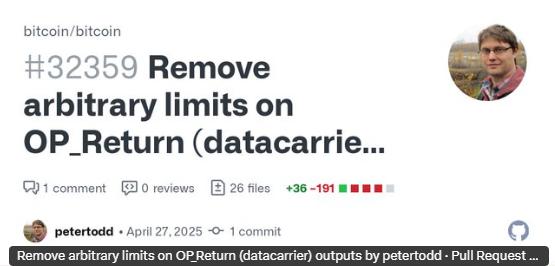 Peter Todd's proposal to remove arbitrary limits on OP_Return. Source: GitHub
According to Peter Todd, formalizing higher limits would reflect existing practices and benefit use cases like sidechains and cross-chain bridges.
Many in the Bitcoin community view this change as a dangerous shift away from non-monetary use cases for the pioneering cryptocurrency. This recalls the 2014 OP_RETURN Battle when spam concerns forced developers to reduce data limits from 80 to 40 bytes before increasing again.
That era saw services like Veriblock flooding the chain with data, leading to increased block size and transaction fees.
"Sidechain builders should not impact Bitcoin Core. Bitcoin at its base layer is money and should focus solely on money," warned Willem S, founder of Botanix Labs.
Willem argues that changing standard rules to make development easier sets a worrying precedent, especially when alternative solutions exist.
Proposal Seen as Betraying Bitcoin's Fundamental Principles, Critics Say
Meanwhile, critics call this proposal a betrayal of Bitcoin's fundamental principles. One such critic is Jason Hughes, who works in development and engineering at Ocean Mining. He accuses developers of ignoring opposition and disregarding broader user concerns.
Hughes suggests this change could push Bitcoin into becoming a worthless altcoin.
"Bitcoin Core developers are about to merge a change that turns Bitcoin into a worthless altcoin, and it seems no one cares to do anything about it. I've spoken out against it, lost sleep over this, and although the community clearly rejects the PR, it's still moving forward," Hughes lamented.
However, others are more optimistic, with some acknowledging the potential of this move to promote network improvements.
"Serving applications like sidechains and bridges that drive more transactions is good for the network," countered Karbon, a prominent X user.
This perspective is based on the assumption that people have already bypassed this limit. The opposition also stirs broader philosophical objections, with some comparing it to Ethereum's ongoing troubles.
"Bitcoin should not pursue an 'L2-centric' path. That's really what killed Ethereum. Bitcoin is money and should focus on that," another user argued.
Amid debates about the technical value of the change, the social impact may be harder to control. The proposal has heightened long-standing concerns about developer centralization and recalled the risk of alienating users who believe Bitcoin should remain a minimalist and sovereign monetary protocol.
Whether the proposal progresses or not, this controversy reveals increasing tension between Bitcoin's pure origins and the pressure to develop.