Preface:
Communication is still necessary to realize the pain points.
In fact, many people are troubled by how difficult it is to grow small funds, which seems almost impossible.
But that's not the case. For small funds to grow or enter the primary market, the key is to establish your own trading system. (I was a bit annoyed with myself when I wrote this sentence) Everyone can talk about this grand principle, but no one talks about the real situation, and no one explains how to truly establish and thoroughly understand this trading system.
No problem, I'll talk about it, I'll write about it. My writing style has always been heavily casual, and my wording might be inappropriate, too direct, and not beating around the bush. But that's not bad, this market needs someone to write about these things.
Additionally, this article contains mostly text, which might seem a bit troublesome to read. Those familiar with me should know that for me, being practical and truly actionable is the priority. So I believe this article is exceptionally valuable. If you feel lost, be a bit more patient, read carefully, and you will gain something.
Based on my own experience and insights, I'll write about the specific strategy and path from a few hundred U to crossing 1 million U.
Up to now, I haven't completely figured out A8, and I'm actually quite mediocre, not as good as some other great guys. So for the path to A8.5 and A9, I don't have practical experience, so I can't write about it.
Regarding my journey, I don't consider myself very successful yet, so I won't write about it. I'll brag about my achievements when I cross 5 million U someday.
Let's get to the point. Retail investors' small funds, how small? Some are a few hundred U, some a bit more, 1K~10,000 U. Let's start with 300 U. So this article is about the real strategy path from 300 U to 1 million U in the primary MEME market, which should help everyone avoid some detours.
(Additionally, all calculation data and processing in this article definitely have deviations, and data calculations are only one of the standards for judging pros and cons)
I. Data Compilation (using PUMP as an example)
Let's start with some data analysis.
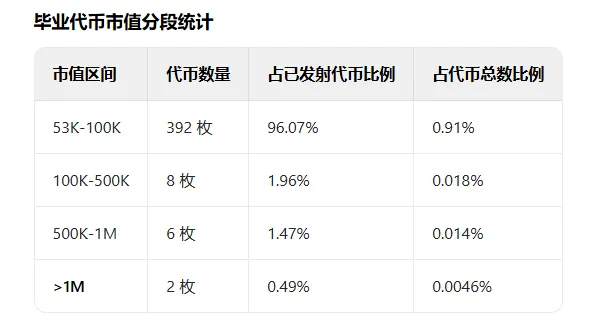
On April 15th, PUMP gave birth to 43,271 MEME tokens. However, the number of graduated (fully launched) tokens was only 408.
The graduation rate was only 0.94%, less than 1%, with 99% of tokens dying in the internal market.
Data for the 408 fully launched tokens is as follows.
II. Thorough Clarity of Strategy
Strategy classification is essentially: number of trades (many/few) + pursuit of high/low profits
Combining these will result in the following four strategy models:
1. Many trades + pursuing high profit rate model
2. Many trades + pursuing low profit rate model
3. Few trades + pursuing high profit rate model
4. Few trades + pursuing low profit rate model
Next, we'll mathematically quantify the situation and pros and cons of these four strategies.
Since this article is about strategies for small funds, the following analysis will be based on 300 U as the starting capital (I'm just like you, starting with this amount of funds). Strategies for more funds, such as 10,000 U~200,000 U, 200,000 U~1 million U, will be discussed later.
If it's 300 U, it's currently about 2.4 SOL, let's calculate based on 2.5 SOL.
Let me clarify the profit percentage issue. Due to gas and bribe fees, if you sell 0.1 SOL each time, the transaction loss (calculated at standard speed) is about 0.005 SOL. If you're just breaking even, you'll need another selling transaction, with the same 0.005 SOL loss. The total loss for two transactions is 0.01 SOL. This means you need at least a 10% profit before fully selling to break even. Account profits below 10% are actually a loss.
[The translation continues in the same manner for the rest of the text](100K-500K) This segment's increase is generally composed of what. 1. Small leading traders. 2. The authenticity of the narrative (with a slight hook and spread). We cannot rely on others' small leading traders' buying orders and following, so we are left with our experience and judgment of the narrative. Excluding this factor, let's look at the mathematical data.
According to the data, we can know that there are 16 plates over 100K, of which 50% do not exceed 500K, the rest exceed 500K, and went up to over 1M. This data is extremely impressive. If we act every time, the winning rate is around 43%, and the rough total profit figure is 125%~675%. Is this conclusion surprising to you?
(500K-1m)+(>1M). These are the same type. To reach this interval, the conditions for increase are three: 1. Big leading traders enter. 2. Banker's plate. 3. T2-level or above narrative. Similarly, whether big leading traders come is an uncontrollable factor, unless you are their parent. So only two remain: judging whether there is a banker, and judging the narrative and spread.
These two are also extremely empirical factors. Mathematically, without considering the impact of experience factors, if we enter each, your rough comprehensive profit rate would be 223%~1250%~with no upper limit. The reason for such huge fluctuations is related to your take-profit point.
3. Fewer trades + pursuing high profit rate model
This category seems seemingly contradictory. This places extremely high requirements on your ability and experience. The experience factor's influence on this strategy occupies an overwhelming proportion. This strategy will not be discussed in detail, and from a novice retail investor's perspective, it has no guiding significance.
But it seems I bolded two words. If not in a small capital retail investor's position, this model is actually not contradictory in some cases. With sufficiently rich experience and strong ability, spending time pursuing this model is no problem.
4. Fewer trades + pursuing low profit rate model
Conditions: Fewer trades (controlled between 1-3 times, low profit rate, set 100% as take-profit upper limit, take-profit points ranging from 25%~100%. Each trade amount is 0.5 SOL).
In this model, due to quantity, 100K is an important watershed. We merge intervals and set the upper limit of intervals above 100K to 5M.
Under this condition, we start calculating the expected earnings of fewer trades (average 2 times, each 0.5 SOL) + pursuing low profit rate model (average 62.5% take-profit) in these two intervals, as shown in the image.
Do you realize that this data is very enlightening? Why? Because in the 100K-5M interval, your profit trigger probability actually reaches 99.67%. You might not feel it strongly, but conversely, entering trading in this interval, mathematically, your failure probability is actually only 0.33%.
That's right, fewer trades + pursuing low profit rate model is the optimal solution among all strategies.
After A7, you will experience a huge sense of achievement. Withdraw 50,000 USDT, take a break, satisfy your material desires, and your mentality will greatly improve. Believe me. You won't be bothered by various trivial matters in life anymore. These aspects will significantly strengthen your psychological account.
At the A7 stage, your psychological account is strong, and you have rich experience. At this point, you need to calm down and think more.
One path is to reduce the number of trades, participate more in established MEME trades, and spend more time thinking and finding opportunities. But remember, after having this money, do not All In, do not All In, do not All In!! Take out 20% for trading. Cycling 150,000 USDT will definitely help you cross the 1 million USDT mark.
Another path is PVP, investing in new disk trading. Your principal is enough for trial and error, and your psychological account reserves are sufficient. You can cover all losses or make significant profits through enough trading attempts.
V. Some Final Thoughts
MEME seems to have been divided into two eras: one before Trump and one after Trump, which is now.
Those who profited from Trump withdrew massive liquidity, enjoyed lavish nights, and even retired. Those who missed out are still struggling in this market, constantly hitting walls, working extremely hard with little reward.
I'm not good at long psychological massages. For me, the sentence that has always motivated me is: Market trends are born in despair.
Let me share two things from my experience. At the end of 2023, in another market, liquidity was completely dried up, and it was my lowest point, filled with confusion about the future and dissatisfaction with myself.
I was extremely angry, extremely unwilling, and extremely hated myself. Why wasn't I the one making money? Why do I always lose money? Why can't I have the life I want? Why did I miss every opportunity?
But what made me different was that even in my despair, I persistently stayed in the market, trying to verify: Are market trends truly born in despair?
One day later, I hit the mark. I caught the salvation vehicle that always emerges in a desperate market, rose with the wind, and survived. I don't think I had any special technique then, just more persistence.
Do not say there is no transcendence in the human world, the celestial secret is seen in the deepest abyss.