Key Takeaways
Visa and Mastercard are the two major operators of the global payment network. It is no exaggeration to say that they almost dominate the global payment market. It is estimated that by 2024, the total global payment transaction volume will reach US$20 trillion. If card payments can be processed through blockchain networks in the future, this will bring huge development opportunities to the blockchain and stablecoin industries.
While the front-end experience of today’s payment systems has greatly improved thanks to innovations from various fintech companies, the back-end systems that actually process transactions still rely on outdated technology. There are still many problems in settlement and cross-border payments, and blockchain provides an exciting solution to these problems.
In April this year, Visa and Mastercard respectively announced their roadmaps for blockchain and stablecoin applications. Both companies have launched related plans in the following areas: 1) card services pegged to stablecoins; 2) stablecoin-based settlement systems; 3) peer-to-peer international remittances; and 4) institutional tokenization platforms. It remains to be seen who will take the lead in the Web3 payments market.
1. Background - Can blockchain be used for payments?
1.1 Two Giants of Traditional Payment
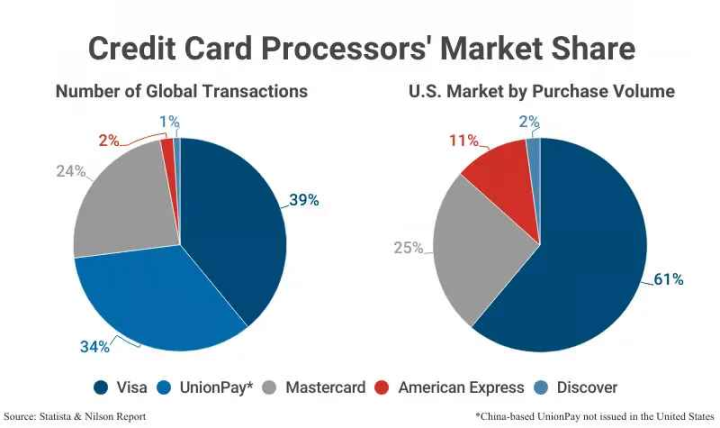
Source: Statista and Nilson
Visa and Mastercard are the world's leading payment network companies. By 2024, Visa will have 39% of the global payments market, and Mastercard will have 24%. Given that China UnionPay primarily processes transactions based in the domestic Chinese market, it is no exaggeration to say that Visa and Mastercard pretty much dominate the global payments landscape.
The two companies make huge profits by providing card payment networks that process transactions between consumers and merchants and settle settlements between card issuers and acquirers for a small fee. (We'll explore the payment process in more detail below.) In fact, Visa and Mastercard are expected to have operating margins of 67% and 57%, respectively, in 2023. This reflects its low fixed cost network business characteristics based on large transaction volumes.
Card network payment transaction volume in the U.S. alone is expected to reach approximately $10.5 trillion in 2024, according to Upgraded Points. Combined with China UnionPay's domestic transaction volume, the global transaction volume is estimated to be approximately US$20 trillion. If card payment processing is done over blockchain networks in the future, this will bring huge opportunities to the blockchain and stablecoin industries.
1.2 Card payment process
Both Visa and Mastercard operate open card payment networks that adopt a "four-party model" that includes card issuers, acquirers, merchants and cardholders. Visa and Mastercard do not directly issue cards or provide loans, but only provide payment networks. The basic process of the four-party model widely used in the United States is as follows:
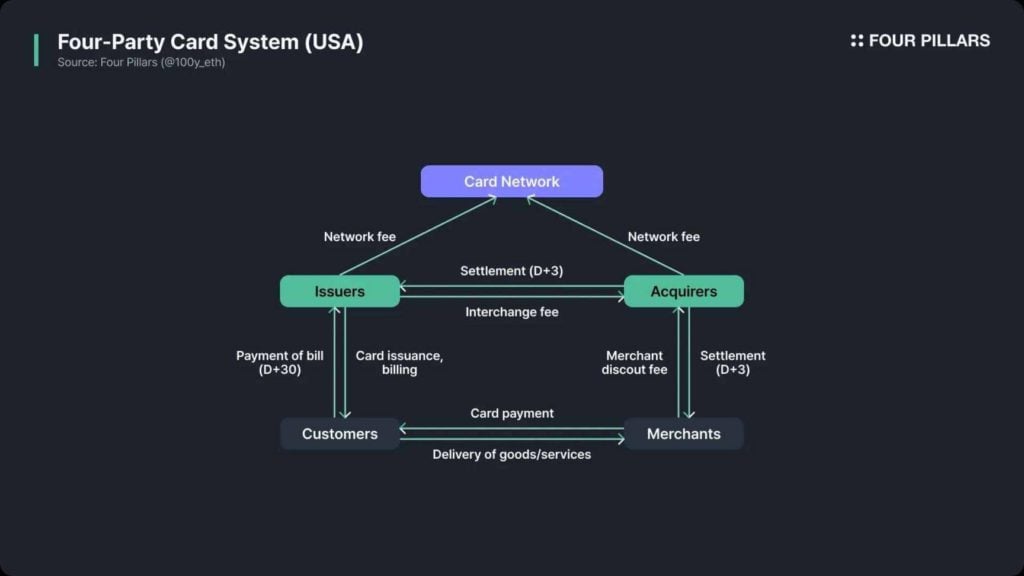
Payment request (D+0: transaction day): When a cardholder makes a purchase at a merchant, a payment request is initiated through the card. Payment information is passed from the merchant to the acquiring institution, then to the card network, and finally to the issuing institution.
Payment authorization day (D+0: transaction day): The card issuer checks the cardholder's credit limit, card validity, and whether there are signs of fraud, and then decides whether to approve the payment. The approval information is returned to the merchant in reverse order, completing the transaction.
Settlement (D+3: 3rd business day after transaction): The card issuer pays the acquirer after deducting the settlement fee, and the acquirer pays the merchant after deducting the merchant fee. The card networks charge a network fee to both the card issuer and the acquirer from each transaction.
Bill and Repayment (D+30: 30th working day after the transaction): The cardholder receives a bill from the card issuer in the following month and repays the amount due.
1.3 Can blockchain be used for payment?
Over the past few decades, various payment-related fintech services have emerged, from the initial PayPal to later Stripe, Square, Apple Pay and Google Pay. These services bring innovation on the front end, making it easier and faster for users to complete payments than ever before. However, the back-end processes for actually executing payments have remained virtually unchanged. Therefore, there are still several problems with the existing payment system.
The first issue is settlement time.
In the traditional payment process, most merchants and acquirers process transactions in daily batches. This batch processing is usually done once a day. Additionally, settlements are typically only processed on business days, so if there are holidays or weekends involved, the overall settlement time may be extended.
The second problem is the high costs of international transactions.
When the card issuer and the merchant are from different countries, cross-border fund transfers are required during the authorization and settlement process. This would add about 1% in cross-border transaction fees and 1% in foreign exchange fees, making international payments more expensive than domestic payments.
There is a system that can solve both of these problems, and that is blockchain. As a decentralized network, blockchain can operate 24 hours a day, regardless of national boundaries, and even international transactions can achieve fast settlement and low fees. Based on these advantages, Visa and Mastercard have actively adopted stablecoins and blockchain technology in their payment networks in recent years. So, how exactly do they use blockchain?
2. Key point: The payment war has begun
Visa's Four Strategies

Source: Visa
Visa operates one of the world's largest payment networks, VisaNet, which can process up to 65,000 transactions per second and supports payments at 150 million merchants in more than 200 countries. Visa sees stablecoins as a core component of the future digital payment system and announced four specific strategic initiatives in April this year to integrate stablecoins into existing payment networks.
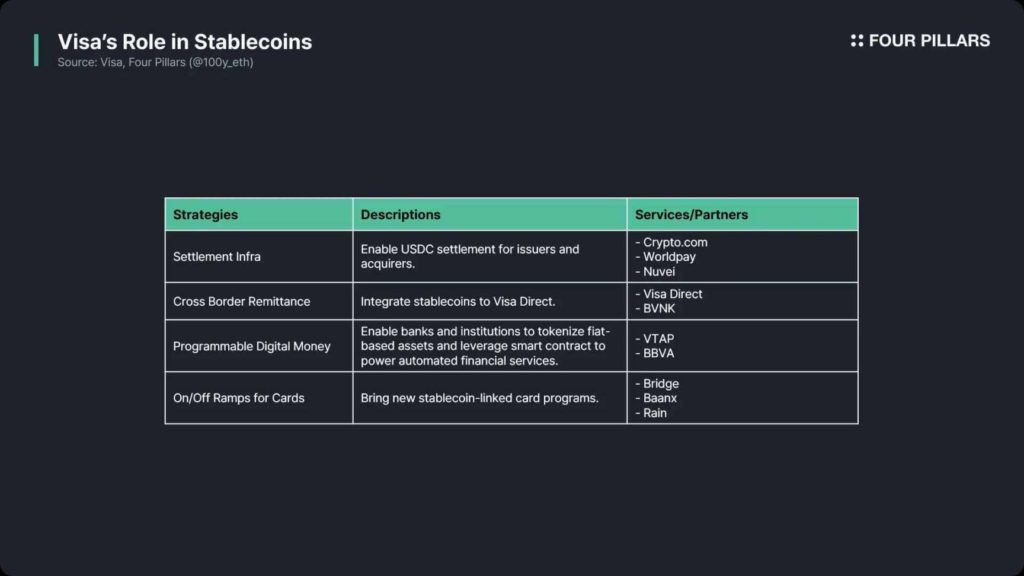
1. Modernization of settlement infrastructure
Since 2021, Visa has begun piloting the use of USDC (US dollar stablecoin) for payment settlement through its existing VisaNet network. To date, more than $225 million has been settled. Traditionally, card issuers need to remit funds to Visa in the form of US dollars for settlement, but now they can also use USDC directly for settlement. This not only improves settlement efficiency, but also reduces cross-border transaction costs.
For example, the Crypto.com Visa Card offered by Crypto.com allows users to make payments through their cryptocurrency accounts. In the past, these cryptocurrency-focused companies needed to convert digital assets into fiat currencies such as the U.S. dollar to complete payment processing, a process that was time-consuming and costly. Now, they can settle directly using USDC. In partnership with Anchorage, Visa established a custodial account to safely store stablecoins. Card issuers like Crypto.com can settle payments by transferring stablecoins to these accounts via the Ethereum network.
By eliminating the need to convert cryptocurrencies into fiat currencies and transfer them across borders, Crypto.com has reduced average upfront payment times from eight days to four days and reduced foreign exchange fees to 20 to 30 basis points.
Visa not only allows card issuers to use USDC for settlement, but also launches a function that allows acquiring institutions to directly use USDC for settlement. In September 2023, Visa established settlement infrastructure for acquirers such as Worldpay and Nuvei, allowing them to receive USDC through the Ethereum and Solana networks. Acquirers can pass USDC to merchants or convert it into fiat currency as needed.
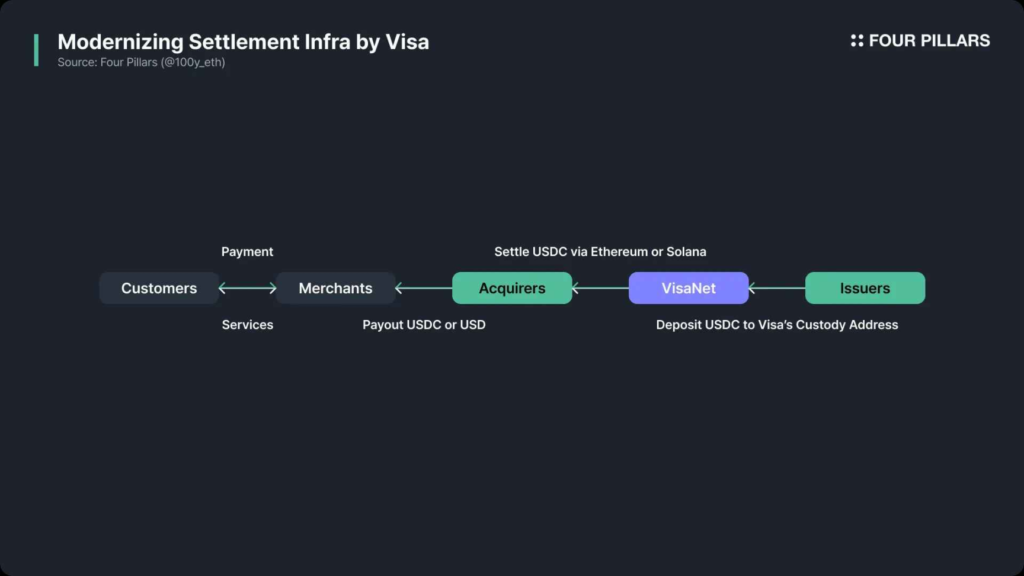
In summary, Visa has successfully built a channel that enables card issuers to settle with acquirers through the Visa network in USDC instead of US dollars. In the future, Visa plans to expand the stablecoin settlement system suite to more partners and regions, implement 24/7 real-time settlement, and support multiple blockchains and stablecoins.
2. Strengthening global remittance infrastructure
Visa already supports large-scale cross-border transactions through the VisaNet infrastructure. One of its services, Visa Direct, enables peer-to-peer fund transfers through cards, wallets and account numbers, covering payment scenarios between friends and between businesses and customers. Visa plans to further improve the efficiency of global remittances by integrating stablecoins into Visa Direct. Additionally, Visa recently invested in BVNK, a startup developing stablecoin infrastructure for businesses, with the aim of expanding its stablecoin capabilities beyond the retail sector to cover the enterprise ecosystem.
3. Launch of programmable digital currency
One of the main advantages of stablecoins over traditional cash is the ability to utilize smart contracts on the blockchain. Visa pays close attention to the potential of automated financial services based on smart contracts, and announced the launch of the "Visa Tokenized Asset Platform (VTAP)" in October 2024.
VTAP is a blockchain-based financial infrastructure that allows banks and financial institutions to issue and manage fiat-backed digital tokens (such as stablecoins and tokenized deposits). Since these features are provided through Visa’s API, integration with existing financial systems becomes very easy. Tokens issued through VTAP can be used in conjunction with smart contracts to automate complex processes such as conditional payments or customer loans.
Currently, VTAP has not been released publicly and is still executed in a sandbox environment. Initially, it partnered with Spanish bank BBVA to test token issuance, transfer and redemption capabilities. According to the roadmap, Visa plans to start launching pilot projects for real customers on the Ethereum public blockchain in 2025.
4. Develop stablecoin deposit and withdrawal cards
Visa is helping card issuers provide on-ramp and off-ramp services through stablecoin-linked cards. To date, Visa has processed over $100 billion in cryptocurrency purchases and $25 billion in cryptocurrency spending through its cards. To expand this ecosystem, Visa is working with stablecoin card infrastructure companies such as Bridge, Baanx, and Rain.
Bridge is a stablecoin infrastructure platform acquired by Stripe. Recently, Bridge partnered with Visa to launch a card issuance solution that enables users to use stablecoins for real-world payments. Fintech companies can provide users with card services linked to stablecoins through Bridge’s simple API. Cardholders can pay directly using their stablecoin balances, while Bridge converts the stablecoins into cash and pays the merchant. Currently, the service is available in Argentina, Colombia, Ecuador, Mexico, Peru and Chile, with plans to gradually expand the suite to Europe, Africa and Asia.
Baanx is a London-based fintech company founded in 2018 that focuses on connecting traditional finance with digital assets. In April 2025, Baanx announced a partnership with Visa to launch a stablecoin payment card that allows users to pay directly with USDC in self-hosted crypto wallets. During the payment process, USDC is instantly transferred to Baanx via a smart contract, and then Baanx converts it into fiat currency to complete merchant settlement.
Rain is a New York-based fintech company founded in 2021 that operates a global stablecoin-based card issuance platform. Rain provides an API that allows companies to issue Visa cards linked to stablecoins, and also provides a variety of financial services including 24/7 instant payment settlement, tokenization of credit card receivables, and automation of settlement processes through smart contracts.
Mastercard's full-chain stablecoin payment solution

Source: Mastercard
Mastercard, like Visa, is one of the leading companies in the global payment network space. Unlike Visa, which processes payments through its high-processing centralized network, VisaNet, Mastercard processes payments through Banknet, a powerful decentralized structure supported by more than 1,000 data centers around the world. On April 28, 2025, Mastercard announced that it had established an end-to-end infrastructure covering the entire stablecoin-based payment ecosystem, from wallets to checkout functions.
1. Card issuance and payment support
Mastercard has partnered with several crypto wallets (such as MetaMask), crypto exchage(such as Kraken, Gemini, Bybit, Crypto.com, Binance and OKX), and fintech startups (such as Monavate and Bleap) to provide stablecoin payment services.
MetaMask has partnered with Mastercard and Baanx to launch the MetaMask card, which allows users to make card payments using crypto assets stored in MetaMask. Payment settlement is done behind the scenes through Monavate’s solution, which connects the Ethereum network to Mastercard’s Banknet and converts cryptocurrencies into fiat currencies. The MetaMask Card will initially be available in Argentina, Brazil, Colombia, Mexico, Switzerland, the United Kingdom, and the United States.
Mastercard has also partnered with the above-mentioned crypto exchage to support users to make payments using stablecoins in their accounts.
2. Provide USDC settlement support for merchants
Despite the growing popularity of stablecoin-based payments, most merchants still prefer settlement in fiat currencies. However, if merchants have demand, Mastercard also supports settlement in USDC through partnerships with Nuvei and Circle. In addition to USDC, Mastercard also supports the settlement of stablecoins issued by Paxos through cooperation with Paxos.
3. On-chain remittance support: Mastercard Crypto Credential service
Transferring stablecoins via blockchain has the advantages of being simple, fast, and low-cost. However, user experience, security, and compliance remain major challenges when applying it to real life. To this end, Mastercard launched the "Mastercard Crypto Credential" service, which allows users of crypto exchage to establish aliases through a verification process and conveniently transfer stablecoins through these aliases. Visa and Mastercard are actively expanding the application scenarios of stablecoin payments, from card issuance to on-chain settlement to merchant support. They have promoted the integration of blockchain technology and traditional payment systems through in-depth cooperation with financial technology companies, crypto wallets and exchanges. This marks an important step forward for stablecoin payments on a global scale and also lays the foundation for the future development of the crypto industry.
Mastercard's Crypto Credential service simplifies users' payment experience on the blockchain through an alias system, eliminating the need to enter complex encrypted wallet addresses, and greatly improving user friendliness. Additionally, if the recipient’s wallet does not support a specific cryptocurrency or blockchain before the transfer, the transaction will be blocked in advance to prevent loss of assets. In terms of compliance, Mastercard automatically exchanges the Travel Rule information required for international remittances to meet regulatory requirements and ensure transaction transparency. Currently, exchanges that support the service include Wirex, Bit2Me and Mercado Bitcoin. The service is already available in Latin American countries such as Argentina, Brazil, Chile, Mexico and Peru, as well as European countries such as Spain, Switzerland and France.
4. Enterprise Tokenization Platform
The Multi-Token Network (MTN) launched by Mastercard is a private blockchain-based service designed to help financial institutions and businesses issue, destroy and manage tokens and enable instant cross-border transactions. The following are some of MTN’s application cases:
Ondo Finance tokenized its US Treasury-backed short-term bond fund (OUSG) and integrated it into MTN. This enables businesses to purchase and redeem OUSG instantly around the clock without relying on traditional financial infrastructure, while also earning a stable return.
JPMorgan Chase integrated its blockchain payment system Kinexys with MTN to support businesses’ instant payment needs.
In May 2024, Standard Chartered Bank conducted a pilot project with MTN to successfully tokenize and trade carbon credits as part of a proof of concept.
The time to fight for Web3 payment market dominance
As the U.S. government's support for cryptocurrencies becomes increasingly clear, the adoption of blockchain and stablecoins in various industries continues to gain momentum. As one of the core functions of the blockchain network, financial infrastructure has naturally attracted the attention of payment network giants such as Visa and Mastercard. The two companies are actively developing the next generation of payment infrastructure.
It is worth noting that both Visa and Mastercard released plans regarding blockchain and stablecoin payment systems in April 2025 (Visa released plans regarding the role of stablecoins on April 30, 2025, and Mastercard revealed its full-chain capabilities for stablecoin transactions on April 28, 2025). Both companies highlighted the following four areas: 1) stablecoin-linked card services; 2) enterprise tokenization platforms; 3) stablecoin settlement systems; and 4) peer-to-peer (P2P) remittances.
This shows that Visa and Mastercard are competing for dominance in the Web3 payment market.
Will the adoption of blockchain payment systems bring about significant disruption to existing market shares and competitive dynamics? The authors argue that next-generation systems will significantly change the payments infrastructure itself, but will not drastically alter market share or competitive structures. Blockchain payment systems will improve the efficiency of settlements and international transactions, which will help companies optimize their revenue models and enhance their competitiveness. However, market share in the payments industry ultimately depends on business and marketing relationships with merchants, acquirers and issuers. These relationships are deeply entrenched after decades of development, so the application of blockchain may not significantly change the competitive landscape.