Recently, the U.S. Senate passed the procedural motion for the GENIUS Act with a vote of 66 to 32, signaling that stablecoins are entering the federal legislative "practical stage".
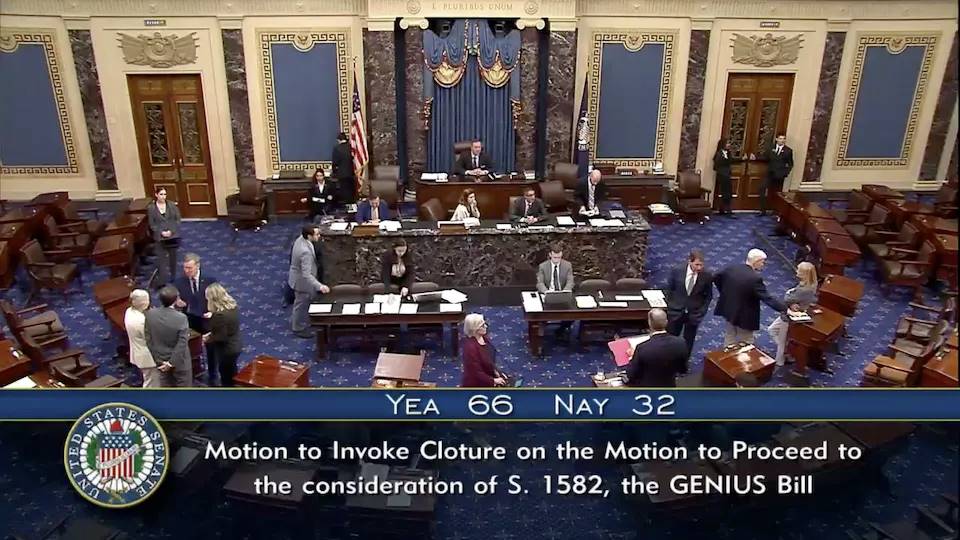
The U.S. Senate advanced the debate on the GENIUS stablecoin bill with a vote of 66 to 32. Source: U.S. Senate
This may be the first time our generation witnesses the "on-chain issuance of the U.S. dollar" entering the legislative core; it may also be the first time we see whether the two swords of Damocles - stablecoins and U.S. Treasury bonds - will fall to pierce people's final utopia. Behind this lies a profound restructuring of virtual currencies, the Web3 ecosystem, and the global payment landscape.
Pt.1. The Damocles Coin
Why is the stablecoin bill so important?
Stablecoins, as the name suggests, are cryptocurrencies pegged to assets like the U.S. dollar, maintaining a stable value. They serve as a "bridge" in the crypto market, widely used for trading, cross-border payments, and decentralized finance (DeFi). By 2024, the global stablecoin market size has exceeded $200 billion, with U.S. dollar stablecoins dominating. However, due to the lack of a clear regulatory framework, the stablecoin industry has been operating in a gray area, facing accusations of money laundering, fraud, and systemic risks.

The core objectives of the GENIUS Act are to establish clear regulatory rules for stablecoin issuers, including:
- Issuance Requirements: Stablecoin issuers need to obtain federal or state licenses and meet strict capital and reserve requirements.
- Anti-Money Laundering and Security: Strengthen anti-money laundering (AML) and know-your-customer (KYC) measures to ensure stablecoins are not used for illegal activities.
- Consumer Protection: Provide transparency and fund safety guarantees for users, preventing tragedies like the TerraUSD collapse in 2022.
- Extraterritorial Jurisdiction: Limit foreign stablecoins from entering the U.S. market, consolidating the U.S. dollar's "hegemony" in the crypto world.
This vote is not only about standardizing the crypto industry but is also seen as a strategic layout by the United States in global financial technology competition. As U.S. Treasury Secretary Bessent said: "U.S. dollar stablecoins will maintain the dollar's status as an international reserve currency."
The Ultimate Outcome of the Bill: Who Are the Winners and Losers?
If the GENIUS Act is successfully passed, several areas will undergo significant changes:
Winners:
- Stablecoin Issuers: Top issuers like Tether (USDT) and Circle (USDC) will obtain legal identities. Although compliance costs are high, market trust will significantly increase.
- Crypto Exchanges: With clear regulations, platforms like Coinbase and Kraken are expected to attract more institutional funds, driving a surge in trading volume.
- U.S. Dollar Hegemony: The bill restricts foreign stablecoins from entering the U.S., further consolidating the global financial dominance of U.S. dollar stablecoins. ECB President Lagarde once warned: "U.S. dollar stablecoins may threaten the euro's monetary sovereignty."
- Investors: The standardization of stablecoins will reduce market risks, attract more traditional capital into the crypto field, and drive up asset prices.
Losers:
- Non-Compliant Issuers: Small stablecoin projects unable to meet regulatory requirements may be eliminated.
- Foreign Stablecoins: Stablecoins pegged to euros or the Chinese yuan will be restricted in the U.S. market.
- Decentralization Idealists: Strict KYC and AML requirements may undermine the anonymity of cryptocurrencies, sparking community controversy.
Any form of excessive currency issuance is immoral. Tether can issue USDT, but either you must completely remove it from real-world circulation after receiving one dollar, or your USDT cannot buy pizza and should only circulate in the crypto market, treating it like an online game.
No matter what, one dollar is one dollar and should never become two dollars. No matter how good the magic trick, it remains a trick, a deceptive act. The higher you climb with such tricks, the harder you'll fall.
"We cannot let corruption blind us to the broader reality: blockchain technology is a done deal. If U.S. legislators do not guide it, other countries will step in—and not in a way that aligns with our interests or democratic values."
Pt.2. The Sword of Damocles

In 2025 and 2026, we all know that the United States has massive national debt maturing, which is the Sword of Damocles hanging over the U.S. and Trump. Trump, at 80 years old, maintaining such high-intensity work in the recent 90 days is enough to glimpse the situation.
Many historical moments of dynasty endings were experienced through imagination, always wondering why no hero would descend. However, the United States is now a living example, with a sense of a dynasty's end—in short, no one can fill this hole.
Initially, Trump hoped to lower national debt interest rates by creating an economic recession, using a stock and exchange rate dual attack to save the debt market, but unexpectedly resulted in a stock, debt, and exchange rate triple attack.
Trump found a reason to temporarily calm the storm and return to think about how to deal with the aftermath. However, this does not mean the storm is over. Trump genuinely wants to balance income and expenditure through tariffs. On the other hand, Trump does not want to decouple from China. A businessman's thoughts are simple yet complex—simple in that he won't refuse money-making opportunities, complex in wanting more from interest distribution, but ultimately converging.
Of course, time will solve everything.
Some say crypto can solve the U.S. debt problem, which is theoretically sound. We assume various countries buy stablecoins with their currencies, and the U.S. dollars supporting these stablecoins purchase U.S. bonds, roughly equivalent to countries buying U.S. bonds. Additionally, the U.S. government's continuously appreciating BTC could bring significant income. However, the ideal is plump, reality is skinny. The trillion-dollar stablecoin scale is merely a drop in the ocean compared to the $40 trillion U.S. scale, and the gap is expanding. Even if BTC goes all-in on total market value, it would only cover one year of U.S. bond interest payments, not to mention the U.S. government and enterprises holding only 5% of BTC.
In other words, even using these two methods to solve the U.S. bond issue would require years of accumulation and waiting.
Therefore, the key question is—how long can U.S. bonds and the U.S. dollar payment system last? The Bretton Woods system collapsed after 27 years, and the debt monetary system since its collapse has lasted 54 years. Regarding its cycle, we both hope it survives and anticipate its rebirth.
Perhaps, decades from now, when people look back on history, they'll discover that a new era might have already begun today.
"The desolate autumn wind is here again, changing the world."