Author: mteam.eth
Compiled by: TechFlow
Any successful blockchain must build a flywheel effect as follows:
Economic progress (such as TVL, price, revenue, trading volume, etc.) must bring attention and visibility to the chain, thereby:
Enabling new applications to be funded, new developers to learn relevant technologies, and new users to utilize everything we've built to improve their lives, which will inevitably lead to:
Innovation and improvement of infrastructure and applications to enhance efficiency and explore new use cases and architectures. Collaboration is particularly crucial during the innovation phase, but this stage often leads to team dispersion due to natural incentive mechanisms. Innovation drives economic progress, and the cycle begins again.
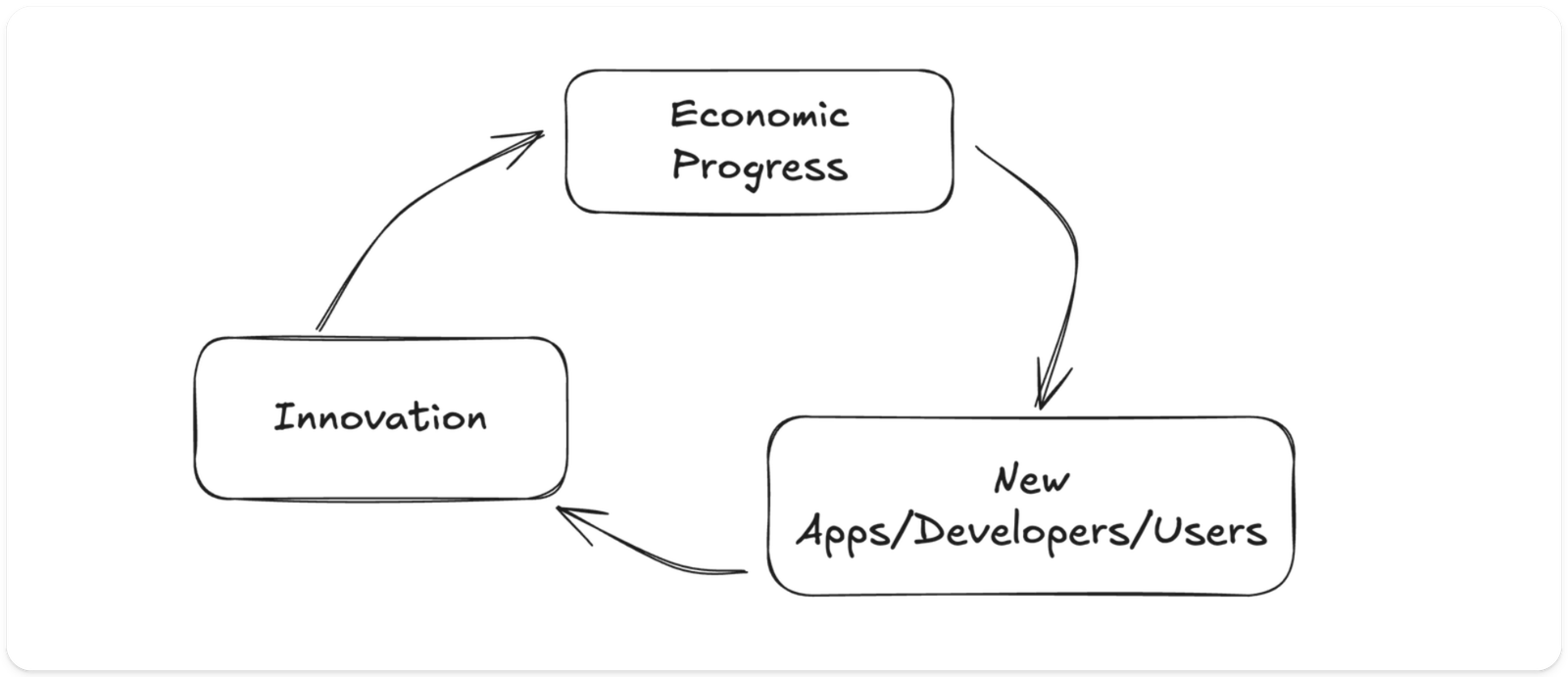
The problem Ethereum faces is simple - we have broken every part of this flywheel.
Note: This article discusses Ethereum's high-level technical roadmap and does not focus on the social layer roadmap. Both must be combined to present a complete picture.
First, accept the problem
New applications, developers, and users are on L2! Innovation is happening on L2! Economic progress is also shifting to L2.
If these L2s can provide feedback to the flywheel, this would not be a problem for Ethereum, but such situations are often not common.
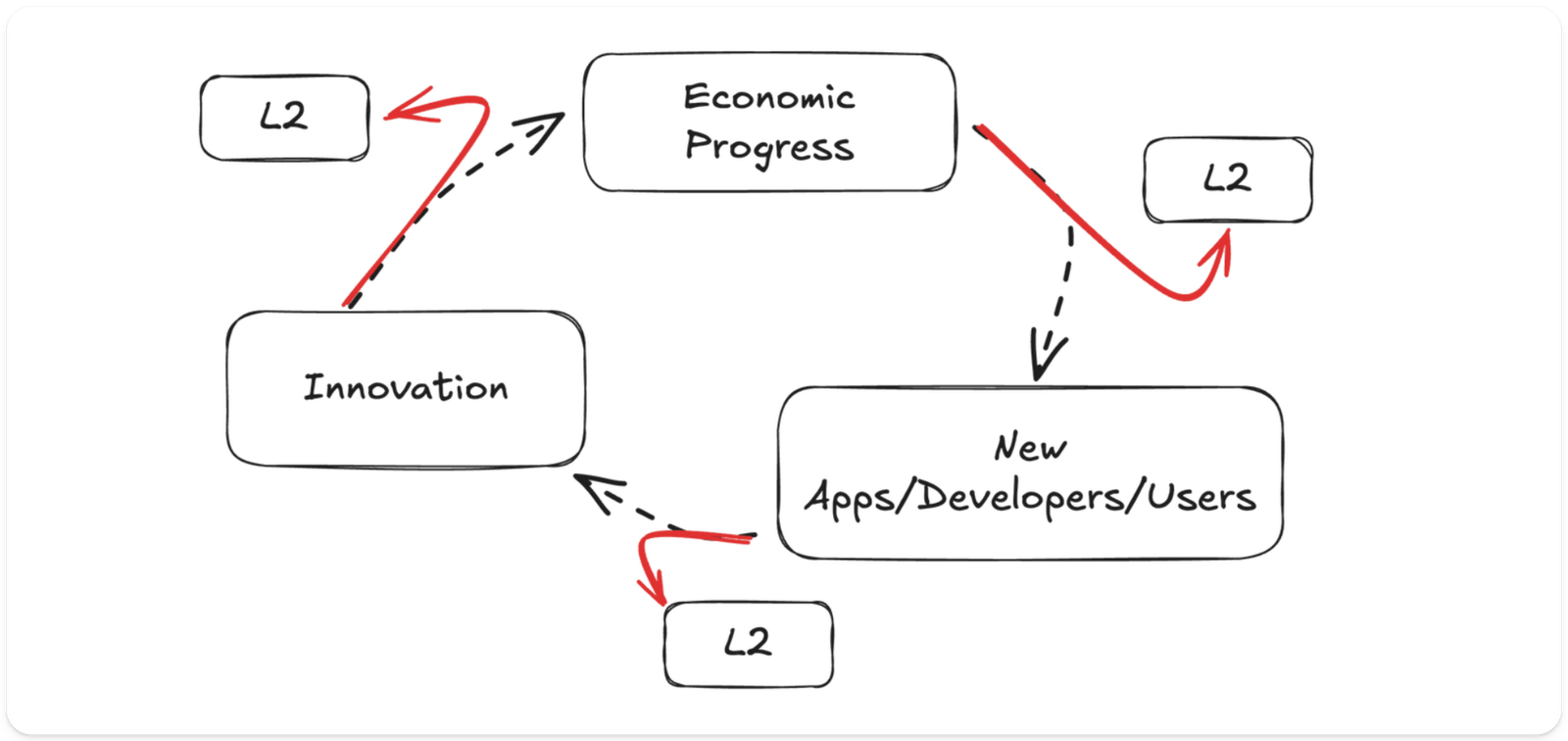
Where is the root of the broken flywheel?
Ethereum (since around 2020) believed that scaling through Rollup was the only expansion method and severely overestimated L2's contribution to Ethereum's overall flywheel.
Rollup was seen as a scaling solution. Compared to sharding, Rollup seemed simpler, avoided diluting Ethereum L1's security, and could even bring better composability.
But Rollup is not just a scaling architecture; it is also an incentive architecture. A simplified logical chain might look like this:
We need to expand Ethereum.
Some form of sharding is a necessary condition for expanding a blockchain with the characteristics we need.
Sharding is too complex and has other problems in protocol execution.
Therefore, Rollup is the only way to expand Ethereum.
In my opinion, point 2 is the first major mistake. Empirically, it is obvious that we were wrong (at least to some extent). For example, Solana and Monad have both demonstrated reasonable expansion roadmaps that do not involve any form of sharding. At the same time, many Ethereum core developers have proven that we can push L1's performance much further than now.
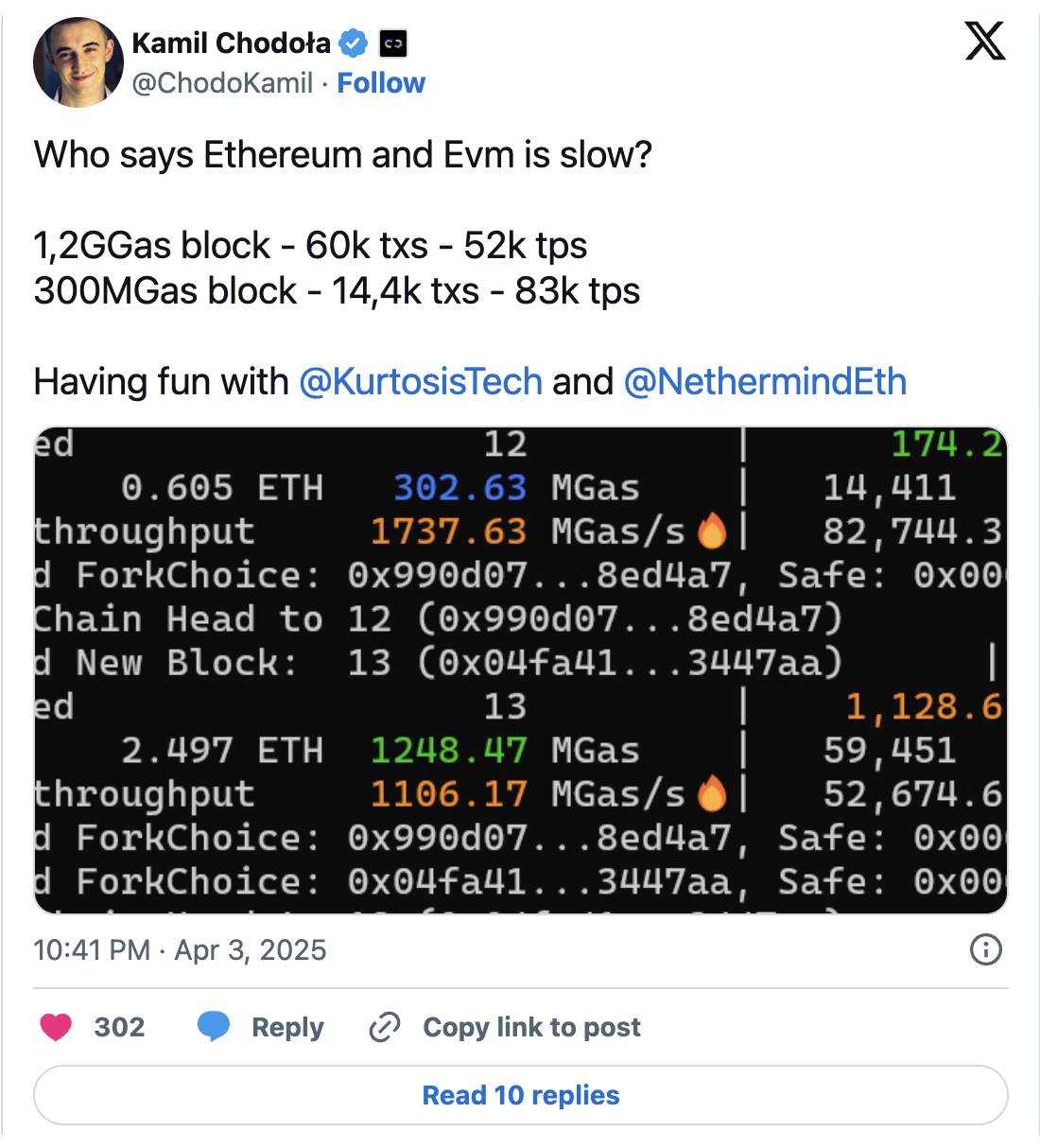
Although I do not believe a single chain can meet all needs, I think we pushed to this conclusion before exploring L1 expansion opportunities.
Point 4 in this reasoning is also insufficient. We failed to correctly assess the potential drawbacks of a Rollup-centric roadmap on the L1 network effect flywheel.
Ideal Flywheel
I believe we can reconstruct the network effect flywheel like this:
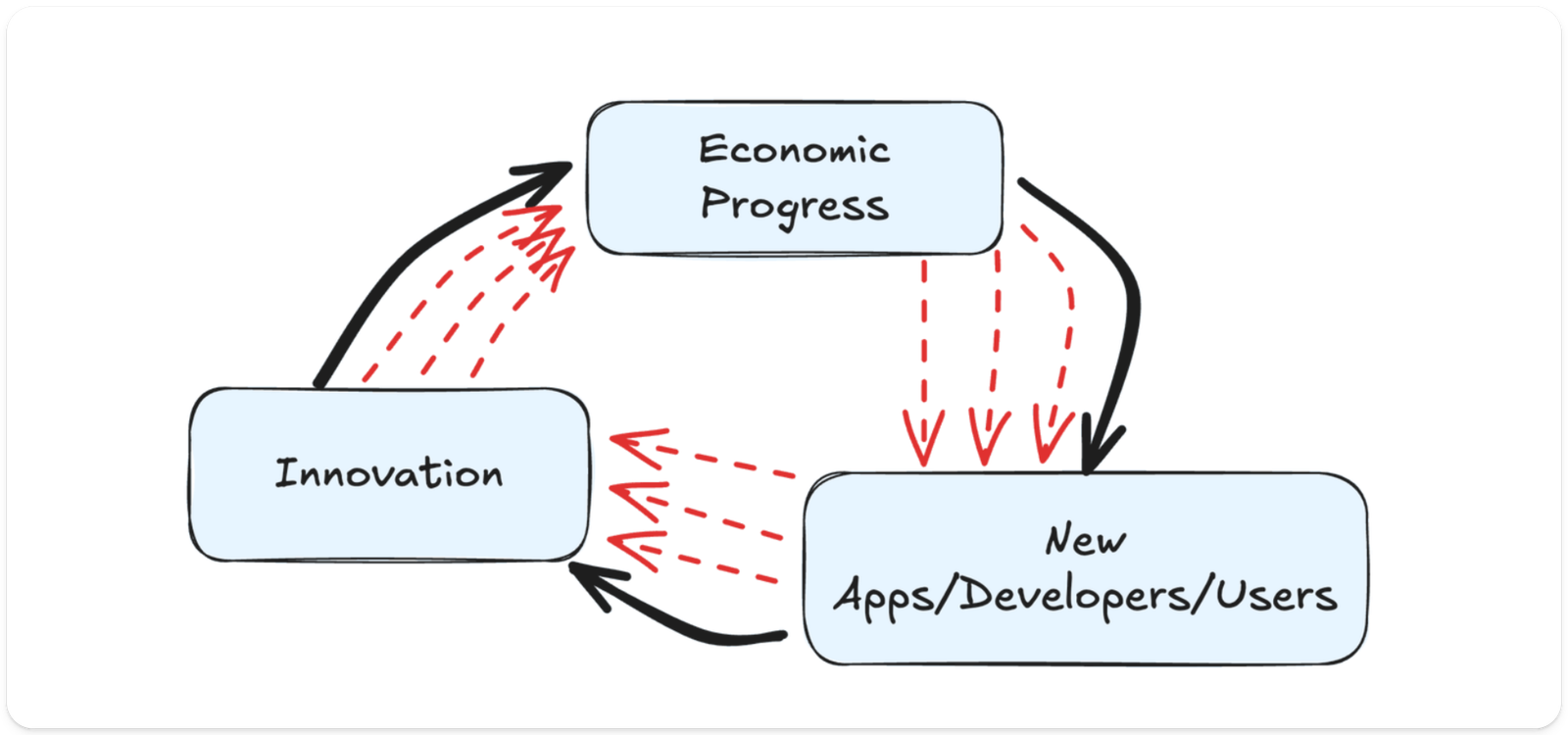
L2 should not drain network effects from the flywheel but should accelerate the flow between each network effect.
Specifically, this means:
Providing almost unlimited flexible scaling as overflow
Driving customization, specialization, and bold experiments
Attracting users and developers
Increasing the total revenue of the Ethereum ecosystem and Ethereum L1 itself
Maintaining high composability with Ethereum
This interaction produces the expected effect for both Ethereum and L2 - a rising tide lifts all boats.
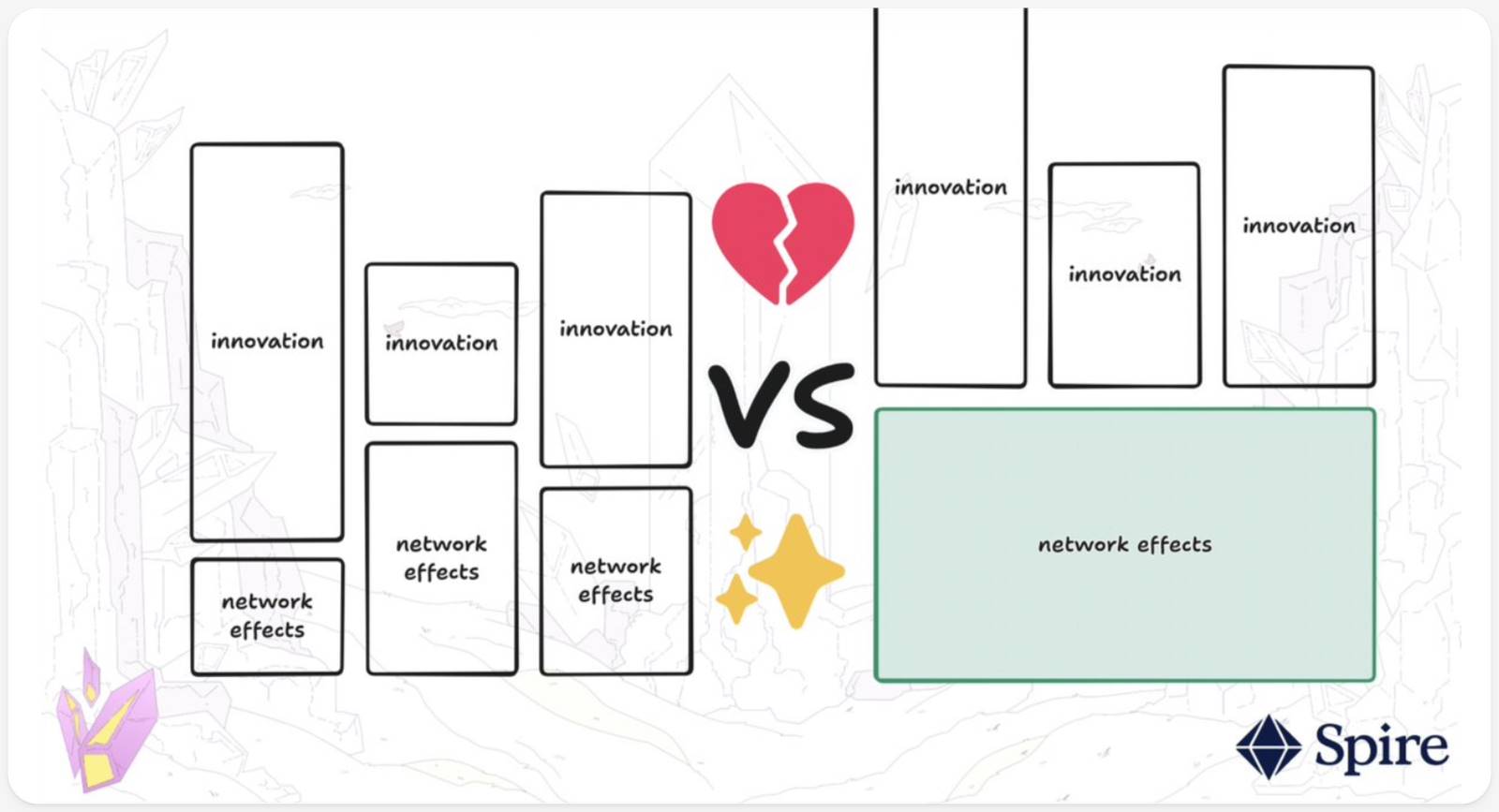
Slide from my talk at "Sequencing Day" in November 2024
Solid Foundation
To effectively restart the flywheel, we need a strong L1. An L1 worth composing. An L1 with ETH worth holding in your treasury. An innovative coordination point.
How to achieve this? The answer is simple. Actively expand L1.
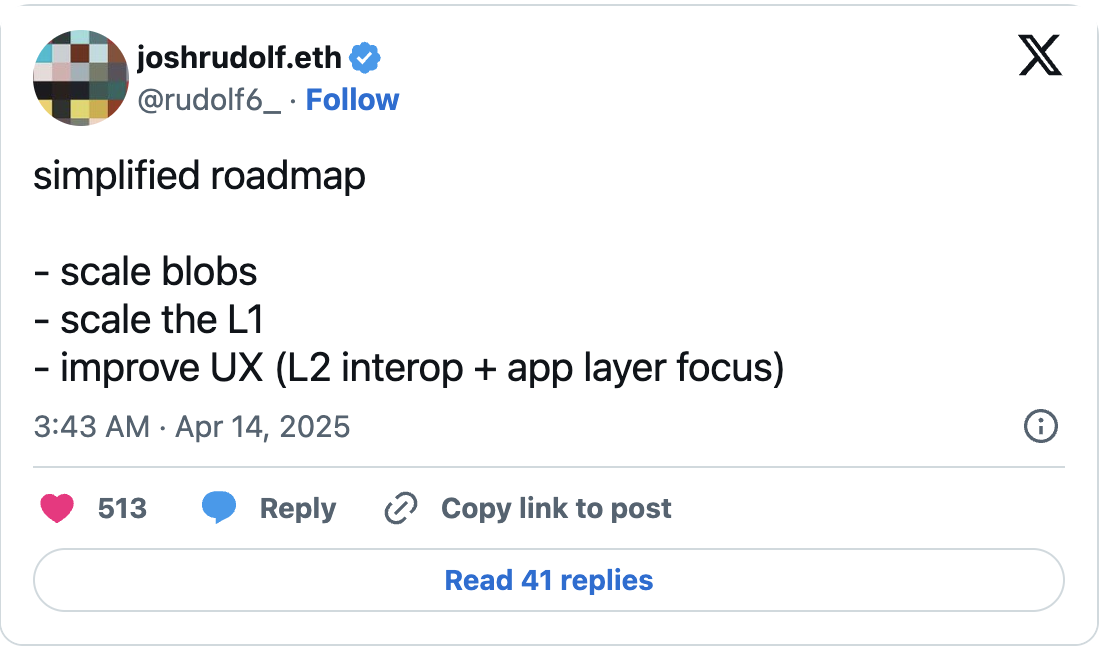
We start with innovation at the L1 level.
There are three reasons:
Expanding L1 increases network effects under the ideal flywheel
Expanding L1 raises the competitive threshold for any L2
Expanding L1 is beneficial to L2! (Especially the one I will discuss in the next section)
Most readers of this article probably understand what expanding L1 means in practice, but the core is increasing TPS and gas per second while reducing slot time. We must build Ethereum L1 into the most powerful settlement network, yes, but also an execution network.
Combined, this is the solid foundation that L2 needs.
Bring Rollup Back
As L1 expands and establishes its own network effects, the time to optimize L2 to contribute to the ideal flywheel cannot be wasted.
Several things need to be balanced here:
Ethereum's impression that Rollups will be prioritized within Ethereum.
Rollups have successfully grown their own network effects.
Any transition back to L1 expansion must be careful not to completely alienate major L2s (although some L2s have no reason to exist and absolutely should die).
I propose a simple Rollup design:
Rollup uses Ethereum for data availability (DA).
Rollup uses Ethereum for execution. This means it is a native Rollup.
Rollup uses Ethereum for sequencing. This means it is a Rollup-based.
Rollup uses ETH as its native gas token.
This type of Rollup is called "Ultrasound Rollup" and "Native + Based Rollup". I have written about them in detail!
"Ultrasound Rollup" is currently not achievable on the current Ethereum. To enable its native part, Ethereum needs to add a new opcode through a hard fork, namely the execution engine opcode. The sequencing-based design currently also has some practical issues, which are closely related to L1 expansion.
What would we get if we could achieve this?
Ultrasound Rollup contributes to Ethereum's network effect flywheel by maintaining composability and enabling customization. Their comprehensive expansion capabilities are theoretically very powerful, and any Ultrasound Rollup could drive execution like MegaETH or RISE. Ultrasound Rollup is not a step back but a necessary step forward.
The synergy between Ultrasound Rollup and Ethereum is so strong that I view it as an extension of Ethereum's network effects. Solana's concept of network expansion is correct, but Ultrasound Rollup is not just about increasing Ethereum's capabilities; they are Ethereum's network themselves.
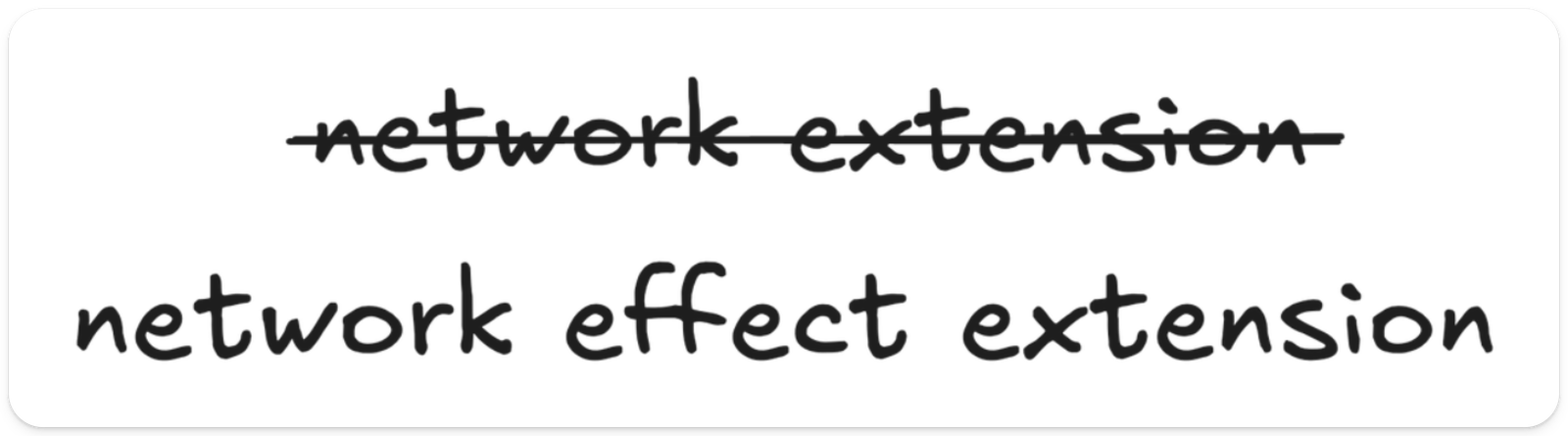
Existing Rollups have the potential to transition to Ultrasound Rollup. In fact, some teams have committed to further exploring this option. New Rollups and application chains should prioritize this direction.
Through this approach, a unified Ethereum ecosystem can achieve "Universal Synchronous Composability", bringing crazy expansion capabilities while also having unlimited expressiveness.
In this ecosystem, user and developer activities occur on L1 or specialized Rollups. Important and controversial states may still remain on L1. Developers can build cross-chain applications without worrying about underlying chain differences. Users experience chain abstraction within Ethereum's expanded economic zone.
This is the era of Ethereum integration.
From "Multiple Choices" to "Obvious Choice"
Ethereum is building top-tier data availability (DA), sequencing-based Rollups are outputting our continuously improving sequencing technology, and native Rollups will provide superior execution capabilities.
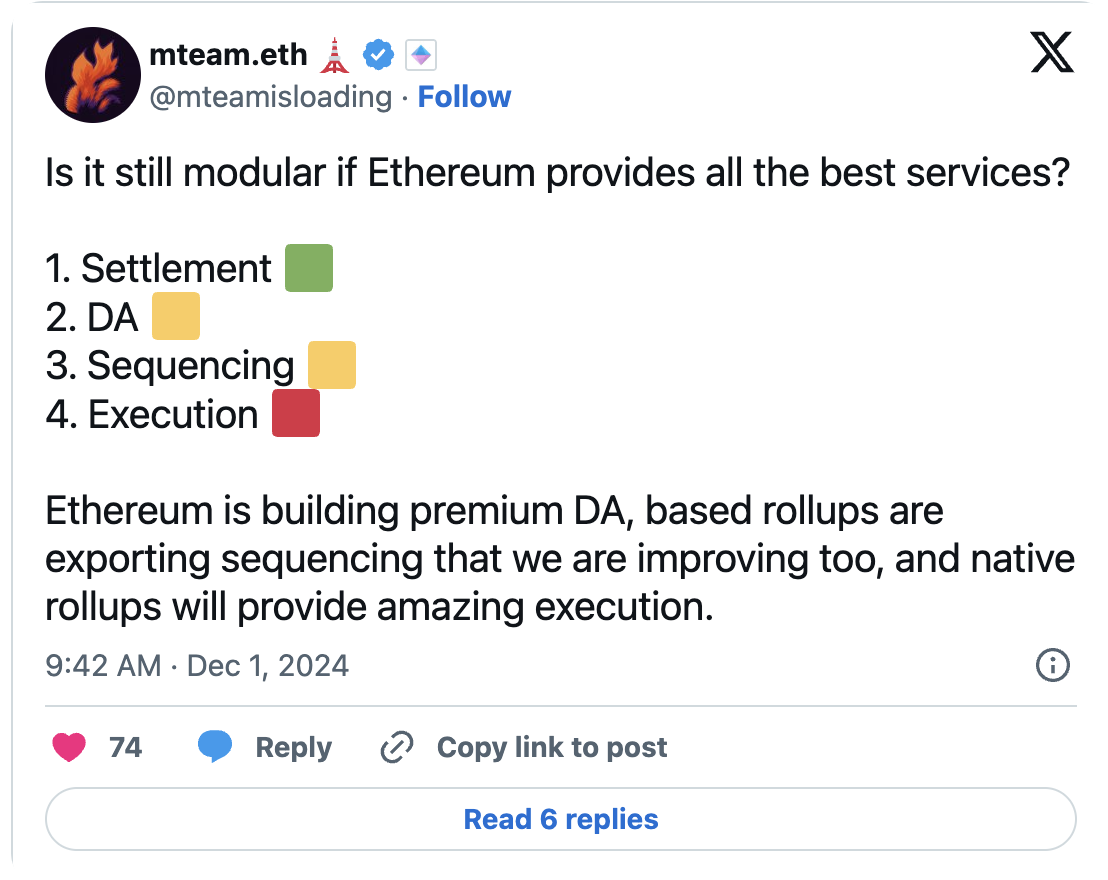
太坊 L1core Rollup services into a ultRollup. Although permissionless, chain can remain modular, but Ethereum itself such important comprehensive services that make any competitors irreetelev> In this model, value accumulation (in the form of fees) becomes straightforward: providing the most valuable services, accessing the largest synchronized economic zone, the strongest economic security, the most censorship-resistant ordering, the most reliable settlement layer, and the most secure data availability.
>narrative forms ethereum" → The> >Expand L1.
>Letup>>.>>launch as soon as possible.