What is a Dark Pool?
Dark Pools in Traditional Finance
Although CZ's statement might create a misunderstanding that dark pools are unique to Web3, they are actually private trading platforms that have long existed in financial markets. The history of dark pools can be traced back to 1979 when the SEC passed Rule 19c-3, allowing securities listed on specific exchanges to be traded on other platforms. Subsequently, the rise of electronic high-frequency trading (HFT) in the 1980s, which exposed order book information more extensively than before, gave birth to institutional investors' demand for non-public large-scale trading venues. While we typically encounter public exchanges like NYSE and NASDAQ, establishing large buy and sell positions on these open markets can significantly impact market prices and potentially cause unexpected losses to ordinary traders. Dark pools are independent trading systems that allow institutions or large investment banks to execute such block trades privately. In traditional exchanges, all buy and sell orders are publicly displayed on the order book, whereas dark pools do not disclose order prices or quantities before execution. With this characteristic, large institutional investors can hide their trading intentions while minimizing market impact. As of 2025, 51.8% of US stock trading volume is completed through dark pools, indicating its evolution from a supplementary trading method to a mainstream approach.The article also focused on James Wynn's liquidation event worth hundreds of millions of dollars on Hyperliquid, directly pointing to the huge demand for dark pools. Wynn had established a $1.25 billion long Bitcoin position with 40x leverage, but because his liquidation price was publicly visible, it attracted targeted attacks from market participants. In fact, a trader continuously took opposite positions against Wynn's position, earning $17 million within a week. This event not only proved the backlash effect of perpetual contract DEX transparency but also demonstrated the substantial market demand for a trading environment that does not expose position information.
Different Implementation Methods of On-Chain Dark Pools
Although many people may have first encountered the concept of dark pools through CZ's tweet, multiple projects are already advancing dark pool construction. Since there are multiple technical paths to achieve the core goal of "trading privacy", different projects have adopted various encryption schemes. Here are the main implementation methods and representative projects.
Renegade
Renegade is one of the most attention-grabbing on-chain dark pool projects, deployed on the Arbitrum mainnet, aiming to build a privacy solution by combining Secure Multi-Party Computation (MPC) and Zero-Knowledge Proofs (ZKP).
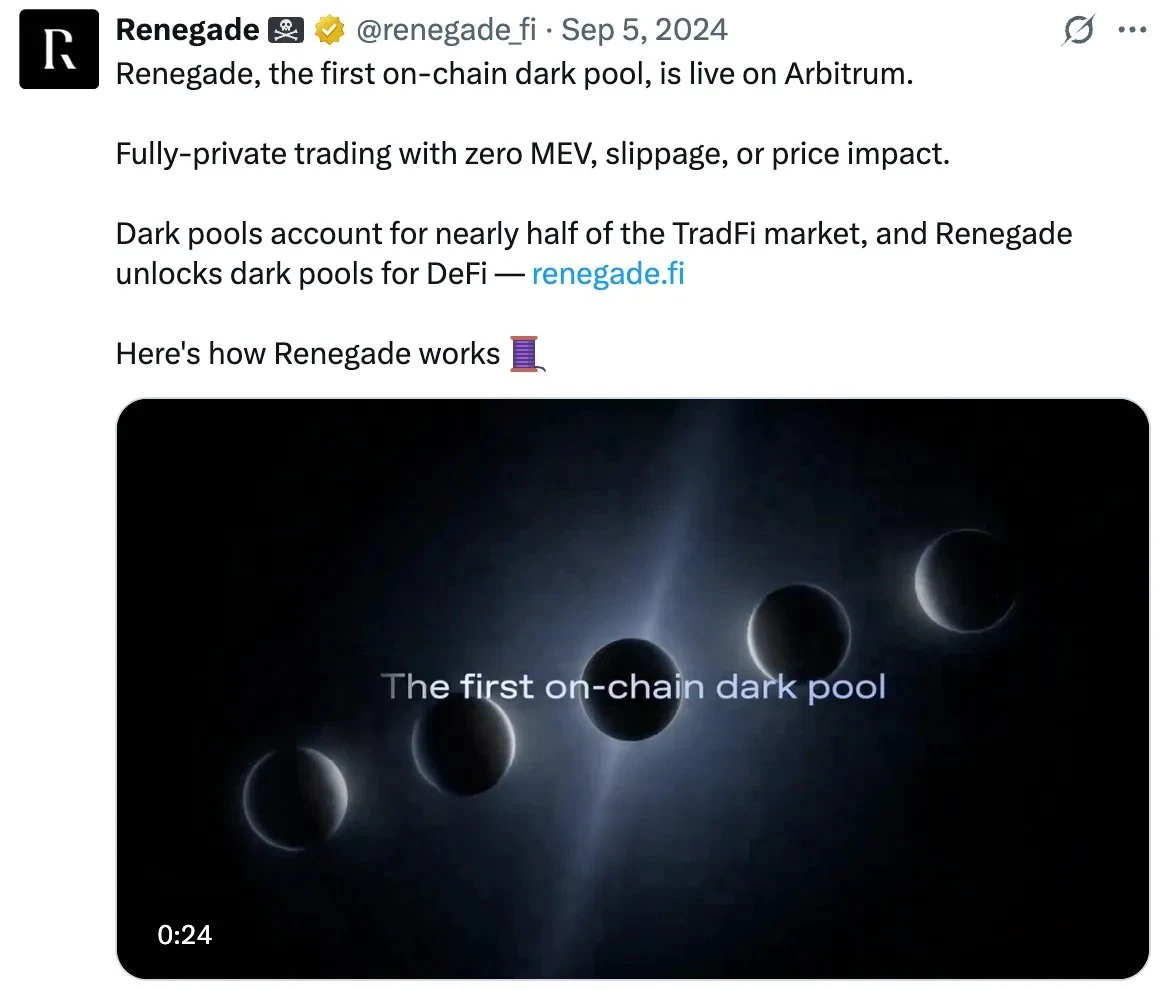
In Renegade, all states (balances, order books, etc.) are locally managed by traders, without relying on centralized or distributed servers. Transaction execution requires knowing both new and old wallet states and submitting three pieces of information to the smart contract: commitment, nullifier, and validity proof. This structure is similar to ZK projects like Zcash.
Renegade's core feature is ensuring complete privacy before and after transactions: hiding order details (price, quantity, direction, etc.) before trading, and only the counterparty knowing the asset exchange situation afterward. All transactions are executed anchored to Binance's real-time mid-price, with no slippage or price impact, making the Web2-like experience highly attractive.
In Renegade's architecture, multiple independent relayers continuously execute MPC through a P2P network. During the MPC process, Renegade proves a special NP proposition called "VALID MATCH MPC", verifying that both parties indeed possess valid input orders. Through this collaborative zero-knowledge proof structure, users are provided with complete anonymity, privacy, and security.
Arcium
Arcium is a privacy project in the Solana ecosystem, using MPC technology based on additive secret sharing to achieve "encrypted shared state". Developers can store encrypted states on-chain and execute calculations without exposing original data. This solution supports non-interactive local addition operations and single-round communication multiplication operations while maintaining strong security.
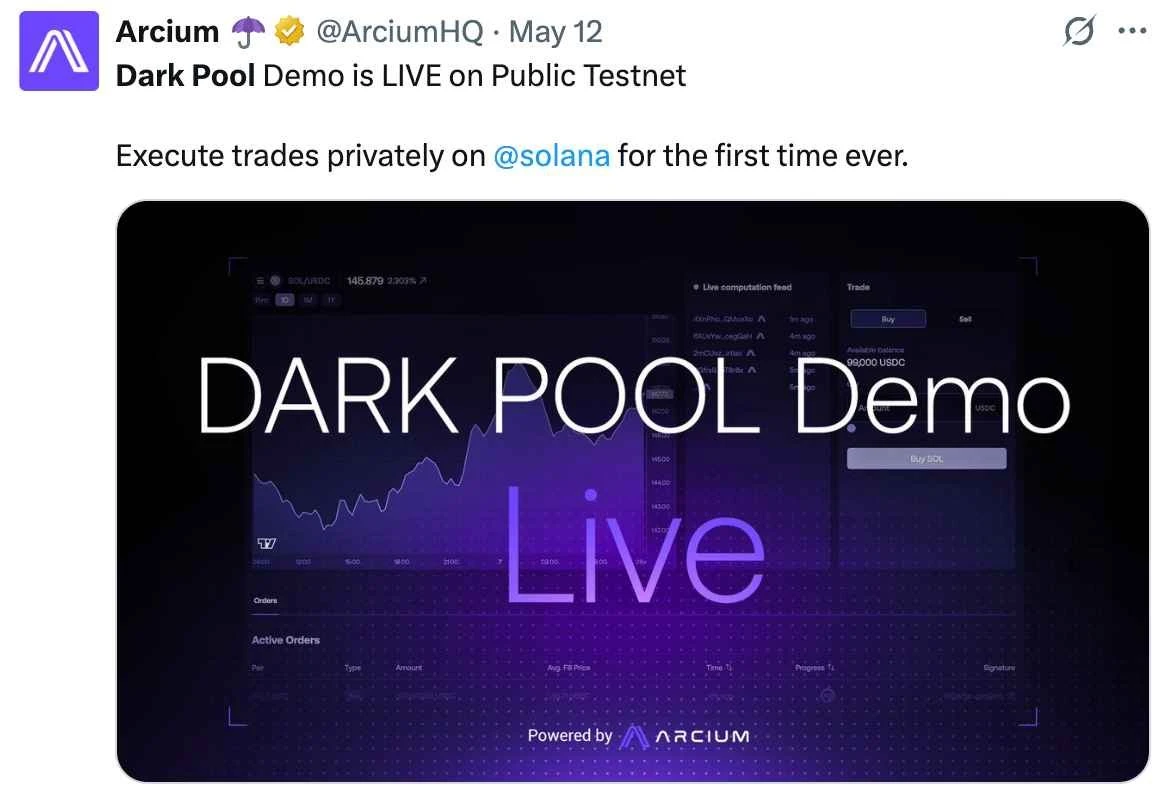
Arcium also introduces programmable privacy, allowing developers to specify which states need to be encrypted and which functions should perform calculations on encrypted states in Solana programs. Arcium's MPC tasks are managed by a virtual execution environment called MXE, responsible for setting parameters such as data, programs, and computing nodes. This architecture supports large-scale parallel transaction processing similar to Solana.
Recently, Arcium has successfully deployed a dark pool demo version on the Solana testnet, becoming the first confidential trading venue on the chain. Any Solana DeFi team can build a dark pool based on Arcium to provide privacy trading services for users.
Aztec
Aztec is an Ethereum privacy ZK-Rollup solution that completed a Series B funding round of $100 million led by a16z crypto in 2022, becoming one of the largest single investments in the privacy technology field.
Similar to Arcium, Aztec allows developers to annotate private functions - annotated functions are executed locally on user devices and generate proofs, only exposing the function's execution on the Aztec network. Private function state values are stored in UTXO form, decryptable only by the owner, ensuring no one can read them except the user.
Aztec previously collaborated with Ren Protocol to develop a privacy exchange protocol based on dark pools, with its system conducting transactions through ZK tokens called Aztec Notes, where the order book does not disclose any transaction information. After user deposits, Aztec creates crypto vouchers similar to cash through an off-chain UTXO system, updating encrypted messages in the state tree during transaction execution, with only the owner able to view voucher contents, completely protecting user identity and balance.
Challenges and Opportunities for Dark Pools
The biggest technical challenge for Web3 dark pools is scalability and performance issues. Current MPC and ZKP technologies are computationally intensive, with limitations in handling large transaction volumes. Taking Renegade as an example, its P2P network structure would cause exponential complexity increase as the number of participants grows.
Moreover, there is a certain trade-off between dark pool privacy and scalability. Aztec co-founder Zac Williamson once pointed out: "Fully private transactions contain more data because everything needs to be encrypted. This consumes more resources, thereby reducing scalability." To break through these fundamental limitations, more efficient cryptographic algorithm libraries need to be developed.
Network stability is also a crucial challenge. Recently, when Arcium tested a dark pool demo application on the Solana Devnet, some nodes crashed due to high traffic, causing order queue backlogs. Since this test was intended to verify infrastructure stability and resolve issues before mainnet launch, the fault was quickly repaired. This indicates that dark pool implementation requires precise technology and comprehensive testing to handle high-load demands.
In the long term, dark pools are expected to become an important part of the cryptocurrency trading ecosystem. Considering that CZ mentioned dark pool trading volume in traditional finance exceeds 50%, a similar proportion might be achieved in the crypto market. This trend will become more apparent as institutional investor entry accelerates.
This does not mean existing DEXs will be completely replaced; instead, they are more likely to form a complementary relationship in demand - small transactions crucial for price discovery will occur on existing DEXs, while large transactions with strong privacy needs will be completed in dark pools.
The development of dark pools will also extend beyond the privacy domain. As explored by Arcium, the demand for privacy protection technologies is growing in areas such as AI, DePIN, and supply chain management. As the starting point of the privacy revolution, dark pools are poised to become a core component of the privacy ecosystem.