How to eat an elephant? One bite at a time.
In recent years, machine learning models have achieved leapfrog development at an astonishing speed. As model capabilities improve, their complexity has simultaneously surged - today's advanced models often contain millions or even billions of parameters. To address such scale challenges, various zero-knowledge proof systems have emerged, which are always committed to achieving a dynamic balance among proof time, verification time, and proof size.
Table 1: Exponential Growth of Model Parameter Scale
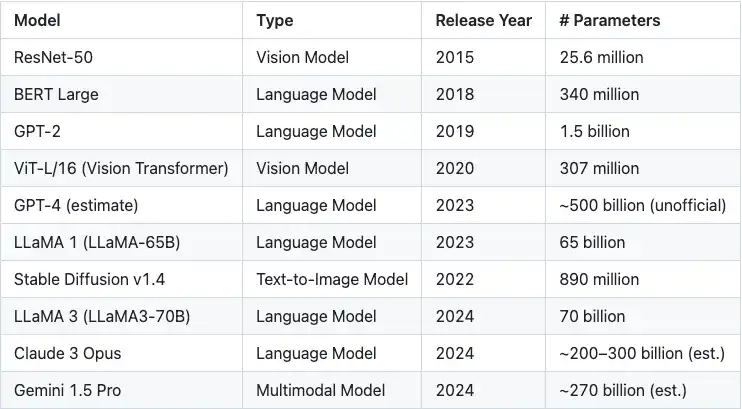
Although most current work in the zero-knowledge proof field focuses on optimizing the proof systems themselves, a critical dimension is often overlooked - how to reasonably split large-scale models into smaller, more manageable submodules for proof generation. You might wonder why this is so important.
Let us explain in detail below:
Modern machine learning models often have parameters numbering in the billions, which already occupy extremely high memory resources even without any cryptographic processing. In the scenario of zero-knowledge proofs (ZKP), this challenge is further amplified.
Each floating-point parameter must be converted to an element in the arithmetic field, and this conversion process itself can increase memory consumption by approximately 5 to 10 times. Additionally, to precisely simulate floating-point operations in the arithmetic field, extra operational overhead is introduced, typically around 5 times.
Comprehensively, the model's overall memory requirements may increase to 25 to 50 times the original scale. For example, a model with 1 billion 32-bit floating-point parameters might require 100 to 200 GB of memory just to store the converted parameters. Considering intermediate computational values and the proof system's overhead, total memory usage can easily exceed the terabyte level.
Current mainstream proof systems, such as Groth16 and Plonk, typically assume in unoptimized implementations that all relevant data can be simultaneously loaded into memory. While technically feasible, this assumption is extremely challenging under actual hardware conditions, greatly limiting available proof computation resources.
Polyhedra's Solution: zkCuda
What is zkCuda?
As we stated in the zkCUDA Technical Documentation:
Polyhedra's zkCUDA is a zero-knowledge computing environment for high-performance circuit development, designed to enhance proof generation efficiency. Without compromising circuit expressiveness, zkCUDA can fully utilize the underlying prover and hardware parallel capabilities to achieve rapid ZK proof generation.
The zkCUDA language is highly similar to CUDA in syntax and semantics, making it very friendly to developers with existing CUDA experience, and its underlying implementation in Rust ensures both safety and performance.
With zkCUDA, developers can:
Quickly build high-performance ZK circuits;
Efficiently schedule and utilize distributed hardware resources, such as GPUs or MPI-supported cluster environments, to achieve large-scale parallel computing.
Why Choose zkCUDA?
zkCuda is a high-performance zero-knowledge computing framework inspired by GPU computing, capable of splitting extremely large machine learning models into smaller, more manageable computational units (kernels), and implementing efficient control through a CUDA-like frontend language. This design brings the following key advantages:
1. Precisely Matched Proof System Selection
zkCUDA supports fine-grained analysis of each computational kernel and matches the most suitable zero-knowledge proof system. For example:
For highly parallel computational tasks, protocols like GKR that excel at handling structured parallelism can be selected;
For smaller-scale or irregularly structured tasks, proof systems like Groth16 with low overhead in compact computation scenarios are more appropriate.
By customizing backend selection, zkCUDA can maximize the performance advantages of various ZK protocols.
2. Smarter Resource Scheduling and Parallel Optimization
Different proof kernels have significantly varying resource requirements for CPU, memory, and I/O. zkCUDA can accurately assess each task's resource consumption and intelligently schedule to maximize overall throughput.
More importantly, zkCUDA supports task distribution across heterogeneous computing platforms - including CPU, GPU, and FPGA - thereby achieving optimal utilization of hardware resources and significantly improving system-level performance.
zkCuda's Natural Affinity with GKR Protocol
Although zkCuda is designed as a universal computing framework compatible with multiple zero-knowledge proof systems, it has a naturally high architectural alignment with the GKR (Goldwasser-Kalai-Rothblum) protocol.
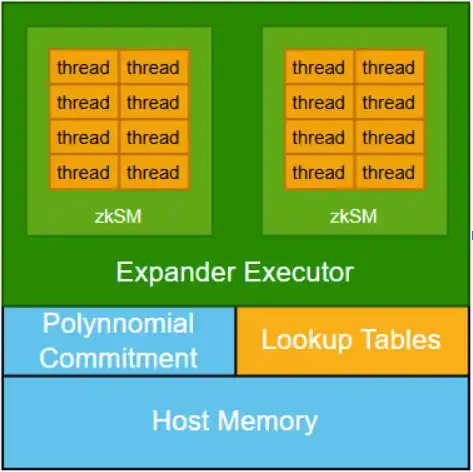
In architectural design, zkCUDA introduces a polynomial commitment mechanism to connect various sub-computational kernels, ensuring all sub-computations run based on consistent shared data. This mechanism is crucial for maintaining system completeness but also brings significant computational costs.
In contrast, the GKR protocol offers a more efficient alternative path. Unlike traditional zero-knowledge systems that require each kernel to fully prove its internal constraints, GKR allows computational correctness verification to be recursively traced back from kernel output to input. This mechanism enables correctness to be transmitted across kernels rather than fully unfolding verification in each module. Its core idea is similar to gradient backpropagation in machine learning, tracking and conducting correctness claims through the computational graph.
Although merging such "proof gradients" in multiple paths introduces some complexity, it is precisely this mechanism that forms the deep collaborative foundation between zkCUDA and GKR. By aligning with the structural characteristics of machine learning training processes, zkCUDA hopes to achieve tighter system integration and more efficient zero-knowledge proof generation in large model scenarios.
Initial Achievements and Future Directions
We have completed the initial development of the zkCuda framework and successfully tested it in multiple scenarios, including cryptographic hash functions like Keccak and SHA-256, as well as small-scale machine learning models.
Looking forward, we hope to further introduce a series of mature engineering techniques from modern machine learning training, such as memory-efficient scheduling and graph-level optimization. We believe integrating these strategies into the zero-knowledge proof generation process will greatly enhance the system's performance boundaries and adaptive flexibility.
This is just a starting point, and zkCuda will continue to move towards a general proof framework that is efficient, highly scalable, and highly adaptable.
Click to Learn About BlockBeats Job Openings
Welcome to Join the BlockBeats Official Community:
Telegram Subscription Group: https://t.me/theblockbeats
Telegram Discussion Group: https://t.me/BlockBeats_App
Twitter Official Account: https://twitter.com/BlockBeatsAsia