Built to scale: Sui’s way to stand out
- Sui is a next-generation blockchain designed for scale and is designed to support mass consumer applications (among other scenarios). Grayscale Research believes that Sui is expected to stand out in the crowded smart contract platform crypto space with its perfect combination of technical advantages and supporting strategies.
- To attract billions of users, blockchain-based applications must provide at least as attractive features as current Web 2.0 applications. This means both high transaction throughput and low barriers to entry for mainstream users. Although it is extremely difficult to achieve, we think Sui may have the ingredients for success.
- Mysten Labs, founded by the core contributors of Facebook's Diem blockchain project, is the core team behind Sui. Mysten not only has top technical strength, but also adopts a vertically integrated active development strategy - not only building on the bottom layer of the blockchain, but also comprehensively deploying the application layer ecosystem.
- The blockchain’s native token, SUI, currently has a market cap of approximately $10 billion[1]. As a relatively early project, its circulating supply only accounts for 33% of the total supply; more than 50% of the tokens will be gradually released after 2030[2].
Sui was launched in 2023, and the founding team came from the core members of Facebook's Diem blockchain project. Their mission at Facebook was to build an encryption platform that could support billions of users. In other words, the team has been focusing on global scale since day one. When they left and founded Sui, they continued the underlying architecture of their previous technical accumulation.
As a new generation of blockchain, Sui focuses on two core aspects: ease of use and scalability. Its goal is to provide a user experience that exceeds that of top Web 2.0 technology companies, while achieving on-chain asset ownership and global instant value transfer. Therefore, we believe that the next consumer-level "killer application" in the crypto space is likely to be born in the Sui ecosystem.
As the native token of the network, SUI has been included in the Grayscale smart contract platform's crypto investment targets. The Sui network mainly competes with high-throughput, low-cost public chains such as Solana, Ethereum Layer 2, and The Open Network (TON) in terms of fee income and market share. In this crowded race, not all projects can succeed. Only networks with differentiated characteristics can break through.
Grayscale Research believes Sui may have the following combination of differentiated features:
Technology : Using the Move programming language and unique blockchain architecture, Sui is particularly suitable for scenarios such as payment and gaming.
Team : The founding team from Facebook (now Mysten Labs) has a deep professional background in product, computer science, and cryptography, and is backed by a16z and Apollo Global
Strategy : The Mysten team adopts a collaborative strategy to build a fully decentralized vertical product stack - not only developing the underlying blockchain, but also building the application layer to promote ecological growth
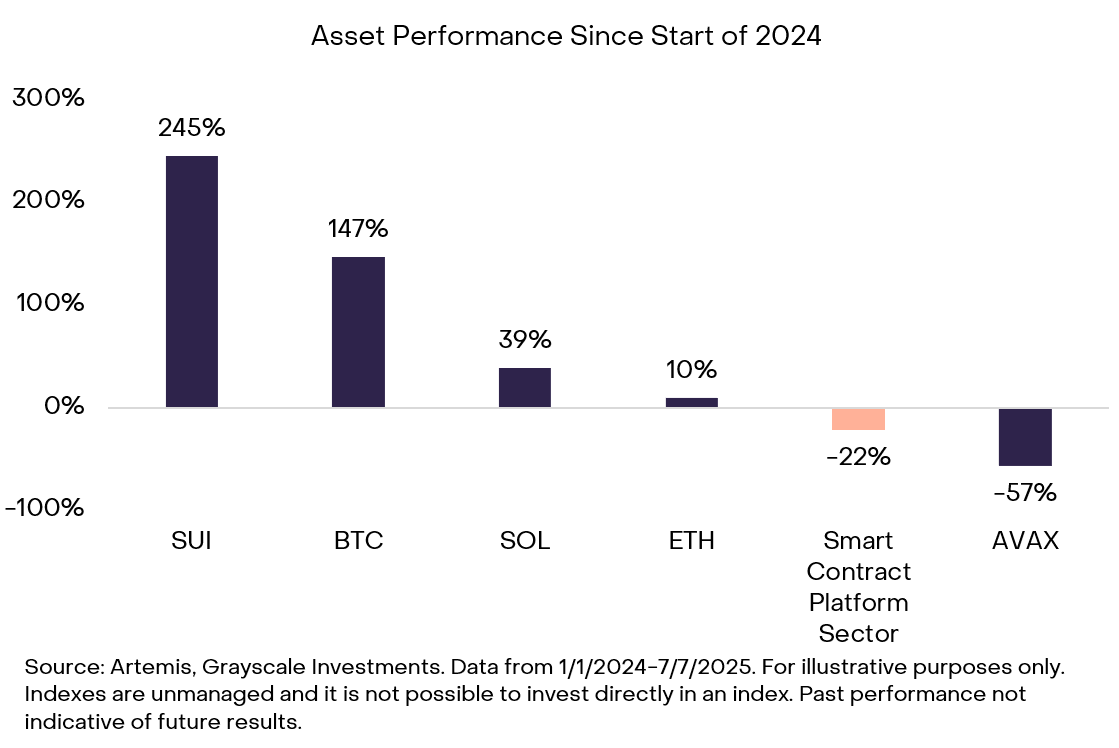
Since the beginning of 2024, SUI has been one of the best performing assets in the crypto space, outperforming Bitcoin (BTC) and outperforming the smart contract platform sector as a whole and direct competitors Solana (SOL), Ethereum (ETH) and Avalanche (AVAX) (see Figure 1).
Chart 1: SUI is one of the best performing assets in the crypto market over the past year
In the following chapters we will explore what makes Sui unique, the key elements required for ecosystem growth and network effects, progress and adoption, value accumulation and fee mechanisms, token supply, and key risks.
Sui's Differentiation
All blockchains pursue usability and scalability (under certain constraints). Sui's uniqueness lies in its technology, team support and vertical integration strategy.
- Technology: Blockchain design and programming language
Blockchain Design :
- Sui's technical architecture is designed for global scalability, especially for high-frequency and low-latency scenarios such as payment and gaming.
- Predictable low transaction fees : Low costs and smooth fee mechanisms help reduce friction and optimize user experience
- Based on object model and parallel processing : Unlike Ethereum, Solana and other account-based blockchains (which require updating the global smart contract ledger), Sui uses an object model - each asset is an independent object bound to the wallet, supporting parallel processing of transactions. By only updating related objects instead of sharing global states, this model reduces the amount of computation, improves efficiency, and enhances network scalability.
- “Fast path” execution : Sui distinguishes between simple asset transfers and complex smart contract calls[3], and simple peer-to-peer transactions achieve near-instant finality through a “fast path”[4], making it particularly suitable for payment scenarios
- Horizontal expansion : Unlike most blockchains, Sui network capacity grows with computing power. Verification nodes can improve performance by adding servers. Team data shows that an 8x increase in hardware performance can lead to a simultaneous increase in throughput without increasing latency.[5]
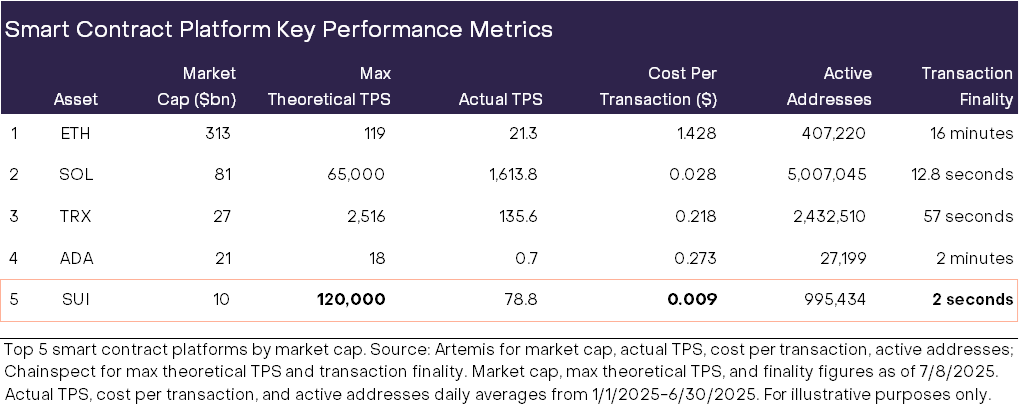
These features give Sui the highest theoretical throughput[6], lowest cost, and fastest final confirmation speed among the top five smart contract platforms by market capitalization (Figure 2)[7]. As of July 2025, Sui’s actual TPS (transactions per second) still lags behind Solana, but this reflects the theoretical capabilities of the current adoption stage rather than maturity. We believe that this data will improve significantly as the ecosystem develops.
Figure 2: Comparison of key indicators of the top five smart contract platforms by market value
programming language :
The Move language used by Sui was developed by Mysten Labs team members during their time at Facebook and is based on the globally popular Rust language. As a high-level programming language, Move provides strong security protection for smart contract development and significantly reduces common programming errors and vulnerabilities[8]. In contrast, Ethereum's Solidity language lacks built-in protection mechanisms, and developers need to manually implement security best practices.
2. Team: Top Entrepreneurs and Deep Experience
Mysten Labs brings together award-winning technical experts in product, computer science, and cryptography. The core founding members include:
- Evan Cheng : CEO of Mysten, former engineering director of Facebook/Meta
- Sam Blackshear : Mysten CTO, created the Move language during Facebook/Meta, and was the chief engineer of the Diem project
- Adeniyi Abiodun : Product manager at Mysten, who led the Facebook/Meta crypto project (including Diem and Move)
- George Danezis : Chief Scientist of Mysten, winner of the Computer Laboratory Ring Award
- Kostas Chalkias : Chief cryptographer at Mysten, former head of cryptography at Facebook/Meta, three-time winner of the Best Cryptography Research Paper Award[9]
Mysten Labs has more than 100 team members with 75+ PhDs[10]. We believe that its core advantage is its ability to directly transform technical expertise into products, while competitor foundations tend to take a more academic approach.
3. Strategy: Vertical Integration Path
Mysten not only participates in the blockchain infrastructure layer, but also goes deep into the Sui application layer to build products, tools and consumer applications for the entire network, including:
Walrus
An innovative decentralized storage solution that balances performance and cost-effectiveness. Compared to centralized service providers such as AWS, it eliminates single points of failure and ensures data reliability. Through its unique erasure coding technology, it reduces storage overhead by 80%, significantly outperforming Filecoin and Arweave[11]. It is now adopted by encrypted media such as Decrypt, Unchained Podcast, and Plume Network (RWA data storage). Designed for high-throughput data-intensive applications, ranging from RWA datasets to large language models.
Walrus is revolutionizing decentralized storage like Sui is transforming blockchain execution: eliminating friction, reducing costs, and expanding real-world use cases. As the Sui ecosystem's demand for AI models, video content, and off-chain proof storage grows, Walrus is expected to become a core component of the network's data layer.
DeepBook
The central limit order book (CLOB) on the Sui chain is aimed at institutional-level transactions. Compared with mainstream AMM pools, DeepBook provides precise order control, lower slippage and narrower spreads, and is favored by professional traders[12]. As an ecological shared liquidity layer, its unified order book can improve capital efficiency and reduce liquidity fragmentation.
Currently, it serves the top two decentralized exchanges and lending/derivatives applications on Sui[13]. As institutional adoption increases, DeepBook may grow into a key layer of financial infrastructure on the Sui chain, driving the expansion of the DeFi ecosystem.
Other Components
- zkLogins : Patented technology that supports Google/Twitch accounts to log in to on-chain applications directly, simplifying the encryption operation process
- SuiNS : Decentralized domain name service, similar to Ethereum ENS
- Ika : An innovative network that supports direct cross-chain transactions of assets such as Bitcoin and XRP (without bridging or wrapping tokens). Its token is scheduled to be launched in mid-July.
The Sui ecosystem (including the main chain, zkLogins, DeepBook, Walrus, SuiNS and Ika) constitutes the first fully vertically integrated application suite in the crypto space.
Although Sui’s degree of decentralization is inferior to some public chains, this may be an advantage for its focus on mainstream consumer applications. The Sui network, which was established only two years ago, is still in its early stages. The Mysten team is rapidly advancing through multi-scenario products to lower the threshold for users and developers. This proactive strategy may accelerate the prosperity of the ecosystem.
Growth Factors
Compared to mature networks such as Ethereum and Solana, Sui is still in its early stages in terms of developer appeal and ecosystem maturity[14]. However, its high scalability and user-centric design give the SUI token, which currently has a market value of approximately US$10 billion (equivalent to 12% of SOL and 3% of ETH), significant growth potential[15].
User side :
- zkLogin technology enables frictionless entry, allowing users to directly access their crypto wallets using Web 2.0 credentials such as Gmail (the identity provider cannot know the actual use), a feature unique to Sui
Developer side :
- The sponsored transaction mechanism allows the application party to bear the gas fee, and users can enjoy "zero-fee" on-chain interaction
- zkLogin is combined with sponsored transactions to replicate the Web 2.0 experience: users can complete on-chain records without holding tokens or actively operating wallets
These features (seamless onboarding, zero-gas-fee experience, and intuitive operation in a secure development environment) lay the foundation for the growth of network effects.
Despite its early days, Sui has seen strong user growth in the first half of this year: monthly active users (MAU) soared from 10 million to over 40 million (ranked second among smart contract platforms), with a slight decline recently. In addition to Mysten products, third-party applications such as Recrd (a video monetization platform for creators, with 490,000 daily active addresses) and Fan TV (video sharing, imported into 5 million crypto wallets) have also achieved significant adoption [16].
Cost and value accumulation
The key to the long-term competitiveness of smart contract platforms lies in the value accumulation and network fee generation capabilities. Sui generates revenue through transaction fees, and the value is distributed to stakers in the form of rewards (rather than token destruction).
Its transaction fee is divided into two parts: computing and storage. The fee rate is adjusted every 24 hours by the reference price anchored by the verification node. This mechanism keeps the fee relatively stable throughout the day, avoiding the drastic fluctuations in gas fees similar to Solana/Ethereum when the network is congested.
Chart 3: Sui transaction fees are low and relatively stable
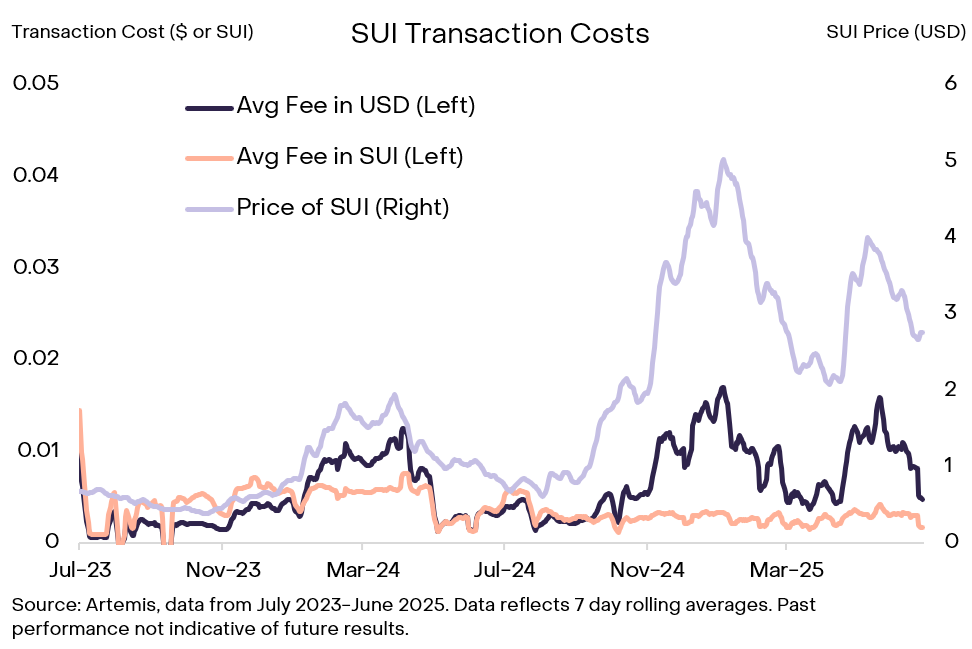
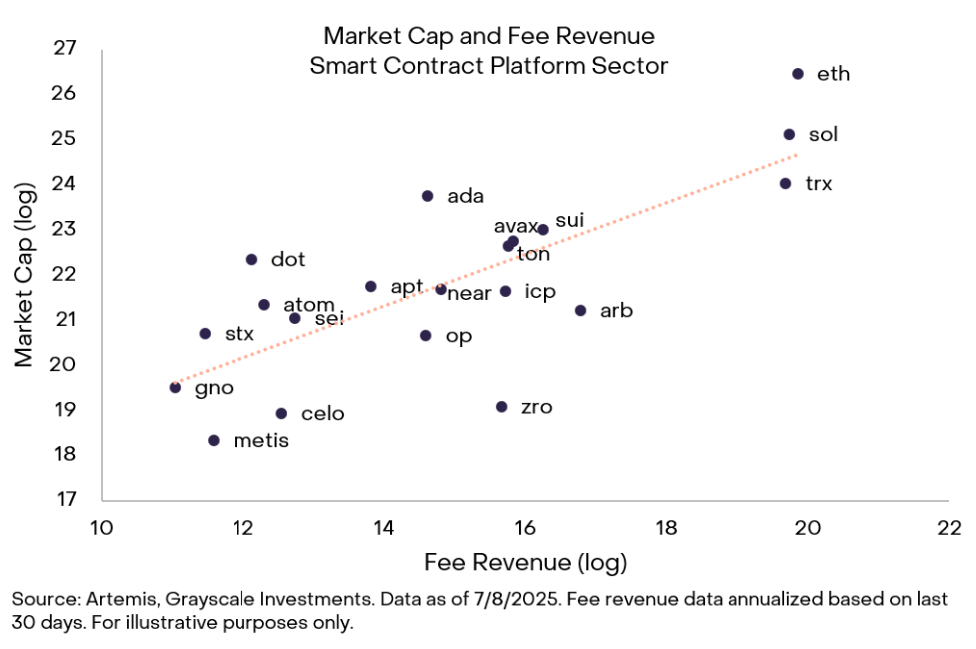
However, in terms of revenue generation, Sui still lags behind its top competitors. Ethereum and Solana are both expected to generate annualized network fee revenues of more than $500 million in 2025, while Sui’s is only $15 million[17]. This suggests that user monetization on the Sui network is still in its early stages, partly due to its extremely low average transaction costs (about 1/3 of Solana and 1/150 of Ethereum)[18]. This low cost means that Sui needs to achieve a larger volume of network activity to match the revenue scale of its competitors. Compared with its fee revenue, the current circulating market value of SUI tokens is basically reasonable (Figure 4).
Figure 4: Comparison of market capitalization and fee income in the crypto space of smart contract platforms
Token supply continues to be released
As an early-stage project, Sui’s current circulation only accounts for 33% of the total supply, and more than 50% of the tokens will be unlocked after 2030[19]. Under the same conditions, token inflation may put pressure on valuation, but the growth of network adoption can offset this impact.
SUI tokens will be issued in May 2023, with a total locked supply of 10 billion. The initial distribution is as follows[20]:
- 50% belongs to the community reserve managed by Sui Foundation (for delegation plan, verification node subsidy, research and development and funding plan)
- 20% allocated to early contributors
- 14% allocated to venture capitalists
- 10% will be transferred to Mysten Labs treasury
- 6% for community access programs and application testing
The inflation rate of SUI will be 17.4% in the next year, and it is expected that approximately US$1.7 billion worth of tokens will be released to the market (based on current prices)[21].
Risk Considerations
Unlike other Layer 1’s “pure decentralization” approach, Sui takes a gradual approach:
- The small number of validating nodes and high staking threshold[22] make it less decentralized and less censorship-resistant than mature networks such as Ethereum.
- Prioritize hardware performance and scalability in design
Another key factor is the strong dominance of Mysten Labs:
- In the short term, it is an advantage (it can quickly advance development and deliver applications)
- In the long run, if the ecosystem fails to further decentralize, it may limit the potential market of blockchain.
- Mysten’s current dual layout at the infrastructure layer and the application layer may squeeze the living space of developers in the same field
Sui also faces stiff competition in the smart contract platform space:
- Ethereum, Solana, etc. occupy a higher market share and on-chain assets
- Emerging networks such as Monad provide alternative high-throughput solutions
- TON can be distributed with the help of Telegram's massive user base
However, we believe that Sui's technology and Mysten's strategy can still form differentiated competitiveness in low-latency scenarios such as games, transactions, and payments.
in conclusion
Sui is a next-generation blockchain built for scalability and usability:
- Its architecture is designed to support consumer applications, with key elements such as low fees, near-instant finality and intuitive onboarding
- Unlike competitors that focus on speculative use cases or are limited by throughput issues, Sui was born to scale, and Mysten is committed to cultivating the next "killer app"[23]
The current market value of $10 billion plus a large number of tokens to be released indicates that the project is still in its early stages, which also means that its upside potential has not yet been fully released. We believe that:
- SUI is a high-confidence growth investment target
- It realizes the diversified layout of the proposition of "consumer-level application on the chain"
- With strong technology, Mysten's top team and vertical integration strategy, Sui is uniquely positioned to realize this vision.