Today, the number of listed companies incorporating cryptocurrencies into their balance sheets has reached a record high. On the surface, they aim to diversify their portfolios, hedge against inflation, and attract new investors; of course, the undisclosed reason is that management wants to boost stock prices. In recent months, merely announcing the so-called "crypto treasury" strategy has been enough to provide companies with a premium valuation.
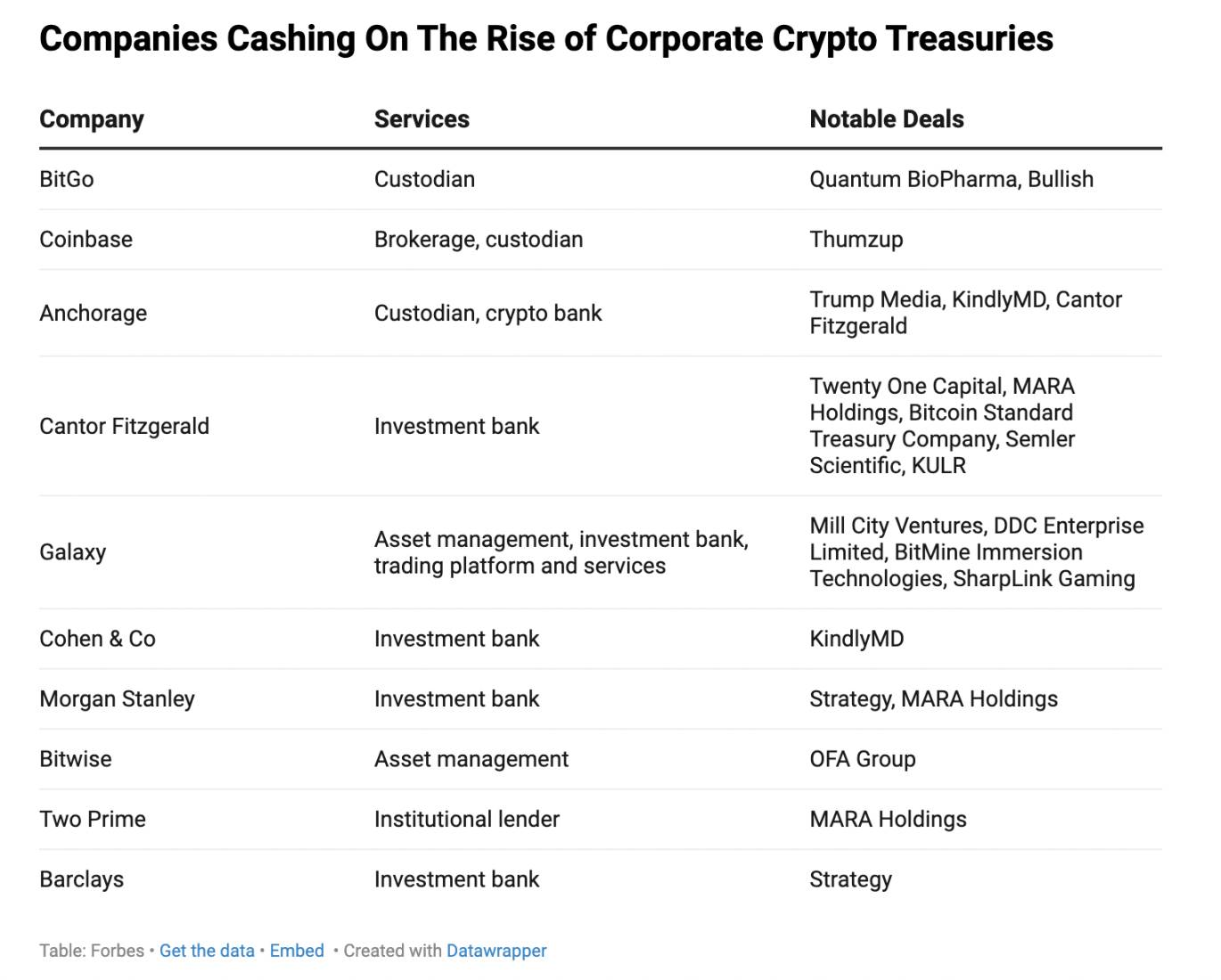
However, the real wealth feast is flowing to the "tool providers" in this latest "gold rush": custodian institutions, brokers, asset management companies, and investment banks, which collect fees from every transaction, transfer, and storage business.
Nathan McCauley, co-founder and CEO of San Francisco-based Anchorage Digital, stated that over the past six months, this trend has reached a "feverish level" and "created a contagion effect". The crypto bank has completed multiple transactions: managing a $2 billion Bitcoin treasury for Trump Media Group and a $760 million asset custody for Nakamoto Holdings. Nakamoto Holdings, a Bitcoin-focused company, recently announced a merger with KindlyMD through a SPAC. KindlyMD is a small, unprofitable medical company in Salt Lake City, whose stock price was long below $2 before the merger announcement in May; now, Nakamoto Holdings, paying tribute to Bitcoin's anonymous founder Satoshi Nakamoto, is listed on Nasdaq (ticker: NAKA) with a stock price of $15 and a market value of $114 million.
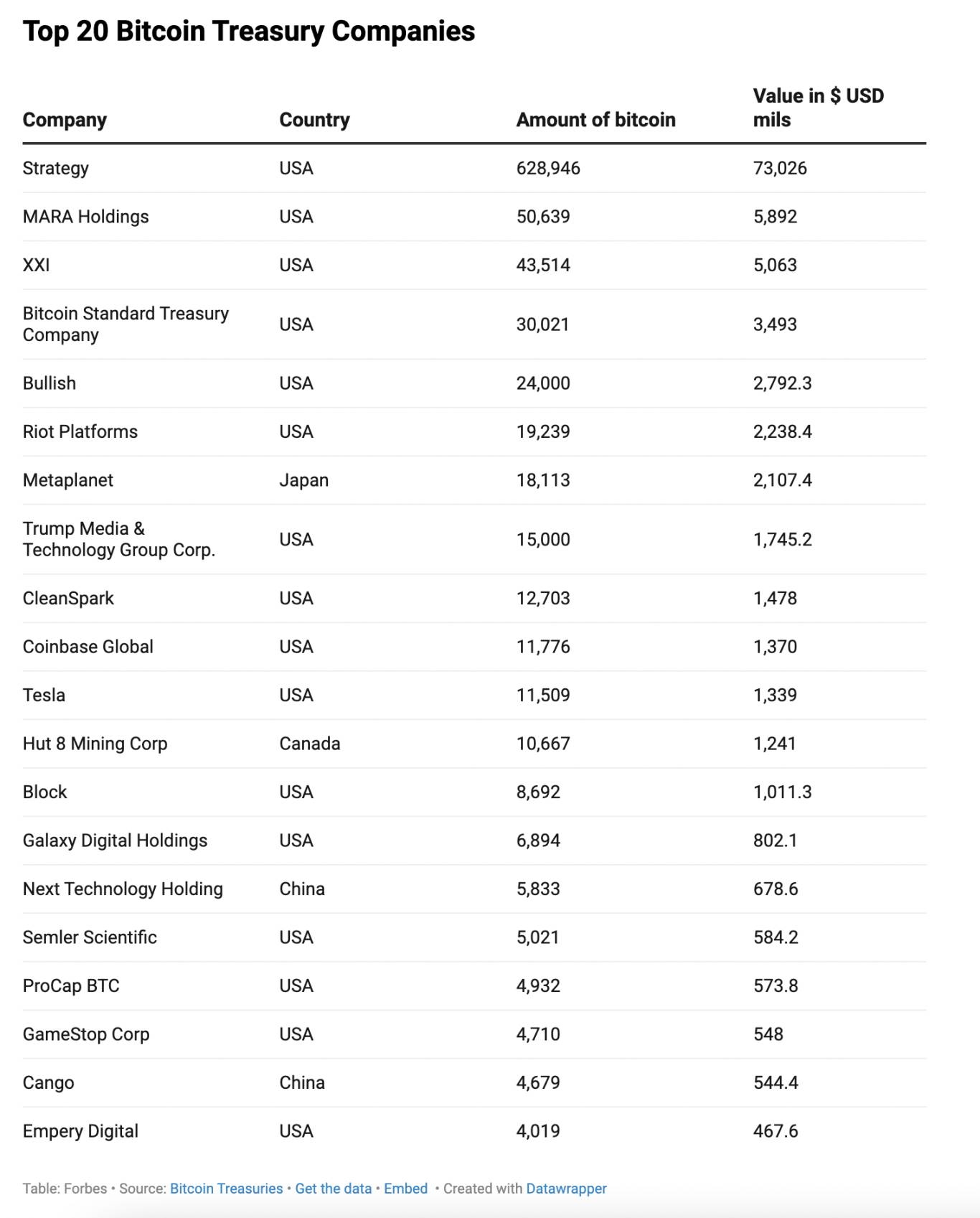
According to Bitcoin Treasuries.net, a year ago, a few corporate buyers held just over 416,000 Bitcoins; now, at least 152 listed companies hold over 950,000 Bitcoins, valued at over $110 billion. The undisputed "whale" is still Strategy Inc. from billionaire Michael Saylor. The company pioneered the corporate crypto treasury model, heavily utilizing innovative financing methods like convertible bonds and floating-rate perpetual preferred shares. The predecessor of Strategy Inc. was a small software company in Tysons Corner, Virginia called MicroStrategy, which now holds Bitcoins worth $73 billion and has a market value of $95 billion, a 25% premium over its crypto asset holdings.
Companies emulating Strategy are not just focusing on Bitcoin but are also buying Ethereum, Solana, and other crypto assets. According to data from Palo Alto crypto consulting firm Architect Partners, corporations have raised over $98 billion for such investments this year alone; since June, another 139 companies have committed $59 billion. The latest case is World Liberty Financial, a crypto company controlled by the Trump family, which recently announced a $1.5 billion treasury centered on its own token WLFI - not including the Trump Media Group's $2 billion Bitcoin treasury.
Elliot Chun from Architect Partners stated that while this trend is still in its early stages and its overall impact is difficult to quantify, the wave has "comprehensively generated massive fee income".
For many traditional investment banks and broker-dealers like Morgan Stanley, Barclays Capital, Moelis & Company, and TD Securities, underwriting commissions and other fees from preferred stock and convertible bond issuances have become a profitable business.
For example, when Strategy issued 8.5 million preferred shares in March, raising $722 million, Morgan Stanley and about 12 other institutions acted as underwriters, estimated to have earned $10 million in fees. In July, MARA Holdings, a crypto mining company in Fort Lauderdale, Florida, issued $950 million in convertible bonds, with Morgan Stanley and other institutions potentially profiting $10 million from this transaction.
Another group of beneficiaries in the crypto treasury boom are "qualified custodians" - those who safeguard digital assets for clients. Take the long-established Palo Alto company BitGo, which, benefiting from the crypto market's prosperity and corporate treasury expansion, saw its custody assets exceed $100 billion in the first half of 2025.
"(Corporate treasury business) is increasingly taking up our business. Six months ago, such business was scarce, but now it comprises a significant portion of new clients," said Adam Sporn, Head of Brokerage Business and US Institutional Sales at BitGoPrime. He estimates that about 24 crypto treasury-related companies have announced custody partnerships with BitGo in just the past few months. The business surge has also paved the way for BitGo's secret IPO filing in July.
Major custodians like BitGo and Coinbase charge institutional clients fees including initial, annual, and additional fees, linked to crypto asset custody and helping clients earn returns. Ravi Doshi, Global Markets Co-Head at FalconX, says the most common fee model is an annual fee based on custody asset size, typically 0.15% to 0.30%, but can be negotiated down to 0.10% for large clients.
Although these fees mean hundreds of millions in revenue for custodians managing hundreds of billions in Bitcoin, custody transaction profits are usually slim. Mizuho Securities senior fintech analyst Dan Dolev points out that the crypto demand generated by these "agents" also brings additional income to exchanges and brokers like Coinbase, FalconX, and Cumberland: buying drives price increases, attracts new investors, and thus promotes more token trading, creating a cycle.
Beyond trading and custody, services like staking, lending, and options coverage are another highly profitable domain. Staking involves users locking tokens to help validate blockchain transactions and earn rewards; options strategies adjust portfolio risk-return structures through financial derivatives without changing underlying asset allocation.
"After these companies raise funds and incorporate them into their balance sheets, they quickly face the question of 'what's next'," said Chun from Architect Partners. "Over $60 billion in crypto assets need to generate returns, which these listed companies cannot do themselves." Sidney Powell, CEO of Melbourne crypto lending company Maple Finance, points out that companies currently rely on underlying asset appreciation for returns, but the rapid spread of the crypto treasury trend will force companies to differentiate by seeking yield strategies or buying Bitcoin with low-cost funds.
Juan Leon, a senior investment strategist at crypto asset management and advisory firm Bitwise, says that to build competitive advantages, these companies may increasingly turn to institutional lenders like Two Prime and Maple Finance, as well as asset management companies such as Wave Digital Assets, Arca, and Galaxy, whose treasury management services typically charge 25 to 50 basis points. At the beginning of this month, Galaxy reported an inflow of $175 million in its treasury asset management business, partly due to providing solutions for about 20 clients holding crypto treasury.
Meanwhile, Wall Street has been "transfusing" this trend. Encouraged by the more friendly policy environment and clearer regulatory framework during the Trump administration, entities like Capital Group, hedge fund D1 Capital Partners, and investment bank Cantor Fitzgerald have been providing funding for corporate crypto hoarding.
Despite crypto currency opponents, the crypto asset treasury trend has just begun. "We believe that ultimately all companies will become crypto treasury companies in some form," Leon noted, pointing out that global corporate cash reserves are currently around $31 trillion. "Whether they allocate 1%, 10%, or 100% of their balance sheet to crypto assets, they will hold a portion. Therefore, we still have significant room for development."