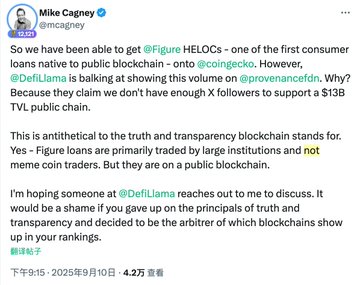
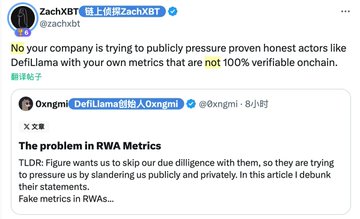
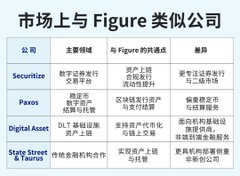
The dispute between Figure and DefiLlama is a reflection of the current rift between the RWA business and lagging regulation, where ideals are plentiful but reality is bleak. To briefly describe the dispute, last week, Figure co-founder Mike Cagney tweeted that Figure's home equity line of credit (HELOC) had successfully launched on CoinGecko. He also accused DefiLlama of refusing to display Figure's $13 billion TVL on the Provenance chain due to "insufficient social media followers" and questioned the fairness of its "decentralization standards." On the 13th, DefiLlama co-founder 0xngmi published a lengthy article titled "The Problem in RWA Metrics" in response, detailing the data anomalies behind Figure's claimed $12 billion figure. He also pointed out the unverifiable nature of its on-chain data, the lack of a true asset transfer path, and even suspicions of circumventing due diligence. For a time, suspicions of Figure's on-chain fraud and even business fraud were rampant. Here's my understanding: 1. As a US-listed company that recently went public, all of Figure's business and financial data should have been rigorously audited by a third-party auditing firm. The cost of fraud for US-listed companies is enormous. If discovered, the company faces substantial compensation, core team members face imprisonment, and the auditing firm faces heavy penalties from the SEC. From this perspective, I personally believe that the possibility of Figure's business fraud is low. Of course, that's not to say it's completely impossible, given the Enron fraud incidents 20 years ago and the Luckin Coffee fraud incidents four years ago, but generally speaking, the probability is still very low. So, I believe Figure's business data is likely to be authentic. 2. What's the source of the controversy? The core issue is that, due to current regulatory policies, the majority of the RWA business, which is used to create real assets, is still conducted off-chain, with only a portion occurring on-chain. It's still illegal for banks to use stablecoins to transfer funds to customers' loan accounts. Furthermore, according to Figure Technology's SEC S-1 filing (EDGAR ID: 0001628280-25-041443) and company public information, the Provenance Blockchain developed by Figure is a permissioned consortium blockchain, not a permissionless public blockchain. Only entities that have authenticated the blockchain (such as financial institutions, loan originators, and investors) can join with permission. This makes it difficult to fully view many business data, as is the case with permissionless public blockchains, and even then, only certain aspects are displayed on-chain. This raises a question: Defilma's calculation of TVLT is based on the on-chain amount users deposit into these protocols, not the actual value of the assets held. Figure believes that the actual value of assets held should be included. When discussing Figure previously, @youyouAllen mentioned that the Provenance Blockchain and its stablecoin are merely embellishments in Figure's context, simply to add the "crypto" label. This is a valid point. 3. The key question is what happens next. I personally think the content shared by Zheng Di @futurist2077 in his "Dots Institutional Investor Community" on Just Planet is very insightful. I've posted it here for your reference, as shown in Figures 3 and 4 below. The key points are: 1) Figure's RWA Token is not a simple information token, but it's also not a fully self-executing on-chain property token. It employs a hybrid model of "on-chain visibility + off-chain ownership confirmation," with ultimate ownership determined by the transfer agent's records. Although Figure's on-chain RWA Tokens (such as Transferable Certificates and YLDS) have visible transfer records on the Provenance Blockchain, the final legal record of ownership must be based on the official records of the registered transfer agent. On-chain transactions do not automatically take effect; only after the transfer agent confirms and records the transaction is legally binding. This is currently the case with BlackRock's BUIDL. This isn't a technical issue; it's a result of a poorly established legal system. Under US securities law, the transfer agent's records are the legally recognized definitive proof of ownership; on-chain records serve only as "auxiliary records." To achieve true "on-chain ownership confirmation" in the future, we must await updates to laws or SEC rules. 2) According to the Securities Exchange Act of 1934 and related SEC regulations, record ownership of securities must be reflected in the books of a registered transfer agent. This system evolved from paper stock certificates and later became electronic, but the core remains unchanged: only the transfer agent's books serve as the legal basis. 3) Why on-chain records cannot directly constitute legal ownership? a. Identity compliance issues: The law requires that security holders undergo AML/KYC and investor vetting. A wallet address alone is insufficient proof of legal identity. b. Investor protection issues: If someone loses their private key, a fraudulent transfer occurs, or a dispute arises, there must be an authoritative record to arbitrate. The transfer agent has the legal standing to handle these issues. c. Regulatory framework not updated: The SEC has not yet amended its rules to recognize "on-chain registration = legal ownership." Any attempt to bypass the transfer agent will be considered a violation. 4) Figure's compromise: hybrid ownership a. On-chain function: Transparent, immutable transaction traces; transfers can be verified by everyone. b. Off-chain function: The transfer agent synchronizes records daily or periodically, and its ledger is the final legal confirmation of ownership. c.SEC The document clearly states: "On-chain transfers are visible, but the record ownership is based on the transfer agent's records." · "Peer-to-peer transactions are not final ...until recorded in the official records by the transfer agent." In other words, Figure Token currently operates on a hybrid model of "on-chain display + off-chain ownership." 5) What will the future hold? a. Short-term (1-3 years): Hybrid ownership is likely to remain the norm, as regulation must balance compliance, identity verification, and legal remedies. b. Medium-term: The market anticipates the SEC's "innovation exemption/safe harbor" or congressional legislation recognizing that "on-chain registration can serve as the final legal record." c. Long-term: If the legal framework is upgraded, the role of transfer agents may be partially replaced by on-chain smart contracts, ushering in an era of "on-chain ownership confirmation." As the trend of on-chain and off-chain integration continues, this disconnect is likely to become significant in the future. While businesses are expanding rapidly and policy announcements are loud, regulatory details are still being released piecemeal, and implementation is likely to lag even further.
This article is machine translated
Show original

qinbafrank
@qinbafrank
09-12
昨晚上市的Figure Technologies会不会成为正宗RWA第一股?今天看了下Figure的资料,这是一家基于区块链的金融科技公司,业务涵盖贷款、资产证券化和稳定币,成立于2018年,由前SoFi Technologies首席执行官Mike



Sector:

From Twitter
Disclaimer: The content above is only the author's opinion which does not represent any position of Followin, and is not intended as, and shall not be understood or construed as, investment advice from Followin.
Like
Add to Favorites
Comments
Share
Relevant content