➥ ERC-S: The Standard That Gives Tokens Real Value
ERC-20 built the foundation of DeFi, but it also exposed its biggest flaw, tokens with no real intrinsic value.
ERC-S is a new answer to that problem. It links tokens to real company performance while staying compliant.
Here's all you need to know about ERC-S in 30s 🧵
— — —
► What is ERC-S?
@ethereum Request for Comment (ERC) is the framework that defines how tokens are created and interact on Ethereum.
Simply put, ERC-20 is the base standard for fungible tokens. It powered DeFi’s growth but represents utility, not value, so most tokens fade once hype ends.
ERC-S is the model proposed by @StreetFDN. It links tokens to real company cash flows, giving holders compliant exposure to business growth and turning tokens into assets with real value.
—
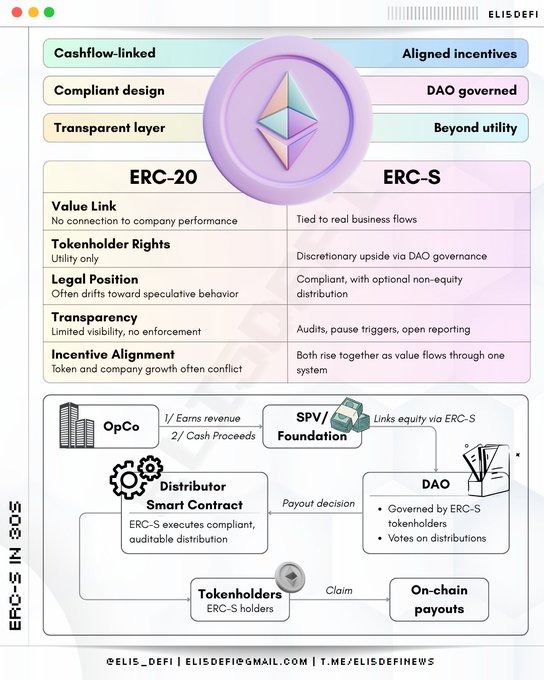
► ERC-20 vs ERC-S
Value link:
ERC-20 → no connection to company performance.
ERC-S → ties tokens to real business flows.
Tokenholder rights:
ERC-20 → utility only.
ERC-S → discretionary upside via DAO governance.
Legal position:
ERC-20 → often drifts toward speculative behavior.
ERC-S → compliant with optional, non-equity distributions.
Transparency:
ERC-20 → limited visibility, no enforcement.
ERC-S → audits, pause triggers, and open reporting.
Incentive alignment:
ERC-20 → token and company growth often conflict.
ERC-S → both rise together as value flows through one system.
If one comparison matters most, it’s this: ERC-20 runs on speculation, ERC-S runs on substance.
—
► How it Works
ERC-S connects the company, its equity, and its tokenholders through one transparent structure.
Flow: OpCo → SPV/Foundation → DAO → Tokenholders
➤ OpCo is the operating company that earns revenue.
➤ SPV/Foundation holds the company’s equity and receives the proceeds.
➤ DAO votes on when and how much to distribute.
➤ Tokenholders claim payouts on-chain through a distributor.
Distributions are discretionary, keeping ERC-S non-security.
Audits, pause triggers, and dual-key custody add protection and trust.
This structure links token value directly to business performance, aligning holders with the company.
—
► Why it Matters
ERC-20 made fundraising easy but separated holders from real company value, pushing founders to chase hype instead of performance. Tokens became short-term trades rather than long-term assets.
ERC-S fixes that by aligning holders, founders, and investors in one structure that shares success. Startups can raise capital without selling equity, while holders gain exposure to real growth.
—
► Wrap-Up
ERC-20 built DeFi’s foundation and made token creation simple, but it never linked tokens to real company value. Most projects grew on speculation and faded once the hype passed.
ERC-S upgrades that model with transparency, compliance, and real economic alignment. It allows tokens to reflect business performance without becoming securities, marking a new phase where Ethereum assets are backed by revenue and trust.
--
CC - @MiyaHedge
— Disclaimer
Found this thread helpful?
Show your support with:
🔵 Share
🔴 Like
🟠 Retweet
🟢 Bookmark
And follow @eli5_defi

Eli5DeFi
@eli5_defi
10-08
➥ ERC-S: The Standard That Gives Tokens Real Value
ERC-20 built the foundation of DeFi, but it also exposed its biggest flaw, tokens with no real intrinsic value.
ERC-S is a new answer to that problem. It links tokens to real company performance while staying compliant.
sounds bullish on Ether ngl
the infra for the world finance
Ethereum is still the OG and Goated chain (despite $10 gas fees)
no fred cuz we have l2s base arbitrum stuff
ERC-S could be the game changer, linking tokens to real value!
Finally the real ICM
As always man’s pretty early
Sector:

From Twitter
Disclaimer: The content above is only the author's opinion which does not represent any position of Followin, and is not intended as, and shall not be understood or construed as, investment advice from Followin.
Like
Add to Favorites
Comments
Share