By ian.btc | 0xWorkhorse, Translated by Shaw Jinse Finance
Amid the wave of liquidations that rocked the cryptocurrency market last Friday, one platform stood out: Hyperliquid. While other platforms struggled to remain solvent, the platform generated $41.5 million in fees over a single weekend and delivered a 10% return to HLP depositors.
Products with this level of resilience aren’t common – so what is HLP, how does it work, and how can we get involved ?
Let’s start from the beginning.
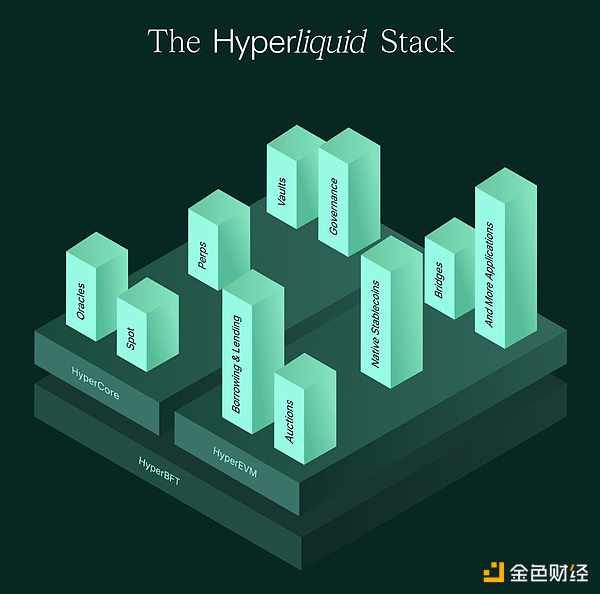
Hyperliquid is a decentralized perpetual futures contract exchange (Perp DEX) built on its own high-performance Layer-1 blockchain, HyperEVM. Launched by Hyperliquid Labs in 2023, the protocol quickly became the dominant player in the decentralized perpetual futures contract market, with a market share exceeding 73% by mid-2025 and a peak daily trading volume exceeding $59.5 billion.
At the heart of this success lies the Hyperliquid Protocol (HLP) Vault—a protocol-managed, community-owned liquidity pool . It allows everyday users like you and me to deposit stablecoins like USDC and earn returns through intelligent automated trading strategies. Unlike traditional automated market makers (AMMs) that simply rebalance token pairs, HLP takes a more hands-on approach: it actively trades across over 130 perpetual contract markets, handles liquidations and arbitrage, and then returns all profits to depositors.
The key point worth emphasizing here is that they return all HLP revenue to depositors .
This means that HLP transforms pooled deposits into powerful trading counterparties—earning fees, funding rates, and spreads in the process. To better understand this, we can think of it as a diversified professional market maker business: individuals, decentralized autonomous organizations (DAOs), and even large institutions can participate without requiring deep trading knowledge or significant initial capital.
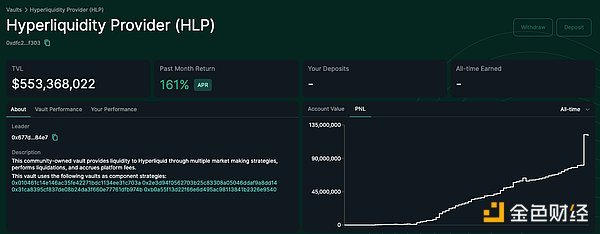
As of the time of writing in October 2025, HLP’s total locked value (TVL) is approximately $300-400 million, and its returns are stable, often rising against the trend when the cryptocurrency market declines.
How HLP works
HLP runs on Hyperliquid's HyperCore engine, which powers a fully on-chain centralized limit order book (CLOB). This engine provides sub-second finality and processes over 100,000 orders per second, reaching the speed of centralized exchanges, all of which must keep up with the trading volume passing through the vault.
The vault itself benefits entirely the community users who provide liquidity for trading. Therefore, unlike user-created vaults, HLP is owned by the protocol itself and does not incur any fees. This means that 100% of profits go directly to depositors, distributed based on the user's staked amount.
Key aspects

1.) Liquidity Provision
When a trade can’t find an immediate match, HLP steps in and acts as a counterparty. This narrows the spread and ensures the trade goes through smoothly—in other words, it makes the trade feel “as expected,” meeting the standards set by platforms like Robinhood.
For example, during Friday's liquidation storm, HLP's excellent execution of the liquidation process during the $10 billion platform liquidation helped Hyperliquid maintain 100% uptime while many competitors struggled. This means that even during periods of market volatility, HLP has access to stronger liquidity, but also faces short-term risks if the market moves against it.
2.) Price Oracles and Funding Rates
The decentralized oracle fetches spot prices from major exchanges every three seconds. This anchors funding rates and liquidation points, helping to prevent manipulation and keep prices within 1% of real-world reference prices. For example, the oracle uses weighted medians from sources such as Binance (weight 3) and OKX (weight 2), calculated by validators to ensure robustness.
Building on this, the HIP-3 upgrade can integrate more assets without changing the core oracle settings, ensuring fair capital distribution even in new and exotic asset pairs such as commodities.
3.) Liquidation
If traders are overleveraged, HLP steps in to absorb and manage these positions. It collects fees and bonuses from these positions while also maintaining the stability of the platform. To be clear, this funding comes from HLP's own approximately $400 million in reserves, separate from the protocol's $1.3 billion bailout fund.
This means that HLP acts as a “toxic-free liquidator,” profiting from chaos—like making $41.5 million in a single day during Friday’s crash—while avoiding bad debts. However, in extreme tail events, it combines with the automatic position deleveraging (ADL) mechanism (see below) to spread losses.
4.) On-chain transparency
From trades to liquidations, all operations are centralized within a single block and auditable by anyone. Deposits are initiated from Arbitrum using the native USDC bridge to the HyperEVM, with fees paid in ETH. Tools like the Hyperliquid explorer allow users to verify everything in real time, building trust. This transparency has been particularly prominent during recent market volatility, with on-chain data confirming zero downtime and a fair mechanism.
5.) Automatic Deleveraging (ADL) Mechanism
When liquidations in extreme markets deplete counterparty funds, Auto-Deleveraging (ADL) is activated as an emergency measure. It sorts contract positions by profit, loss, and leverage to spread losses. For example, it may close highly leveraged profitable positions to balance the books and protect the entire system.
This is closely related to HLP, which spreads risk across the entire vault. For example, last Friday, open interest fell from $15 billion to $6 billion without generating any bad debts. This means that HLP depositors have improved stability, but in rare cases, it may "limit" the returns of individual winners.
6.) Profit Distribution
All fees generated from trading, funding, and clearing will flow directly into HLP and be distributed proportionally to depositors, with no fees charged. For example, the historical annualized yield for this community-owned model was approximately 17%, surging to 165% to 200% after Friday's frenzied trading—though this will eventually return to normal. That said, this means users will receive a stable passive income, which, combined with HIP-3's permissionless market, is expected to increase overall trading volume and fees, further boosting returns.
Strategies used by HLP

The HLP Vault utilizes a proprietary algorithm meticulously crafted by the Hyperliquid team, which has extensive experience as a traditional financial market maker, including veterans from firms like Jane Street, renowned for their high-performance trading systems. This expertise enables automated, 24/7 operation, and the ability to adapt based on on-chain data.
1.) High-Frequency Market Making
HLP places and adjusts buy and sell orders around the "fair" price to capture the bid-ask spread. For example, it bets on a short-term price rebound to normal levels while avoiding significant directional risk. However, this exposes it to the risk of adverse selection—trading with informed counterparties—which the team mitigates through real-time oracle data and order book analysis.
2.) Funding Rate Arbitrage
It exploits the gap between long and short funding rates, typically with a slight bias toward net short positions. This strategy generates consistent returns for HLP when retail investors place large bullish bets. For example, during a bull market like the one in early 2025, this net short bias generated positive returns from overleveraged long positions, contributing to HLP's 50% return in 2024. However, it's worth noting that in a deep bear market, a reversal in funding rates could put pressure on yields without dynamic hedging.
3.) Dynamic Adjustment
As the treasury scales, strategies will expand into more markets and adapt to market volatility. This will smooth returns, but growth may slow slightly due to increased competition. Furthermore, HIP-3's permissionless listing mechanism will enable faster expansion of asset classes into new areas, such as commodities or meme coins, thereby enhancing scalability without manual intervention.
4.) Clearing and Fee Collection
HLP actively participates in liquidating highly leveraged positions, earning bonuses and a portion of trading fees. Essentially, this converts platform risk into profit—we already know how well it performed on Friday. This means a stable income stream, albeit one tied to overall market activity.
Essentially, this active approach distinguishes HLP from passive strategies like GMX's GLP, which bet on long-term asset growth. HLP's largely neutral response to market movements enables it to match centralized exchanges, offering minimal slippage (0%-0.01%) even for large trades.
Performance
If all of this plays out as expected, HLP will likely become the best tool to hedge against a sharp pullback, making it a great fit for a bear market strategy.
Since its launch in May 2023, HLP has achieved strong risk-adjusted returns through its automated strategies. As of this writing, HLP's cumulative profit and loss (PnL) is approximately $121.8 million, representing a total return of approximately 450%, considering the recent surge in volatility. This translates to an annualized percentage yield (APY) of approximately 65% to 70% over its approximately 2.4-year lifespan, though the historical average yield has hovered around 17% during stable periods due to variations in compounding and TVL.
In short, the performance has been strong – very compelling, and honestly a little crazy.
Summarize

HLP has evolved from a niche feature in 2023 to become the go-to market maker for DeFi. Milestones such as permissionless listing, spot trading, and the HyperEVM debut in February 2025 have opened the door to more integrations. HIP-3 also brings new improvements.
In a bear market, I believe HLP will perform well—better than most DeFi platforms—and can be considered a hedge, especially in volatile markets like the recent ones. The platform has successfully built resilience and is able to profit from the turmoil that hurts directional bets. It may not "pop" during a quiet winter, but due to its low-risk characteristics, it should be able to remain stable and generate positive returns (even if modest).
That being said, as I begin to position myself for a long hibernation period in the coming bear market, HLP will be part of that strategy.