Author: CBB
Compiled by: TechFlow
In March 2025, the crypto market looked precarious. The onslaught of tariffs exacerbated the situation, and we began to wonder where the best opportunities lay next.
With 40% of the HyperEVM ecosystem's $HYPE remaining unallocated to the community, we believe this could be a potential opportunity. In February, we tested some market-making strategies on the UNIT asset, but not in depth, only on a small scale.
HyperEVM had just launched, and it was supported by several decentralized exchanges (DEXs). My brother suggested, "What if we try to arbitrage between HyperEVM and Hyperliquid? Even if we might lose money, maybe we can pave the way for Hyperliquid's liquidity mining in Season 3?"
We decided to give it a try. The arbitrage opportunity was there, but we weren't sure we could actually compete successfully.
Why does arbitrage opportunity exist on HyperEVM ?
HyperEVM has a 2-second block time, meaning the price of $HYPE updates every 2 seconds. During these 2 seconds, the price of $HYPE can fluctuate. Therefore, $HYPE on HyperEVM can often appear "undervalued" or "overvalued" relative to the price of Hyperliquid.
Preliminary attempts and results
We built a first version, which was very basic. Whenever there was a price discrepancy between the AMM DEX pool on HyperEVM and the spot market on Hyperliquid, we would send a trade on HyperEVM while simultaneously hedging on Hyperliquid.
For example:
If $HYPE is priced higher on Hyperliquid and undervalued on HyperEVM:
Action: Buy “cheap” $HYPE with USDT0 on HyperEVM → Sell $HYPE for USDC → Redeem USDC back to USDT0 on Hyperliquid.
In the first few days, we were trading around $200,000 to $300,000 per day on Hyperliquid without losing money. Even better, we were making a few hundred dollars.
Initially, we only executed arbitrage trades that yielded a profit of more than 0.15% (after deducting fees from AMM DEX and Hyperliquid). After two weeks, as profits gradually increased, we saw more potential and discovered two competitors with similar strategies, albeit at a smaller scale. We decided to eliminate them.
In April 2025, Hyperliquid launched the $HYPE staking feature, which provides trading fee rebates. This was a perfect update: we had significantly more capital than our competitors. We staked $100,000 in HYPE, receiving a 30% fee discount and lowering the profit threshold for arbitrage from 0.15% to 0.05%.
We began to put more pressure on our competitors to give up so that we could seize the market opportunity. At the same time, our goal was to achieve more than $500 million in trading volume within two weeks in order to increase our trading fee tier on Hyperliquid.
As both trading volume and profits grew, we successfully surpassed $500 million in trading volume, leaving our competitors struggling to keep up. I remember one day, two of our competitors shut down their bots. My brother and I were flying from Paris to Dubai, frantically watching the bots "print money." Our profits in that 24-hour period reached $120,000.
Despite the high trading fees, our competitors didn’t give up and forced us to lower our margins, which were around 0.04%, essentially the difference between their fees and ours. Even so, trading volume remained strong, and our daily profits remained stable between $20,000 and $50,000.
Scaling Issues
As we scaled, we began to encounter bottlenecks. HyperEVM has a gas cap of 2 million per block, and each arbitrage trade consumes approximately 130,000 gas, so each block can only accommodate a maximum of 7-8 arbitrage trades. This became increasingly difficult as more pools and DEXs were added. Some transactions were stuck, and we needed to resolve them quickly to avoid queue buildup and ledger imbalance. To this end, we implemented the following measures:
Create more than 100 wallets, and send arbitrage transactions to each wallet independently to avoid the transaction queue of a single wallet being too long.
A maximum of 8 arbitrage transactions can be executed per block.
Gas Control: When HyperEVM gas prices spike, we increase the required return on investment (ROI) threshold to avoid transactions getting stuck due to high gas fees.
Rate Limiting: If the number of transactions sent in the past 12 seconds exceeds a certain value, we will increase the profit requirement before sending new transactions.
Improvement Era
As we continued to profit, trading 5-10 times the volume of our competitors, we became obsessed with optimization. This wasn't our first attempt. One day you could be "printing money" while drinking beer, and the next day you could be "delivered to hell" by a new force.
Become a Maker on Hyperliquid
In June 2025, my brother came up with an idea he had been brewing for weeks: to start arbitrage trading on Hyperliquid as a Maker (order maker) instead of a Taker (order taker).
Two major benefits:
Follow the pin market on HYPE → Create more arbitrage opportunities.
Save 0.0245% in fees per trade → Increase profits.
This was a challenging update because we performed a transaction on Hyperliquid, but we weren’t sure if we would be able to perform the opposite transaction on HyperEVM (someone might be faster than us).
Previously, we initiated arbitrage by sending a transaction on HyperEVM. If the transaction failed, we did nothing on Hyperliquid; if the transaction succeeded, we executed the transaction on Hyperliquid.
However, as the order maker, we bear the risk because our orders on Hyperliquid may be filled, but there is no guarantee that the corresponding transaction will be completed on HyperEVM. This situation may lead to ledger imbalance and potential losses.
Initially, each test would cause the HYPE value to fluctuate by 10,000. We had a hard time understanding why this imbalance occurred, as we sometimes sent 100 transactions in 20 seconds, but without the data analysis tools to track the cause, it was a complete mess.
To perform arbitrage as a maker, we introduced some new concepts and translated them into new code and parameter sections:
Profit range : Determines when to create an order, when to keep an order, and when to cancel or replace an order.
AMM pool selection : Identify the AMM pools we are willing to trade on as maker (e.g. the HYPE/USDT0 0.05% pool on HyperSwap, or the HYPE/UBTC 0.3% pool on PRJX).
Order size and quantity : Set order size and quantity limits for each AMM pool.
The parameters for the order-taking transaction are as follows:
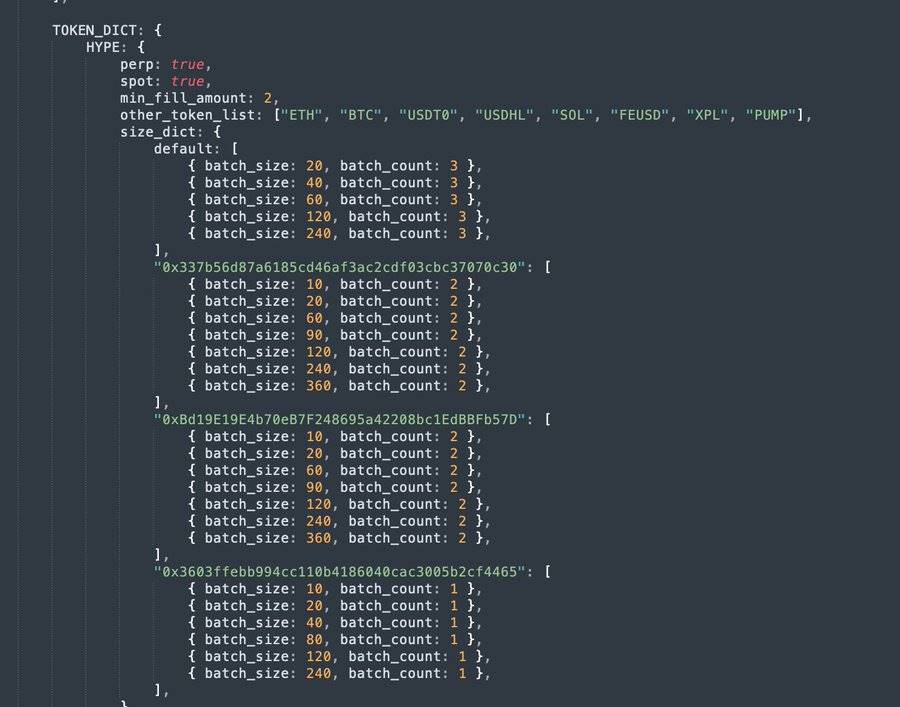
After days of fine-tuning, we've finally avoided most ledger imbalances. Even when imbalances do occur, we immediately employ a TWAP (Time-Weighted Average Price) strategy to quickly balance risk. This change is a game-changer. Meanwhile, our competitors continue to employ only taker strategies, while we've already increased our trading volume to 20 times theirs.
Skip USDT/USDC trading on Hyperliquid
The next challenge is specific to USDT0.
On Hyperliquid, USDC is the top-ranked stablecoin, while on HyperEVM, USDT0 is the top-ranked stablecoin.
The pool with the largest trading volume and the most arbitrage opportunities on HyperEVM is the HYPE-USDT0 pool. However, since we need USDT0 on HyperEVM and USDC on Hyperliquid, we have to execute two transactions on Hyperliquid to balance the two assets.
For example, when the HYPE price increases:
Order Execution → Sell HYPE in exchange for USDC (0% handling fee)
Buy HYPE with USDT0 on HyperEVM
Exchange USDC back to USDT0 as the taker on Hyperliquid (0.0245% handling fee)
But this third step is terrible:
We need to pay the order-taking fee (resulting in reduced profits and reduced competitiveness)
The USDT0/USDC market on Hyperliquid is immature, with wide spreads and inaccurate pricing.
We decided to skip this step whenever possible. To do this, we developed new parameters and logic:
USDC threshold : USDT0→USDC transactions will be skipped only when the USDC balance exceeds 1.2 million.
USDT0 threshold : USDC→USDT0 transactions will be skipped only when the USDT0 balance exceeds 300,000.
Real price information : Request the Cowswap API every minute to obtain the real USDT0/USDC price instead of relying on Hyperliquid's order book.
Introducing perpetual contracts to participate in arbitrage transactions
Before we begin, let me state: in our entire crypto trading career, we’ve almost never used leverage or perpetual contracts (except for one absurdly failed attempt on BitMEX in 2018). Therefore, we have no idea how they work.
However, we noticed that at a certain point in time, the trading volume of HYPE perpetual contracts was much higher than the spot market, and the transaction fees were slightly lower (0.0245% for spot and 0.019% for perpetual contracts).
So, we decided to try incorporating perpetual swaps into our strategy. No other competitors were using perpetual swaps, which meant we weren’t competing with them for the same order book liquidity.
While testing perpetual swaps, we discovered that we could profit from the funding rate and exploit arbitrage opportunities when the HYPE perpetual swap trades at a premium or discount to spot. This is an area that competitors haven’t yet explored.
We designed a new system parameter for this purpose:
Boundary value : Maximum HYPE long/short position size → Avoid liquidation or depletion of USDC/HYPE balance.
Premium/Discount : The current premium or discount of the perpetual contract.
Max Premium/Discount : If the premium is too high, we stop creating long orders and trade in spot instead.
Progressive ROI : As the long/short position increases, we increase our profit requirements to avoid getting into an unfavorable long/short position too quickly.
ROI formula : Dynamically adjusted based on the perpetual contract's premium/discount and position size.
This is the interface for configuring the parameters of a HYPE short position, which looks quite complicated:
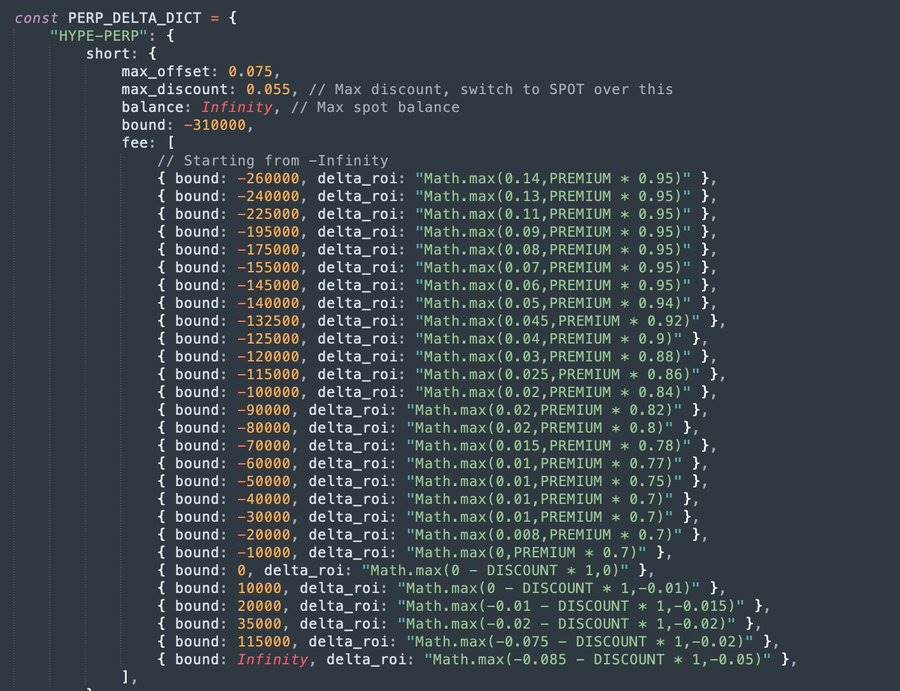
The introduction of perpetual swaps was probably one of our most significant upgrades, earning us around $600,000 USD from funding rates alone, and even more from premium/discount arbitrage opportunities.
About the collaboration and dynamics between the two brothers
Many people ask how we divide the work. I'm often seen as the "talker" on the team, spouting nonsense on Crypto Twitter (I don't deny that), while my brother is considered the "tech geek" who buries himself in code.
But it's more complex than that. Our dynamic is very similar to the collaborative model of Blur's token incentives. With an arbitrage bot like this, you never know what's going to happen. We encounter challenges and problems every day that must be solved quickly. We discuss improvements daily and only act on them when we reach consensus. He writes the code, but also develops tools for me to manage parameters.
I can't code at all, but I know how to configure a robot; he has no idea how to configure a robot, but he can code.
Interestingly, we have very different personalities at work. My brother likes to update frequently and try new features (too frequently, in my opinion), while I tend to be more conservative (too conservative, in his opinion) and prefer to stick with the current version as long as I can "print money."
Typical conversation:
Me (very venomous): “The robot is acting weird… did you change anything???”
Him: “No…uh, maybe I changed a few small things.”
When two people collaborate on a bot without formal enterprise processes, after 250 updates, it can feel like you’ve created something you no longer fully understand or control.
Every time a new update is released, it's difficult to fully anticipate all of its impacts.
Summarize
Over the past eight months, we have been fully committed to the development and optimization of this arbitrage robot. Especially in June, when Wintermute joined the battle with a large amount of liquidity and a "worker army", we felt tremendous pressure.
I remember the five days we spent between Istanbul and Bodrum in July that were supposed to be relaxing but ended up being locked in a room, constantly improving the robot.
We successfully maintained our number one position in the market for 8 months, but as our market share gradually declined in October, we felt it was time to exit.
Final result:
$5 million profit
$12.5 billion in Hyperliquid trading volume
$1.2 million in gas fees paid on HyperEVM (20% of the total since HyperEVM launched)
More than 2,000 hours of hard work
5% of the total Unit trading volume
We look forward to the arrival of Hyperliquid Season 3 and Unit Season 1.
Thanks for reading! I look forward to seeing you all again on new on-chain adventures.