Written by: Charlie.hl, desh_saurabh
Compiled by: Block unicorn
Foreword
The New York Stock Exchange is open five days a week, but only for 6.5 hours each day, representing just 27% of the total weekday trading hours. For the remaining 73% of the time from Monday to Friday, the trading system is idle. How can we solve this problem?
For over 17 hours each workday, we have no way of knowing "how much someone globally is willing to pay for this asset" because the infrastructure for price discovery is deliberately shut down. This creates a paradox at the very core of modern trading: an asset that can be traded anytime is more valuable than a similar asset that can only be traded for six hours—that's the value of liquidity. Being able to open or close positions when information becomes available is valuable, and we'll discuss later the direct losses traders incur when opportunities arise. Yet, we've built a multi-trillion-dollar market in a system that prevents traders from accessing liquidity more than 70% of the time.
The strange thing is, the problem isn't that technology can't support sustained or extended trading hours. The gap between what technology can achieve and how markets actually operate has never been greater. We can connect with someone on the other side of the world instantly and complete peer-to-peer payments in seconds. But if you're chatting with a friend on a Saturday night about Tesla and its future, and your friend wants to buy Tesla stock at 3 a.m., it's simply impossible. It's not because there are no sellers, nor because of a lack of technology to facilitate transactions, but because the mechanisms that allow markets to operate are built on an era where information was transmitted via telegraph and settlement required physical evidence.
This is important because every hour the market closes, information accumulates: earnings reports are released after the market closes, geopolitical events occur overnight, company announcements are released over the weekend, and so on. All of this information has value, and that value is compressed into the first few minutes of the next trading day. The result is price gaps, soaring volatility, and the losses from this inefficiency are not evenly distributed among all market participants, but are primarily borne by traders who lack self-protection tools.
The assumption that markets must close is so deeply ingrained that most participants never question it. Why does the ability to discover the fair price of an asset depend on your time zone or day of the week? The answer reveals a system optimized for limitations from decades ago, a question we will explore in this article, along with solutions for putting price discovery and markets on the blockchain.
Overnight gap problem
The inefficiency of market closures manifests in the data as a persistent and quantifiable drag on returns. Study after study has documented the same anomaly: the majority of gains in the U.S. stock market occur during market closures.
From 1993 to 2018, the cumulative overnight return of the S&P 500 index was on average 2.75 basis points higher than the intraday return per day. Compounded annually, this translates to an annualized difference of approximately 7.2%. That's no small sum.
However, if we focus on a specific time period, the situation becomes more extreme. Between 1993 and 2006, all premiums in the US stock market were generated overnight. If you bought at the close and sold at the open each day, you would capture all the gains. If you bought at the open and sold at the close each day, your gains would be zero or even negative. The market didn't generate any gains during the actual trading hours. All gains accumulated in the price gaps.
Traders have mastered this technique for decades. Strategies that exploit overnight price fluctuations for statistical arbitrage have achieved annualized returns exceeding 51% and Sharpe ratios exceeding 2.38. Between 1998 and 2015 alone, researchers recorded 2,128 overnight gaps in the S&P 500. The consistency and exploitability of this pattern suggests that the market's pricing of risk is inaccurate. If it were accurate, such opportunities wouldn't persist.
Negative gaps are larger and more volatile than positive gaps. When bad news is released after hours, the market overreacts. Overnight price declines far exceed gains, and the standard deviation of negative gaps is significantly higher than that of positive gaps. This creates tail risk that cannot be reflected in intraday trading. If you hold positions overnight, you will face unhedged downside risk due to market closure.
This is not how an efficient market works. In theory, prices should reflect all available information at all times. But in reality, prices only reflect information when the market is open for updates. Market closures create blind spots. Information arrives, but prices cannot adjust in time; by the time the adjustment is complete, the opportunity has passed, and the chance to trade at fair value has disappeared.
The few investors who are able to trade after hours face different problems. After-hours trading accounts for only 11% of total daily trading volume, while overnight trading from 8 p.m. to 4 a.m. accounts for only 0.2% of market activity. This lack of liquidity leads to predictable costs.
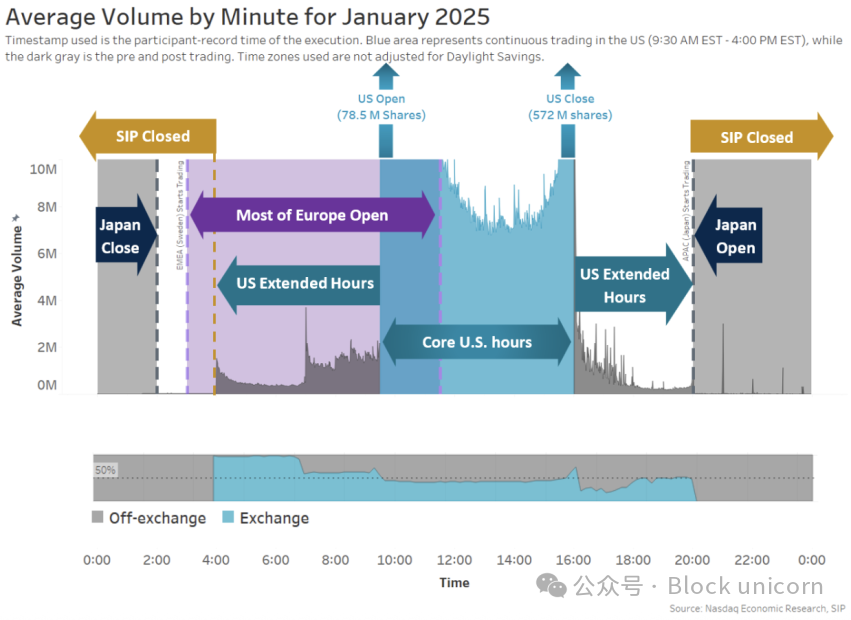
Nasdaq trading volume distribution per minute in January 2025
After trading ceases at the exchange, spreads widen dramatically. For stocks traded overnight, spreads widen by approximately 40% compared to normal trading hours. For less liquid stocks, spreads can inflate to 144%. Market depth for the most actively traded stocks can plummet to 47% of normal levels. As a result, the actual spreads for retail orders executed overnight are three times greater than during the day, and price shocks increase sixfold.
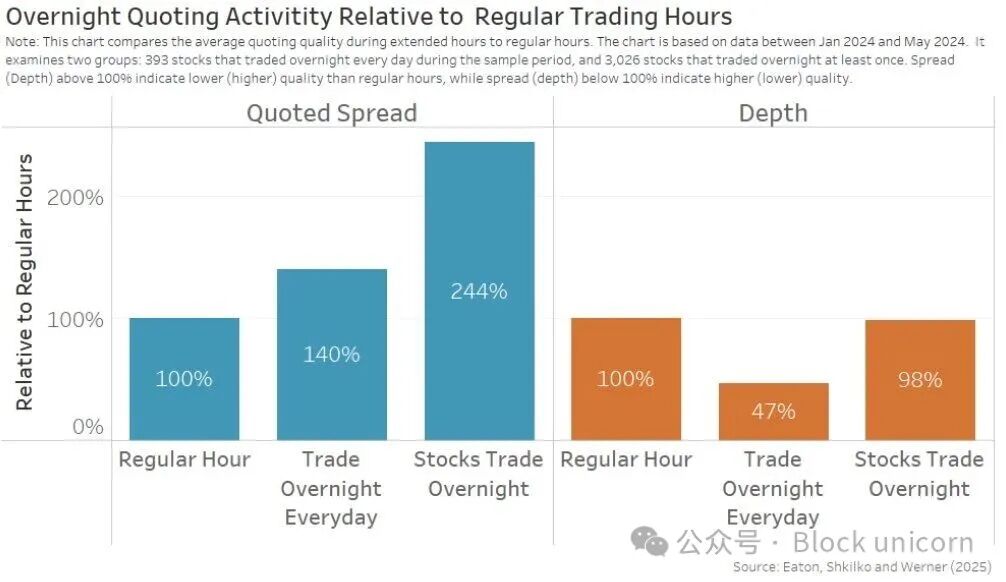
Overnight quote research – Eaton, Shkilko and Werner
Transaction costs also vary significantly. After-hours trading costs four to five times more than during normal trading hours. Most overnight trades are executed at or below the best offer. Who trades in this environment? According to Nasdaq data, approximately 80% of overnight trading volume comes from the Asia-Pacific region, with about half of that coming from South Korea. The remaining 20% is primarily comprised of US retail investors. These retail investors are mostly individual traders trying to respond to information in real time, for which they pay several times the normal trading costs.
Retail investors suffer a double blow from this structural deficiency. They lack adequate pre-market trading infrastructure. They cannot adjust their positions after hours, otherwise they will pay extremely high spreads. When the market gaps down due to overnight news, their positions are adversely affected while they sleep. Professional traders with 24/7 trading infrastructure reap the profits, while retail investors suffer the losses.
The scale of this wealth transfer is quite substantial. Individual investors' average annualized return is 5.2% lower than that of the S&P 500.
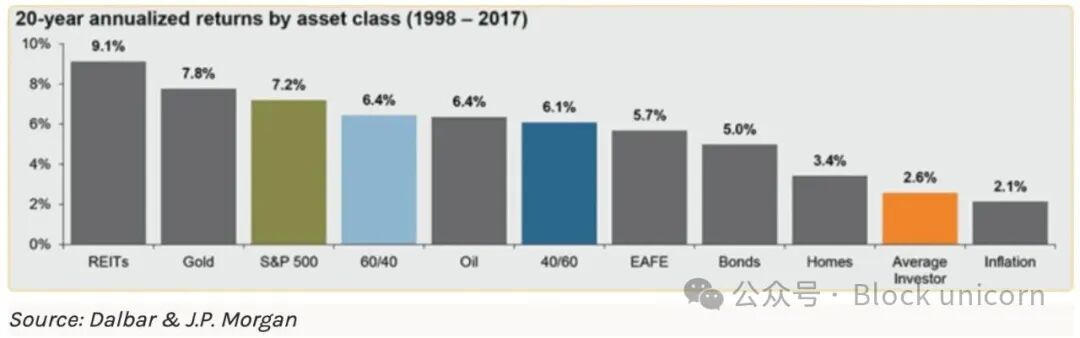
20-year annualized returns for various asset classes – Dalbar and JPMorgan Chase
When overnight yields consistently exceed intraday yields by 7%, retail investors systematically miss out on this premium due to their inability to optimize their portfolios, and the long-term compounding effect is evident. Upon closer examination, this is not merely a matter of market timing or stock-picking skills: it is an inherent structural disadvantage of the market structure itself.
geographical dispersion
Time fragmentation is only one aspect of the problem. Markets are also fragmented spatially. The same asset may trade at different prices in different countries/regions. This is not only because participants in one market have more information than those in another, but also because infrastructure hinders price convergence.
Between 2017 and 2018, Bitcoin traded at an average premium of approximately 10% on Japanese exchanges. We witnessed this phenomenon firsthand in Japanese Bitcoin arbitrage trading conducted by Sam Bankman-Fried before he founded FTX in 2018. This price discrepancy is entirely due to the outdated and disconnected infrastructure in an increasingly interconnected world.
This phenomenon was even more pronounced in South Korea. Between January 2016 and February 2018, the average price of Bitcoin on South Korean exchanges was 4.73% higher than on US exchanges. In January 2018, the premium reached as high as 54%. At the peak of the price, you could buy Bitcoin for $10,000 in the US and sell it for $15,000 in South Korea.
Why does this premium exist? South Korea has strict capital controls, making it very easy for funds to flow in. However, transferring funds out requires compliance with complex regulations designed to prevent money laundering and capital flight. These restrictions make it difficult to profit from price differences on a large scale, even when the opportunity is obvious. For most participants, the infrastructure required for arbitrage simply doesn't exist.
This phenomenon is not unique to cryptocurrencies. Traditional stocks exhibit the same pattern. Dual-listed companies on two exchanges often show a persistent price discrepancy, which can last for months or even years. For example, Royal Dutch Shell's shares listed in Australia and London are priced significantly higher than its shares listed in the UK. Rio Tinto, despite offering shareholders the same dividends and capital gains, has significantly different share prices in Australia and London.
These price differences shouldn't exist. If markets were truly efficient and globally integrated, arbitrageurs would immediately eliminate any price discrepancies, buying low and selling high to profit from the difference.
The reason lies in geographical fragmentation. An investor in Utah cannot buy Indian stocks at 2 a.m. This is not because there are no sellers in India, nor because the asset is unavailable. Buyers want to buy, and sellers want to sell, but the infrastructure does not allow them to connect frequently. Although technology has long since eliminated any technical barriers to instant global trading, markets remain isolated from each other due to geography.
When cryptocurrency trading volumes surged in 2017-2018, the potential arbitrage profits between the US, South Korea, Japan, and Europe exceeded $2 billion. However, the infrastructure at the time couldn't capture these profits. This is the price of fragmentation. Price discovery occurred in isolated regions rather than globally; liquidity was dispersed across various areas, and investors who happened to be in the wrong place at the wrong time had to pay a premium simply because the market refused to recognize the same assets as the same.
The situation is even worse in the private market.
The public markets are closed 73% of the week. The private markets, on the other hand, are never open.
As of June 2023, the assets under management in private equity had ballooned to approximately $13.1 trillion. Companies that once eagerly sought to go public now linger in private hands for a decade or more. The average time from founding to IPO in 1999 has lengthened from four years to over ten years today. By the time retail investors could invest in these companies through the public market, most of the value creation had already occurred behind the scenes.
A secondary market for private equity does exist, but calling it a market would be overly optimistic. Transactions typically take about 45 days to complete. In today's market environment, even the T+2 settlement time in the stock market seems quite fast. Price discovery is achieved through private negotiations between the transacting parties, who may or may not have accurate information about the underlying asset. In June 2024, SpaceX was valued at $210 billion by some secondary market buyers, while just six months earlier, its transaction price was only $180 billion.
Stripe experienced similar volatility. Secondary market trading showed the company's valuation to be between $65 billion and $70 billion, depending on the buyers and the timing of the transactions. Due to the lack of a consistent price discovery mechanism, valuations tend to drift rather than converge.
The cost of this lack of liquidity manifests in persistent discounts. In the first quarter of 2025, the average secondary market price of pre-IPO stocks was 16% lower than the price of their previous funding round. This is the price you have to pay to exit. Due to the inability to trade continuously, each transaction requires forfeiting a considerable amount of value to access your own funds.
More than $50 billion is trapped in pre-IPO companies. The money is invested but cannot be accessed. Valuations are uncertain, and exit timelines are unknown. The existing system simply lacks the infrastructure to make these assets liquid. Investors hold positions they cannot price or sell, watching opportunities slip away while their funds are locked up.
The gap between what technology can achieve and what the private market actually provides is even greater than that of the public stock market. We have the ability to make any asset tradable, achieve continuous price discovery, and eliminate geographical barriers. Yet, we maintain a system where access depends on connections, pricing depends on behind-the-scenes deals, and liquidity depends on the decisions of those in power.
Infrastructure mismatch
Inefficiency persists because infrastructure was not designed to fit the world we live in today.
When the New York Stock Exchange was founded in 1792, settlement required physical certificates. Buyers and sellers needed time to deliver paper documents, verify their authenticity, and record the change of ownership in manual ledgers. The settlement mechanism determined the rhythm of the market. Technology has continuously advanced, but the underlying architecture has remained largely unchanged.
Currently, stock purchases still require two business days for settlement. This is known as T+2, which was shortened from T+3 in September 2017, seemingly a revolutionary improvement from three days to two. Transactions are executed instantly, and your account immediately displays your holdings. However, the actual settlement—the moment when ownership is formally transferred and the transaction is finally completed—requires waiting 48 hours.
Since instant settlement technology has existed for decades, why does this delay persist? Because current systems involve multiple intermediaries, and each additional step adds to the delay. Your broker sends your order to the exchange. The exchange matches buyers and sellers. The transaction information flows to the clearinghouse. The clearinghouse becomes the counterparty to both parties, assuming the risk that either party may fail to deliver. The custodian holds the actual securities. The transfer agent updates the ownership record. Each institution operates its own system according to its own schedule, processing transactions in batches, rather than continuously in real time.
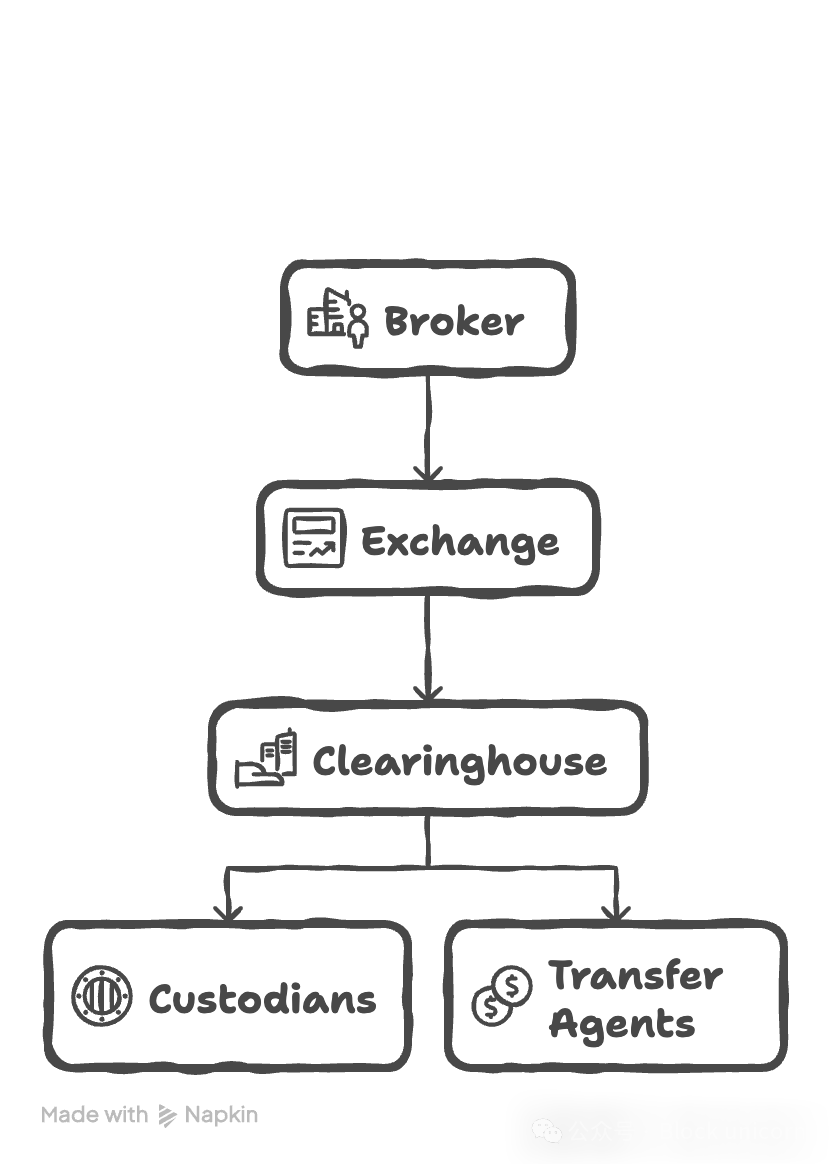
Layered infrastructure
This layering of intermediaries also means a layering of costs. Clearinghouses charge fees, custodians charge fees, transfer agents charge fees. The infrastructure itself extracts value from every transaction. Funds are tied up, funds that could have been used for other purposes. Transactions that should be completed instantly are instead spread over days, passing through multiple intermediaries. The appearance of digital markets masks the fact that settlement still follows a model designed for physical certificates and telegraphic communication.
What would the market look like if settlement were truly instantaneous? What would the market look like if ownership were transferred atomically the instant a transaction was executed? What would the market look like if no intermediaries were needed between buyers and sellers, because the transaction itself was encrypted to guarantee its singleness of completion or failure? The infrastructure to build such a system already exists. The question is not about technological capability, but whether the market will migrate to a path compatible with existing technology.
The architecture of the continuous market
The promise of continuous markets goes far beyond simply extending exchange hours. A truly continuous market fundamentally redefines price discovery, ensuring that trading infrastructure operates continuously, unaffected by business hours, geographical limitations, or settlement delays.
In a sustained market, when news is released at 3:00 AM Eastern Time, the market reacts immediately, rather than accumulating pressure as in traditional markets and then releasing it sharply at the 9:30 AM opening. The overnight gap issue disappears completely because there is no overnight gap.
Settlement is completed almost instantly, unlike the two-day cycle common in traditional infrastructure. Investors' risk exposure is immediately eliminated after they close their positions at 2 PM, instead of requiring 48 hours for final settlement as in traditional markets. This eliminates the risk window where portfolio exposure remains even after trades have been executed. Funds locked in clearinghouse margins can be immediately used for redeployment, rather than sitting idle for days during the settlement cycle.
On-chain infrastructure makes this possible by maintaining a continuously running, globally synchronized ledger. Platforms like Hyperliquid demonstrate the scalability of this technology with sub-second settlement finality and 24/7 operation. Their infrastructure can process hundreds of thousands of orders per second while maintaining complete transparency for each transaction. Participants have access to the same liquidity regardless of location or local time, and transaction settlement is completed through consensus mechanisms, rather than the time-consuming batch processing between intermediaries as in the past.
The key breakthrough lies in replacing the traditional tiered architecture of markets with a unified execution mechanism. Modern exchanges coordinate the operations of brokerages, clearinghouses, and custodians through systems designed for the era of physical stock trading. On-chain systems, however, integrate these layers into a single settlement mechanism, with trade execution and final settlement completed atomically. Ownership of the same transaction matched between buyers and sellers is transferred in a cryptographically final manner.
This possibility alters how markets function. Retail investors can avoid the systemic disadvantage of overnight gaps, while institutional traders can leverage after-hours trading for excess returns. At 10 AM Tokyo time, a Japanese pension fund rebalances its portfolio, with the same liquidity as a hedge fund operating in California at 5 PM Pacific Time; both orders originate from the same global pool of funds. This is precisely the price discovery mechanism we want. Just because someone is in South Korea shouldn't mean they have to pay a 50% premium to buy Bitcoin compared to someone in the US.
Achieving on-chain perpetual price discovery
Existing infrastructure already supports applications beyond crypto-native assets. Tokenization companies like Ondo Finance have created blockchain versions of popular global stocks, including Tesla and Nvidia. These tokenized versions trade 24/7 and settle instantly on-chain, while market makers arbitrage against price discrepancies with traditional exchanges to maintain a 1:1 price match. This arbitrage mechanism keeps the price of tokenized stocks aligned with their off-chain counterparts, but as on-chain liquidity increases and updates outpace traditional markets, the direction of price dominance could reverse. Ultimately, market makers will primarily quote prices based on on-chain pricing, rather than viewing the blockchain market as a derivatives market that follows traditional exchange prices.
This shift completely eliminates the need for centralized ownership databases. Trusted platforms like Fidelity or Charles Schwab can build advisory services and user-friendly front-end interfaces on top of blockchain infrastructure, while the actual asset transactions and settlements take place transparently in the back-end. Tokenized assets become productive capital, serving as collateral in lending markets or for yield strategies, while maintaining continuous tradability and a transparent ownership record accessible to all participants.
Its impact extends far beyond this, reaching areas where transparency is currently even lower than that of public stock markets. The private markets for secondary stocks and pre-IPO assets suffer from information asymmetry, primarily due to geographical location and distance from potential counterparties. Blockchain infrastructure enables global participation in these opaque markets and facilitates continuous price discovery.
Protocols built on the Hyperliquid infrastructure are supporting perpetual futures contracts for both public and private equity. Ventuals offers leveraged perpetual exposure to pre-IPO companies including OpenAI, SpaceX, and Stripe, allowing traders to leverage long and short positions on these privately held assets. Felix Protocol and trade.xyz offer similar perpetual contracts for listed stocks, enabling 24/7 trading, freeing stock trading from exchange trading hours. These stock perpetual contracts settle on-chain and, like crypto-native assets, feature instant finality and transparent execution, eliminating the settlement delays and geographical limitations common in traditional stock derivatives.
Currently, these platforms use oracle systems to aggregate price data from various off-chain sources before uploading this information to the blockchain for settlement. For pre-IPO assets, oracles integrate fragmented information from secondary markets, tender offers, and recent funding rounds to establish a reference price. For listed stocks, oracles obtain prices from traditional exchanges during trading hours and run a more self-referential pricing system during non-trading hours. However, as more stock trading migrates to on-chain execution at the first level, these oracle systems will become less necessary. The on-chain order book itself will provide continuous price discovery, and perpetual contract platforms can directly provide leveraged exposure based on this transparent price data.
These applications share a common architecture. Traditional markets suffer from fragmented liquidity due to time zones, access restrictions based on geolocation or authentication status, and delayed settlements through multi-party coordination processes. On-chain trading infrastructure unifies liquidity globally, providing open access to any participant with a network connection and enabling atomic settlement through cryptographic consensus. As a result, assets that previously could only be traded sporadically through opaque bilateral negotiations or limited trading hours can now achieve continuous price discovery.
Market makers provide continuous liquidity throughout all trading sessions, rather than withdrawing during periods of market volatility or scheduled maintenance windows. This infrastructure maintains order book depth across all trading sessions, rather than allowing it to decrease when regional participation declines. As competition intensifies among global participants, bid-ask spreads narrow, and isolated trading windows are avoided.
These functionalities already exist and operate at a considerable scale. The infrastructure handles hundreds of billions of dollars in trading volume monthly while maintaining sub-second settlement and continuous uptime. Extending this architecture from crypto-native assets to tokenized stocks, and ultimately to private market instruments, requires primarily regulatory adjustments rather than technological innovation. This technology demonstrates that markets can function as a unified global mechanism, rather than a collection of regional exchanges operating on a set schedule.
Continuous markets eliminate the artificial limitations of traditional infrastructure on price discovery. They replace fragmented regional trading sessions with perpetual global access, multi-day settlement cycles with instant settlement, and opaque private negotiations with transparent order books. This technology is now ubiquitous and operational, demonstrating that markets no longer need to be closed and assets no longer need to be traded in secret. It brings price discovery on-chain.