Pakistan and global cryptocurrency exchange Binance signed a memorandum of understanding (MoU) on Friday to explore how to "tokenize" up to $2 billion in sovereign bonds, treasury bills, and commodity reserves.
Article author and source: Arab News
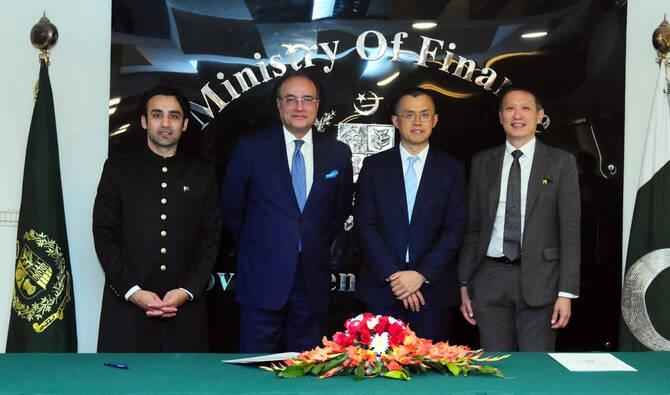
(From left to right) Bilal Bin Saqib, Chairman of the Virtual Asset Regulatory Authority of Pakistan (PVARA), Muhammad Aurangzeb, Minister of Finance of Pakistan, CZ, CEO of Binance, and Richard Teng, Co-CEO of Binance, pose for a group photo after signing a Memorandum of Understanding (MoU) at the Ministry of Finance in Islamabad, Pakistan on December 12, 2025.
Pakistan's Ministry of Finance said on Friday that Pakistan has signed a Memorandum of Understanding (MoU) with global cryptocurrency exchange Binance to explore how to "tokenize" up to $2 billion of sovereign bonds, treasury bills, and commodity reserves to improve liquidity and attract investors.
This development occurred hours after the Pakistan Virtual Assets Regulatory Authority (PVARA) issued No Dispute Certificates (NOCs) to Binance and HTX.
The Ministry of Finance stated that "the memorandum of understanding establishes a framework for cooperation to explore the tokenization and blockchain-based distribution of Pakistan's real-world and sovereign assets, including government bonds, treasury bills, commodity reserves, and other federal government-owned assets."
The Treasury Department added that "subject to compliance with applicable laws, policies and regulatory approvals, the project could involve up to $2 billion in assets, with the aim of improving liquidity, transparency and access to international markets."
According to the memorandum of understanding, Binance and its affiliates will provide technical expertise, advisory support, training and capacity building to assist Pakistan in assessing a modern, compliant blockchain infrastructure.
The Ministry of Finance further stated that this cooperation aims to explore a secure and transparent digital platform to promote broader participation from international investors, while fully respecting Pakistan's regulatory framework and national sovereign control.
Finance Minister Muhammad Aurangzeb described the agreement as a strong signal of Pakistan's reform process.
He said, "Our next step is implementation, and we are committed to delivering results with high speed and high quality."
Issue No Dispute Certificates (NOCs) to Binance and HTX.
Previously, PVARA had issued no-objection certificates to HTX and Binance. The regulator stated that this move was made after conducting a review process with public sector stakeholders, focusing on corporate governance structures, compliance frameworks, risk management controls, and their consistency with emerging virtual asset regulatory requirements in Pakistan.
Pakistan is pushing for regulation of its rapidly growing crypto and digital asset market by bringing Virtual Asset Service Providers (VASPs) under a formal licensing regime. Officials say the move aims to curb illicit trading, strengthen oversight, and encourage innovation in blockchain-based financial services.
PVARA stated that the relevant no-objection certificate allows Binance and HTX to conduct preparatory and contact activities in Pakistan under clear regulatory supervision, but this does not constitute a full operating license.
The no-dispute proof also allows Binance and HTX to register as reporting entities on FMU goAML, Pakistan's anti-money laundering reporting platform. Exchanges can also engage with the Securities and Exchange Commission of Pakistan (SECP) to establish subsidiaries locally.
PVARA stated that once the relevant licensing regulations are officially issued, HTX and Binance can prepare and submit a complete VASP license application and provide registered anti-money laundering (AML) related services after completing goAML registration.
The regulator stated that "as the regulatory framework enters its next phase, PVARA will continue to communicate and collaborate with domestic and international stakeholders."