
Marcos Viriato, CEO of Parfin, said, "We are targeting the digital won and RWA tokenization markets... We are exploring partnerships with KB Kookmin Bank and Shinhan Bank."
Brazilian CBDC privacy solutions provider Drex announces full-scale entry into the Asian market.
);)
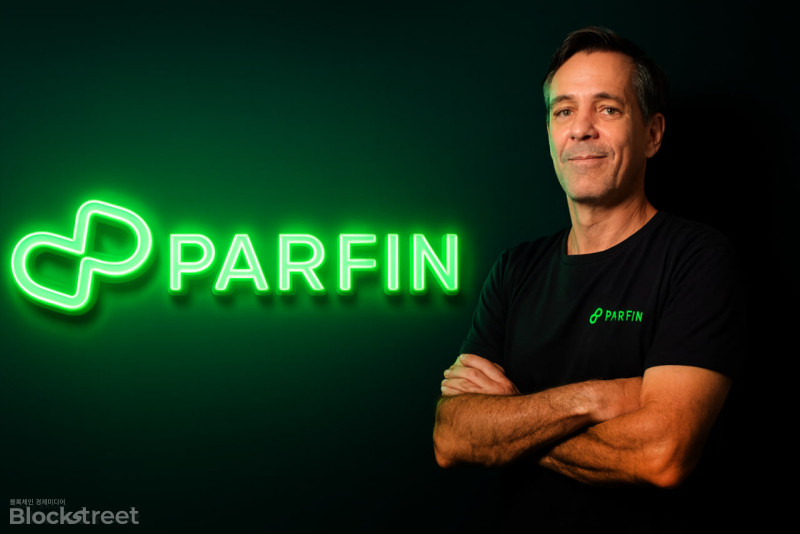
Marcos Viriato, CEO of Parfin, a key privacy solutions provider for Brazil's Central Bank Digital Currency (CBDC) project, officially announced plans to enter the Korean market in the first quarter of next year in an exclusive interview with Blockstreet. "Our goal is to build strong partnerships with Korean financial institutions and secure a local presence," Viriato said, revealing a detailed roadmap for entering the market.
Brazil's CBDC experience can be applied to the development of a digital won.
With the Bank of Korea deciding to resume its temporarily suspended "CBDC (Central Bank Digital Currency) testing" next year, Parfin is ready to apply the technological expertise it has accumulated from the Brazil-based Drex project to the Korean market. CEO Birriato offered three key lessons for Korea's digital won development.
"First, we need to focus on simple use cases. South Korea's focus on tokenized deposits for retail payments and wholesale CBDC for interbank settlements is an excellent choice. This provides a solid foundation for expansion into diverse use cases in the future."
Second, he emphasized the need to clearly define the outcomes of privacy solutions. "It must be clear whether all transactions and data will be completely private, or whether selective disclosure is required." Third, he advised that scalability metrics, such as transactions per second (TPS) and the number of concurrent transfers, should be defined in advance.
Rails Blockchain Removes Regulatory Barriers for Korean Institutional Investors
Rails, developed by Parfin, is a permissioned Ethereum Virtual Machine (EVM)-compatible blockchain that serves as a bridge between traditional finance (TradFi) and decentralized finance (DeFi). Parfin's solution to regulatory compliance, a key barrier to entry for Korean institutional investors in the cryptocurrency market, operates on three levels.
First, banks and financial institutions can install "Rayls Privacy Nodes" in their own clouds or data centers, gaining complete control over their infrastructure. This allows them to protect customer data and manage asset custody in full regulatory compliance.
Second, Rails' Enygma privacy-preserving protocol allows banks and customers to keep transaction data private to network participants, while still allowing regulators to audit and inspect transaction history when necessary.
Third, Rails' built-in attestation services allow banks and institutions to verify that a specific wallet has passed KYC (Know Your Customer) without disclosing any data, and to conduct various compliance verifications, such as whether a customer is eligible to trade specific assets.
Potential for collaboration with Korean financial institutions... "We will demonstrate this with real-world examples."
At a time when major Korean financial institutions, including KB Kookmin Bank and Shinhan Bank, are actively considering adopting blockchain solutions, Parfin's entry into Korea signals a notable shift in the market.
CEO Biriato emphasized, "Our experience in conducting actual production projects with the Central Bank of Brazil and several major banks around the world will be invaluable in accelerating the project development of Korean financial institutions and effectively providing new products and services to customers."
“Rails plans to establish strong partnerships and a local presence in Korea in the first quarter of 2026,” he said. “Our goal is to demonstrate already implemented use cases to local institutions and secure the first real-world use cases in Korea.”
Targeting the RWA tokenization market... "Seamless bridging between private and public chains."
Parfin also presented a differentiated approach to the rapidly emerging real-world asset (RWA) tokenization market, which recently received regulatory sandbox approval in Korea.
"The combination of the Rails Privacy Network and the upcoming Rails public mainnet provides a very powerful design for financial institutions," said Biriato, explaining that financial institutions can internally tokenize assets and distribute them to their customers frictionlessly, and then seamlessly bridge these assets to public chains when external liquidity is needed.
In particular, it was emphasized that the Enigma Privacy Protocol allows for transactions between institutions to be conducted with complete privacy, thereby protecting customer data and transaction details.
Converging AI and Blockchain... "Focusing on Real Solutions Amidst Hype"
Regarding the intersection of AI and blockchain, a topic of great interest to Korean virtual asset investors, CEO Biriato expressed a cautious yet specific position.
"While there's a lot of hype surrounding the convergence of AI and blockchain, some solutions hold promise, including pre-transaction validation, wallet screening, portfolio optimization, and on-chain credit scoring."
He added that Parfin is focusing on AI capabilities that provide real value and is reflecting this in its roadmap.
Simultaneously implementing institutional-level security and regulatory transparency
In response to privacy and security concerns, which are paramount to Korean institutional investors following several major cryptocurrency incidents in Asia, Rails addresses them with a four-step approach: ▲Confidentiality ▲Regulatory Transparency ▲Security ▲Compliance Automation.
"The biggest opportunity in the next 2-3 years will be the convergence of TradFi and DeFi."
CEO Biriato sees the greatest growth opportunity for institutional cryptocurrency adoption in Asia over the next two to three years at the intersection of traditional and decentralized finance.
"Financial institutions and banks will tokenize assets, launch DeFi tools for lending and borrowing, collateral vaults, and on-chain forex trading using AMMs. This is what Parfin and Rails are building."
He predicted that Korean investors would have a much wider range of new asset options available on-chain, which would boost digital asset adoption.
Parfin's entry into Korea is seen as more than simply a market expansion for a foreign company. It represents an opportunity for the proven technology from the Brazilian CBDC project to directly contribute to the advancement of Korea's digital financial infrastructure. The industry is paying close attention to Parfin's technological capabilities, which perfectly align with three megatrends in the Korean market: the development of the digital won, the expansion of the regulatory sandbox for RWA tokenization, and the acceleration of institutional investor entry into the cryptocurrency market. This is expected to be a major inflection point for the Korean blockchain market in 2026.
Joohoon Choi joohoon@blockstreet.co.kr