Over the past year, a puzzling phenomenon has been spreading within OpenAI: even though ChatGPT has launched the “most powerful brain” that can win gold medals in the International Mathematical Olympiad and top programming competitions, ordinary users do not seem to be buying it .
According to foreign media reports and data released by OpenAI in September, most users of ChatGPT may only ask fairly simple questions and do not need to use those inference models that consume huge computing resources and require half a minute of "thinking".
This glaring data points to a profound crisis hidden beneath OpenAI's peak: a strategic expansion personally driven by CEO Sam Altman is triggering a serious deep crisis, including organizational fragmentation, resource dispersion due to multi-front operations, and a serious disconnect between its technology roadmap and user needs, which is dragging its flagship product ChatGPT into a competitive quagmire.
01
The core contradiction: the gap between cutting-edge research and the "performance overkill" of public needs.
OpenAI’s core conflict stems from the growing divergence of goals between its research department and product team.
An independent research team of over a thousand people within the company has recently focused its efforts on pursuing the ultimate goal of "inference models" and "artificial general intelligence" (AGI). While such models can excel at solving complex mathematical and scientific problems, they come at the cost of high computational costs and slow response times, with processing a single problem potentially taking several seconds or even minutes.
However, this is severely out of sync with the needs of ChatGPT's hundreds of millions of mainstream users. As Peter Gostef, head of AI evaluation agency LMAreena, said, "OpenAI focuses on 'science, math benchmarks, cutting-edge mathematics, and programming competitions,' but this doesn't seem to match the typical ChatGPT user." He pointed out that "most ChatGPT users probably only ask very simple questions, such as movie ratings or everyday inquiries, 'which don't require the model to think for half an hour at all.'"
This "performance overkill" directly led to setbacks at the product level. In early 2025 , when OpenAI attempted to convert its state-of-the-art inference model into a version usable by ChatGPT, its performance "unexpectedly deteriorated." Even after being embedded in forms such as "thinking mode," it was only frequently used by a very small minority of its nearly 900 million weekly active users.
Even more embarrassingly, OpenAI discovered that even traditional non-inference models, when integrated into the ChatGPT product, may experience performance degradation due to conflicts with features such as "personalization".
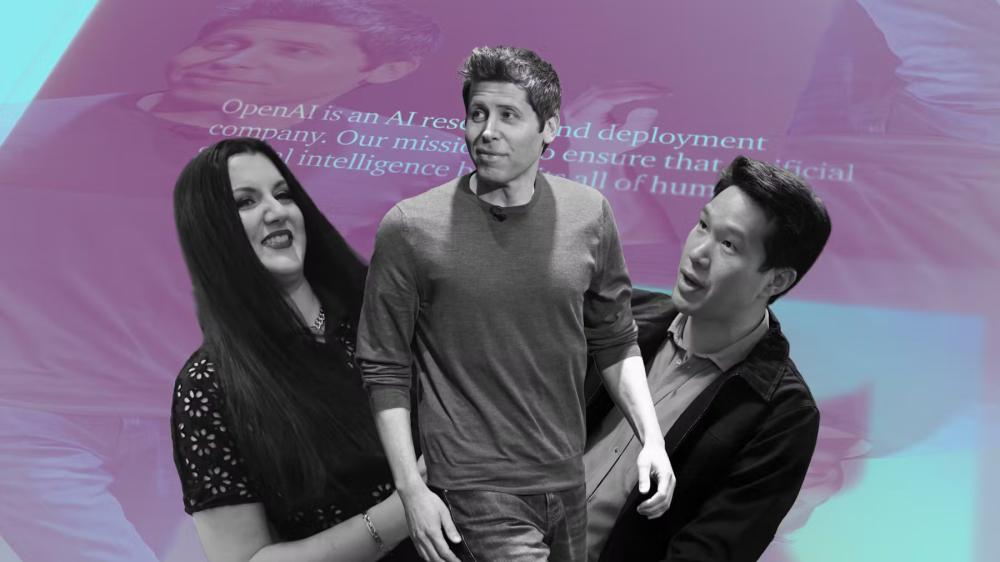
Photo: From left to right: Figgi Seymour, CEO of OpenAI Applications Division; Altman, CEO; and Mark Chen, Chief Research Officer.
02
Multi-front warfare: Ultraman's "imperial ambitions" and ChatGPT's internal resource consumption.
While facing a user experience gap in its core products, Ultraman launched a dazzling "multi-front campaign." In addition to ChatGPT, he simultaneously advanced a series of ambitious projects, including Sora video generation, music AI, AI web browser, AI intelligent agent, consumer hardware devices, and robots.
These parallel new projects have continuously diverted key resources that should have been concentrated on ChatGPT. Several OpenAI researchers have confirmed that the development of some new directions has objectively weakened the investment in improving ChatGPT's appeal to a wider audience. The result is a rather ironic situation: while external competition is becoming increasingly fierce, OpenAI's core revenue engine is gradually "bleeding" due to internal resource competition.
Even Figi Simo, the CEO in charge of applications and product lines, had to admit that at OpenAI, "the product itself is not the end goal." The company's culture and decision-making are still deeply dominated by a "research-first" DNA.
This fragmented strategy is particularly vulnerable when facing Google's fierce counterattack. Google, with its vast product ecosystem (Gmail, Chrome, YouTube, and billions of user entry points), is seamlessly integrating AI capabilities into users' existing workflows. As analysts have noted, users are turning to Gemini "not just because its model is better, but because they've discovered this capability is already integrated into everything." In contrast, ChatGPT remains largely a standalone tool requiring active user access, facing significant costs associated with migrating user habits .
OpenAI's wavering on image generation capabilities is a microcosm of internal strategic incoordination. Earlier in 2025, the company temporarily de-prioritized image generation, only hastily refocusing after Google released the wildly popular Nano Banana image generator in August. According to employees, this even sparked a disagreement between Altman and research director Mark Chen. This "catch-up" response exposes the decision-making lag and passivity resulting from operating on multiple fronts.
03
The growth paradox: the race between slowing user growth and monetization.
OpenAI is facing a critical growth inflection point. The company set an ambitious goal at the beginning of the year to reach 1 billion weekly active users, but as of early December, its user base was "less than 900 million," indicating that its user growth is slowing significantly.
However, in stark contrast to the slowing user growth, OpenAI has made remarkable progress in monetization. Its annualized revenue has surged from $6 billion in January to over $19 billion currently, primarily driven by subscriptions from individual and enterprise users. This financial performance puts it on track to achieve its year-end target of $20 billion in annualized revenue, set in August, and surpass its 2025 revenue forecast of $13 billion. Based on this, the company is seeking funding at a valuation of $750 billion, 50% higher than two months ago.
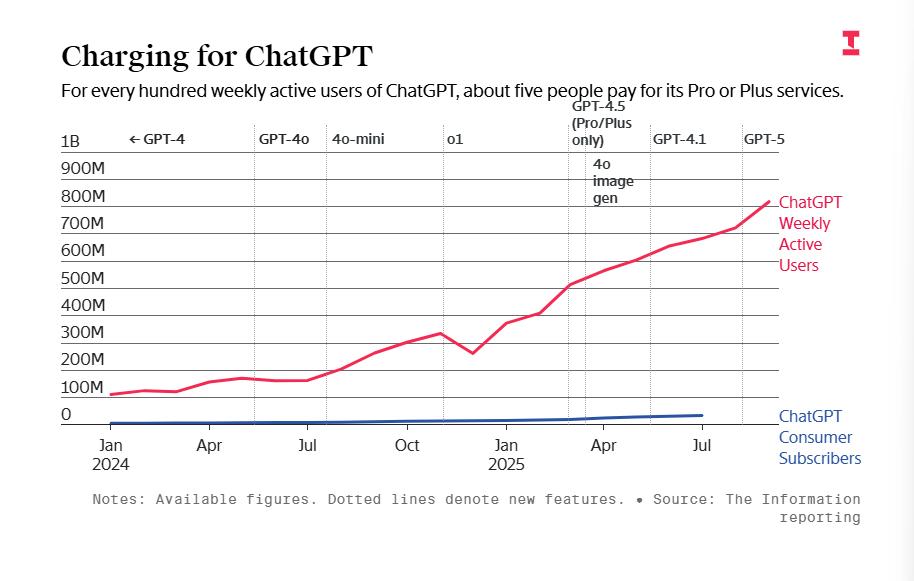
Figure: Approximately 5 out of every 100 weekly active users of ChatGPT subscribe to its Pro or Plus service.
However, to achieve OpenAI's $200 billion revenue vision for 2030, the company must convert weekly active users into daily active users to create more monetization opportunities. This includes advertising within sales plans or taking a cut from transactions facilitated by chatbots.
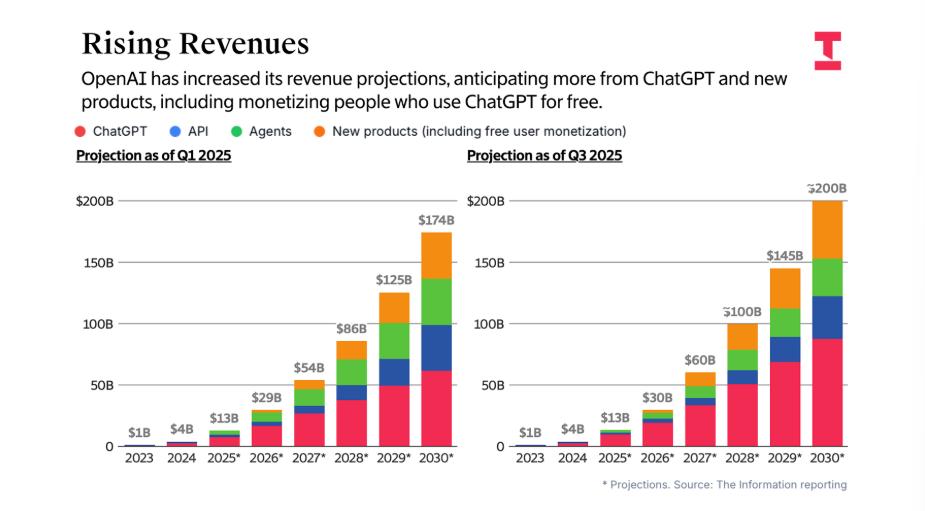
Figure: OpenAI projects its revenue will reach $200 billion by 2030.
While an OpenAI spokesperson claims ChatGPT accounts for approximately 70% of global assistant usage and is the most downloaded free app on the Apple App Store, its growth model reveals a deep-seated contradiction: commercial success may come at the cost of slower user growth. Its strategy of focusing on generating high subscription revenue from existing users may be hindering further expansion of its user base.
Furthermore, as competitors such as Google Gemini rapidly advance in user scale and ecosystem integration, if OpenAI cannot effectively address the issue of stagnant user growth, its short-term impressive financial data may conceal a long-term crisis of hitting a market ceiling.
04
Competitive Encirclement: Google's Counterattack and Ecosystem Disadvantages
The current view on whether ChatGPT can replace Google Search is in stark contrast to the mainstream expectation one or two years ago.
At the time, executives at both OpenAI and Google believed that ChatGPT could effectively replace traditional search engines. However, Google quickly integrated AI-generated answer summaries at the top of search results. According to a company report in October 2023, this feature was driving meaningful search growth and revenue increases because "users are increasingly realizing that Google can answer more types of questions."
Google's counterattacks in other areas were equally precise and lethal. In 2025, its Gemini experienced rapid growth: monthly active users increased from 450 million in July to 650 million, and website visits grew by 14.3% in a single month, while ChatGPT's visits declined for two consecutive months during the same period. More importantly, Gemini's average session duration surpassed ChatGPT's since September.
Google's success stems not only from model performance. Its Nano Banana Pro image generator became a social media sensation for producing "readable and context-aware text," while the Gemini 3 has garnered widespread acclaim for its performance on complex business problems, writing, and coding. Analysts point out that users are turning to Gemini "not just because the model is better, but because they've discovered this capability is integrated into everything."

Image: A picture generated by Google's Nano Banana model
In contrast, OpenAI's ecosystem is clearly at a disadvantage. Former employees warn that if Google surpasses OpenAI in raw performance, or even offers Gemini for free, it could simultaneously kill OpenAI's API and consumer subscription businesses. Although OpenAI is building its ecosystem through partnerships with Disney and the hiring of former Apple design chief Jony Ive, its hardware devices won't be available for "within two years," and the window of opportunity is narrowing.
05
The next "red alert" might hit Apple.
Faced with the crisis, Ultraman sounded the "Code Red" alert in December. He explicitly demanded that resources be refocused on ChatGPT and its core foundation, such as its reasoning capabilities, and postponed short-term profit-generating projects such as advertising and expanding e-commerce. He hoped to turn the tide with a major product update by the end of January next year.
At the same time, OpenAI quickly launched a series of countermeasures:
GPT-5.2 (internal codename Garlic) was released, regaining the top spot on multiple AI model performance benchmarks.
Introducing a new image generation model in response to competition from Google's Nano Banana.
The fallback model routing system allows free users to default to the faster GPT-5.2 Instant.
However, these measures exposed deeper problems. The model routing system was withdrawn after only four months because it significantly increased costs by raising the percentage of free users using the inference model from less than 1% to 7%, while its slow response time negatively impacted daily active users. This once again proves that purely technical upgrades do not necessarily lead to product success.
In fact, this is not the first time OpenAI has issued a "code red" alert. Chief Research Officer Mark Chen revealed that the company has used this mechanism many times, but this time, the eight-week duration is a "longer" emergency than before.
Previously, this mechanism had been used to address competitive threats ranging from DeepSeek to Anthropic's release of Claude. However, Altman's ambitions mean that the company may face many more moments in the future that require raising the alarm.
The current eight-week "Code Red" initiative focuses on countering competition from Google, but this may only be the prelude to a larger-scale industry conflict. While consolidating its software and model advantages, Altman has begun to lay out a more ambitious hardware strategy, indicating that OpenAI may directly clash with another consumer electronics giant, Apple.
Altman is a firm believer in the crucial role of hardware in the popularization of AI. He has publicly set a highly disruptive goal: to develop an OpenAI device that will replace smartphones as the new standard for what people carry with them. To achieve this vision, in May of this year, he hired Jony Ive, the former design luminary of Apple, and acquired his startup to jointly create the next generation of AI hardware.
It is foreseeable that, just as Google is launching a fierce counterattack against OpenAI at the software level, Apple will certainly not sit idly by and watch a challenger rise in the hardware field, which it considers its core. This upcoming hardware battle will not only be a contest of product features, but also a struggle for the right to define the next generation of human-computer interaction paradigms.
06
Future Mystery: A Survival Battle That Is Not Yet Over
Besides technology and product performance, OpenAI also faces other challenges:
Financially, while OpenAI projects annualized revenue exceeding $19 billion, the company is "burning billions of dollars in cash annually" to cover staggering computing costs. Its planned $1.4 trillion infrastructure investment is astronomical, making it imperative for ChatGPT to generate larger and more stable cash flows.
In the ecosystem arena, compared to giants like Google, Microsoft, and Apple with their mature software and hardware ecosystems, OpenAI is essentially still a "model company." It's attempting to build its ecosystem through partnerships with Disney and hiring a former Apple design chief to develop hardware, but this takes time, and its competitors won't wait.
In the lucrative enterprise customer market, OpenAI also appears to be losing more market share, with its share dropping to 27% according to a recent report by Menlo Ventures, while Gemini has risen to 21%, and Anthropic leads with a 40% share.
A review of OpenAI's strategy reveals its core problem: after gaining a first-mover advantage through a technological blitzkrieg, it failed to efficiently and focusedly transform this technological advantage into sustainable product advantages and a user experience moat . Altman's simultaneous pursuit of AGI, hardware ambitions, and a diverse product ecosystem led to a dispersion of resources in key battles. Furthermore, its pursuit of ultimate "inference" performance mismatched with the mass market's core needs for "instantaneous, reliable, and easy-to-use" solutions, resulting in a "performance overkill" trap.
The "Code Red" was an emergency measure to stem the bleeding and a strategic retreat, but ChatGPT's quagmire is far from over. The fundamental question OpenAI needs to answer is: Is it a laboratory with AGI research as its ultimate mission, or a company aiming to win the AI product market? The answer to this question will determine whether it can weather the storm of giants and hold onto the era it pioneered.
As the history of Silicon Valley has shown, the battle between innovators and established giants often results in a winner-takes-all scenario, while the loser becomes nothing more than a footnote in history. OpenAI is standing at such a crossroads that will determine its fate.
(Jin Lu, a special translator for Tencent Technology, also contributed to this article.)
This article is from the WeChat official account "Tencent Technology" , author: Lu Lu, editor: Xu Qingyang, and published with authorization from 36Kr.