
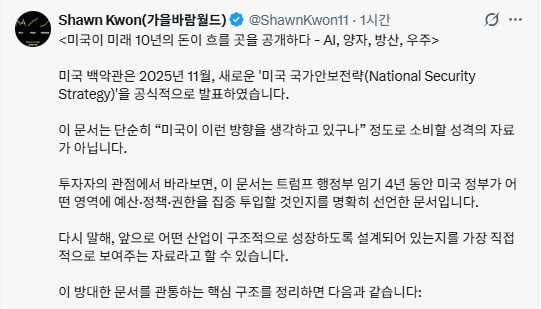
(Source: Autumn Wind World) In November 2025, the White House officially released the new "US National Security Strategy." This document isn't something to be consumed simply as a "this is the direction the US is thinking." From an investor's perspective, this document clearly states where the US government will focus its budget, policies, and authority during the four years of the Trump administration. In other words, it is the most direct document showing which industries are designed for structural growth in the future. The core structure that runs through this extensive document is summarized as follows: <2025 US National Security Strategy - Structural Key Summary> First, the "America First" principle has once again become the absolute standard for policy. The document clearly demonstrates that America's national interests will be the top priority across diplomacy, security, and the economy. It also aims to minimize unnecessary foreign interventions and protracted conflicts, while maintaining a stronger military deterrence and technological edge. Second, the focus of military power shifts to "modernized deterrence" and a "nationwide defense system." The modernization of nuclear forces and the reorganization of strategic assets are emphasized, and the establishment of a nationwide integrated missile defense system, dubbed "Golden Dome," has been officially announced. This is not a single weapon system, but a massive system designated as the top priority of America's security strategy for the next 10 to 20 years. Third, the approach to borders, immigration, and transnational threats will fundamentally change. The document explicitly states that "the era of mass immigration is over," implying a significant strengthening of physical and technological measures against illegal immigration, drug cartels, human trafficking, terrorist organizations, and overseas spy networks. Fourth, economic security is no longer a secondary concept but is defined as national security in its own right. Reshoring, the return of manufacturing to the United States, and supply chain independence were presented as key goals. In the energy sector, a comprehensive "Energy Dominance" strategy encompassing oil, gas, coal, and nuclear power was declared. Excessive reliance on specific countries, particularly China, for technology, resources, and supply chains was identified as a clear security risk. Fifth, the core of the technological hegemony competition is clearly condensed into three key points. The document explicitly states: "AI, biotech, and quantum computing standards must be driven by the United States." This is not simply a statement of technological advancement; it is a strategic declaration that the United States will lead the "standards" for AI, biotech, and quantum technologies. Dominating standards means dominating the market, dictating the technological choices of allies, and structurally blocking the entry of competitors. Sixth, the comprehensive reconstruction of the Defense Industrial Base will begin in earnest. The need for next-generation weapons systems capable of low cost, mass production, and rapid deployment, moving beyond high-cost, low-efficiency weapon systems, is repeatedly emphasized. The defense supply chain is being reorganized around the United States, with limited sharing with allies. Seventh, the defense cost-sharing structure among allies will fundamentally change. The goal of NATO member states spending 5% of their GDP on defense, known as the "Hague Commitment," has been clarified. The United States will reduce its excessive burden and encourage allies to shoulder a greater share of regional defense responsibilities. Eighth, China is defined as a "long-term competitor," not a short-term variable. Continued competition across the economic, military, and technological axes is predicated on supply chain restructuring, blocking technology outflows, and securing strategic minerals. This axes include maintaining the Taiwan status quo, denying access to the First and Second Island Chains, and strengthening cooperation with the Quad (India, Japan, and Australia). Ninth, strategic priorities in the Middle East will be adjusted. The Middle East is no longer a top security priority, and the burden of military intervention will be reduced, shifting to a management strategy centered on energy, investment, and diplomacy. The expansion of the Abraham Accords and the achievements of striking Iranian nuclear facilities are mentioned. Tenth, the Americas are redefined through a "Trump-style Monroe Doctrine." Key priorities include blocking external powers like China and Russia from entering the Americas, eliminating cartels and illegal immigration, and jointly establishing industrial and energy supply chains with Latin America. First, the essence of hegemonic competition has shifted from "military power" to "technological power." The message repeated throughout the document is clear: technological power is national security, and national security is economic power. In particular, AI, bio, and quantum are defined as core strategic technologies upon which the United States must maintain its edge. Second, these three industries will grow not through "market logic," but through "national design." The United States will directly establish standards, disseminate them globally, and demand their adoption by allies. This means that it is not a naturally growing industry, but rather one fostered by policy. Third, Golden Dome is not a defense project, but a technology integration platform. For this system to function, AI-based judgment, satellite networks, quantum sensing, quantum-resistant cryptography, and data and communications infrastructure are simultaneously required. In other words, defense, AI, quantum, and space are integrated into a single structure. Fourth, geopolitics no longer functions as an investment risk, but as an investment opportunity. The United States is redefining conflict as an arena for economic and technological competition, rather than military conflict. Reshoring, energy independence, and technological blocs are providing strong growth momentum to specific industries. Fifth, the United States is returning to being a domestically-centered industrial nation. A clear structure has emerged: reducing dependence on China and fostering American companies across all sectors, including manufacturing, energy, technology, defense, and minerals. Sixth, future warfare is a war of computing and algorithms. Cyber warfare, autonomous weapons, AI command, quantum security, and space surveillance. The outcome of war hinges on computing power and data. Seventh, the real crux is the "technology standards war." AI, quantum, and biotechnology. The country that dominates the standards in these three areas will set the rules for the global economy. Eighth, the world is being reorganized into two technological blocs: the American technological sphere and the Chinese technological sphere. Companies within the American technological bloc are highly likely to enter a period of structural growth lasting more than a decade. Ninth, the essence of the American economy is once again confirmed: a technological powerhouse, an energy powerhouse, and a defense powerhouse. Companies at the center of these three pillars will function as national strategic infrastructure. Tenth, companies necessary for national security are ultimately nurtured by the state. Government contracts, research funding, tax benefits, military needs, and international expansion. All these resources are concentrated in specific companies. This document is not a simple outlook report. It is a national growth map designing the next 10 years. AI, bio, quantum, defense, energy, space. These six areas are not a matter of choice, but of structure, and the companies at the center of this structure will become strategic infrastructure protected and expanded by the state. Therefore, this document can be considered the clearest and most powerful map of the future for investors. Therefore, investors who carefully plan their investment strategies in line with these megatrends will be able to achieve strong performance over the next decade. www.whitehouse.gov/wp-content/...
This article is machine translated
Show original
Sector:

Telegram
Disclaimer: The content above is only the author's opinion which does not represent any position of Followin, and is not intended as, and shall not be understood or construed as, investment advice from Followin.
Like
Add to Favorites
Comments
Share
Relevant content