This article is machine translated
Show original
Seeing Ma Boyong share his diary-writing method was very interesting!
And it's quite similar to Karpathy's recording method, which I shared before.
This method can be well integrated with AI, and I'd like to try it out in 2026.
Let me first introduce how they both recorded:
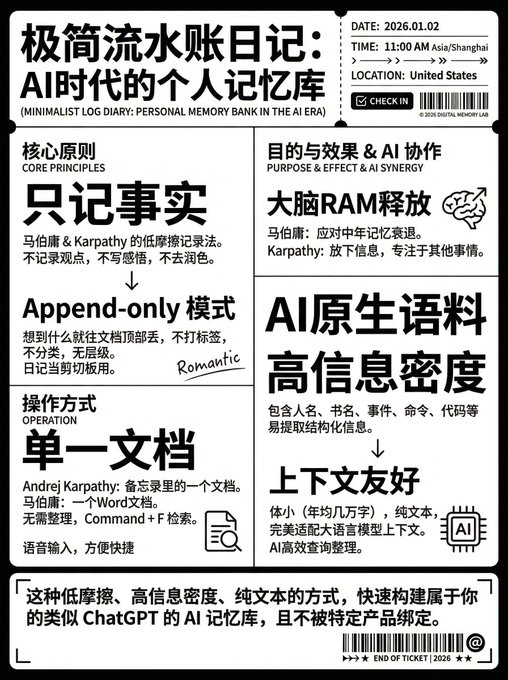
To reduce friction, he only recorded facts (basically a diary entry), without recording opinions, reflections, embellishments, or worrying about word choice.
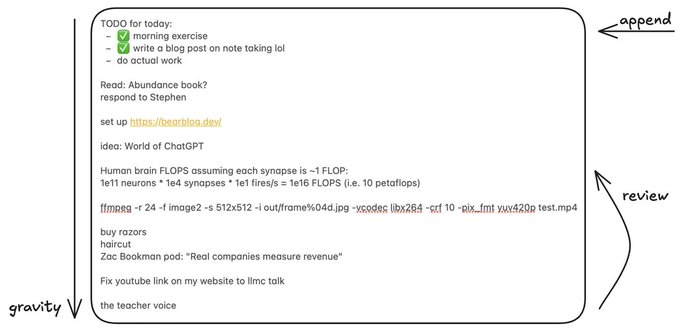
Karpathy's diary also used an append-only mode; he would just throw whatever came to mind at the top of the document, without tags, categorization, or hierarchy, using the diary as a clipboard.
By only recording facts, the space for "performing for others" or "self-indulgence" is eliminated, significantly reducing the friction of the input process.
Furthermore, it can also be used for voice input; after writing something down, simply turn on voice input and say a sentence—very convenient.
Furthermore, they share a common characteristic: they use only one file for recording.
Andrej Karpathy uses a single document in his notes app.
Ma Boyong uses a single Word document.
This eliminates the need for organization; they can simply use Command + F to search for keywords when needed.
Moreover, this kind of diary-like record is relatively short, perhaps only tens of thousands of words a year, making it easy to retrieve relevant information.
Ma Boyong primarily uses this method to address his mid-life memory decline. Andrej Karpathy views it as a tool for freeing up the brain's RAM: through note-taking, the brain can store this information, allowing it to focus on other tasks requiring concentration.
I found that their recording method is also very compatible with AI:
This kind of data is excellent native AI corpus.
Because it possesses high-density semantics, including: names, book titles, events, commands, and code—all easily extracted structured information.
Furthermore, this method is very context-friendly.
Because of its small size, perhaps only tens of thousands of words a year, it perfectly fits the context of current large language models. Furthermore, because it's plain text, AI can query and organize it very efficiently and conveniently.
This low-friction, high-information-density, plain text recording method is inadvertently very suitable for modern AI.
Through this method, you can quickly build your own AI memory, similar to ChatGPT.
And plain text prevents you from being tied to any particular product.
Karpathy's note-taking method is here: You can find Ma Boyong's on his WeChat official account of the same name.

Andrej Karpathy
@karpathy
03-20
Seeding my Bear ʕ•ᴥ•ʔ blog with more random posts, e.g. here's something I had on backlog for a while:
# The append-and-review note
An approach to note taking that I stumbled on and has worked for me quite well for many years. I find that it strikes a good balance of being
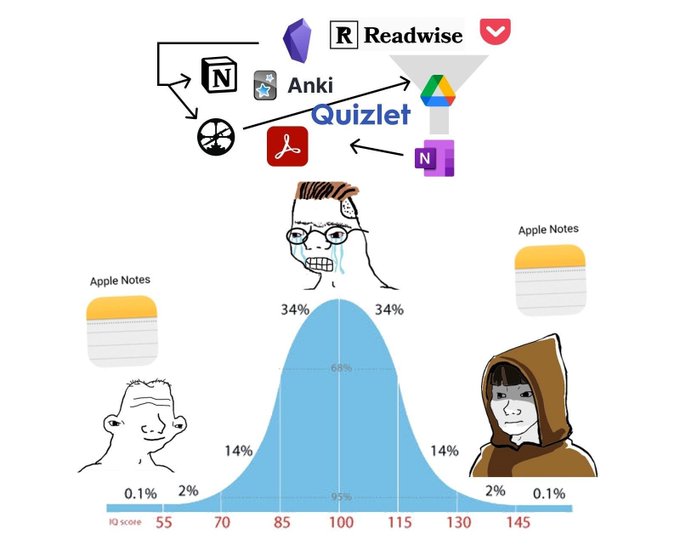
Haha, this meme!
Vibe has created an app:

歸藏(guizang.ai)
@op7418
01-02
现在 vibe Coding 一个产品的成本就是这么低!
一下午写了一个可以实现上午说的马伯庸和卡帕西的日记的产品 Vibe Diary
支持 AI 分析生成标签、判断 Todo 和稍后读的意图分类
支持导出单个 Markdown 文档的所有日记,方便跟顶级 AI 交互
支持 PWA 应用,手机上使用体验也很好,目前需要邀请码 x.com/op7418/status/…

From Twitter
Disclaimer: The content above is only the author's opinion which does not represent any position of Followin, and is not intended as, and shall not be understood or construed as, investment advice from Followin.
Like
Add to Favorites
Comments
Share
Relevant content