This article is from Fisher8 Capital .
Compiled by Odaily Odaily(@OdailyChina); Translated by Azuma (@azuma_eth)
Editor's Note: 2025 has come to an end. At the start of the new year, many VCs are rushing to release their 2025 reviews and 2026 predictions. However, due to their own business model orientation, VCs often focus more on the primary market perspective, offering less guidance for retail investors focused on the secondary market. This review and preparation from leading liquidity fund Fisher8 Capital is quite different. It comprehensively records the institution's successful and unsuccessful secondary market operations in 2025 and also offers some more secondary market-oriented thoughts on the market trends in 2026.
The following is the original content from Fisher8 Capital, translated by Odaily.

summary
2025 was an exceptionally challenging year for most liquid funds, characterized by extremely aggressive capital rotation and the overall underperformance of crypto assets compared to traditional assets. While Fisher8 Capital achieved some results in mainstream and on-chain assets, we maintained a strong belief in several long-term themes (such as AI and DePIN) and chose to continue holding positions in these areas despite significant drawdowns, given the underperformance of some emerging sectors.
Ultimately, Fisher8 Capital closed the year with a 16.7% return. We are confident that the discipline and insights gained during this highly volatile year will help us continue to outperform the market in the future. However, from a risk-adjusted perspective, we might have been better off investing in daycare (note: this is a dig at the Minnesota daycare scandal).
If you're interested in collaborating with us, or are working on some interesting and innovative projects, feel free to contact us on X. We hope you enjoy our year-end review, and wish everyone a wonderful new year.
Transaction records
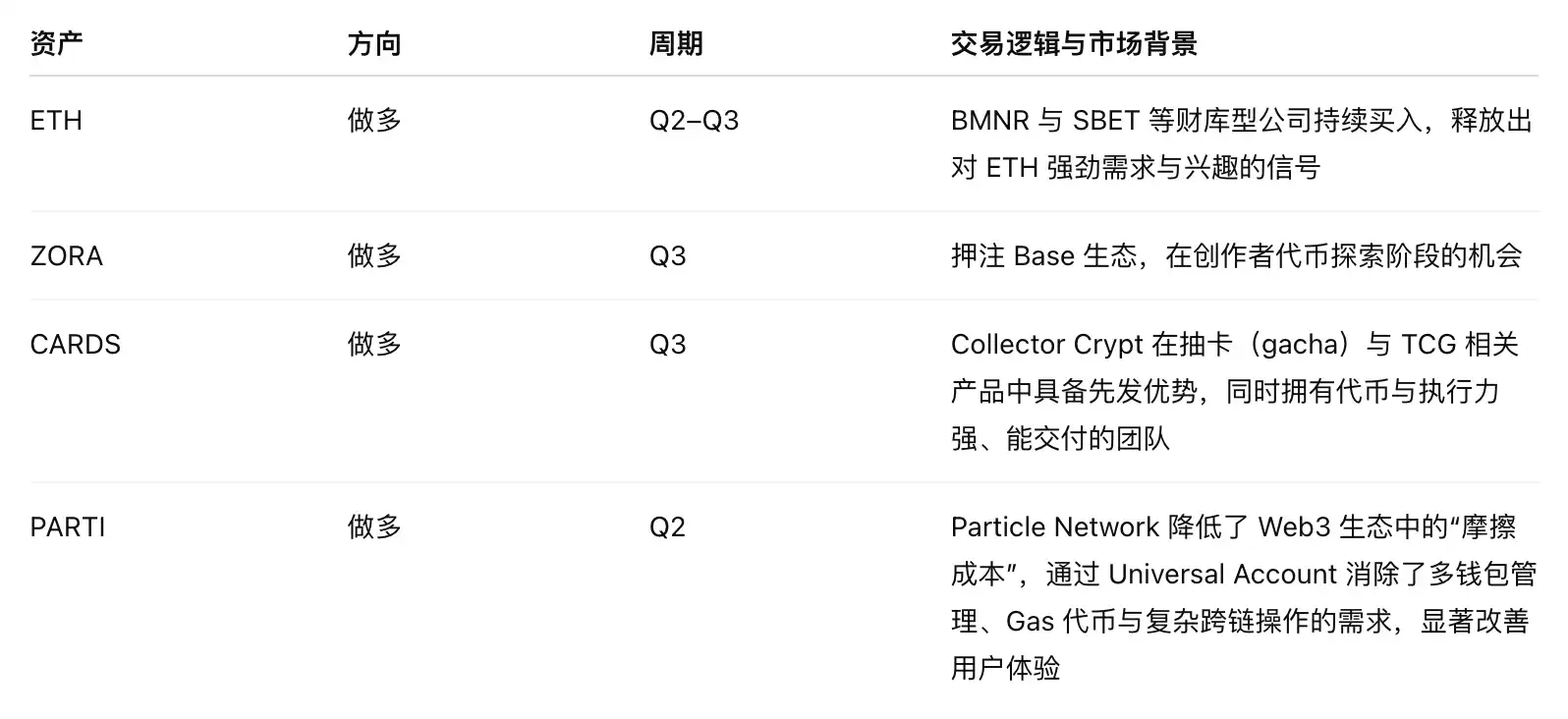
Our best trading strategies for 2025 are as follows.
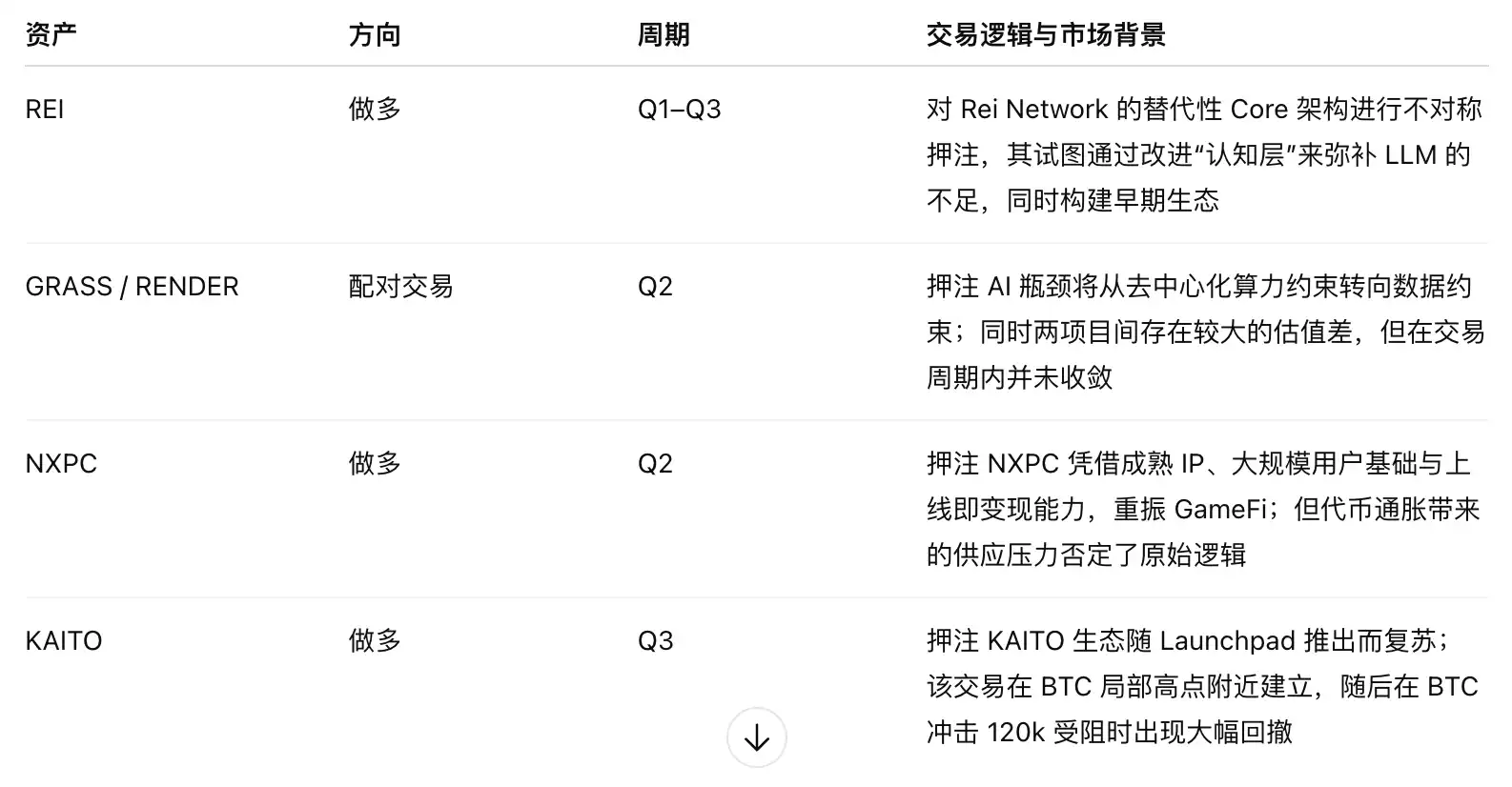
These are the worst trading operations.
2025 Market Review
Trump's clear connection to the crypto market
Ahead of the 2024 presidential election, the market widely anticipated that a Trump victory would mark a major turning point in the cryptocurrency regulatory environment and valuation. These expectations included:
- End the regulatory approach of "substituting enforcement for supervision";
- Explicit support for stablecoins;
- Exploring the establishment of a "strategic Bitcoin reserve";
- And in September 2024, it will launch Trump-related projects, such as World Liberty Financial (WLFI).
These factors combined make crypto assets one of the highest-beta expressions in the broader "Trump Trade," incorporating significant policy optimism into prices before the election results were announced.
However, as this optimism began to recede, the "Trump trade" reversed overall. This phenomenon was not only reflected in crypto assets but also in stocks highly correlated with Trump, such as DJT, whose share price peaked before the election and subsequently fell significantly. Although the post-election environment confirmed more favorable policy statements for the crypto industry, the market faced the inertia of legal and regulatory progress, as well as a series of scattered and gradual policy achievements, which were insufficient to offset the impact of overall de-risking on "Trump-related assets."
Furthermore, Trump himself has gained direct economic exposure to the cryptocurrency industry through his association with WLFI and the emergence of Trump. This has exacerbated market concerns— crypto assets have been financialized to some extent around Trump's personal popularity, thus introducing a "perceived risk"—that a decline in his political capital could directly translate into a weakening of related asset prices.
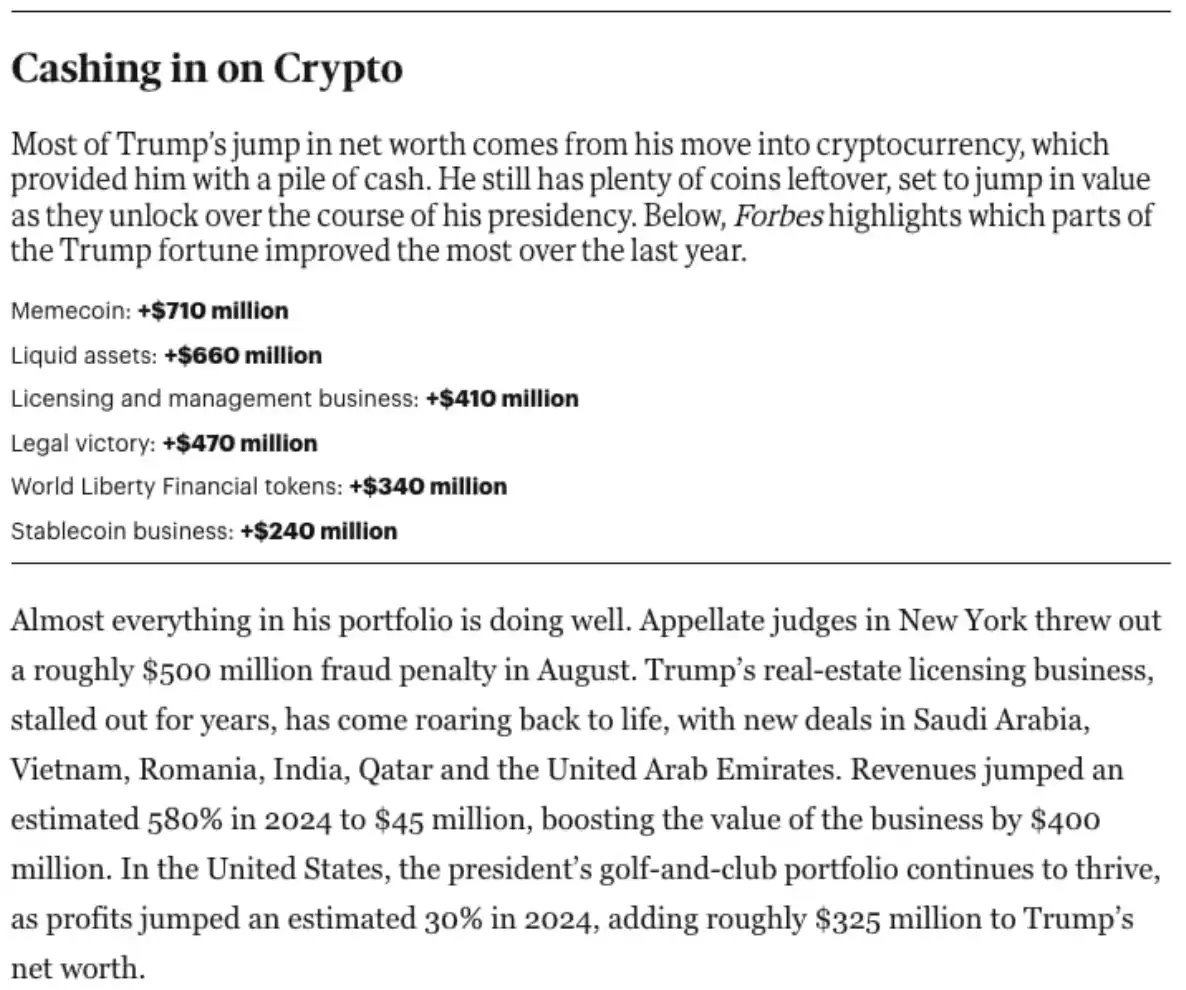
Odaily note: Forbes reports that Trump's presidency increased his net worth by $3 billion in one year.
While these concerns are not entirely unfounded, they can be mitigated through long-term policies or by reducing reliance on charismatic demand. Most notably, the Executive Order on the Access to Alternative Asset Investments, signed in August 2025, expands the permitted scope for 401(k) retirement plan trustees to include digital assets in their portfolios. While the order does not mandate allocation, it effectively lowers the legal and reputational barriers to institutional participation, reshaping cryptocurrencies from a speculative, fringe asset into one that can at least be permitted in long-term capital pools.
The true significance of this shift lies not in whether a large influx of funds will occur immediately in the short term, but in the change in market demand structure. With the possibility of including long-term capital related to retirement funds, the crypto market is beginning to transition from a purely supply-driven halving cycle to a policy-regulated demand cycle characterized by longer-term, more sticky capital. Even marginal adoption in a scaled-up context has the potential to raise the price equilibrium level and compress downside volatility compared to the 50-80% retracements of past cycles.
Narrowing of the "risk appetite" trading range
The implications of "risk appetite" trading are becoming more complex. Unlike previous cycles where speculative capital would flood into memes and long-tail assets during periods of rising risk appetite, the performance divergence among beta assets in 2025 was exceptionally significant. This was particularly evident in the relatively lackluster performance of memes when BTC hit its all-time high in early October.
Instead, investors are concentrating their funds on a smaller subset of crypto assets, such as "equity-like assets" with crypto exposure (DAT, CEXs, and funds), prediction markets, or tokens with clear value capture mechanisms. This differentiation reflects a maturing market structure: capital is becoming increasingly selective and rapidly rotating, with fund flows becoming more short-term and narrative-driven. Investors chase local momentum, quickly reap profits, and continuously roll liquidity to the next narrative. By 2025, narrative cycles will be compressed, and trades will last for shorter periods than before.
In this environment, the idea of holding Altcoin long-term for huge returns has largely become an illusion. Apart from major tokens like BTC, ETH, and SOL, which benefit from institutional funding, other tokens tend to appreciate only when a compelling narrative is active. Once that narrative fades, liquidity dries up, and prices revert to their previous levels. The narrowing of risk-averse trading ranges has not extended the lifespan of Altcoin; instead, it has accelerated the pace of capital testing, draining, and abandoning new narratives. This further reinforces the conclusion that truly long-term crypto investment remains concentrated in a very small number of assets.
Expansion of the Digital Asset Treasury (DAT)
The rise of Digital Asset Treasuries (DATs) has introduced a completely new capital formation mechanism, designed to replicate the success of MicroStrategy. DATs allow publicly traded companies to raise funds and allocate them directly to crypto assets, thus creating an embedded crypto exposure proxy and bypassing a regulatory vacuum before Altcoin ETFs are approved.
As these structures spread rapidly, the market quickly showed signs of becoming a bubble—a large number of new carriers competed to package themselves as the "DAT" of a certain Altcoin, even if there was no real and sustained demand for the asset.
The capital structure employed by many Altcoin like DAT can be categorized as a predatory structure. Specifically, this type of structure often employs financial engineering by exchanging tokens for shares, aiming to attract new participants while simultaneously creating exit liquidity; this is further complemented by private placements with extremely low costs and very favorable lock-up conditions.
These mechanisms allow insiders to sell off large amounts of stock even with extremely limited buying pressure, resulting in retail investors having their value rapidly extracted in both the stock and token markets. This mismatch in scale is particularly evident in some aggressive DAT schemes—some companies attempt to raise far more funds than their market capitalization actually exists in the public market.
Investment theme for 2026
Conclusion 1: Asymmetric benefits will appear at the application layer.
The era of "monetary premium" enjoyed by the new generation of Layer 1 altcoins is coming to an end. Historically, this premium was mainly supported by the "Fat Protocol Thesis" and the "Moneyness" narrative—that is, the idea that infrastructure would disproportionately capture value and that its tokens would eventually evolve into global store-of-value assets.
However, the market has already integrated this monetary function around mainstream assets such as BTC, ETH, SOL, and stablecoins, and the imagination space for the "monetary" nature of the new Layer 1 has been completely stripped away.
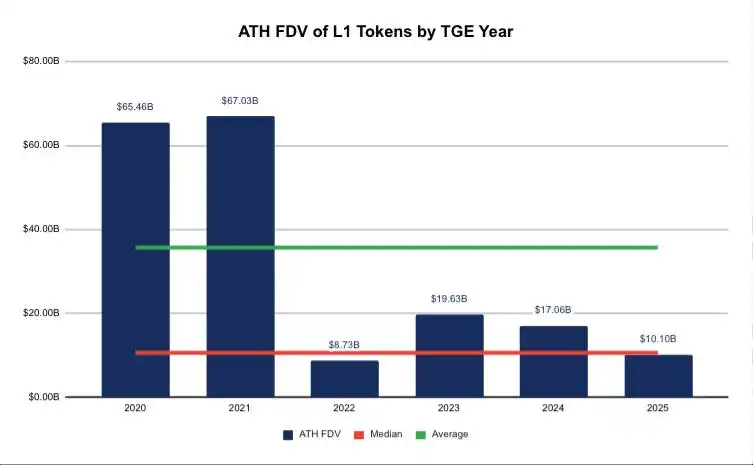
Odaily Note: Statistics on the highest all-time fully diluted valuation (ATH FDV) of Layer 1 tokens for TGE in each year.
With the disappearance of the "monetary" moat, the social consensus that once gave new public chains valuations of billions of dollars is crumbling. Since 2020, the historical peak FDV of altcoin Layer 1 blockchains has shown a clear structural downward trend, which strongly indicates that the monetary premium is continuing to fade.
Furthermore, the current valuation "bottom" is largely artificially created: in recent years, many Layer 1 assets have launched through fixed-price ICOs or direct listings on CEXs, with the initial price artificially set by the team. If these assets are forced to undergo true price discovery upon listing, we believe their valuations are unlikely to approach the historical average level of previous cycles.
This valuation collapse trend is being further amplified by the inertia of existing public chains. Mature ecosystems already have a large number of "sticky applications" that firmly lock in users, creating extremely high barriers to entry for new, copycat Layer 1 blockchains.
Data shows that since 2022, approximately 70-80% of DEX trading volume and TVL have consistently been concentrated on three chains. Ethereum has consistently held a dominant position, while the other two have rotated in different cycles. For new entrants, breaking this oligopoly is almost a battle against the odds, and historical experience shows that most projects ultimately fail to secure a long-term foothold.
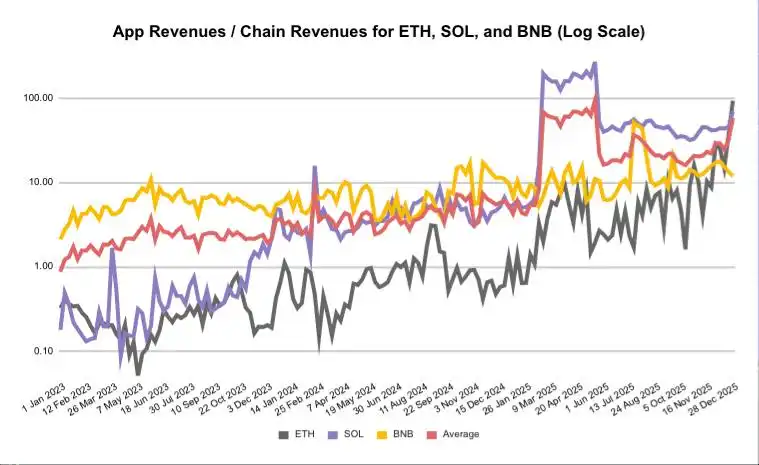
Odaily Note: Comparison of application revenue/chain layer revenue for ETH, SOL, and BNB.
We believe that the revaluation of application tokens has begun, driven primarily by the significant divergence in value capture capabilities between Layer 1 tokens and underlying applications. As shown in the chart above, application layer revenue has become significantly decoupled from infrastructure revenue over the past two years: application revenue in the ETH and SOL ecosystems has grown by as much as 200–300 times.
Nevertheless, the market capitalization of these applications remains only a fraction of the market capitalization of their respective L1 tiers. As the market matures, we expect this mismatch to be corrected as capital rotates from overvalued infrastructure assets to applications with real revenue.
Conclusion 2: The midterm elections will create a highly volatile environment.
The Trump administration's current policy focus is clearly on securing victory in the 2026 midterm elections, with overall policy design leaning towards supporting short-term economic momentum. The One Big Beautiful Bill Act (OBBBA), through deficit financing to stimulate demand, marginally increases the probability of a reflation environment. For digital assets, this fiscal expansion is beneficial to hard assets like Bitcoin, making them once again the ultimate "scarcity hedge."
At the same time, this fiscal expansion is also likely to encounter supply-side constraints in some areas, such as grid capacity and manufacturing capacity. These bottlenecks will create inflationary pressures on input costs and wages in related industries, even though the overall economy will still be suppressed by structural deflationary forces such as tariff normalization and AI productivity gains.
The resulting macroeconomic environment is characterized by high nominal growth, but simultaneously rising volatility, with the market periodically repricing inflation risks. This tension will structurally push up volatility. The market may oscillate between "optimism about reflation" and "concerns about a resurgence of inflation," especially given that economic data is gradually revealing capacity constraints rather than insufficient demand.
Adding to this macroeconomic backdrop is the historical pattern that midterm election cycles have consistently driven up political risk premiums—investors typically demand higher risk compensation before elections to cope with policy uncertainty. Supporting this pattern is a clear political motivation—to tolerate, or even expand, fiscal deficits during midterm election cycles. Simultaneously, a dovish stance from the Federal Reserve leadership would also provide a more relaxed liquidity environment for risk assets.
While this combination implies higher volatility in the short term, the combined impact of OBBBA and the ongoing progress of crypto legislation still lead us to believe that 2026 will be a constructive year for digital assets, albeit with a more turbulent path.
Conclusion 3: Enhanced selectivity shapes a K-shaped differentiated token economy.
The crypto market is bidding farewell to a phase of indiscriminate capital allocation and entering a period of brutal structural differentiation—a K-shaped economy dominated by selectivity. The era of universal price increases is over. The market has shifted from blindly chasing speculative narratives to focusing more on the genuine alignment of interests between the protocol level and token holders.
At the heart of this shift is the market's complete rejection of the "Equity-Token Split" model. Originally designed to address regulatory pressures during the Gensler era, this structure's ambiguity regarding its enforceability has always been a significant concern. Under this model, insiders (the team and VCs) control the real value (IP, revenue, equity), while retail investors receive only "governance tokens" with no enforceable rights.
This mismatch creates a two-tiered system—insiders possess the fundamentals, while token holders possess the sentiment. Because the market struggles to differentiate the true nature of different protocols, it ultimately chooses to apply an indiscriminate discount to the entire sector. Therefore, the current downturn is essentially a repricing of trust. Future winners will depend on their ability to demonstrate a clear, executable, and sustainable path to value capture.
In this new paradigm, the upper K of the "K-shape" will consist of teams that replace "trust me" with "verifiable." Here, credibility no longer stems from the founders' reputation or social capital, but from their willingness to proactively impose structural constraints on themselves. These teams demonstrate their ability to align value by: making the value engine auditable; making the flow of revenue actionable; and proactively disclosing their ability to transfer value off-chain. This transparency will become the basis for token buying—in a downtrend, sticky capital is willing to support its valuation because they trust the mechanism, not just the people.
Blockworks' Token Transparency dashboard is a great tool that categorizes protocols based on the level of information disclosure required by the framework.
Conversely, assets on the downside of the "K-shaped" pattern are facing a liquidity crisis triggered by the collapse of team credibility. The market now views ambiguity as an acknowledgment of conflicting interests. If a team refuses to clarify the relationship between protocol revenue and tokens, investors often assume that such a relationship simply doesn't exist. Lacking the high-cost signal of "executable value capture," these tokens cannot be valued fundamentally, and when the narrative fades, there are no natural buyers to support them. Teams that demand investors rely on "goodwill" or selectively obscure future promises are being systematically eliminated and are destined to continue bleeding money in the competition with quality protocols.
Other preliminary assessments
The collectibles market is poised for further expansion—extending into the realm of sports memorabilia, particularly items of exceptional value associated with significant historical moments. For example, Shohei Ohtani's 50/50 home run ball set a new record at auction.
Prediction markets are poised to become the new meta. Following Hyperliquid's TGE, which has had a demonstrative effect on the entire sector, Polymarket and Kalshi's TGE are expected to ignite the prediction market narrative.
skepticism surrounding the "equity-token" dual structure will continue to intensify. More and more investors will demand clear, auditable explanations of value allocation, clarifying how economic value is divided between the equity structure and token holders; otherwise, they should revert to a pure token structure.
The potential risk of DAT being removed from the MSCI index (final decision date: January 15, 2026) is being closely watched by the market. Once this uncertainty is eliminated, it could trigger a new round of early-year rebound.
Ownership coins will become the new normal, structurally reducing the risk of founders' "chronic rugging".
DApps with privacy capabilities will be more popular with both individual users and institutions. Those that can strike a balance between user experience and programmability, while simultaneously achieving highly compliant protocols, will ultimately win in the privacy race.
Tokenized stocks will experience an accelerated version of the "boom-bust" cycle, as their initial adoption is likely to remain limited.