2025 will undoubtedly be a landmark year for Taiwan's virtual asset industry, marking the beginning of its compliance era. In this year, Taiwan will officially bid farewell to the past era of rudimentary management relying solely on the Anti-Money Laundering Act, and move towards a comprehensive regulatory era centered on the Virtual Asset Management Act (VASP Act). This shift is not accidental, but rather the result of a confluence of factors, including international regulatory trends, increased domestic industry maturity, and the strong entry of traditional financial institutions.
The BlockTempo team has compiled this report, summarizing five core trends for the Taiwan market in 2025:
(1) Legalization of the regulatory framework: The Financial Supervisory Commission submitted the draft VASP special law to the Executive Yuan, establishing the regulatory logic of "licensing system" and "classification and hierarchical management";
(2) CBDC in practice: The Central Bank and the Hakka Affairs Council jointly launched the "Digital Hakka Currency" pilot project, which became the first large-scale retail CBDC in Taiwan.
(3) Traditional industries enter the market: Four large private banks apply to pilot virtual asset custody business, and Taiwan Mobile's TWEX exchange opens to the public;
(4) Precision in tax collection: The Ministry of Finance used the NT$500,000 reporting threshold for AI-assisted verification, uncovering over NT$100 million in underreported income;
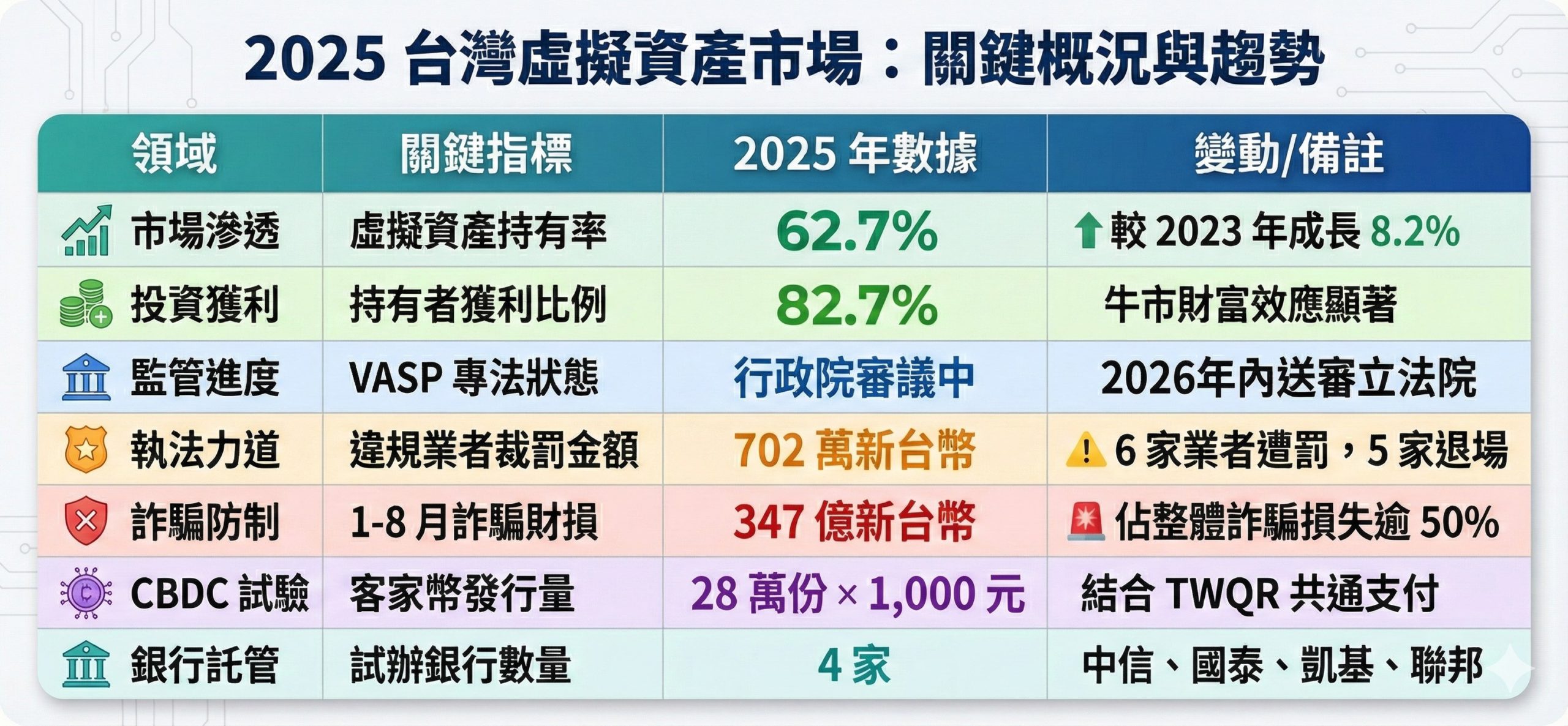
(5) Market behavior matures: The holding rate of virtual assets has exceeded 62.7%, the profit ratio of holders is as high as 82.7%, and the main investment force has shifted to Generation X and Generation Y with a solid economic foundation.
These trends collectively define the landscape of the Taiwan market in 2025, marking a turning point for Taiwan's virtual asset industry as it moves from the "periphery" to the "core".
This article is compiled, analyzed, and written by the Dongqu Research Team, drawing on various sources including official documents from the Financial Supervisory Commission, the Central Bank's CBDC pilot program, and the Bankee 2025 Virtual Asset Survey Report from Far Eastern International Bank .
Industry Status Snapshot: Key Indicators for 2025
To present the core data of the Taiwan market in 2025 in a clear and intuitive way, the following key indicators have been compiled:
In-depth analysis of regulatory policies
Legal Framework Analysis: A Paradigm Shift from Anti-Money Laundering to Industrial Development
Prior to 2025, Taiwan's regulation of virtual assets was primarily based on the "Measures for the Prevention of Money Laundering and Combating Terrorist Financing by Virtual Currency Platforms and Trading Businesses" under the Money Laundering Prevention Act. While this regulatory model curbed the flow of illicit funds to some extent, it lacked specific regulations on consumer protection, asset segregation, cybersecurity standards, and market manipulation.
With the collapse of the FTX exchange receding into the past and the formation of global regulatory frameworks (such as the EU's MiCA and Hong Kong's VASP licensing system), Taiwan's Financial Supervisory Commission realized that it was necessary to establish a dedicated "Virtual Asset Management Act".
Taiwan's virtual asset regulation has evolved through four stages:
- Phase 1 (2018-2020) : In the absence of specific legislation, only the Anti-Money Laundering Act was used for low-level management.
- Phase Two (2021-2023) : The emergence of self-regulatory norms and the establishment of the preparatory group for the Republic of China Virtual Currency Commercial Association.
- Phase Three (2024) : The Anti-Money Laundering Declaration Registration System will be implemented, and businesses will be required to complete an anti-money laundering declaration before commencing operations.
- Phase Four (2025) : The VASP (Visa-Sponsored Statute) bill will be submitted for review, marking Taiwan's entry into the "Special Bill Legislation Management Phase".
In June 2025, the Financial Supervisory Commission (FSC) formally submitted the draft VASP (Vacuum-Based Specified Service Provider) Act to the Executive Yuan, establishing a regulatory logic of "licensing" and "classification and tiered management." This means that the operating qualifications of cryptocurrency service providers have shifted from "reporting and registration" to "licenses," significantly raising the market entry threshold.
Regulatory agencies and division of powers and responsibilities
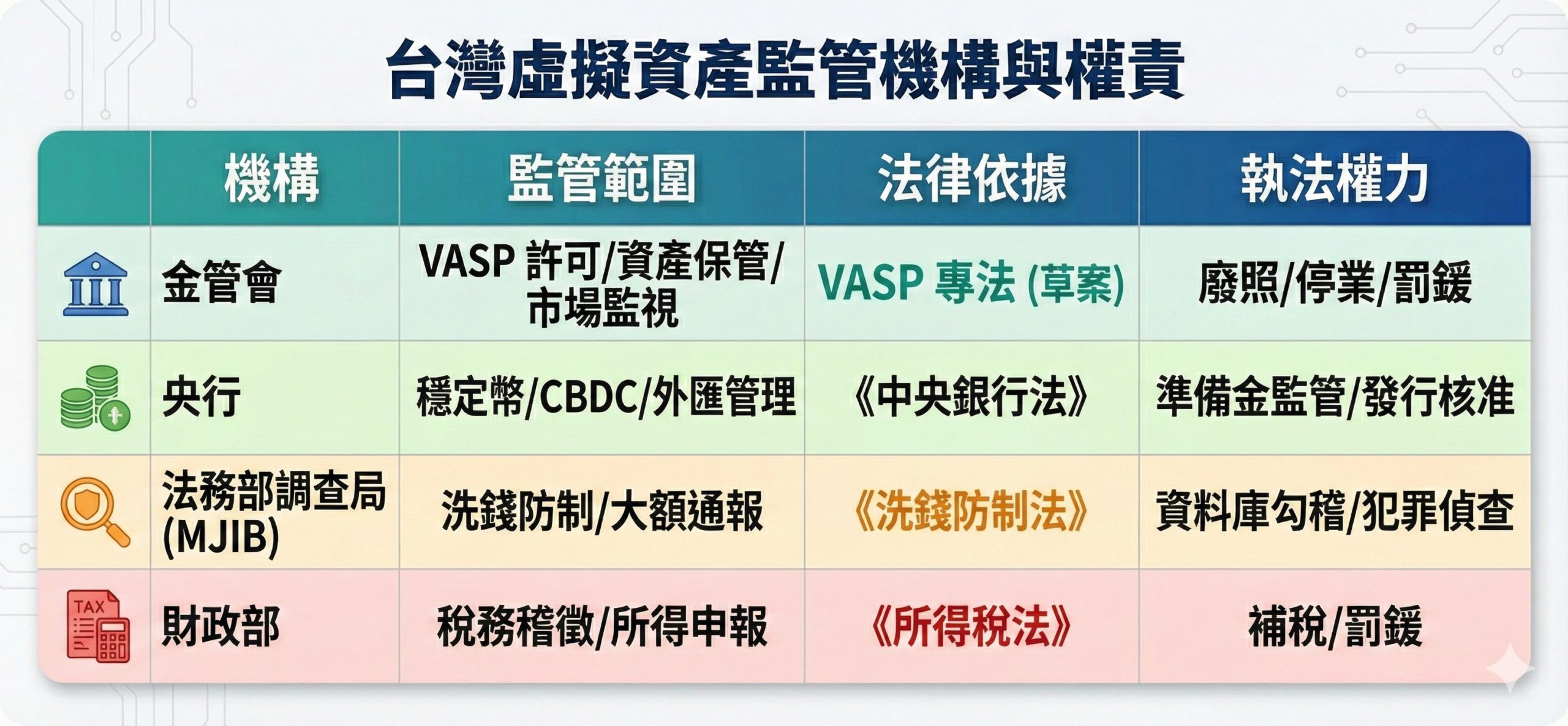
The VASP (Visa-Assisted Professional) Act established a multi-departmental collaborative regulatory system, with each agency performing its regulatory duties based on different legal grounds.
Explanation of each core clause
The following three most crucial clauses will be analyzed in depth:
Clause 1: VASP Four-Category Definition
The draft clearly classifies Virtual Asset Service Providers (VASPs) into four types, each with different compliance obligations and capital requirements:
Virtual Asset Dealer/Broker : A business that operates the exchange of virtual assets with fiat currency, or between virtual assets.
Virtual asset trading platform operator : A business that operates a "centralized trading market" for virtual assets, that is, a platform that matches orders between buyers and sellers.
Virtual Asset Transfer Service Provider : A business that accepts client requests to transfer virtual assets from one account/address to another.
Virtual asset custodian : A business that manages a client's virtual assets or their private keys.
Plain Language Explanation
These four categories cover the core links of the virtual asset industry chain:
- Exchange brokers : The most basic VASP model, similar to over-the-counter (OTC) exchanges, encompassing models such as buying cryptocurrency at convenience stores.
- Trading platform providers : the most strictly regulated category, including mainstream exchanges such as BitoPro, MaiCoin, and TWEX.
- Money transfer providers (wallet service providers) must implement the "Travel Rule" to ensure the traceability of transfer information.
- Custodian : A core business that four banks are vying for by 2025, responsible for managing customer private keys.
Practical impact
Compliance costs : Platform provider > Custodian > Exchange provider > Transfer provider.
Trading platforms need to establish mechanisms to prevent market manipulation, such as alert systems for abnormal price and volume movements, including the detection of wash trading and pump-and-dump schemes. The cost of building such systems can reach tens of millions of New Taiwan Dollars.
The difficulty of implementation is highest for trading platforms, as they must maintain neutrality, refrain from betting against their clients, and undergo regular on-site inspections by the Financial Supervisory Commission.
Risk of violation : The draft law proposes license revocation and fines in the tens of millions of NT dollars. Unlicensed operators could face fines of up to NT$5 million and imprisonment for up to 7 years (referencing Hong Kong's VASP system).
Clause Two: Separation of Client Assets
The property rights of client assets held in custody by a custodian belong to the client and must not be commingled with the custodian's own assets. If the custodian goes bankrupt, the client's assets do not belong to the bankruptcy estate and the custodian has the right of segregation.
Plain Language Explanation
This is the most important clause following the disastrous collapse of the FTX exchange. One of the core reasons for FTX's downfall was that the exchange misappropriated customer assets for high-risk investments.
The draft of the asset separation provisions in the VASP special law clearly stipulates:
- Exchanges do not permit the use of clients' fiat currency assets and virtual currencies for investment (misappropriation is prohibited).
- Client assets must be kept separate from the exchange's own assets (independent accounting).
- Even if the exchange goes bankrupt, customers can still get their coins back (segregated custody, bankruptcy protection).
Practical impact
Compliance costs : Businesses need to establish independent accounting books, use blockchain address transparency technology (such as Proof-of-Reserves), and regularly engage the Big Four accounting firms for third-party audits, with annual costs of approximately NT$3-5 million.
Execution difficulty : High. A complete asset tracking system needs to be established to ensure that every customer asset corresponds to a specific blockchain address.
Case Study : Binance launched the "Proof-of-Reserves" system in 2024, which uses Merkle Tree technology to allow users to verify that their assets are indeed in cold wallets. This is a popular practice of compliance measures for trading platforms.
Clause 3: Stablecoin Reserve Requirements
Stablecoin issuers must deposit sufficient reserves, which must be highly liquid. Issuers may not use these reserves without the permission of the regulatory authorities, ensuring that redemption requests are 100% satisfied.
Plain Language Explanation
Stablecoins serve as the "fiat currency anchor" in the virtual asset market, and their stability directly impacts overall market confidence. The VASP (Virtual Asset Protection Act) adopts a highly cautious approach to the regulation of stablecoins.
- Issuing 100 million yuan of stablecoins → 100 million yuan of reserve assets must be available (1:1 full deposit).
- The assets prepared cannot be used to buy stocks or make loans (restricting the scope of investment).
- The issuance of stablecoins involving foreign exchange must be handled in accordance with the regulations of the central bank (dual supervision).
Practical impact
Taiwan Dollar Stablecoins (TWDC) : To issue a stablecoin pegged to the New Taiwan Dollar in Taiwan, it is necessary to obtain dual approval from the Financial Supervisory Commission (VASP Act) and the Central Bank (Foreign Exchange Management), which is an extremely high threshold.
Foreign stablecoins (USDT/USDC) : Currently, they are mainly circulated in Taiwan through overseas exchanges. If Tether or Circle wants to establish a branch in Taiwan to issue stablecoins directly, they will need to meet reserve requirements and be subject to regular audits.
Regulatory Challenges : How to regulate algorithmic stablecoins? These stablecoins have no physical underlying assets and rely solely on smart contract algorithms to maintain their exchange rates. The VASP (Variable Interest Investor) law currently lacks clear regulations, but it is expected that supplementary legislation will be introduced in the future.
Cross-border regulatory comparison: Taiwan's position on the global regulatory spectrum
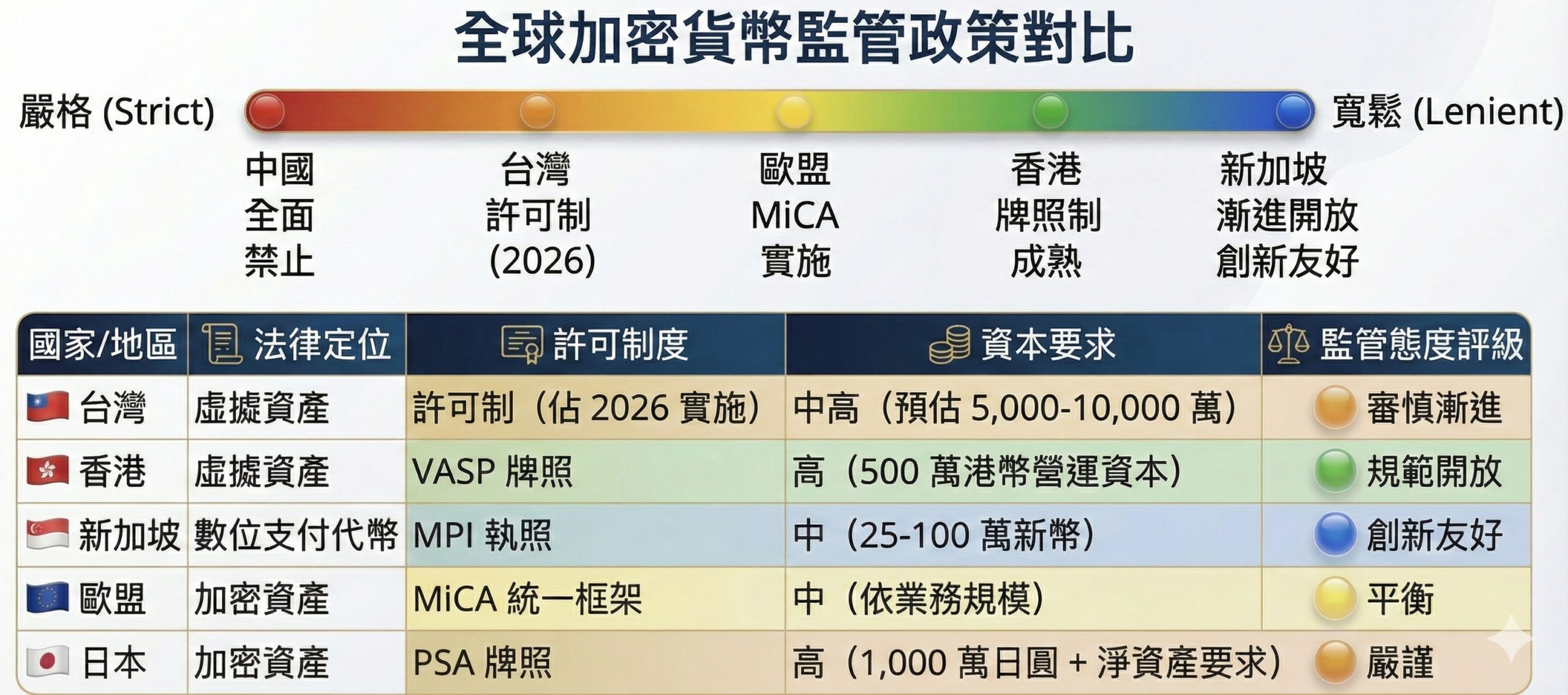
Placing Taiwan's VASP (Vacuum-Assisted Professional) Act within the global regulatory spectrum reveals that Taiwan adopts a "prudent and gradual" approach, falling somewhere between strict and lenient:
Case studies from other countries and regions
Singapore's MAS "Payment Institution License" : The Monetary Authority of Singapore (MAS) has established a tiered system that allows small and medium-sized enterprises (SMEs) to apply for "MPI-Small" light licenses (with lower capital and compliance requirements), avoiding a "one-size-fits-all" approach that stifles innovation. Taiwan could learn from this model and provide "light license" options for businesses focusing on specific markets (such as NFTs and wallet services).
Hong Kong's SFC's "Wealth Management Gateway" : The Hong Kong Securities and Futures Commission (SFC) allows licensed exchanges to offer more diversified virtual asset products, including derivatives and leveraged trading, to "professional investors" (those with assets exceeding HK$8 million), while imposing stricter protections on retail investors. This segmented regulatory strategy is worth considering for Taiwan.
Market Trends and Industry Landscape: Three Core Trends Reshaping the Taiwan Market
Industrial Ecosystem Map: A Four-Layer Pyramid Structure
According to the BCDA (Bitcoin and Virtual Asset Development Association) 2024-2025 Taiwan Blockchain Industry Report and analysis by members of the Virtual Currency Business Association, Taiwan's virtual asset industry presents a four-tiered pyramid structure:
The four-layer pyramid of the industry: Layer 1: Infrastructure Layer (15%) - Public chain development, node services, developer tools - Representative companies: XREX (cross-chain technology), Cross-chain Technology Layer 2: Financial Services Layer (40%)Largest Categories - CEX: BitoGroup, MaiCoin, TWEX, HOYA BIT - Custody: 4 banks applying for custody (CITIC, Guotai, KGI, Federal) - Payment: XREX Pay, MaiCoin PAY, Zone Wallet Layer 3: Application Layer (25%) - Wallets: Zone Wallet, KryptoGO - NFT/Web3: Digital Content, Games, Social Layer 4: Support Services Layer (20%) - Compliance/Legal: VASP Guild, Law Firms, Accounting Firms - Media/Education: BlockTempo, BlockCast, Influencers, etc. - Security: XREX XRAY (On-Chain Analytics Tool)
Market Concentration Analysis
In 2025, Taiwan's virtual asset market will show an intensified trend of "head effect":
- The top three exchanges —Bitoo, MaiCoin, and TWEX—estimated to hold over 70% of the market share.
- Number of exits in 2025 : 5 companies exited the market due to penalties for violations or inability to afford compliance costs.
- Survival threshold : With the implementation of the VASP (Visa-Assisted Professional) legislation, it is estimated that the number of compliant businesses in the market will shrink from 30+ to around 15, or even fewer.
At the same time, we have updated the " Taiwan Blockchain Industry Map " to Q4 2025, providing industry participants with the most comprehensive and convenient industry database, real-time tracking of the current status of more than 200 Web3 companies, 11 popular sectors, and the latest developments in cryptocurrency regulation.
Key Trend Analysis
Trend 1: The Banking Industry's "Ice Breakthrough"—The First Year of Virtual Asset Custody Business
Trend Description
The most groundbreaking development in 2025 will undoubtedly be the entry of traditional banks into the virtual asset custody market. Four major private banks—China Trust Commercial Bank, Cathay United Bank, KGI Bank, and Union Bank—officially submitted applications to the Financial Supervisory Commission (FSC) in April 2025 to pilot virtual asset custody services, breaking the banking industry's decade-long taboo against cryptocurrencies. The FSC is expected to announce the first batch of approved applications by the end of June 2025, marking the official start of the "virtual asset custody era" for the banking industry.
Data to support
- Banks applying: CTBC Bank, Cathay Bank, KGI Bank, Federal Bank (Taishin Bank is currently receiving guidance and preparing for a second round of applications).
- Potential Market Size: According to a survey by Bankee, a Far Eastern Commercial Bank, Taiwan's virtual asset ownership rate has reached 62.7%, with nearly 30% of holders investing over NT$1 million and 4% investing over NT$10 million. Based on Taiwan's population of 23 million, the total market value of virtual assets is roughly estimated to exceed NT$1 trillion.
- Custody fee income: If the market practice of charging an annual custody fee of 0.2%-0.5% is followed, the four banks could generate hundreds of millions of yuan in revenue.
Driving factors
- Policy liberalization : The Financial Supervisory Commission (FSC) released trial measures at the end of 2024, allowing banks to apply for virtual asset custody business.
- Market Demand : Institutional clients (HNWI, corporate finance departments) are extremely sensitive to the pain point of "private key security," and bank-grade custody services can significantly reduce cybersecurity risks.
- Mature Technology : The maturity of Multi-Party Computation (MPC) technology allows banks to provide custody services without holding the complete private key, reducing single point of failure risk.
Industry impact
For exchanges : With banks entering the market, exchanges will lose their "full-featured advantage" (trading + custody + payment all in one), and will be forced to focus on their core business of transaction matching, and improve their trading experience and product innovation capabilities. They will also increase their efforts to develop overseas business.
For institutional investors : Once the private key security issue is resolved, the willingness of HNWIs (high-net-worth individuals) and corporations to allocate assets to virtual assets will increase significantly. According to HSBC's Global Entrepreneur Wealth Report, 26% of surveyed Taiwanese entrepreneurs have already adopted crypto assets, demonstrating high-net-worth individuals' keen awareness of the digital economy. The launch of bank custody services will further drive funds from institutions, high-net-worth individuals, family offices, and private funds into the market.
For RWA (Real-World Asset Tokenization) : Bank custody is a prerequisite for bond tokenization and real estate tokenization. Investors will only be willing to purchase tokenized assets when they have a trustworthy custodian. The launch of bank custody services will lay the foundation for the RWA market boom in 2026-2027.
Case Studies
CTBC Bank's strategic considerations : As Taiwan's largest private bank, CTBC Bank boasts a massive digital financial user base (over 5 million MyWallet users). Integrating virtual asset custody services into MyWallet would create a one-stop management experience for both fiat currency and virtual assets, significantly enhancing user stickiness.
KGI Bank's Synergies : KGI Bank is a subsidiary of China Development Financial Holding Co., Ltd., which holds a full range of financial licenses including securities, banking, and venture capital. Through the synergies of securities and banking, KGI can create a one-stop investment platform for "stocks + virtual assets," attracting the diversified asset allocation needs of the younger generation.
Future Outlook
- Short-term (6-12 months) : The first batch of 2-3 banks have obtained pilot qualifications and launched custody services for high-net-worth clients.
- In the medium term (1-2 years) : Custody fee income reaches hundreds of millions, and banks begin to launch "virtual asset wealth management" products (such as BTC fixed deposit products, virtual asset collateralized lending, stablecoin wealth management, etc.).
- Long term (3-5 years) : Banks become the core of RWA issuance and custody, promoting the tokenization of assets such as stocks, bonds, real estate, and carbon credits.
Trend Two: CBDC Moving from Research to Everyday Life – The Strategic Significance of Hakka Coin Taking the Lead
Trend Description
In July 2025, the Hakka Affairs Council, the Ministry of Digital Development, and the Central Bank jointly launched the "Hakka Coin" project, issuing 280,000 units, each with a face value of NT$1,000, for a total scale of NT$280 million.
This is not only a cultural policy, but also the most important "retail testing ground" in the history of Taiwan's CBDC (Central Bank Digital Currency) development.
Data to support
- Participating banks : 17 partner banks (including Bank of Taiwan, Land Bank of Taiwan, Taiwan Cooperative Bank, CTBC Bank, Taishin Bank, E.SUN Bank, etc.)
- Technical Standard : Integrates the TWQR common payment standard, allowing users to store and use Hakka currency using existing banking apps or electronic payment apps (such as Taiwan Pay).
- Privacy Design : Adopting a "de-identification" design, the central bank can only see transaction flow data and cannot know the user's true identity; user personal data is retained by each bank.
- Usage Restrictions : Limited to participating stores in 70 key Hakka cultural development areas across 11 counties and cities in Taiwan, valid until June 30, 2026.
Driving factors
- Policy impetus : The central bank is promoting a roadmap for retail CBDCs, with Hakka Coin being the first large-scale trial.
- Technical verification : Programmable money enables "limited-use" functionality, laying the foundation for the digital distribution of future policy subsidies (such as stimulus vouchers and childcare allowances).
- Cultural support : The Hakka Affairs Council provides budgetary support to combine the CBDC pilot program with the promotion of Hakka culture.
Industry impact
Verifying the two-tier architecture : The Hakka Coin adopts a two-tier architecture of "Central Bank - Intermediary Institutions - Public," where the Central Bank does not directly face the public, thus avoiding the risk of "financial disintermediation." This provides an architectural template for the future formal issuance of a digital New Taiwan Dollar.
Paving the way for a Taiwan Dollar stablecoin (TWDC) : The successful operation of the Hakka Coin will validate the technological and legal foundation for the digitalization of the Taiwan Dollar. In the future, the central bank or large financial institutions may launch stablecoins pegged to the New Taiwan Dollar under strict supervision for cross-border payments and trade settlement.
Promoting the adoption of TWQR : Through the Hakka currency trial, the usage rate of the TWQR common payment standard will be greatly increased, reducing the fragmentation problem in Taiwan's electronic payment market (currently there are multiple mainstream payment tools such as JKO Pay, LINE Pay, and EasyPay, as well as dozens of other companies with significant visibility).
Case Studies
Compared to China's digital yuan : China's digital yuan (e-CNY) employs a "controlled anonymity" design, allowing the central bank to track all transactions. Taiwan's Hakka currency, on the other hand, adopts a "de-identification" design to protect user privacy, activating the tracking mechanism only in the event of large, unusual transactions.
Compared to the Bahamas Sand Dollar : The Bahamas Sand Dollar was the world's first officially issued CBDC, but its scale was relatively small (issued at approximately US$400,000). The Taiwan Hakka Currency trial, with a scale of NT$280 million, integrates with the existing banking system, making it more practically valuable.
Future Outlook
- In the short term : After the trial concludes in June 2026, the central bank will assess the usage rate, technical stability, and privacy protection effectiveness of the Hakka currency.
- Mid-term : Launch the second phase of the trial, which may be expanded to the entire island of Taiwan, and test cross-border payment functions (such as interoperability with CBDCs in Singapore and Hong Kong).
- Long-term : Officially issue a digital New Taiwan Dollar, which will coexist with cash and be used for daily payments and policy subsidies.
Trend 3: Telecom giants' "lower-dimensional attack" – TWEX launches the Tele-Fi track.
Trend Description
The most eye-catching cross-industry case in 2025 was the opening of Taiwan Mobile's "TWEX Taiwan Virtual Asset Exchange" to its own users, and its opening to the general public in January 2026.
TWEX has set an extremely low entry threshold, with investments starting from NT$100, and is directly integrated into Fubon Securities' "AI PRO App," allowing millions of Fubon Securities users to view Taiwanese stocks, US stocks, and Bitcoin assets within the same app. This marks the official launch of the "Tele-Fi" model in Taiwan.
Data to support
- Taiwan Mobile users : approximately 8 million (Taiwan's second largest telecom operator)
- Fubon Securities users : millions (one of Taiwan's top five securities firms)
- Minimum investment : NT$100 (the lowest in the industry, far lower than the NT$1,000-3,000 threshold of other exchanges).
Driving factors
- Policy liberalization : A special VASP law allows telecommunications operators to apply for VASP licenses, removing legal obstacles to the full public accessibility of TWEX.
- Market saturation : User growth for pure crypto exchanges has slowed, necessitating the expansion into new users "outside the crypto".
- Technological advantages : Mobile ID real-name authentication technology significantly reduces KYC costs, allowing users to complete identity verification with a single click.
Industry impact
Customer acquisition costs have been significantly reduced : The customer acquisition cost (CAC) for a single user on a pure crypto exchange is approximately NT$1,000-3,000. TWEX, leveraging the massive user base of Taiwan Mobile and the Fubon Group, estimates its customer acquisition cost could be reduced to NT$100-300.
Enhanced cybersecurity and trust : Taiwan Mobile possesses telecommunications-grade cybersecurity protection capabilities, alleviating users' fears about exchange hacking. Compared to purely crypto-native exchanges, TWEX, with its telecommunications background, is more likely to gain the trust of traditional investors.
Increased competition : TWEX's entry will be a "game-changer" for pure crypto exchanges. For established players like BitTorrent and MaiCoin, over the course of several years, they will need to accelerate product innovation (such as launching more diverse financial products and optimizing the trading experience) to maintain their market share in trading volume.
Case Studies
Similar to Rakuten's cryptocurrency exchange in Japan : Rakuten Wallet, also under the Rakuten Group, successfully attracted a large number of "Rakuten members" to the cryptocurrency market by leveraging the group's ecosystem (e-commerce, credit cards, securities). TWEX's strategy is exactly the same as Rakuten's.
Analogous to PayPal's crypto business : After announcing the launch of its cryptocurrency trading service in 2020, PayPal quickly surpassed 20 million users. Its key to success lay in "leveraging existing payment users," allowing them to buy cryptocurrencies without downloading a new app. TWEX's strategy of integrating into Fubon Securities' AI PRO app can be seen as a localized version of PayPal's experience.
Future Outlook
- Short term : After being open to all users in January 2026, TWEX's user base is expected to grow rapidly to 500,000-1,000,000.
- Mid-term : TWEX becomes one of the top three exchanges in Taiwan, forming a three-way competition with CoinTrust and MaiCoin.
- Long-term : With the mature integration of telecommunications, finance, and encryption into a super app, TWEX has become part of Taiwan's "digital lifestyle gateway."
Tax and Compliance Practices: The $500,000 Reporting Threshold and the Dilemma of Proof Cost
Individual Tax Filing Guide: Domestic vs. Overseas Income
By 2025, Taiwan's tax authorities will have significantly improved their ability to audit virtual assets. Although there is no specific "Virtual Asset Tax Law," the Ministry of Finance, based on the principle of substantive taxation, classifies income from virtual asset transactions as "income from property transactions" under the Income Tax Act.
Taxpayers must distinguish between "domestic income" and "overseas income" when filing their returns:
| Income Category | Trading platform | Taxation method | tax rate | Application threshold |
|---|---|---|---|---|
| Domestic income | Domestic exchanges (have completed anti-money laundering declarations) | Included in total comprehensive income | Progressive tax rates from 5% to 40% | No threshold |
| Overseas income | Overseas exchanges (such as Binance, Bybit) / On-chain wallets | Included in Individual Basic Income (AMT) | 20% | Total overseas income of the household > 1 million |
The pain points and coping strategies of cost-based evidence
The biggest controversy in the 2025 tax season lies in the "burden of proof of cost." If taxpayers cannot provide clear proof of purchase cost (such as Bitcoin acquired at a low price many years ago), the IRS may extrapolate income based on the data obtained (such as the total amount withdrawn) at a certain percentage, or directly determine that the cost is zero, resulting in an extremely high tax burden.
Recommended strategies for investors :
- Retain all transaction records : Download the CSV file provided by the exchange, which contains the time, price, and quantity of each transaction.
- Using a blockchain explorer : For on-chain transactions, use blockchain explorers such as Etherscan or Blockchain.com to download the complete transaction history.
- Use tax software : If the transaction volume and inflow/outflow amount are large (exceeding NT$10 million), it is recommended to use cryptocurrency tax software such as Koinly or CoinTracker to automatically calculate the cost basis and taxable income.
The 500,000 reporting threshold and AI-related practices
According to the Money Laundering Prevention Act, when a user withdraws funds from an exchange to a bank account and the amount exceeds NT$500,000 in a single transaction, either the bank or the exchange must report the large-value currency transaction to the Investigation Bureau of the Ministry of Justice.
In 2025, the IRS's anti-money laundering unit and the Ministry of Finance's Tax Center worked more closely together, with the IRS using AI and big data analysis to conduct tax audits on accounts with frequent large withdrawals.
Data Flowchart
Withdrawal from exchange → Bank account (single transaction ≥ NT$500,000) ↓ Bank reports to the Investigation Bureau of the Ministry of Justice (large-value currency transactions) ↓ Investigation Bureau database → Interconnected with the Tax and Finance Center of the Ministry of Finance ↓ National Taxation Bureau AI Big Data Analysis ↓ Tax reconciliation ↓ Back taxes + fines (for underreporting)
2025 Verification Results
- Shortages and omissions discovered: NT$129 million (2024) → Estimated NT$250 million (2025)
- Tax and penalty fines: NT$34.03 million (2024) → Estimated NT$70 million (2025)
- High-risk individuals include: those who frequently withdraw large sums of money, those who engage in arbitrage across multiple exchanges, and those who use nominee accounts to disperse withdrawals.
Corporate Taxation and Invoice Issues
For profit-making businesses (such as investment companies or dedicated trading teams), their profits and losses from virtual asset transactions must be recorded in accordance with commercial accounting laws and subject to a 20% profit-making business income tax.
Furthermore, the sale of virtual goods (such as NFTs) involves a 5% sales tax (VAT). In 2025, the Ministry of Finance strengthened its oversight of merchants accepting cryptocurrency payments, requiring them to issue invoices in New Taiwan Dollars.
Investor Behavior Insights: Generational Distribution and the "Positive Profit Cycle"
Demographic characteristics: Generation Y dominates, Generation X is a blue ocean market.
According to the "2025 Virtual Asset Survey Report" released by Bankee and BlockTempo, the landscape of cryptocurrency investors in Taiwan has changed significantly:
| generations | Age range | percentage | Core features | Investment Strategy |
|---|---|---|---|---|
| Generation Z | 18-26 years old | 13% | High risk appetite, 31.2% of daily transactions. | Small, frequent transactions; chasing trending cryptocurrencies |
| Generation Y | 27-42 years old | 46.1% | Market leaders and a solid economic foundation | Medium- to long-term allocation, DYOR independent research |
| Generation X | 43-58 years old | 35.3% | Strong assets, low-frequency transactions (65.4%) | Asset preservation and risk management are priorities. |
| Baby boom | 59+ years old | 5.6% | Conservative, high profit margin | Long-term holding, infrequent trading |
Top 5 Occupational Distribution
- Technology sector (20.5%)
- Service sector (12.4%)
- Manufacturing (12.3%)
- Financial industry (10.3%)
- Proprietary dealers (9.8%)
This breaks the stereotype that "the crypto is full of young college students," showing that middle-aged and older adults with economic strength have become the main force in Taiwan's cryptocurrency investment market.
Investment Behavior and Performance: Holding Rate and Profitability Reach New Highs
Historical changes in holding ratio
- 2021: 34.2% (peak of the bull market)
- 2023: 54.5% (Still holding firm at the bottom of the bear market)
- 2025: 62.7% (a record high)
Profitability Distribution
- Winners: 82.7%
- Of which, more than 10 times: 4.3%
- 5-10 times: 12.1%
- 2-5 times: 28.6%
- Small profit: 37.7%
- Those who suffered losses: 17.3%
Asset allocation scale
- Over 10 million: 4%
- 1 million - 10 million: 26%
- 100,000 - 1,000,000: 45%
- Under 100,000: 25%
In-depth insights: Two key findings
Insight #1: A positive cycle of "profit-takers being more optimistic" has been formed.
Four-layer insight analysis :
- Level 1 (Descriptive) : 82.7% of holders are in a profitable position.
- Level 2 (Comparative) : Profitability increased by nearly 26.4 percentage points from 56.3% in 2023.
- Level 3 (Insight) : Profitable investors tend to hold for the long term (average holding time 2.8 years vs. loss-making investors 1.2 years), reducing selling pressure → price stability → more people profit → more optimism → continued holding, forming a positive cycle.
- Level 4 (Predictive) : In 2026, the market will enter a "holder-driven" phase, with reduced speculation and lower market volatility.
Industry implications : Exchanges' "holding for interest" products (such as staking and stablecoin investment) will be more popular with "depositing" investors, opening up a customer base that does not encourage high-frequency trading. Long-term holders are gradually becoming market stabilizers, and exchanges must also design "long-term holding reward programs" (such as fee discounts for holding for a full year) to retain users.
Insight #2: Generation Y is a market stabilizer, while Generation X represents a potential blue ocean.
Four-layer insight analysis :
- Level 1 (Descriptive) : Generation Y accounts for 46.1%, Generation X accounts for 35.3%.
- Level 2 (Comparative) : Generation X invests more on average (380,000 vs. Generation Y 420,000), but their participation rate is much lower than that of Generation Y.
- Level 3 (Insight) : Generation X possesses stronger purchasing power but has low participation rates, indicating that education and trust barriers remain high. Generation X prefers "low-risk, stable-return" products rather than highly volatile Altcoin .
- Level 4 (Predictive) : If Generation X can be effectively reached (through compliant products such as bank custody services and BTC ETFs), the market size could grow by another 30%-50%.
Industry implications : Designing "wealth management-grade" products (such as BTC fixed deposits and stablecoin wealth management) for Generation X and promoting them through banking channels (such as CTBC Bank's "virtual asset wealth management" service) will be key to market growth in 2026-2027.
Fraud, oligopoly and the innovation dilemma
Three core risks
Risk 1: Rampant Fraud Industry Chain – Social Cost of 34.7 Billion Yuan
Despite accelerated compliance processes, fraud remains the biggest shadow over the development of virtual assets in Taiwan. From January to August 2025, investment fraud losses across Taiwan reached NT$34.7 billion, accounting for more than half of all fraud losses. Due to their anonymity and ease of cross-border transfers, virtual currencies have become the preferred money laundering tool for fraudulent groups.
Innovative methods : In addition to the traditional "fake dating investment" (pig butchering scam), a large number of scams combining AI deepfake technology emerged in 2025, impersonating celebrities (such as Jensen Huang and Morris Chang) to recommend fake cryptocurrency investment platforms.
Preventing the dilemma : Although the Financial Supervisory Commission has promoted a "joint prevention mechanism" between banks and exchanges, once funds are transferred to overseas exchanges or decentralized wallets (self-hosted wallets), recovery becomes extremely difficult.
Countermeasures :
- The government will increase targeted criminal penalties, establish a 24-hour reporting window, and procure on-chain analytics tools (such as Chainalysis, TRM Labs, XREX, and XRAY).
- Industry : Strengthen KYC, establish a blacklist sharing mechanism, and cooperate with law enforcement agencies to track fund flows.
- Personal advice : DYOR (Do Your Own Research), do not blindly trust community recommendations, and use compliant platforms.
Risk 2: Market oligopoly and innovation suppression – a survival crisis for small and medium-sized enterprises
In November 2025, the Financial Supervisory Commission (FSC) issued fines totaling NT$7.02 million to six companies that failed to implement anti-money laundering measures. Five of these companies—Asia Pacific E-Tech, Power International, and Taiwan Chih-Ching—have already exited the market due to their inability to bear compliance costs or violations. This demonstrates that regulation has had a substantial "exit effect."
Reason : Compliance costs (human resources, systems, capital) are too high. Establishing a complete AML monitoring system requires an investment of tens of millions of yuan, and hiring 5-10 full-time compliance personnel costs approximately 5-8 million yuan annually.
Consequences : Market concentration among 3-5 leading players (Bito, MaiCoin, TWEX, XREX, HOYA BIT) → Lack of competition → Potential increase in transaction fees → Reduced incentive for innovation.
Countermeasures : The Financial Supervisory Commission should consider a "light licensing" system (referencing Singapore's MPI-Small) to allow small and medium-sized enterprises to focus on specific markets (such as NFTs and DeFi aggregators) and avoid "one-size-fits-all" regulation that stifles innovation.
Risk 3: The dilemma of balancing over-regulation and insufficient innovation
The core dilemma : How to strike a balance between protecting consumers and encouraging innovation?
International experience :
- The EU's MiCA has been criticized for "stifling DeFi" due to its unclear regulatory definition of decentralized protocols, leading many DeFi projects to leave the EU.
- Hong Kong : Due to the early allowance for retail investors to directly buy and sell all tokens, fraud was rampant, forcing the SFC to strengthen regulation.
Taiwan's approach : a cautious and gradual approach, first regulating CeFi (centralized finance), then progressively studying DeFi regulation. This avoids attempting to regulate all sectors from the outset, leaving room for innovation.
Outlook for the next five years (2026-2030)
Short term (2026): Implementation of special laws and market restructuring
- The VASP (Vendor-Sponsored Services) legislation has been completed, and the first batch of licenses has been issued (10-15 companies are expected).
- The number of compliant businesses has decreased from over 30 to around 15.
- The formal commercialization of bank custody services has attracted institutional funds to enter the market.
Mid-term (2027-2028): The Year of RWA and the New Taiwan Dollar Stablecoin
- Banks have launched bond tokenization products, allowing investors to purchase tokenized government bonds with a minimum investment of NT$100,000.
- The central bank or major financial institutions may launch a regulated Taiwan Dollar stablecoin (TWDC) for cross-border trade settlement.
- CBDC enters Phase Two (nationwide) trial, testing cross-border payment functionality (interoperability with other countries' CBDCs).
Long term (2029-2030): Establishment of digital financial center status
- Taiwan has become the Asia-Pacific "compliant crypto asset hub" (similar to Hong Kong's positioning), attracting international VASPs to establish their Asia-Pacific headquarters in Taiwan.
- Deep integration of Web3 and AI: decentralized AI computing power market, privacy computing (such as the application of zero-knowledge proof ZKP in medical data)
- Cross-border payments: Utilizing stablecoins to reduce cross-border trade costs and establish a wealth corridor connecting Taiwan and Southeast Asia.
Recommendations for different stakeholders
Exchanges/Financial Service Providers :
- Apply for a VASP license as soon as possible to avoid a gap period (complete the application before the end of 2025).
- Investing in RegTech, such as automated KYC and transaction monitoring systems, can reduce long-term labor costs.
- Develop "earn interest by holding" products (such as staking and stablecoin investment) to retain long-term users.
Banks and traditional financial institutions :
- Custody services are the entry point, while RWA represents long-term value (the market size for bond and real estate tokenization could reach trillions of dollars).
- Partner with crypto industry players (such as those offering custody technology outsourcing) to quickly build business capabilities.
- Cultivating professionals in crypto assets (e.g., the USTB Master's Program in Blockchain, and wealth management advisors who at least understand the allocation logic of mainstream crypto assets such as BTC/ETH).
investor :
- Prioritize compliant platforms (to avoid overseas exchanges being forced to exit due to regulatory issues, such as Binance's exit from Hong Kong).
- Advance tax planning (keep complete transaction records, consider using tax software such as Koinly)
- Diversified allocation of crypto assets (BTC/ETH 70%, stablecoins 20%, potential coins and memes no more than 10%)
Policymakers :
- To avoid a "one-size-fits-all" approach to regulation, a tiered system should be established (such as Singapore's MPI-Small light license).
- Strengthen investor education (officially certified teaching materials and exams, such as the "Certification on Fundamentals of Virtual Assets").
- Promote "Regulatory Sandbox 2.0" (providing a 6-12 month trial period for new DeFi and RWA models).