Foreign media reports indicate that the U.S. Supreme Court is expected to issue its final ruling on the Trump administration's "global reciprocity tariffs" policy on Friday (January 9). This policy, which invokes the International Emergency Economic Powers Act (IEEPA) to impose tariffs ranging from 10% to 40% starting in April 2025, has already generated over $200 billion in revenue for the federal treasury.
However, a lower court ruled the move illegal, and the cases were consolidated and appealed to the Supreme Court. Market and supply chain participants are holding their breath, as the ruling will determine the fate of massive tax revenues and could potentially reshape the US president's emergency powers in trade.
Three Judgment Scenarios and Predicting Market Temperature
There are currently three most discussed paths:
- One approach is a "mixed ruling": the court may determine that tariffs imposed based on economic deficits exceed the IEEPA mandate, but retain a few items related to national security.
- Secondly, the "policy was fully confirmed," symbolizing a significant centralization of tariff legislative power in the White House.
- Thirdly, the government suffered a complete defeat in the case.
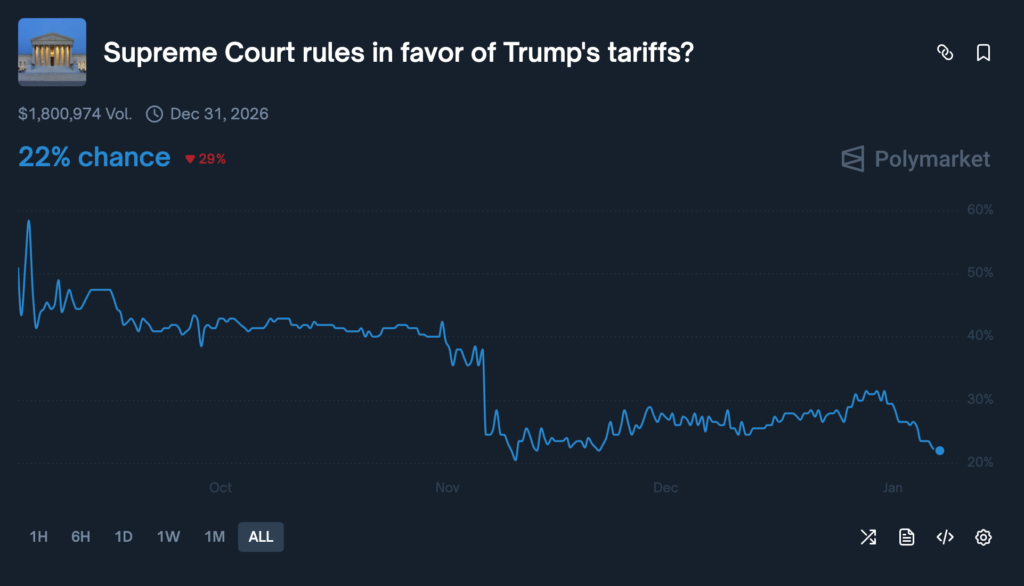
According to Polymarket data, the market estimates that there is a greater than 75% chance that the Supreme Court will rule against Trump; however, even if the Supreme Court finds it illegal, the executive branch can still maintain pressure through other legal means such as Section 301. White House economic advisor Hassett pointed out:
"Even if a refund is needed, the administrative procedures are so complex that it is almost impossible to complete them in one go, and it will not cause social unrest."
Potential impacts in various aspects
If the court does rule the policy unconstitutional, the US government would theoretically be required to return $200 billion. Businesses could face lengthy application and tax assessment processes, and the timing of the return of funds would be unpredictable.
More attention is focused on the issue of separation of powers: tariffs have always been the prerogative of Congress, and the outcome of this case will mark whether the executive branch can make large-scale changes to trade terms without legislative consent under the guise of an "emergency".
This ruling will also impact global supply chains, affecting procurement costs and production location. Regardless of the outcome, the Trump administration has repeatedly indicated it will not abandon tariffs, suggesting that international trade frictions may remain the norm in 2026.