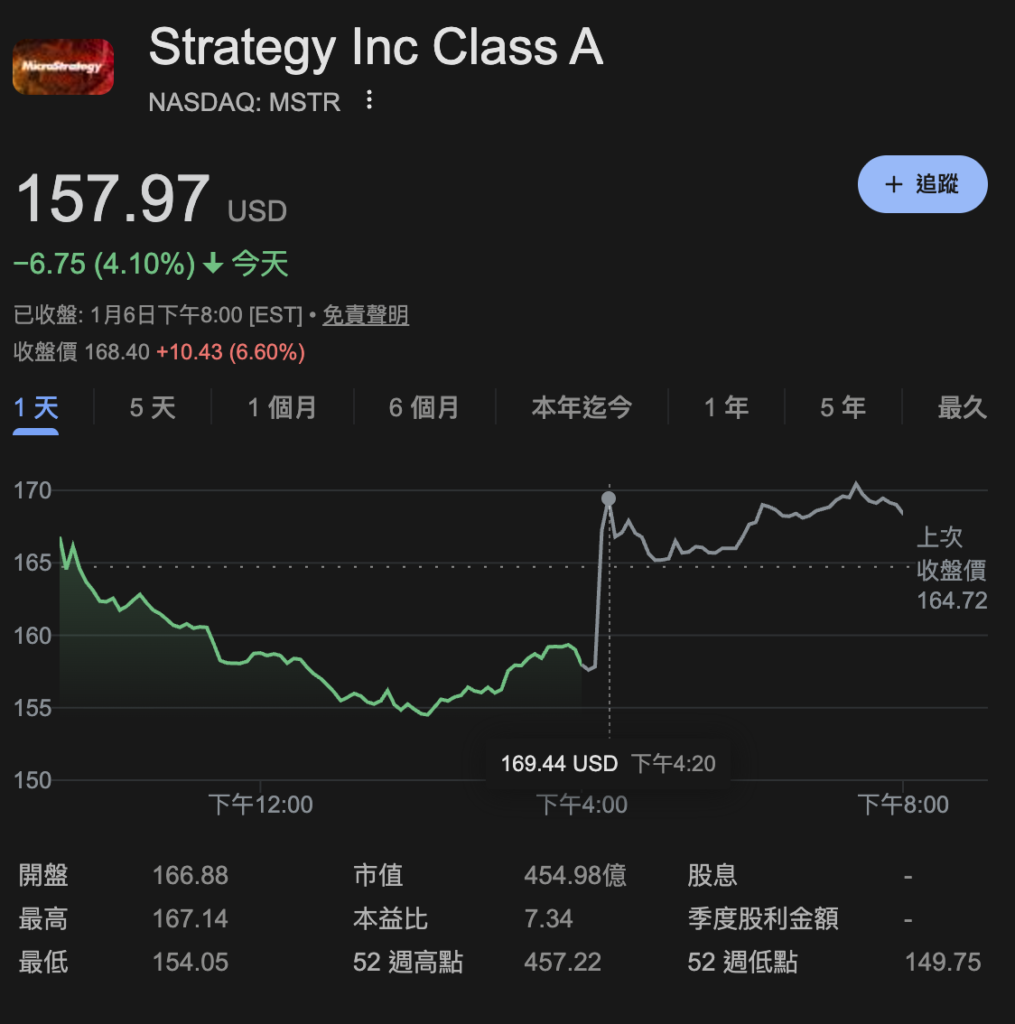
MSCI, the US index provider, announced late on February 6th that it would postpone the implementation of its plan to classify companies with more than 50% digital assets as investment funds during its February quarterly review. This directly alleviated market panic regarding the potential removal of 39 digital asset treasury companies, including Strategy (formerly MicroStrategy). Following the announcement, Strategy's after-hours stock price immediately surged by 5% to 7%, temporarily halting nearly $2.8 billion in potential passive selling.
The index treatment for DATCOs listed in the preliminary list published by MSCI, whose digital asset holdings account for 50% or more of their total assets, will remain unchanged.
The "50%" red line has been temporarily suspended.
MSCI's original proposal stipulated that companies with digital assets exceeding half of their total assets would be classified as passive instruments similar to ETFs, thus losing their inclusion in benchmark indices such as MSCI World and MSCI USA. Critics pointed out that the threshold depended on cryptocurrency price fluctuations; if Bitcoin (BTC) rose, companies could be "passively" removed from the list, making the standard too arbitrary and amplifying market distortions. MSCI ultimately decided to conduct broader consultations first, citing significant differences in accounting standards across countries and the difficulty in achieving a unified assessment.
For stocks like Strategy, inclusion or exclusion from an index is not only a matter of reputation but also a direct link to global passive capital flows. Data shows that if the 50% rule takes effect, Strategy alone could face forced selling of approximately $2.8 billion worth of shares by ETFs tracking the MSCI index, with overall sector outflows reaching as high as $15 billion. Following the announcement, Strategy's stock price rebounded rapidly from around $158, demonstrating that index performance can sometimes dictate prices more than short-term fundamentals.
Regulatory Realities in 2026
The debate centers on the identity issue that legal and economic circles are trying to clarify: when a company considers Bitcoin accumulation a core strategy, can it still be considered an operating company? Strategy Chairman Michael Saylor has repeatedly emphasized that Bitcoin reserves require active allocation and risk management, fundamentally different from passively held ETFs. However, MSCI stated in its announcement that it will establish a new classification of "general non-operating companies," meaning that removing only 50% of the threshold does not end the review process. For the crypto industry, traditional financial gatekeepers have temporarily loosened their grip, but left behind an unsigned examination paper.
This incident also reflects the regulatory atmosphere created by the Trump administration last year: while political rhetoric is favorable to crypto assets, financial infrastructure remains dominated by existing rules. Strategy, facing pressure on cash flow and risk tolerance due to approximately $17.4 billion in unrealized losses on its books after Bitcoin's 25% pullback in the fourth quarter of 2025, has been spared this time, gaining a period of observation, but the next round of scrutiny is still coming. To remain in the benchmark index long-term, they must prove themselves not merely as highly leveraged cryptocurrency holders, but as companies that meet traditional standards in accounting, operations, and governance.
MSCI's delaying tactic has halted the cleansing of Wall Street's passive investment machine and revealed the core conflict between the Bitcoin treasury model and the index compilation controversy. When balance sheets change their identity due to price fluctuations, should traditional valuation frameworks give way to new asset classes? The answer is still emerging.