As expected, the initial target amount for this ICO will be sold out instantly.
Written by Eric, Foresight News
Trove, one of the first perp DEXs to pass HIP-3 and developed based on the HyperLiquid infrastructure, will launch its ICO at 1:00 AM Beijing time on January 9, 2026. The article on X introducing the ICO rules has already been read nearly 800,000 times.
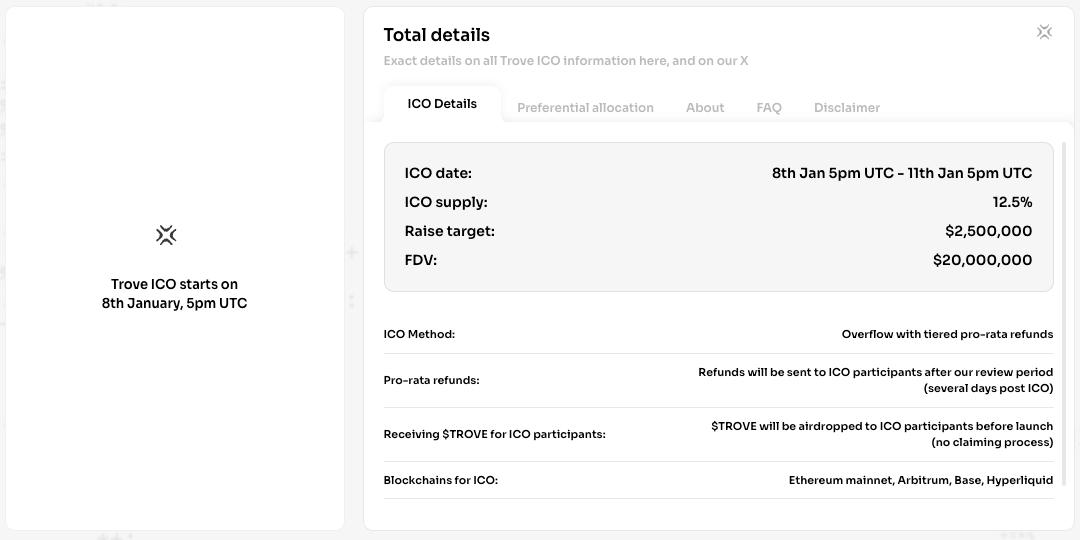
This ICO lasted 72 hours, from 1:00 AM on the 9th to 1:00 AM on the 12th (Beijing time), with a target fundraising amount of $2.5 million and a FDV of $20 million. Tokens purchased by investors will be released in full immediately after TGE. Users who participated in Trove's previous points program and have between 250,000 and 10 million points will receive a 10% to 20% higher allocation than ordinary investors.
Users can participate in this ICO using USDC, USDT, and USDH. Supported chains include Ethereum, Arbitrum, Base, and HyperLiquid (Trove is not explicitly listed as a HyperLiquid chain; users need to confirm this themselves before participating). The official team has not set up any KYC or other restrictions in advance. The amount that participants can receive depends on the proportion of their investment to the total amount at the end of the ICO.
As mentioned earlier, users with extra credit based on points will see this reflected in the token allocation: for example, if two participants both invest $10,000 and ultimately each receive an actual investment of $2,000, the user with points might receive tokens worth $2,200 and a refund of $7,800; the user without points would receive $2,000 in tokens and a refund of $8,000. For investors, investing in projects with no upper limit on oversubscription at the last minute is the most capital-efficient option.
Trove has not announced on which blockchain the TROVE token will be issued on or where it will be traded. Please stay tuned for further announcements.
Those familiar with the HIP-3 mechanism might be surprised by the $20 million FDV figure. This is because projects launching perp DEX under this mechanism need to stake at least 500,000 HYPE tokens to use HyperLiquid's infrastructure, and on the day HIP-3 was approved, those 500,000 HYPE tokens were worth over $20 million.
Furthermore, HIP-3 rules stipulate that the first three assets listed on a new perp DEX are free, but from the fourth onwards, all participants who have staked 500,000 HYPE must bid, with the highest bidder winning the right to list new tradable assets. Therefore, considering other costs associated with developing an exchange, Trove's initial opening costs alone must have exceeded $20 million.
According to another rule of HIP-3, if the project team engages in malicious behavior or is unable to maintain the project's operation, up to all staked HYPE will be forfeited to compensate users or HyperLiquid itself. Furthermore, according to a tweet from Trove, the 500,000 HYPE they invested came from external support, and a Delta-neutral strategy was used to lock the value of HYPE at $40. The protocol will permanently pay 20% of the revenue to the "funders" who provided the HYPE.
According to data provided by Trove, within a week of its testnet launch, the total number of users exceeded 28,000, and the total transaction volume exceeded $1.2 billion. According to DefiLlama data, GMX, with a transaction volume of around $1 billion in a week, still exceeded $100 million in FDV, even though it's no longer what it used to be.

I boldly predict that this will be an ICO where the target amount is "sold out in seconds" and is almost certain to be oversubscribed. For investors, while it's not to say that the project's market value must not be less than the cost of investment or the funds raised, $20 million in FDV is indeed not expensive for the currently popular perp DEX. Not to mention that even if Trove fails, HyperLiquid can use HYPE, which is still worth over $10 million, to compensate the ICO participants who only aimed for $2.5 million in funding.
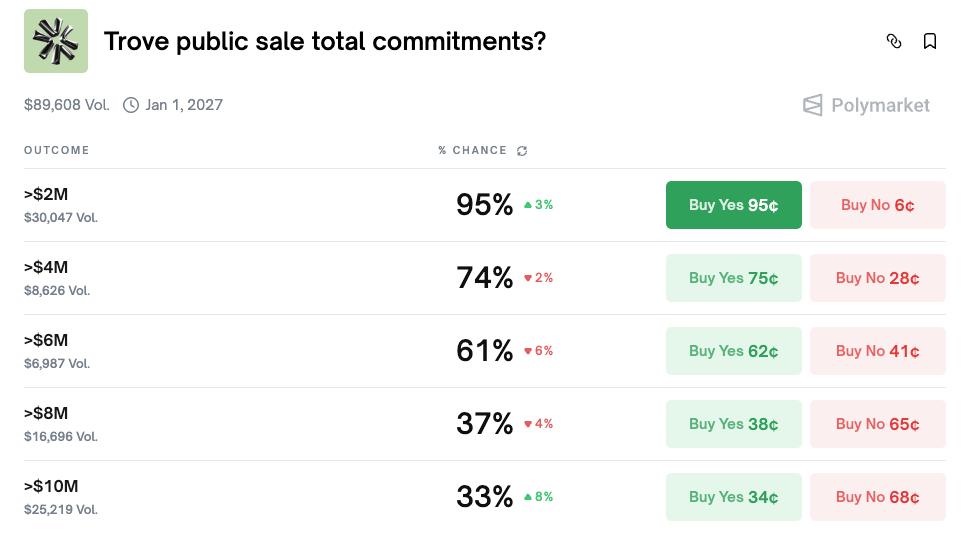
Data from Polymarket shows that people believe investing more than $2 million is almost a certainty, the probability of investing more than $6 million is over 60%, and the probability of investing more than $10 million is also 30%.
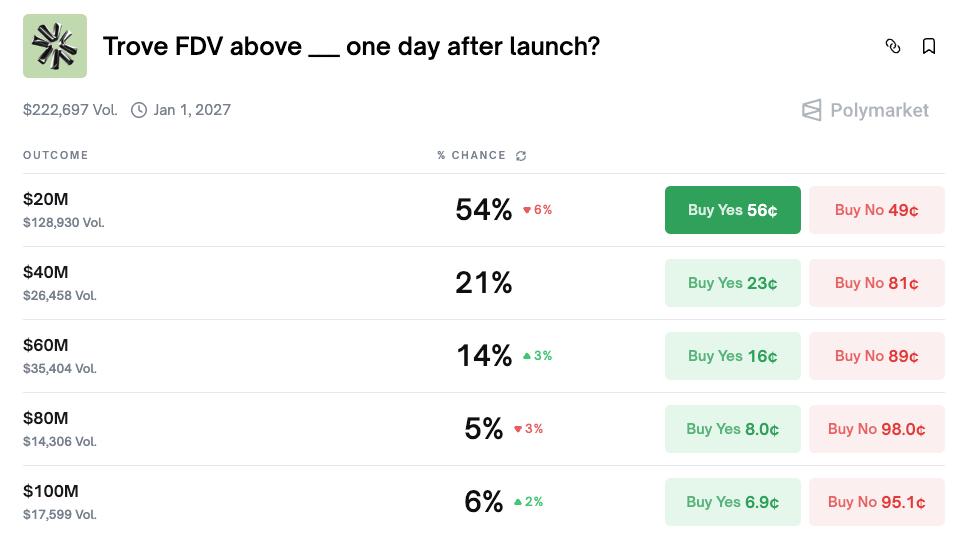
There are very few analyses on X about how much Trove's actual valuation can reach. On Polymarket, among the predictions about how much the FDV will be after one day of token issuance, the probability of exceeding $20 million is more than 50%, while the probabilities of $40 million and $60 million are 21% and 14%, respectively.
Currently, market sentiment remains relatively conservative, and these probabilities may change depending on the level of hype after the ICO begins. Looking solely at the design options, the market hasn't included options below $20 million, meaning that a price above $20 million is a consensus, but no one is yet willing to make a definitive judgment on how much higher.
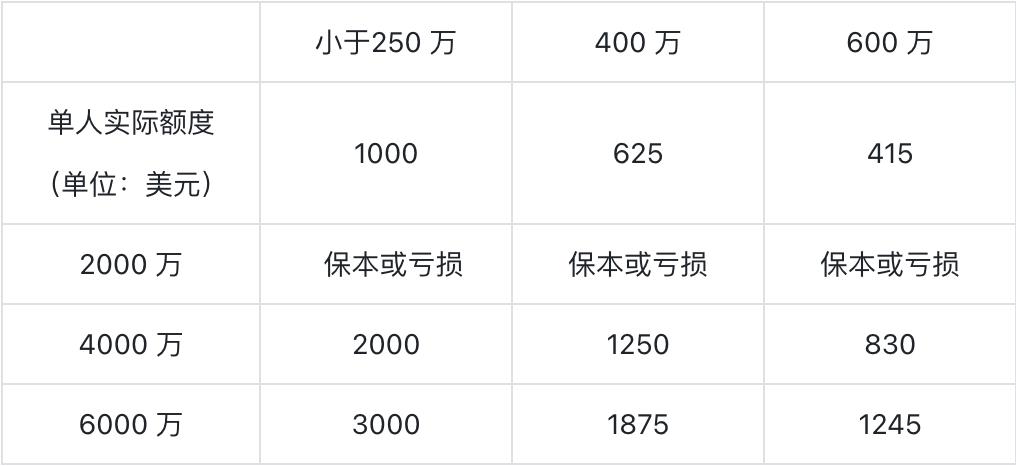
Based on Polymarket data, we present the expected returns for participants who invest $1,000 and do not consider those holding points (the first row is the total ICO investment amount in USD; the first column is the FDV one day after launch in USD; the middle value is the actual amount / expected return in USD):
What does Trove trade?
Platforms developed based on HIP-3 are all perpetual contract markets; the difference lies in the types of contracts traded.
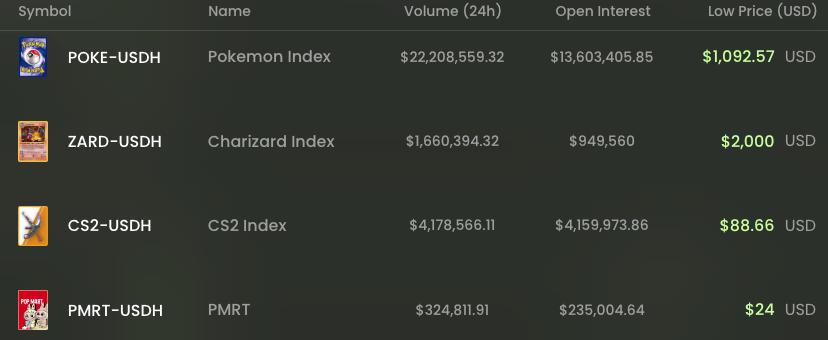
Trove offers a diverse range of trading instruments, essentially encompassing all on-chain assets unrelated to pure tokens, including collectibles, tokenized RWAs, and securities, with leverage up to 10x. Currently available on the testnet include the Pokémon Index (tracking the prices of 1559 Pokémon cards), CS2 (tracking the prices of over 25,000 items and accessories in CS:GO), Pop Mart stock price, and more, all denominated in USDH. Aside from this, the experience is identical to a normal order book perpetual contract market. Regarding its mentioned prediction market, the specific trading mechanism is currently unclear.
Like most projects in the HyperLiquid ecosystem, Trove does not publicly disclose information about its team members. The Trove X account's following list of only 10 people includes two users whose bios contain "Trove," but their identities cannot be determined from their tweets.
TROVE's token economic model
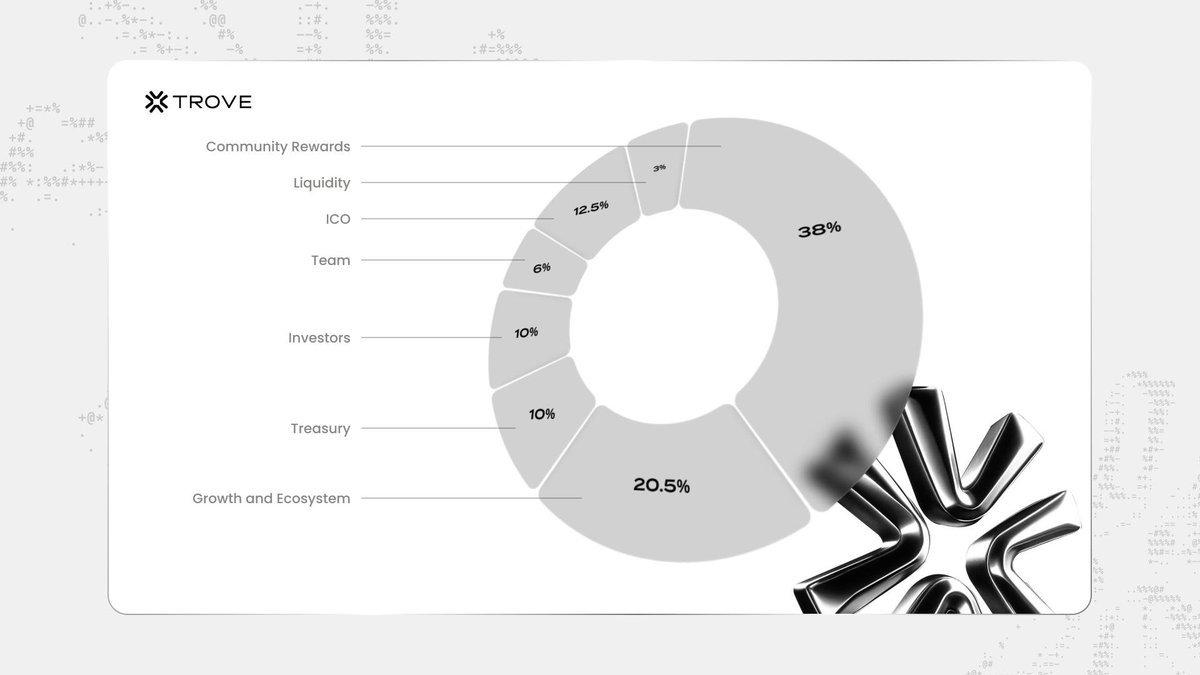
According to official information, the Trove team and investors will hold 6% and 10% of the total TROVE token supply, respectively, with nearly 60% of the tokens allocated for community rewards, ecosystem development, and overall growth. Regarding protocol revenue distribution, in addition to the 20% paid to the sponsor who contributed 500,000 HYPE tokens (mentioned above), 60% will be used for buybacks, and the remaining 20% will be split equally between protocol development and staking rewards.
Trove's roadmap indicates that it will launch mainnet and list three tradable assets before the end of February. The TGE of the TROVE token is expected to take place in the third week of January. Users do not need to claim the tokens; the purchased tokens and refunds will be sent directly to the user's address by Trove.
A "sincere" valuation
As a DEX with a clearly over $20 million investment, perp's opening price of $20 million FDV was not only unexpected, but also received a lot of approval for this "flat opening" strategy in the comments section of the Trove ICO rules tweet. As the first HIP-3 project to publicly conduct an ICO, Trove's performance may provide a model for future projects planning token fundraising.
No one can guarantee that in this market environment, there won't be another scenario where the price peaks immediately upon opening. Cautious investors may choose to wait for a lower price to buy the dips, but if you have enough confidence in the HyperLiquid ecosystem and believe that the on-chain perpetual contract casino business is "guaranteed to make money," this could be a good opportunity.
Finally, I would like to remind readers with caution that, given the team's anonymity, we cannot guarantee the fairness of this game. Investment involves risk, and choices should be made with care.