Author: Packy
Compiled by: TechFlow TechFlow
Hello friends,
Happy Friday! Today, let's talk about a16z.
Today, a16z announced that it has raised a new fund of $15 billion.
To commemorate this moment, I decided to write an in-depth analysis of the company. I interviewed a16z's general partners (GPs), limited partners (LPs), and the founders of the portfolio that manages approximately $200 billion in assets, reviewed relevant documents and presentation materials, and analyzed a16z's fund return data since its inception (see the disclosures in the appendix at the end of this article for details).
There are countless critical articles about a16z on the internet, and everyone is probably already familiar with the controversies. These criticisms have followed the company since its inception.
But I think instead of focusing on these criticisms, we should explore what these smart people who once correctly predicted the future are doing now.
To be honest, I'm not a completely neutral observer. Although I don't have an email address for a16z.com, my perspective is quite subjective.
For the past two years, I have served as an advisor to a16z Crypto (currently without receiving any compensation from the company). Marc Andreessen and Chris Dixon are limited partners at Not Boring Capital. I have occasionally appeared on investment projects with a16z. I maintain friendly relationships with many people at a16z and most of their new media team. I work with them and appreciate and respect them.
However, we don't expect me to assess whether a16z's current investment logic is worth betting on. After all, professional institutional limited partners have already provided the answer with $15 billion in funds. We need ten years to know if their decisions are correct, and neither my opinions nor those of any critics can change that outcome, just as has happened in the past.
But I hope to offer a unique perspective on what a16z truly is. I believe a16z is one of the best marketing firms in the venture capital world. It not only tells a story, but its story is highly consistent with its actions. a16z's external communications are perfectly aligned with the philosophy of its internal team training. Its pitch has been consistent from its very first fundraising prospectus. And you can judge for yourself by its return data.
There are many excellent venture capital funds and investors whose strategies and successes are gradually being understood and recognized by more and more people.
But what a16z does is different—more ambitious and bolder. Its style isn't like traditional venture capital. Part of the reason is that I feel a16z doesn't care whether it's doing "venture capital." Its goal is to build the future and devour the world .
Let's begin.
a16z: Power Broker
"Live in the future, the present is the past."
"My existence is a gift, a kiss on my back." —Kanye West, *Monster*
Andreessen Horowitz (a16z) heard your voice.
You said it's too high-profile and should "shut up and focus on its job" in politics. You said you disagree with one or two of its recent investments. You felt that quoting the Pope on Twitter (Xeet) was inappropriate. You even felt that its fund size was so large that it was impossible for it to generate reasonable returns for its limited partners (LPs).
a16z has heard these sounds, and has been hearing them for nearly twenty years.
Just like when Tad Friend, a writer for The New Yorker, had breakfast with Marc Andreessen while writing "Tomorrow's Advance Man" in 2015. Friend had just heard from a rival venture capitalist that a16z's fund size was too large and its shareholding percentages too small; to achieve a 5-10x total return for its first four funds, the total valuation of its portfolio would need to reach $240 billion to $480 billion.
“When I tried to discuss these numbers with Andreessen,” Friend wrote, “he made a dismissive gesture and said, ‘Nonsense, nonsense. We have all the models—we’re hunting elephants, chasing behemoths!’”
I hope you remember this image to prepare yourself for your possible reaction to the next paragraph.
Today, a16z announced that it has raised $15 billion in new funding across all its investment strategies, bringing its total assets under management (RAUM) to over $90 billion.
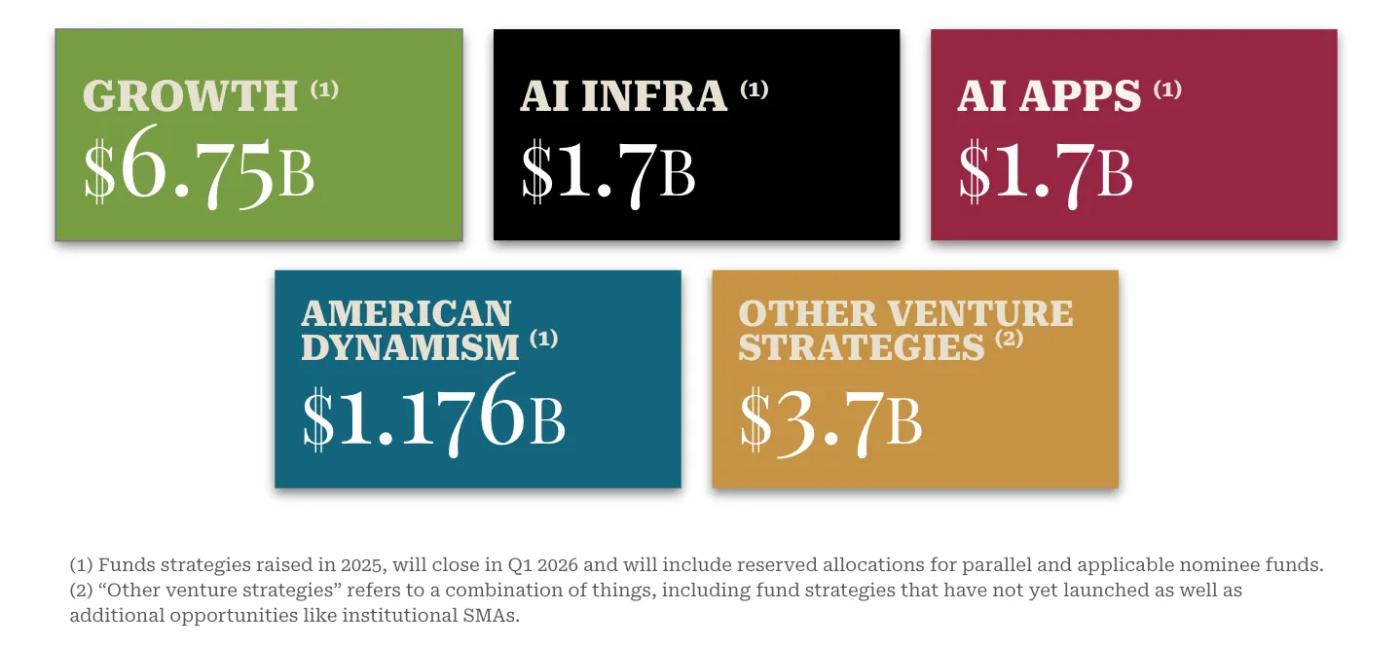
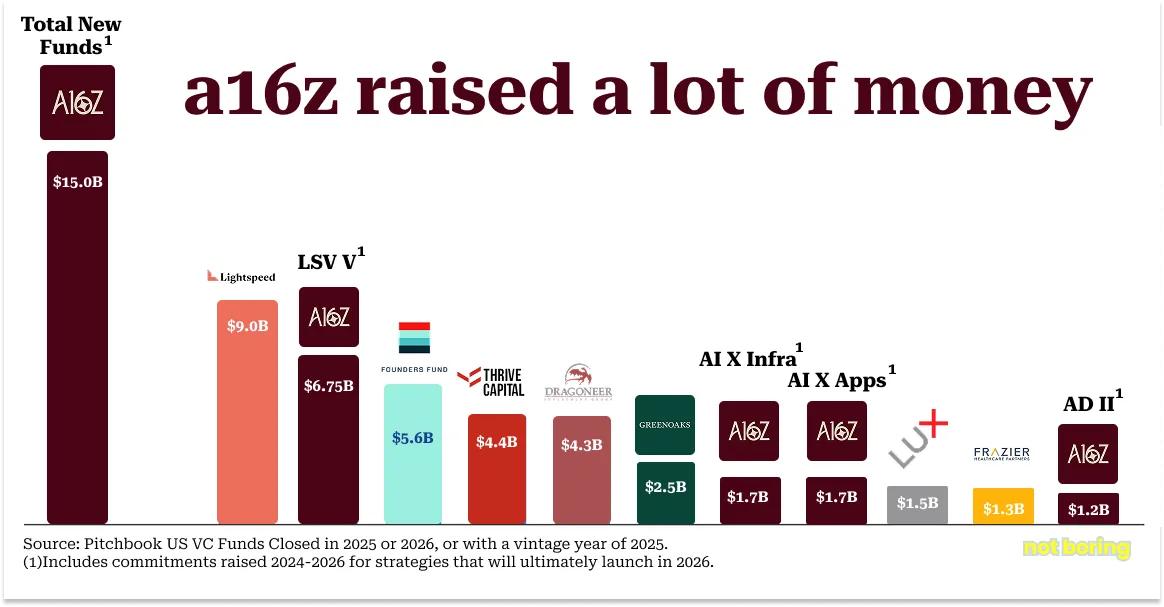
In 2025, the venture capital fundraising market was dominated by a few large companies, and a16z raised more than the combined total of Lightspeed ($9 billion) and Founders Fund ($5.6 billion), which ranked second and third respectively that year.
In what has been the worst venture capital fundraising market in the past five years, a16z is projected to account for over 18% of total U.S. venture capital fundraising in 2025. In a year where the average venture capital fund takes 16 months to raise capital, a16z completed its fundraising in just over three months.
If the funds raised this time were broken down, all four individual funds of a16z would rank among the top ten in terms of fundraising in 2025: Late Stage Venture (LSV) V would be second, Fund X AI Infra and Fund X AI Apps would be tied for seventh, and American Dynamism (AD) II would be tenth.
Some might say this is far too large a sum for a venture capital fund, making it nearly impossible to expect above-average returns. To that, I imagine a16z's collective response would be a dismissive gesture, saying, "Duh, duh." Because it's hunting elephants, chasing behemoths!
Today, a16z is an investor in 10 of the 15 most valuable private companies among all funds: including OpenAI, SpaceX, xAI, Databricks, Stripe, Revolut, Waymo, Wiz, SSI, and Anduril.
Over the past decade, a16z has invested in 56 unicorn companies through its fund, more than any other venture capital firm.
Its AI portfolio accounts for 44% of the value of all AI unicorn companies globally, more than any other company.
From 2009 to 2025, a16z led 31 early-stage rounds with final valuations of $5 billion, 50% more than its two closest competitors.
It has all the models, and now it also has a track record.
Below is the total portfolio value of a16z's first four funds: those that rival venture capitalists believed needed to reach between $240 billion and $480 billion to break the threshold. Ultimately, a16z's funds 1-4 have a total enterprise value of $853 billion at the time of allocation or the latest late-stage valuation.

And that was only at the time of the distribution. Facebook's market capitalization alone has increased by over $1.5 trillion since the distribution began!
This pattern seems to repeat itself: a16z makes bold, "crazy bets" on the future, decisions ridiculed as foolish by industry insiders. Years later, however, they prove to be far from foolish; in fact, remarkably visionary choices!
Following the 2009 global financial crisis, a16z raised its first fund of $300 million, proposing the idea of supporting entrepreneurs through an operating platform. "We visited many friends in the venture capital world, and most of them thought it was a foolish idea and advised us not to try it. They said this model had been tried before, but without success," Ben (Ben Horowitz) recalled. Today, almost every major venture capital firm has its own platform team.
That same year, a16z used $65 million from this fund, along with investors like Silver Lake, to acquire Skype from eBay for $2.7 billion. "Everyone said the deal wouldn't go through due to intellectual property risks" (eBay was then embroiled in a lawsuit with Skype's founders over technical issues). Less than two years later, Microsoft acquired Skype for $8.5 billion, proving a16z's foresight.
In September 2010, Marc Andreessen and Ben Horowitz raised $650 million in their second fund (Fund II) and began making large late-stage investments in companies such as Facebook ($50 million, valued at $34 billion), Groupon ($40 million, valued at $5 billion), and Twitter ($48 million, valued at $4 billion), betting on the reopening of the IPO market. At the time, a Wall Street Journal article, "A Venture-Capital Newbie Shakes Up Silicon Valley," mentioned that competitors were critical of a16z's strategy, arguing that private equity deals were not traditional venture capital business, and even the term "secondary market" was not mentioned in the discussions. Benchmark partner Matt Cohler went even further, stating, "You can make money investing in pork futures and oil futures, but that's not what we're supposed to do."
However, time has proven a16z's choice:
- In November 2011, Groupon went public with a valuation of $17.8 billion.
- In May 2012, Facebook went public with a valuation of $104 billion.
- In November 2013, Twitter went public with a valuation of $31 billion.
In January 2012, Marc and Ben raised $1 billion for their third fund (Fund III) and a $540 million Parallel Opportunities Fund. At this point, criticism shifted to the size of the fund. a16z's funds accounted for 7.5% of total venture capital funding in the US market in 2012, a time when the venture capital market was performing poorly. In 2012, data from the Cambridge Associates showed that the average return on venture capital was only 8.9%, far below the S&P 500's 20.6%. Legendary venture capitalist Bill Draper once said, "The general consensus in Silicon Valley regarding venture capital is that too many funds are chasing too few truly good companies." This situation is strikingly similar to the current one.
In 2016, The Wall Street Journal published an article titled "Andreessen Horowitz's Returns Lag Behind Venture Capital Elite," which David Rosenthal of Acquired called "clearly a smear campaign by a rival venture capital firm." The article pointed out that a16z's first three funds had been established for 7, 6, and 4 years, respectively. While the first fund (AH Fund I) entered the top 5% of venture capital funds, the second fund (AH II) only entered the top quartile, and the third fund (AH III) even slightly lagged behind the top quartile.
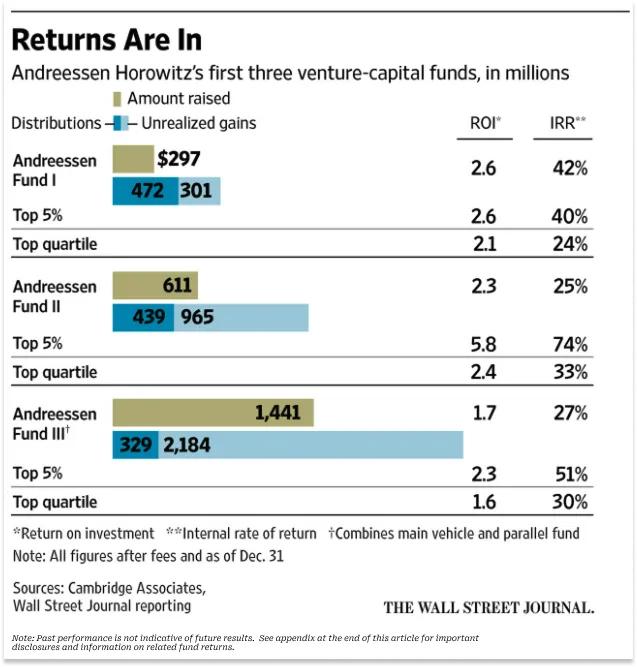
In retrospect, the criticism in this article seems particularly ironic, because AH III has now become a “monster fund”: as of September 30, 2025, its net TVPI (total return on capital, after fees) reached 11.3 times, and 9.1 times if parallel funds are included.
This fund's portfolio includes Coinbase (which generated a total return of $7 billion for a16z's LPs), Databricks, Pinterest, GitHub, and Lyft (although it didn't invest in Uber, this proves that the "original sin" of missing an opportunity can be more regrettable than the "mistake" of making a wrong decision). It's fair to say this fund is one of the best-performing large venture capital funds of all time.
Since the third quarter of 2025, Databricks (currently a16z's largest holding) has been valued at $134 billion, meaning AH III is now performing even better (assuming other holdings haven't depreciated). a16z has already distributed $7 billion in net proceeds to LPs through AH III and its parallel funds, and still has nearly the same amount of unrealized value.
The majority of the unrealized value comes from Databricks—a big data company. In 2016, when the Wall Street Journal questioned a16z, Databricks was a small company with a valuation of less than $500 million. Today, Databricks accounts for 23% of a16z's total net asset value (NAV).
Within a16z, you'll frequently hear the name Databricks. It's not only a16z's largest holding, but also one of the largest single holdings in the entire venture capital industry. Databricks' development is a classic example of a16z's operating model.
a16z's Databricks Success Formula
Before discussing Databricks, we need to understand some key points about a16z:
- Engineering Culture : The founders and managers of a16z are mostly engineers, which has influenced not only the company's design (centered on scale and network effects) but also its strategies for choosing markets and companies.
- Avoid "Second Place" : At a16z, the biggest investment taboo is betting on "second place." If you miss out on the early winners, you can reinvest later; but if you bet on "second place," you may miss out on the ultimate winner, even if that winner hasn't emerged yet.
- Generous support for the "winner" : Once the industry winner is identified, a16z's classic tactic is to provide unexpectedly large amounts of financial support, a strategy that is often ridiculed by outsiders.
These principles were established from the very beginning of a16z.
Back in the early 2010s, "big data" was a hot topic in the venture capital world, and the mainstream framework was Hadoop. Hadoop used MapReduce (a programming model developed by Google) to distribute computation across inexpensive server clusters instead of expensive dedicated hardware. It "democratized big data," spawning a wave of companies around this technology, such as Cloudera and Hortonworks. However, despite the unprecedented hype in the big data market, a16z failed to gain a foothold in this wave.
Ben Horowitz, the "z" in a16z, disliked Hadoop. Before becoming CEO of LoudCloud/OpsWare, Ben, a computer science graduate, didn't believe Hadoop would become the mainstream architecture of the future. Hadoop was notorious for its programming and management difficulties, and Ben believed it wasn't suitable for future development needs: in the MapReduce computation process, each step required writing intermediate results to disk, making recurring workflows like machine learning extremely slow.
Therefore, Ben chose to remain aloof from the Hadoop craze (Hadoopla). Marc, on the other hand, had reservations. As Jen Kha told me:
“Marc complained a lot to Ben at the time because Hadoop was making headlines. He said, ‘We messed up! We completely missed this opportunity! What a huge mistake!’”
Ben responded, "I don't think this will be the next architectural change."
It wasn't until Databricks appeared that Ben finally changed his mind. He said, "This might be the 'next one'." So, without hesitation, he placed all his bets on Databricks.
Databricks was born at the perfect time, its roots being in the University of California, Berkeley (UC Berkeley).
Ali Ghodsi's story begins with the Iranian Revolution of 1984. At that time, he and his family fled Iran and moved to Sweden. His parents bought him a Commodore 64 computer, which Ali used to teach himself programming. Eventually, his outstanding programming skills earned him an invitation to be a visiting scholar at UC Berkeley.
At Berkeley, Ali joined AMPLab (Algorithm, Machine, and Human Lab), becoming one of eight researchers, including his advisors Scott Shenker and Ion Stoica, to work on realizing doctoral student Matei Zaharia's dissertation ideas and to develop Spark—an open-source software engine for big data processing.
Their goal was to "replicate the achievements of large tech companies in neural networks, but without the complex interfaces." Spark set a world record for data sorting speed, and Matei's paper won the Best Computer Science Doctoral Dissertation Award that year. Following academic tradition, they released Spark's code for free, but almost no one used it.
So, starting in 2012, these eight researchers dined together several times and eventually decided to collaborate on starting a company based on Spark. They named it Databricks. Seven of the eight joined as co-founders, while Shenker served as an advisor.
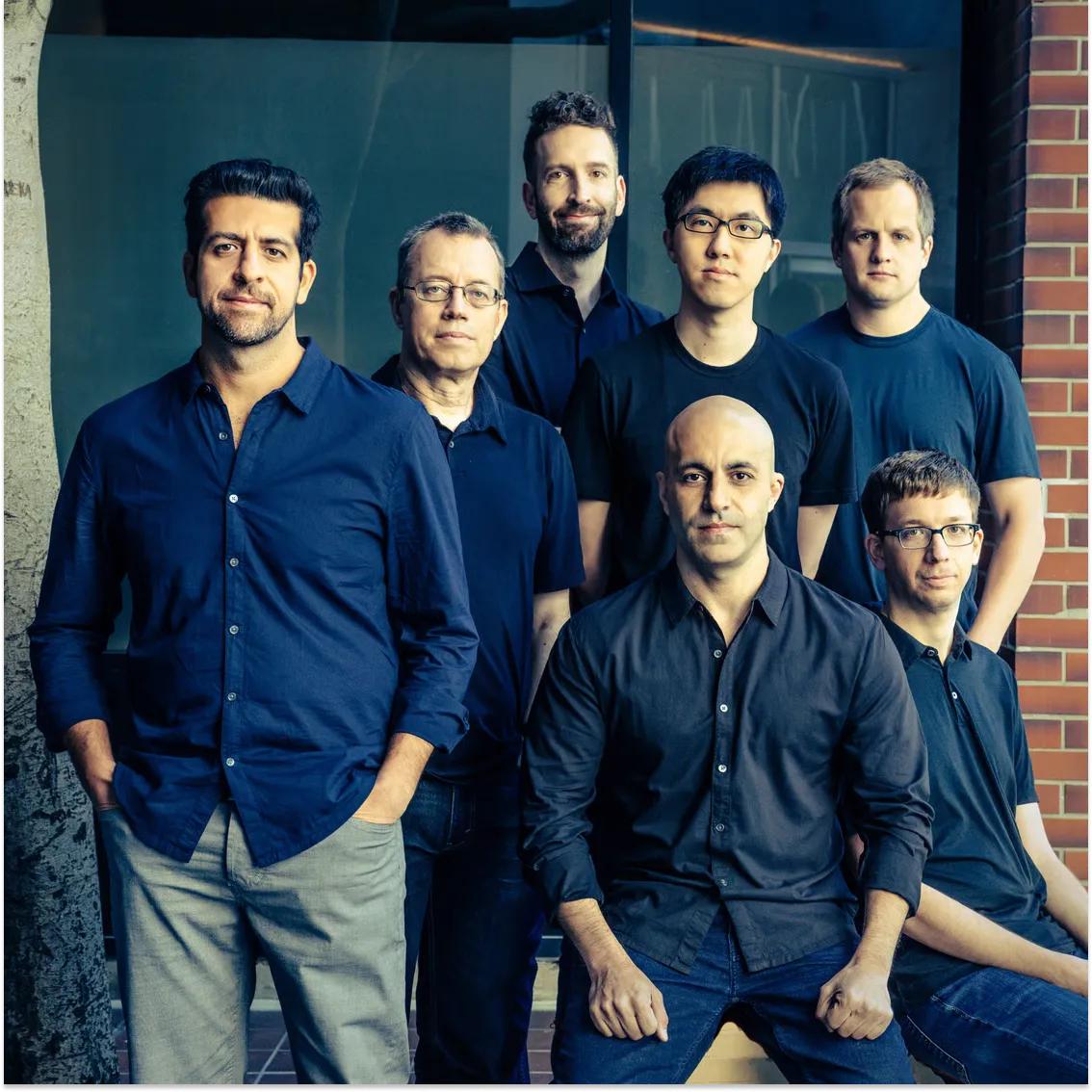
Picture: Databricks Cofounders - Ali Ghodsi seated in front ~ middle, Forbese
The Databricks team at the time felt they needed some funding—not a lot, but a little. As Ben recalled to Lenny Rachitsky:
“When I met them, they said, ‘We need to raise $200,000.’ I knew then that they had something called Spark, and their competitor was Hadoop. Hadoop already had well-funded companies pushing it, while Spark was open source and time was of the essence.”
He also realized that, as academics, the team might tend to do smaller things. “Professors… if you start a company and make $50 million, that’s a huge achievement. You’re a hero on campus,” he told Lenny.
Ben brought bad news to the team: "I'm not going to write you a $200,000 check."
But he also brought good news: "I will write you a check for $10 million."
His reasoning was that if you're going to start a company, "then you have to actually run a company. If you're going to do that, you have to go all out. Otherwise, you should stay in school."
They decided to drop out of school and start their own business. Ben increased his investment, and a16z led Databricks' Series A funding round, valuing the company at $44 million post-investment and acquiring a 24.9% stake.
This initial contact—Databricks originally only wanted $200,000, while a16z was willing to invest more—established a pattern: when a16z invests in you, they genuinely believe in you.
When I asked about the impact of a16z, Ali was blunt: “Without a16z, Databricks might not exist today. And especially Ben, I don’t think we could have made it this far. They really believed in us.”
In its third year, Databricks' revenue was only $1.5 million. "At that time, it was far from clear whether we would succeed," Ali recalled. "The only person who truly believed we could do great things was Ben Horowitz. He believed it more than we believed it ourselves. To be honest, much more than I believed it myself. That's his credit."
Belief is a cool thing. And it's even more valuable when you have the ability to make that belief a self-fulfilling prophecy.
For example, in 2016, Ali was trying to reach a cooperation agreement with Microsoft. In his view, the deal was a sure thing because Azure's demand for Databricks was so strong. He asked some venture capitalists to introduce him to Microsoft CEO Satya Nadella, and these venture capitalists did help with the introductions, but these introductions were "buried in the assistant's process."
Ben then formally introduced Satya to Ali. “I received an email from Satya saying, ‘We are very interested in establishing a very deep working relationship,’” Ali recalled. “He also added his deputies, and their deputies, to the email. Within hours, my inbox was flooded with over 20 emails from Microsoft employees I had previously tried to contact without success. Now they were all asking, ‘When can we meet?’ At that moment, I felt, ‘Okay, this time it’s different. This time it’s going to work out.’”
For example, in 2017, Ali wanted to recruit a senior sales executive to continue driving the company's growth. This executive wanted to include a change of control clause in the contract—meaning that if the company were acquired, the equity could be transferred more quickly.
This became a crucial point, so Ali asked Ben to help persuade the executive that Databricks was worth "at least $10 billion." After speaking with him, Ben sent Ali an email:
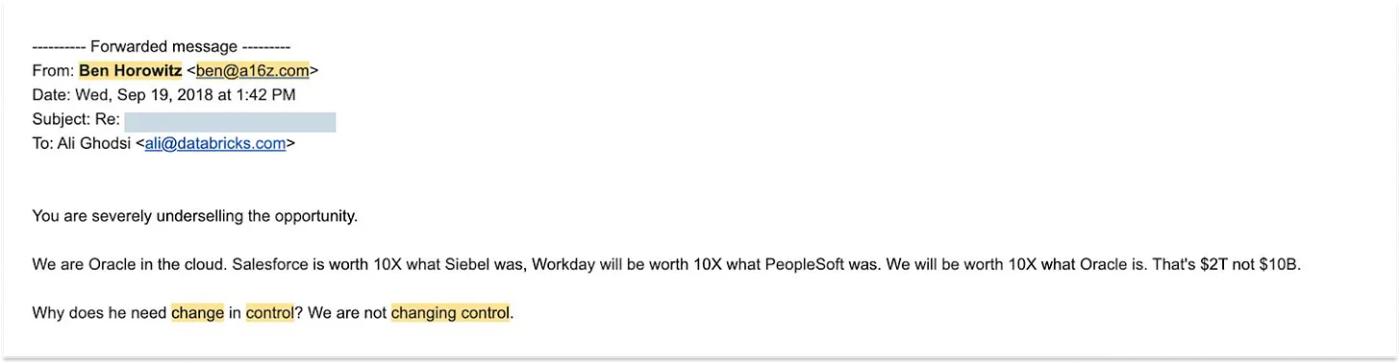
Photo: Ben Horowitz Email to Ali Ghodsi, September 19, 2018 courtesy of Ali Ghodsi
"You have seriously underestimated this opportunity."
We are the Oracle of the cloud. Salesforce's market capitalization is 10 times that of Siebel, Workday's market capitalization will be 10 times that of PeopleSoft, and our market capitalization will be 10 times that of Oracle. This is not $10 billion, but $2 trillion.
Why would he need a change of control? We will not change control.
This is perhaps one of the most hardcore emails in business history, especially considering that Databricks was valued at only $1 billion and had annual revenue of just $100 million at the time. Today, Databricks is valued at $134 billion and has annual revenue exceeding $4.8 billion.
“They saw the full potential of things,” Ali told me. “When you’re deeply involved, running the company every day, you see all sorts of challenges—deals don’t go through, competitors beat you, you run out of money, nobody knows who you are, employees leave you—it’s hard to think about the world that way in those situations. But they come to the board meeting and tell you, ‘You are going to conquer the world.’”
They were right, and their conviction paid off. In total, a16z participated in all 12 funding rounds of Databricks, leading four of them. This company was one of the reasons for the outstanding performance of a16z's third fund (AH 3), and also a major driver of returns for Late Stage Venture Funds 1, 2, and 4.
“First and foremost, they are genuinely very concerned about the company’s mission. I don’t think Ben and Marc see it primarily as a return on investment. That’s secondary,” Ali said. “They are people who believe in technology and want to use it to change the world.”
You can't truly understand a16z if you don't understand Ali's assessment of Marc and Ben.
What is a16z?
a16z is not a traditional venture capital fund. That's obvious! It just completed its largest venture capital fundraising since SoftBank's $98 billion Vision Fund in 2017 and Vision Fund II in 2019. But even though SoftBank's Vision Fund is still a fund, a16z is much more than that.
Of course, a16z also needs to raise capital and generate returns for its limited partners (LPs). So far, it has performed exceptionally well in this regard. We will share a16z fund return data later.
But first of all— what exactly is a16z?
a16z is a "belief movement" about technology. Everything it does is aimed at promoting better technological development, thereby creating a better future. It firmly believes that "technology is the glory of human ambition and achievement, the vanguard of progress, and the realization of potential." Based on this belief, all of a16z's actions revolve around this belief in the future, and it stakes everything on it.
a16z is a "firm," not just a fund. Its goal is to become stronger through scaling. Unlike traditional funds, a16z operates more like a business. As David Haber, a16z's general partner, explains: "A fund's goal is to generate the greatest returns with the least amount of manpower and the shortest amount of time. A firm's goal is to deliver superior returns while building a competitive advantage that can grow exponentially. Our focus is on how to become stronger, not weaker, as we scale up."
a16z is run by engineers and entrepreneurs. Traditional fund managers often try to get a larger share of a fixed "pie," while engineers and entrepreneurs tend to expand the "pie" by building and scaling better systems.
a16z is a "temporal sovereign" existing for the future. At its most ambitious, a16z saw itself as a peer of the world's top financial institutions and governments. It once stated its goal was to become the "JP Morgan" of the information age, but this may actually underestimate its true ambitions. If governments serve a specific space, then a16z serves the "large block of time"—the future. Venture capital is simply the way it has discovered to have the greatest impact on the future, and also the business model that best aligns with the returns from that impact.
a16z's mission is to create and deliver "power." It builds its power through scale, culture, networks, organizational infrastructure, and success stories, and then delivers that power to the tech startups in its portfolio through sales, marketing, hiring, and government relations. a16z's founders often say that it will do anything it can, and it seems like it can do a lot.
If you were to design an organization that believes "technology is eating up a market bigger than ever before," an organization that thinks "everything is technology," then you would be building a company that can provide "the power to win" for hundreds or even thousands of companies. And that organization might be like a16z.
Companies that have the potential to become the backbone of the economy often start small and vulnerable. They are fragmented, have different goals, and even compete with each other. They face current industry giants who are unwilling to relinquish market share.
No matter how promising a small company may be, it may not be able to hire the best recruiters to attract top engineers and executives. It may not be able to advocate for fair competition policies, nor may it have enough influence to make its voice heard in the world, let alone gain the legitimacy to sell its products to governments and large corporations.
For any small company, investing billions of dollars to build these capabilities and serve only itself makes no sense. But if these capabilities can be spread across all potential companies and cover trillions of dollars in future market value, then these small companies can possess the resources of large corporations. In this way, their success or failure will depend on the quality of their products, not the amount of resources they possess. They will be able to drive the future in the way it should.
What if you could combine the agility and innovation of a startup with the power and influence of a “time sovereign”?
This is the direction a16z has always strived for. It began this endeavor when it was still a startup.
Why Marc and Ben founded a16z: From market insights to industry disruption
In June 2007, Marc published an article titled "The Only Thing That Matters" on his blog, *Pmarca Guide to Startups*. While ostensibly advice for tech startups, it's more accurately seen as a guide to founding a16z. In it, Marc explored which of the three core elements for startup success—team, product, or market—was most important.
Entrepreneurs and venture capitalists would say it's the team, while engineers would say it's the product.
Marc, however, stated, "I personally choose the third viewpoint: I believe the market is the most important factor in determining the success or failure of a startup."
Why the market?
He wrote:
"In a great market—a market with a large number of real potential customers—the market will 'pull' products out of startups..."
Conversely, in a bad market, even if you have the best product and the strongest team in the world, it won't help—you're destined to fail...
In homage to Andy Rachleff of Benchmark Capital (who distilled this idea for me), let me state the 'Rachleff Rules for Entrepreneurial Success':
The number one killer of startups is the lack of market access.
Andy said this:
- When a great team encounters a bad market, the market wins.
- Even when a bad team encounters a great market, the market will still win.
- When an excellent team meets an excellent market, extraordinary things happen.
I think what Marc and Ben saw in venture capital was a huge market (nobody realized how huge) and a lot of terrible teams (nobody realized how terrible).
Between 2007 and 2009, Marc and Ben were contemplating their next move. As highly successful tech entrepreneurs, they had already achieved great things, but they still possessed an indomitable fighting spirit. And because of their success, they also had enough wealth to choose their next step at will.
But the question is, how?
As entrepreneurs and angel investors, Marc and Ben have come into contact with many “bad venture capitalists” and they think it might be interesting to compete with these people.
“From my perspective, for Marc, it wasn’t all about making money,” David Haber, a general partner at a16z, told me. “He’d been rich since he was 20. At first, it was probably more about ‘slapping Benchmark or Sequoia in the face.’”
However, venture capital has another advantage, one that few realized during the economic recession triggered by the 2008 financial crisis: it may be the world's greatest market. This is significant for Marc.
Of course, not all venture capital firms perform poorly. The two firms Marc wanted to criticize—Sequoia and Benchmark—actually performed exceptionally well (Marc even cited Andy Rachleff's perspective!), except that they tended to strip founders of control. For founders who wanted to retain control of their companies' fates, Peter Thiel founded Founders Fund in 2005 and launched the outstanding FF II fund in 2007, which ultimately generated a cash return (DPI) of $18.60 per dollar invested.
However, compared to today, the venture capital industry at that time appeared lazy and closed off, more like a workshop-style club.
Marc likes to tell a story about when he and Ben were considering starting a16z in 2009. He met with a general partner at a top venture capital firm who likened investing in startups to randomly grabbing sushi from a conveyor belt. Marc recalls the partner saying to him:
The venture capital industry is like going to a sushi boat restaurant. You just sit on Sand Hill Road in Silicon Valley, and startups will automatically come to you. If you miss one, no problem, because the next "sushi boat" will be right there. You just sit there, watch the sushi boats go by, and occasionally reach out and grab a piece of sushi.
This approach works well if the industry's ambitions are limited. Marc explained in an interview with Jack Altman's Uncapped: "This model can be sustained as long as the industry's ambitions are constrained."
But Marc and Ben's ambitions never faltered. In their company, the biggest "sin" was "missing an opportunity"—not investing in a great company. This was crucial for them because they saw that large tech companies would grow even larger as the market expanded.
“Ten years ago, there were only about 50 million internet users, and very few of them had broadband connections,” Ben and Marc wrote in their fundraising memo for Andreessen Horowitz Fund I in April 2009. “Today, there are about 1.5 billion people online, many of whom already have broadband connections. Therefore, the biggest winners in the industry, whether on the consumer or infrastructure side, are likely to be much larger than the most successful tech companies of the previous generation.”
At the same time, the cost and difficulty of starting a company have been greatly reduced, which means that more companies will emerge.
In a letter to potential LPs (limited partners), they wrote: "Over the past decade, the cost of developing a new technology product and at least getting it to the testing phase has dropped dramatically, now typically costing between $500,000 and $1.5 million, compared to $5 million to $15 million more than 10 years ago."
Finally, as companies transform from tool-based businesses into those directly competing with traditional enterprises, their own ambitions also grow. This means that every industry will become a technology industry, and every industry will therefore become larger.
Why was the market so good at that time?
Marc continued to explain:
“From the 1960s to 2010, venture capital had a set set of rules… The companies were basically tool companies, right? Like manufacturers of pickaxes and shovels. Mainframes, desktop computers, smartphones, laptops, internet access software, SaaS, databases, routers, switches, disk drives, word processors—these are all tools.”
But by 2010, the industry had undergone a permanent change… the big winners in the technology sector were increasingly moving directly into traditional industries.
Did a16z overpay for the startups at the time? Or was the price it paid reasonable relative to the companies' future potential?
From today's perspective, the latter is clearly more reasonable. What's impressive is that a16z had such foresight back then.
As they wrote, roughly 15 tech companies eventually reach $100 million in annual revenue each year, and these companies typically account for 97% of the total market capitalization of all companies founded that year in the public market—this is what we now know as the "Power Law." Therefore, a16z must do everything in its power to get involved in as many potential companies as possible and double or even triple its bets on the winners.
To achieve this, a16z needed to rethink how to build a different kind of company, rather than just a traditional fund, since at the time it only had two investment partners.
When sharing the basic terms of the AHI fund (target fund size of $250 million, of which the general partner has committed $15 million), Ben and Marc summarized their company strategy in one sentence.
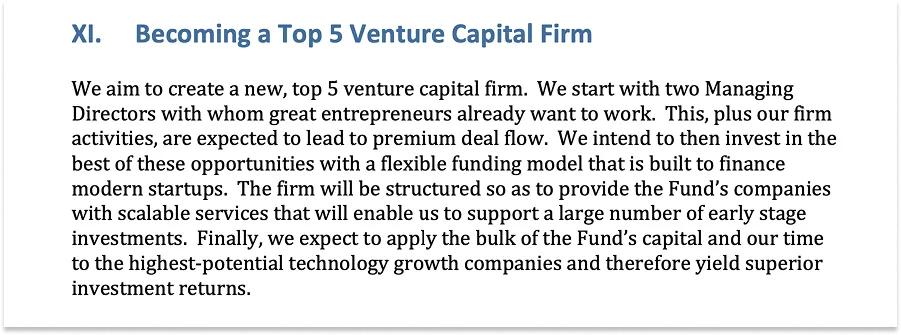
This strategy is still in effect today, even though a16z has far surpassed the initial goals of the two partners and the "top five".
The Three Eras of a16z
Since the inception of its first fund, a16z's core competitive advantage has been its unwavering belief in the future and its asymmetric confidence. This belief is not only a16z's core differentiator but also the source of all its other strengths.
As a16z’s ambitions, resources, fund size, and influence continue to grow, the way it leverages these advantages and the differentiation strategies it chooses are also constantly evolving.
The first era (2009 - c. 2017)
In the first era of a16z (2009-circa 2017), the core insight was: if "software is eating the world," then the best software companies would be more valuable than the market valued at the time.
This belief enabled a16z to employ the following three strategies to quickly rise from a new player to a "top five" company:
- Daring to invest at high prices
As mentioned earlier, a16z made some deals from early-stage funds that were considered by many at the time to be overpriced or contrary to traditional venture capital logic. In the Acquired podcast, Ben Gilbert noted, “The common criticism at the time was that they were paying too high a price for the chance to win, or that they were buying their reputation.” However, he also pointed out that this approach was rational at the time. He added, “Does anyone today think any of their investments between 2009 and 2015 were overvalued? Absolutely not.” As Ben Horowitz explained in a 2014 Harvard Business School case study, “Even at valuations of billions of dollars, investors may still be underestimating the company’s potential.” And this underestimation is precisely a16z’s strength.
- Building operational infrastructure that is considered "wasteful"
a16z built a comprehensive service team, recruited partners, and established a corporate briefing center—expenses that seemed like extra costs for a fund manager at the time. But if you believed the companies in your portfolio could define a category and needed enterprise-level resources to win Fortune 500 contracts, then these expenditures were justified. They were preparing for a future where startups needed to look like truly large corporations.
- Viewing tech founders as a scarce resource
a16z bet on the idea that as companies become cheaper and easier to build, tech geniuses without traditional management experience can and will create more significant companies. Therefore, a16z went to great lengths to attract and support these founders, introducing the CAA (Creative Artists Agency) model to the venture capital field. "Founder-friendly" is now an industry trend, but at the time, it was truly a novel concept.
In the first era, the most important thing was to invest in the right companies and profit from their success, as a16z envisioned. While they did focus on helping the founders, they were primarily taking advantage of arbitrage opportunities in the market at the time.
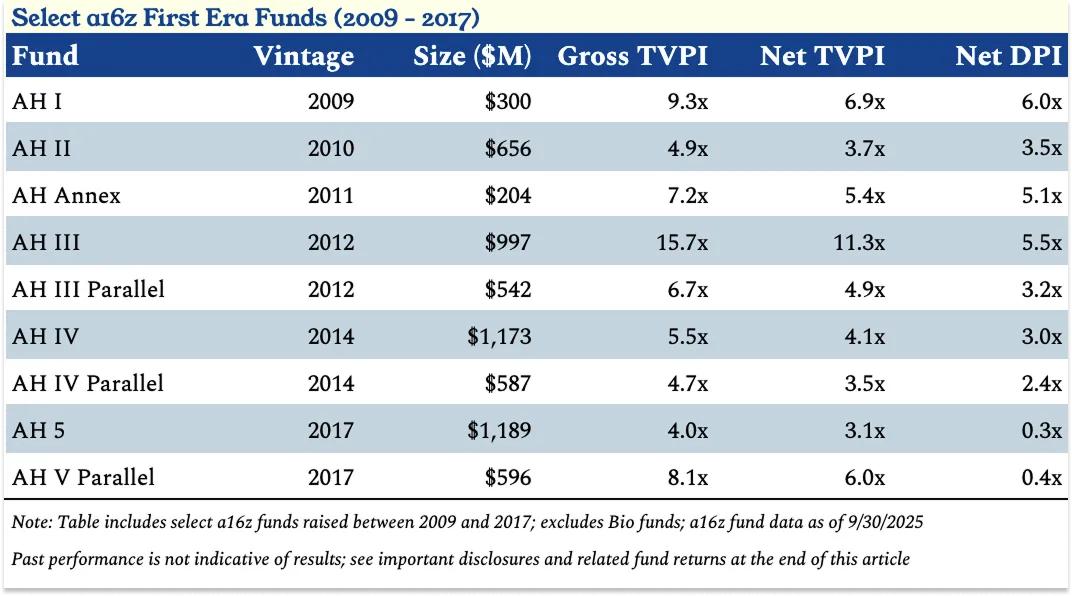
The AH III fund has garnered attention for its investments in Coinbase and Databricks, but its long-term stable performance is even more noteworthy.
David Clark, Chief Investment Officer at VenCap, stated, “As a limited partner (LP), we are satisfied with a consistent return of 3x net TVPI (total value to paid-up capital), and occasionally even more than 5x net TVPI. This is exactly what a16z delivers. a16z is one of the few companies that can consistently deliver this performance while scaling.” This is clearly evident in its performance data.
If the strategy of making a name for itself through "high-priced investments" in the first era was a long-term return strategy, then this strategy does not seem to have brought much cost in the short term.
The Second Era (2018-2024): From Top 5 to Industry Leaders
In the second era of a16z (2018-2024), its core belief is that the winners in the technology sector are bigger than anyone expected, and they have been privatized for longer than ever before. At the same time, technology is devouring more industries, which is something that people have not yet fully realized.
This belief enabled a16z to take the following three steps to leap from a “Top 5 venture capital firm” to an industry leader:
Raise a larger fund
In its first phase, a16z raised $6.2 billion through nine funds. In its second phase, in just five years, a16z raised $32.9 billion through 19 funds. Traditional venture capital holds the view that the larger the fund, the more likely the returns are to decline. But a16z holds the opposite view: if the maximum return on investment is increasing, then you need more capital to maintain a meaningful shareholding through multiple rounds of financing. Marc often says, "You can only lose a maximum of 1x your investment, but your upside potential is virtually unlimited."
Breaking away from the single-fund model and moving towards diversification
In its first phase, a16z primarily raised core funds and later-stage follow-on investments, with all general partners (GPs) investing from the same fund, although each had different areas of focus. Additionally, it raised a Bio Fund focused on the biotech sector, as biotechnology is a completely different field.
In the second era, a16z began to operate in a decentralized manner.
- In 2018, a16z launched its first cryptocurrency-focused fund, CNK I, led by Chris Dixon.
- In 2019, a16z recruited LSV (Late Stage Ventures) fund led by David George, which focuses on late-stage venture capital, and raised LSV I (US$2.26 billion), the largest fund at the time, almost twice the size of any previous a16z fund.
- During this period, a16z raised new funds in its core fund, cryptocurrency fund, biotech fund, and LSV fund, and also launched a seed-stage focused fund ($478 million AH Seed I) and a gaming-focused fund ($612 million Games I) in 2021. In 2022, a16z launched its first cross-strategy fund ($1.4 billion 2022 Fund), allowing LPs to invest proportionally in all funds for that year.
While individual funds can leverage the company’s centralized resources (such as the investor relations team), each fund has designed its own dedicated platform teams tailored to the specific needs of its vertical sector, including marketing, operations, finance, events, and policy.
Holding shares in leading companies for longer
In the second era of a16z, leading companies began to remain private for longer periods and raise more capital in the private market, whether for primary financing for company growth or secondary market financing to provide liquidity for employees and early investors.
Matt Cohler likened a16z's purchase of late-stage Facebook shares on the secondary market to "investing in pork futures," a strategy that became commonplace during this period. Companies like Stripe, SpaceX, WeWork, and Uber achieved similar liquidity in the private market to the public market.
This presents a challenge for the industry: limited access to liquidity for LPs disrupts capital allocation cycles. However, it's a golden opportunity for companies that believe tech companies will grow larger and are willing to hold for the long term. It offers a chance to invest more in high-quality private companies and bring returns that would otherwise belong to public market investors into the private market. I believe this shift is one of the key reasons why venture capital firms like a16z have been able to maintain high returns while scaling up.
In response to this change, a16z has taken the following measures:
- Becoming a Registered Investment Advisor (RIA) grants the freedom to invest in cryptocurrencies, publicly traded stocks, and secondary markets.
- Under David George's leadership, the aforementioned LSV I fund was launched. In its second phase, the LSV fund accounted for $14.3 billion of the $32.9 billion raised by a16z.
- The cryptocurrency fund split into a seed-stage fund ($1.5 billion) and a late-stage fund ($3 billion) in its fourth fund.
The following are the top ten investments of each LSV fund based on the most recent post-money valuation or current market capitalization:
LSV I: Coinbase, Roblox, Robinhood, Anduril, Databricks, Navan, Plaid, Stripe, Waymo and Samsara.
LSV II: Databricks, Flock Safety, Robinhood (which has exited the public market and reinvested the proceeds in more Databricks), Stripe, Deel, Figma, WhatNot, Anduril, Devoted Health, and SpaceX.
LSV III: SpaceX, Anduril, Flock Safety, Navan, OpenAI, Stripe, xAI, Safe Superintelligence, Wiz and DoorDash.
LSV IV: SpaceX, Databricks, OpenAI, Stripe, Revolut, Cursor, Anduril, Waymo, Thinking Machine Labs and Wiz.
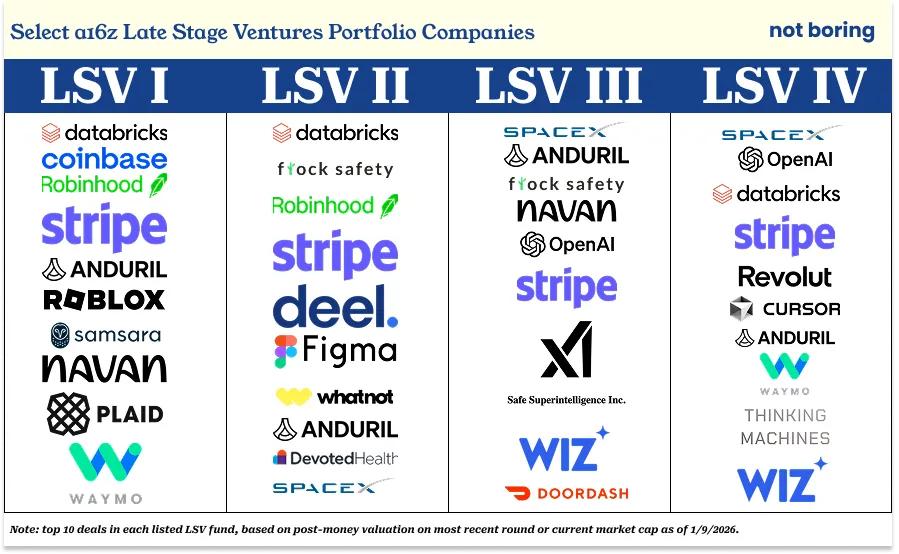
If a16z has been criticized for "spending a lot of money to buy logos of famous companies," then the company logos it has chosen are clearly second to none. According to Cambridge Associates' data for the second quarter of 2025, LSV I ranked in the top 5% of its funds that year, while LSV II and LSV III ranked in the first quartile of their respective years.
As of September 30, 2025, LSV I had a net TVPI of 3.3x, LSV II had a net TVPI of 1.2x (this figure may have been higher with the recent funding rounds for Databricks and SpaceX), and LSV III had a net TVPI of 1.4x (this figure may also be further increased after SpaceX completes a major secondary market transaction with an $800 billion valuation).
By firmly believing that the future potential of these iconic companies far exceeds most people's expectations (although not everyone underestimates them, such as Founders Fund's investment in SpaceX and Thrive's investment in Stripe), a16z has been able to invest more in these top private technology companies.
More importantly, a16z began to demonstrate that, under the right conditions, growth-stage funds can achieve returns similar to those of early-stage venture capital. According to an analysis by one of a16z's LPs, companies with strong early-stage investment capabilities can achieve not only venture capital-like returns but also higher internal rates of return (IRR) by continuing to invest in them during their growth stages. Furthermore, deep relationships with these companies can further enhance a16z's influence.
In the second phase, a16z's core belief is to hold as many shares as possible in leading companies. This is easier to achieve if one can better understand the companies from early investments and continue to add to or correct early investment mistakes through dedicated later-stage funds (although this is still not a controlling investment like in other asset classes).
This strategy is essentially a form of arbitrage, but I believe that in this era, a16z has put in more effort to ensure the success of the companies in its portfolio.
Although returns from the second generation are still in their early stages, they have already outperformed those of first-generation funds at similar stages. According to the Wall Street Journal, first-generation funds underperformed in their early stages, while second-generation funds have performed exceptionally well.
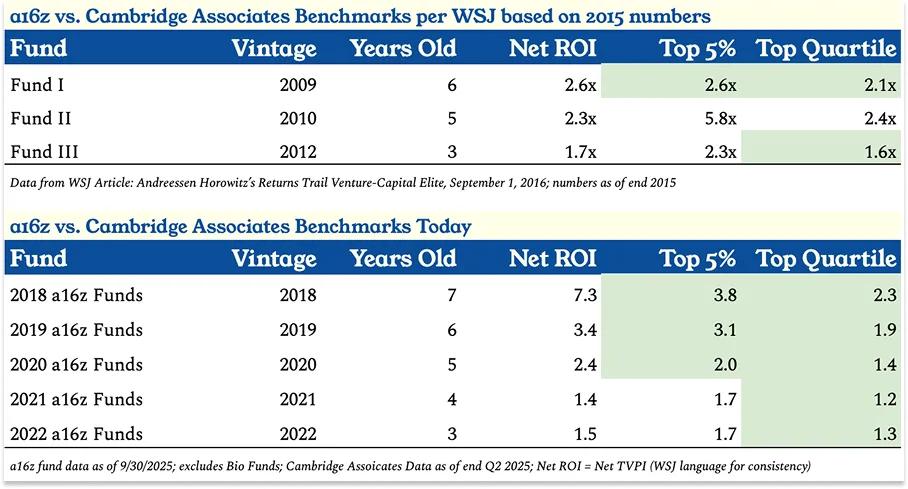
- The fund's net TVPI in 2018 was 7.3 times.
- The fund's net TVPI in 2019 was 3.4 times.
- The fund's net TVPI in 2020 was 2.4 times.
- The fund's net TVPI in 2021 was 1.4 times.
- The fund's net TVPI in 2022 was 1.5 times.
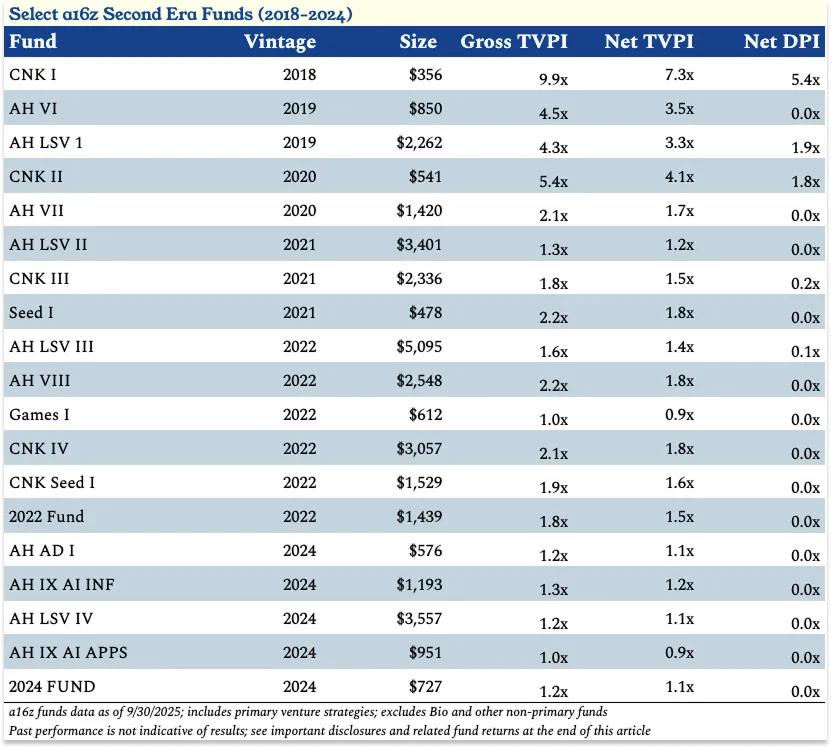
Of particular note in this era is the outstanding performance of cryptocurrency funds (CNK 1-4 and CNK Seed 1). CNK 1 has already delivered a net DPI (distribution payout ratio) of 5.4x for its LPs.
Even more surprisingly, despite criticism that a16z raised $3 billion for CNK IV in 2022 too large and at a bad time, the fund’s net TVPI has reached 1.8 times to date.
The two highlights of the second era—the LSV Fund and the Crypto Fund—demonstrate a16z's dual belief in the future: the LSV Fund responds to the trend of longer company privatization periods and greater demand for capital in the private market. The Crypto Fund embodies the idea that innovation and returns can come from entirely new areas, rather than traditional investment fields.
These highlights also reflect a16z's need to expand in creating more value for its portfolio companies and the industry as a whole. To help later-stage companies thrive, a16z needs to replicate some of its public market advantages in the private market. And to ensure the survival of cryptocurrency in the US and to ensure all emerging technology companies have a level playing field against established players, a16z needs to move into Washington.
a16z's core belief for its third era is that emerging technology companies will not only reshape every industry, but will also dominate them, provided they are given the opportunity. a16z must lead the entire industry and the nation in the right direction.
This belief has once again changed the nature of a16z. With the scale expanding (the new $15 billion fund can serve as a landmark), simply "picking winners" is no longer enough.
a16z must create winners by shaping a competitive environment.
As Ben said, "It's Time to Lead."
The Third Generation of a16z: It's Time to Lead the Future
At this stage, you might imagine an analyst from a competing venture capital firm texting journalist Tad Friend, saying, "To achieve a 5-10x total return on your new $15 billion fund, you'd have to make the entire U.S. tech industry several times larger than it is now."
And Marc and Ben's answer, as you can imagine, was: "That's right."
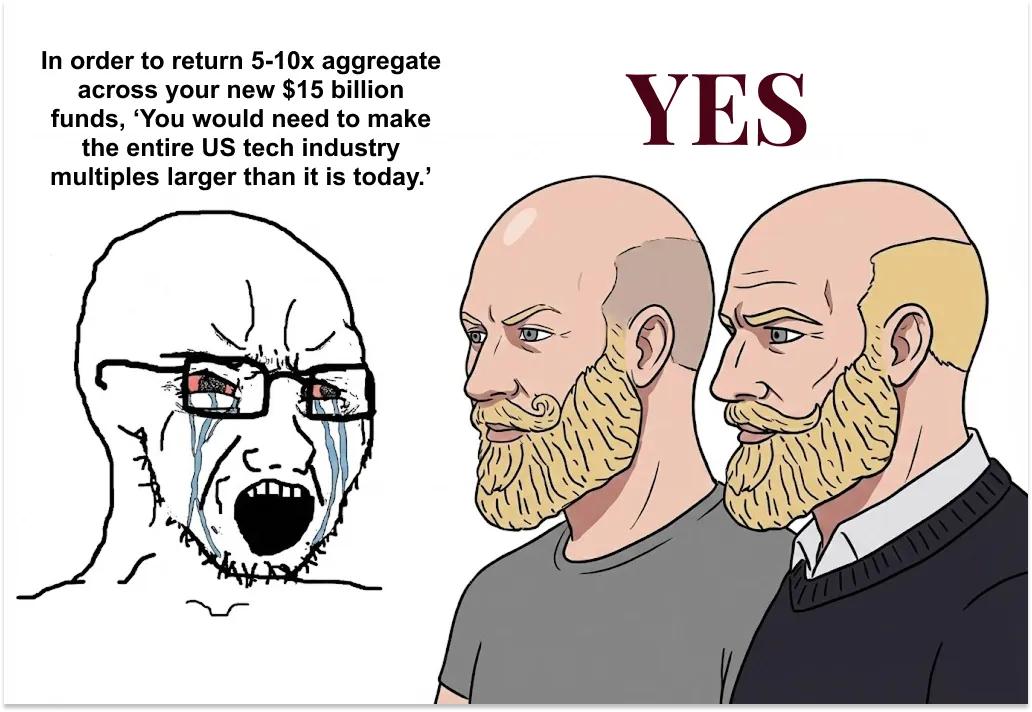
This is a16z's explicit plan, and its logic is as follows:
Since 2015, a16z has invested in more unicorn companies at an early stage than any other investor, and the gap between it and Sequoia Capital, which ranks second, is even equivalent to the gap between Sequoia and the 12th-ranked Sequoia.
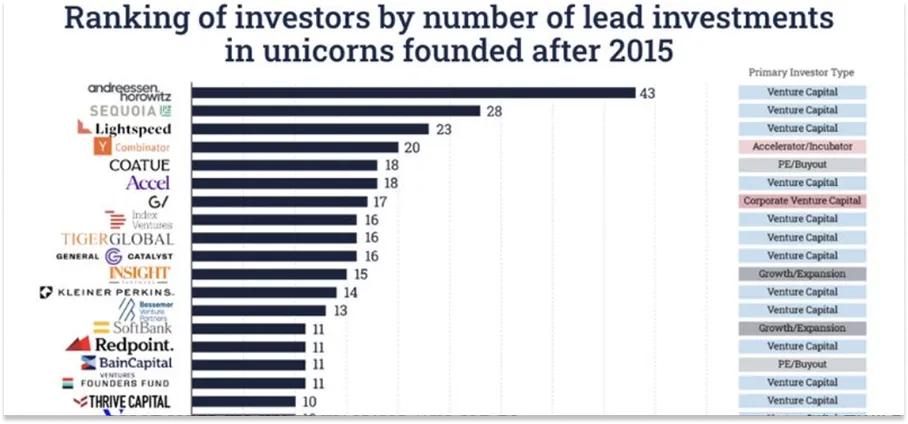
Data source: Stanford University Professor Ilya Strebulaev
Judging "best VCs" by "the number of companies they invest in at an early stage that eventually become unicorns" is undoubtedly a very specific and favorable metric for a16z. More common metrics might be return multiples, IRR (Internal Rate of Return), or total cash allocated to LPs. Others might focus on metrics like hit rate or sustainability. There are many ways to slice and analyze VC rankings.
However, this way of judging seems to align with a16z's view of the world. During my conversations with the a16z crypto team, one point I repeatedly heard was: it's okay to bet on a field because many smart entrepreneurs are exploring it, even if the judgment is wrong. But it's unacceptable to choose the wrong company within that field, or to miss out on the ultimate winner for any reason. As Ben said:
“We know that starting a company is inherently a high-risk endeavor, so if we follow the right processes and conduct appropriate risk assessments when investing, we won’t worry about investments that fail. On the other hand, we would be very worried if we misjudge whether an entrepreneur is the best in their field.”
If we misjudge an emerging field, that's fine. But if we choose the wrong entrepreneurs, that's a big problem. And if we miss out on the right entrepreneurs, that's also a big problem. Losing a groundbreaking company, whether due to conflict or missed opportunity, is far worse than investing in the best entrepreneur in a field we misjudged.
According to a16z's own assessment of "the most important thing," it has become a leader in the venture capital industry.
“So what’s next?” Ben asked. “What does it mean to lead an industry?”
In the X article announcing the $15 billion funding round, he replied, "As a leader in the U.S. venture capital space, the fate of emerging technologies in the U.S. rests in part on our shoulders. Our mission is to ensure that America wins the technological competition of the next 100 years."
This is an unusual self-positioning for a venture capital firm.
But if you accept the following premise:
- Technology is the engine of progress;
- The United States’ continued leadership depends on its technological advantage;
- a16z is the largest and most influential backer of emerging American technology companies, possessing sufficient capability and resources to help them gain a fair chance in competition with traditional giants—so such a positioning is not entirely unreasonable.
To win the technological competition of the next 100 years (which, in a16z's view, is equivalent to winning the overall competition of the next 100 years), Ben believes a16z must achieve victory in key new technological architectures—such as artificial intelligence (AI) and cryptocurrencies. Subsequently, these technologies need to be applied to the most critical areas, such as biology, defense, health, public safety, and education, and even integrated into the government system.
These technologies will dramatically expand market size. As I argued in *Tech is Going to Get Much Bigger* and *Everything is Technology*, this means that industries and tasks previously outside the reach of technology can now become target markets for technology. This also means a significant increase in Venture Capital Addressable Value (VCAV) .
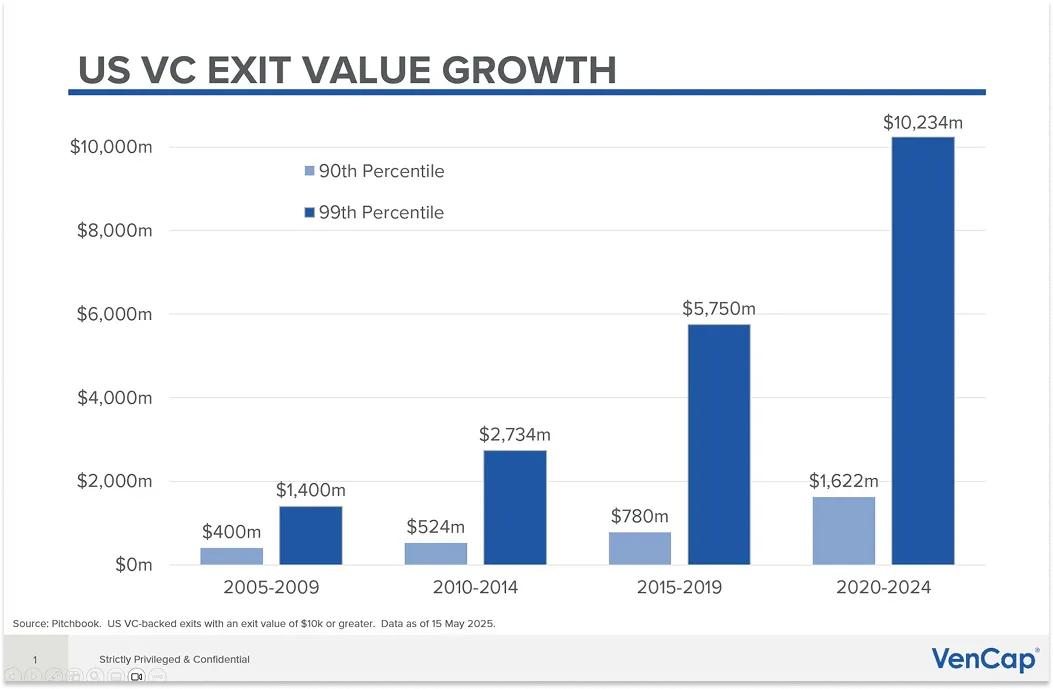
This is a continuation of the gamble a16z has been making, but with a significant shift in belief: if a16z fulfills its responsibilities as a leader, this value will be unlocked, and the future of America (and the world) will be secured.
The concrete implementation of this belief includes the following five aspects:
- Make America Great Again
- Filling the gap between private and listed company construction
- Pushing Marketing into the Future
- Embrace new ways of building a company
- Continue to shape culture while expanding capabilities.
Many of a16z's seemingly perplexing actions are actually in service of these five objectives.
Of particular note is a16z's more active involvement in politics over the past two years. Marc and Ben's public endorsement of President Trump in the last election sparked considerable controversy. Some argue that venture capital funds should not interfere in national politics.
But a16z holds the exact opposite view and is clear in its stance: it wants to "make American technology policy great again."
Marc and Ben articulated this position in "The Little Tech Agenda," the core points of which can be summarized as follows:
- Emerging technology companies are crucial to a nation's success.
- To win the future, we need laws, policies, and regulations that support innovation, while also preventing large corporations from exploiting their resource advantages to capitulate regulators.
- But the reality is quite the opposite: "We believe that poor government policies are now the number one threat facing 'small tech'."
- In government, no one is speaking up for emerging tech companies or standing up to traditional giants: large corporations won't do it, and startups shouldn't be wasting their limited resources on it.
- Venture capital firms benefit from the success of emerging technology companies, so they should be the main force in this struggle, and as the leader of the venture capital industry, this responsibility naturally falls on a16z's shoulders.
a16z has made it clear that it is a supporter of a single issue, that "small tech" is its only concern, and that it is bipartisan.
a16z's fundamental principles are: "We will not participate in political struggles unrelated to 'small tech'" and "We support or oppose politicians, regardless of their party affiliation or their stance on other issues." From my observations at a16z, these principles are absolutely true.
a16z wasn't involved because it was "politically interesting" (although Marc seems to genuinely enjoy the process). Instead, a16z is willing to endure criticism and questioning in the short term in order to help emerging technologies thrive in the long term.
As former Benchmark partner Bill Gurley noted in his article "2,581 Miles," for a long time, the tech industry could largely ignore Washington, and Washington could ignore tech. However, this changed a few years ago, partly due to the tech industry's shift from toolmaking to competing with traditional giants. Cryptocurrency was the first sector to face an existential threat.
When a16z first entered Washington, D.C., "small tech" companies had no representation there. Big tech companies had their own lobbyists and networks, and traditional giants—banks, defense companies, etc.—had their own resources. But "small tech" companies (including those in the cryptocurrency space) had no representation. Aside from Coinbase, a possible exception at the time, no company could afford the cost and infrastructure to establish a presence in Washington or any of the state capitals across the country.
Therefore, in October 2022, a16z's cryptocurrency division appointed Collin McCune as head of government affairs to begin educating U.S. politicians about cryptocurrency. Collin, Chris Dixon, Miles Jennings, general counsel for a16z's cryptocurrency division, along with other team members and cryptocurrency founders in the industry, traveled to Washington multiple times to explain to politicians how cryptocurrencies work, their potential development prospects, and the risks that improper regulation could lead to the demise of emerging technologies.
This effort has paid off. Thanks to the combined efforts of a16z and the bipartisan Fairshake SuperPAC, cryptocurrencies are no longer facing an existential threat from legislation. Last year, President Trump signed the GENIUS Act, the first regulation of crypto stablecoins in the United States. Furthermore, comprehensive market structure legislation passed the House of Representatives with overwhelming bipartisan support and is currently under consideration in the Senate, with the expectation of passing and being signed into law later this year.
This experience is particularly valuable as artificial intelligence becomes a hot topic in Washington. Collin McCune currently leads a16z's government affairs practice, based in Washington, and is responsible for matters covering areas such as artificial intelligence, cryptocurrency, and dynamic innovation in the United States. Currently, a16z is advocating for comprehensive federal AI standards to avoid chaos caused by competing regulations among states and to promote other policies that support innovation.
Although the term “lobbying” often carries a negative connotation, the reality is that competitors in the “small tech” sector already have sophisticated government affairs and policy teams that attempt to block new entrants from gaining a foothold in a level playing field by capturing regulators.
a16z aims to break down this inequality and help "small tech" thrive in a challenging environment. Through its efforts in areas such as technology policy, cryptocurrency, and artificial intelligence, a16z is not only protecting the development of emerging technologies but also paving the way for the future of American technology.
To win the competition in future technologies and ensure that the a16z (Andreessen Horowitz) fund yields returns, staying away from politics is no longer an option. The good news is that, as a company that needs to constantly drive the creation, growth, and success of new companies to sustain itself, a16z is more motivated than any other organization to maintain a level playing field for innovation.
Even at this stage, a16z admits that it doesn't know which companies will emerge in the future, or how they will be structured.
Embracing this new model of company building means accepting the idea that, with the help of artificial intelligence, entrepreneurs may need only one-tenth or even one-hundredth of the staff they used to have to create a company, and that the elements of building a great company may be vastly different from the past. This also means that a16z itself needs to adapt to this change.
For example, a16z launched an accelerator program called Speedrun, which provides startups with up to $1 million in funding and runs a 12-week incubation program. This allows a16z to learn about how these new companies are structured earlier and gain in-depth knowledge of each specific company, enabling it to make smarter follow-on investments in winners.
However, this also comes with risks: increasing the number of companies endorsed by a16z while lowering the barrier to entry could dilute the brand's credibility. For example, a16z faced criticism on Twitter for Speedrun's endorsement of Doublespeed. Doublespeed describes itself as "Synthetic Creator Infrastructure," but others refer to it as a "phone farm" or "Spam as a Service."
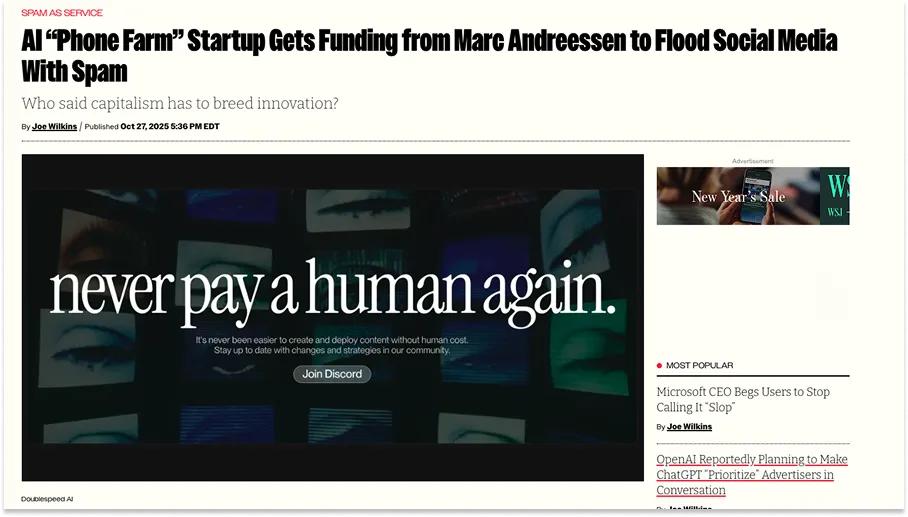
Image: Futurism
From a futuristic perspective, the narrative of this situation—"receiving investment from Marc Andreessen"—is quite interesting, because Marc doesn't personally approve investment applications under $1 million in Speedrun. In fact, each Speedrun check represents only about 0.001% of a16z's total assets under management (AUM). But this precisely reflects the core of the issue. I saw this a16z-backed company mentioned multiple times on Twitter until I guessed it might be part of the Speedrun project and verified it. Most people wouldn't take the time to do such research.
Another, more controversial example is Cluely, a startup that promised to help customers “cheat on everything.” a16z even led a $15 million investment round in Cluely through its AI Apps Fund.
People naturally question why a company like a16z, dedicated to shaping America's future, would invest in a startup that prioritizes viral marketing over ethical considerations. Could Cluely's existence, at least in the eyes of highly online audiences, undermine the credibility of the other portfolio companies?
Very likely. Personally, I don't like it. The atmosphere is off; it seems somewhat undignified.
But! It does indeed conform to internal logic.
Because, setting aside the actual products, Cluely's core idea is that in the age of artificial intelligence, there is a completely new way of building a company: it assumes that the capabilities of the underlying models are converging and becoming commoditized, and that distribution channels will become the only thing that matters, and that it doesn't matter if some controversy is caused in order to acquire distribution channels.
If you're willing to embrace this new way of building a company, then spending $15 million and generating some controversy on Twitter for the opportunity to get a close look at this most innovative business model isn't a high price to pay.
More broadly, in the venture capital industry where a16z operates, occasionally appearing somewhat foolish is the price to pay for avoiding a "Kodak-style" failure. You need the courage to take risks, and risk-taking isn't just about investing capital. For a company the size of a16z, a small loss of funds is actually the least risky.
However, some argue that from a broader perspective, the minor dispute over X (a company in a16z's portfolio) is insignificant. Katherine Boyle, a general partner at a16z and co-founder of the firm's American Dynamism practice, expressed a similar view when I mentioned this to her:
"You could say, yes, maybe we get some criticism on Twitter because of certain companies, because some people—maybe certain group