Interview: The Round Trip
Compiled & edited by: Yuliya, PANews
In the increasingly competitive DEX sector, liquidity and user experience are becoming the scarcest and most valuable core elements globally. Following Aster's TGE completion and explosive growth a few months ago, this DEX, invested in by YZi Labs, has garnered even greater attention.
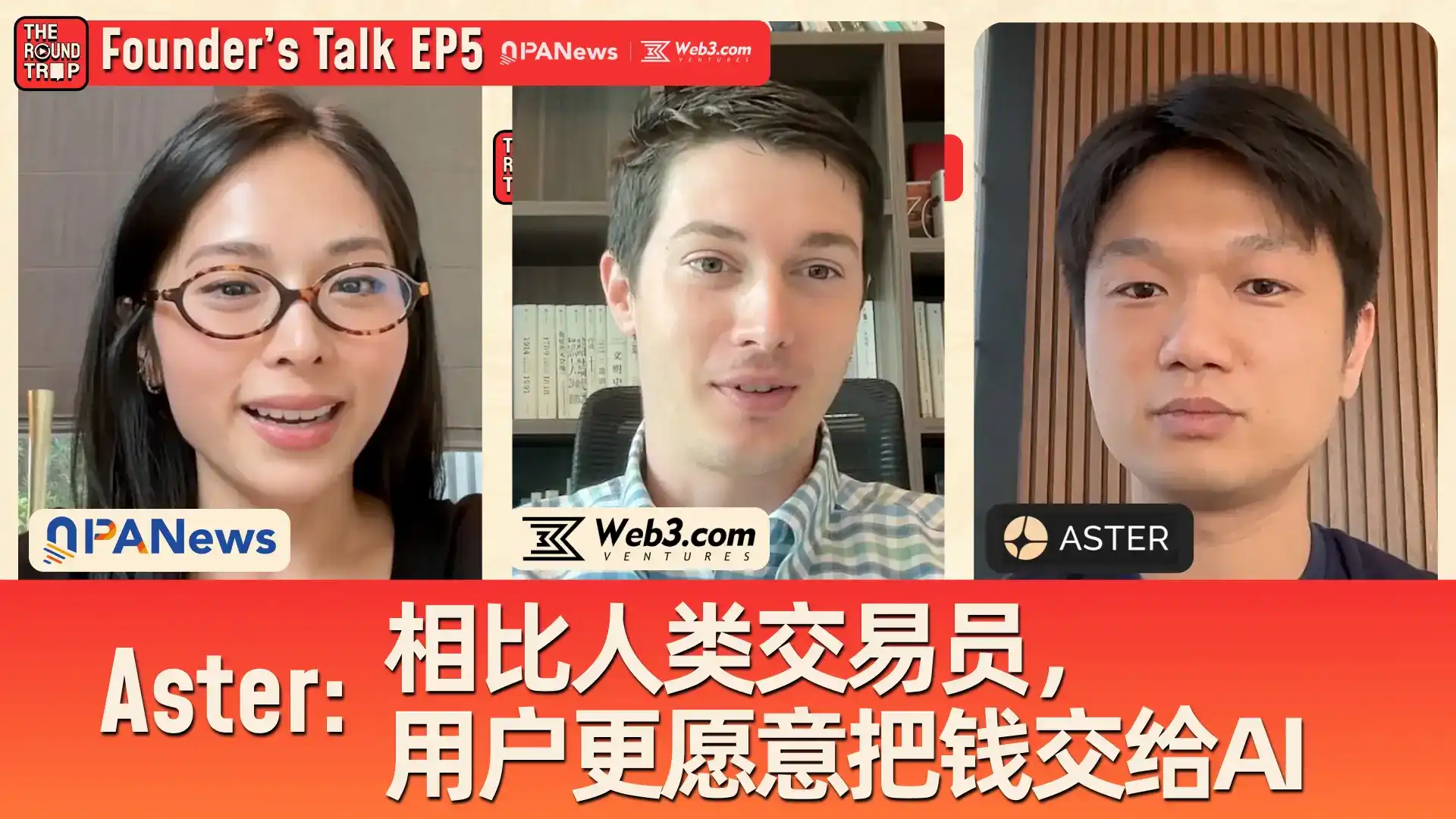
In the new Founder's Talk series of "The Round Trip," co-produced by PANews and Web3.com Ventures, hosts John Scianna and Cassidy Huang invited Leonard, founder and CEO of Aster, to delve into the story behind Aster's success, how it copes with massive traffic and retains users, and how it builds a complete business blueprint for "trustless" asset management.
An unexpected gain from the human-machine trading war
PANews: Hi Leonard, we know Aster recently concluded a highly anticipated "Human vs. AI" trading competition. This competition seemed very challenging for both sides. We'd like to hear your thoughts on it, perhaps you could share your observations of the current market?
Leonard: I think this is a very interesting experiment. Many people focus too much on the performance of human traders versus AI agents, but I think it's difficult to define what a "purely human trader" is these days because almost everyone is using some form of AI tool for research or decision support. Therefore, for both AI and humans, adaptability is far more important than profitability in a particular period.
However, we did make a very interesting observation: AI can actually enable more trustless asset management and copy trading. When we talked to users, we found that when evaluating human traders, people subconsciously speculate about their underlying motivations. This is because the behavior of human traders can change depending on what is being observed or the incentive mechanisms, but AI agents don't. As long as you give it instructions and resources, it will faithfully execute them. Therefore, even if an AI agent's performance is comparable to, or even slightly worse than, that of a human trader, users are more inclined to entrust their funds to AI. This is because the input to AI (i.e., its strategy logic) is explicit, which is crucial in a "trustless" infrastructure.
We believe the key to future breakthroughs lies in creating a truly "permissionless and trustless" AI trading product. This is precisely the direction we plan to continue investing resources in and exploring in the next quarter.
When CZ "knocked on the door": From massive traffic to a "sweet burden"
PANews: Speaking of attention, many people started paying attention to Aster because of CZ. He recently publicly revealed that he holds over $2 million worth of Aster tokens and is very active in the community, even jokingly saying he's "stuck" with them. CZ's involvement is undoubtedly a huge validation and endorsement for Aster. What are your thoughts on this?
Leonard: CZ's attention and personal investment are absolutely positive for us. Any project would be happy to receive this level of attention. Of course, this support also brings huge expectations and pressure , which is reflected in the market and prices.
But I'd rather bear the pressure than be marginalized by the market. To do extraordinary things, one must first bear extraordinary burdens. This "discomfort" keeps us alert and propels us forward. Of course, I also hope that in the future, more respected industry figures like CZ will cast their votes of confidence in us with real money. This attention will bring buzz and users to the ecosystem, which, in the long run, will help us better iterate our products.
PANews: When CZ brought this sudden surge of attention and traffic, how did your team respond? I'm curious because often, products may not be fully prepared to handle this scale of demand.
Leonard: That can be viewed from two perspectives.
The first is "toughing it out." When traffic surges in, the system exposes various problems under pressure. There are no shortcuts; you can only work tirelessly to expand the server capacity and mobilize all available experts to "put out the fire." Ultimately, this tests how strong your and your team's determination to succeed is, and whether you are willing to invest extraordinary resources, time, and energy.
Secondly, after navigating the initial crisis mode, you need to calm down and consider how to convert that traffic more efficiently. We acknowledge that we weren't fully prepared initially, leading to a poor experience for some early users. Winning back a "hurtful" churned user is far more difficult than acquiring a new one. We are currently facing this problem. On the bright side, however, it is precisely these stress tests and user feedback that have forced us to make significant progress in UI/UX and system stability over the past three months.
Every entrepreneur dreams of the moment when their product is in high demand, but for those who haven't experienced it yet, my advice is to "be careful what you wish for," because it is indeed a sweet burden.
Survival Rules in the DEX "Involution" Era: Returning to the Product and Value Flywheel
PANews: The competition in the Perp DEX sector is becoming increasingly fierce, with new projects and features emerging constantly, all vying for users through tactics like airdrops and other incentives. After the initial hype surrounding TGE, how do you maintain market momentum and retain users in this environment?
Leonard: This is indeed a major challenge in the current market, and every project in a hot sector must go through this process. We believe that the ultimate answer still comes down to the product itself.
For Web3 projects, a key point is how "user-driven" your product is. Can you create an environment where users feel like they are part of the product? Can they participate in governance and decision-making regarding the product roadmap? Stickiness arises when the community feels they have a "stake" in the project.
Ultimately, you need to establish a sustainable closed loop:
- Create a product that truly generates value.
- Find a model that users are willing to pay for this value.
- The captured value will be effectively returned to your token holders.
Once this flywheel is spinning, the project becomes sustainable. The rest is about finding a differentiating advantage in the fierce competition—either offering something others don't have, or providing a far superior experience for the same functionality.
From a privacy "shield" to a focus on the "application chain"
PANews: I discovered an interesting feature on Aster DEX called "Shield Mode," which seems to be a new privacy trading feature. Why have you made privacy a core strategic focus? What market gap are you hoping to fill?
Leonard: We've been developing our privacy narrative for a while now. Back in June, there was a lot of discussion in the industry about "liquidation sniping." Regardless of the truth behind these controversies, they reveal a clear market demand: traders want to maintain self-custody and verifiability while protecting their trading privacy. Currently, there isn't a perfect solution on the market that can meet all these requirements simultaneously.
Our team believes that to achieve widespread cryptocurrency adoption, the needs of this market segment must be addressed. Therefore, we've been experimenting with various features that include privacy options. "Shield Mode" is one such attempt; it not only provides privacy but also allows us to test other new features, such as leverage up to 1000x, and these trades are not recorded in the public order book, making it suitable for traders with specific strategy needs. We're also testing a profit-sharing model where we only charge a fee when your trades are profitable.
Our goal is to provide users with more diverse options, whether it's different fee structures, leverage levels, or privacy options, so that users with different preferences can find a trading method that suits them on the DEX.
PANews: Since we're talking about products, and Aster Chain is about to launch, what are your thoughts on Aster Chain as a standalone product? Does this mean Aster will evolve from a single DEX application into a broader ecosystem?
Leonard: First, I want to make one thing clear: Aster's core product remains trading. We will not be focusing too much on building a large ecosystem around Aster Chain for at least the next two to three quarters.
We believe there are already enough general-purpose public blockchains on the market to meet most needs. Our reason for building our own blockchain is a very specific goal: to serve our own trading product. We need a blockchain that can provide the performance we expect, the transparency we require, and support privacy options. We cannot find any existing solutions that simultaneously satisfy this "Blockchain Trilemma," so we must tailor one specifically for ourselves.
Therefore, Aster Chain is currently more like an "application chain," with its primary task being to optimize Aster's own transaction experience. Of course, other projects may find they also need similar blockchain infrastructure in the future, but that's not our focus at this stage. In such a competitive industry, you must be in the top 1% of what you do best to survive. For us, that means refining the ultimate transaction experience.
PANews: Aster Chain is expected to launch mainnet in 2026. What are your views on the market outlook for 2026? (Disclaimer: This is not investment advice)
Leonard: I hope so. I'm not good at predicting prices because it involves too many complex variables such as market liquidity and macro sentiment. But I'm personally quite confident. As long as we keep building, I believe we have the opportunity to reach new heights in the next cycle.
Aster Chain aims to mainnet by the end of Q1, which will undoubtedly give our token more utility, a positive fundamental outlook. We may currently be at the bottom of the market, so future performance is likely to be better than it is now.
How to build confidence with the community
PANews: In the current market environment, what is the sentiment in the community? After all, price performance directly affects the confidence of holders.
Leonard: We completely understand that. A lot of community sentiment is indeed tied to price performance, after all, people are investing real money. Our team has been carefully listening to community feedback and continuously improving our economic model accordingly. For example, we have been continuously optimizing our buyback and burn mechanism based on protocol revenue to ensure that the value captured by the protocol is fairly returned to token holders.
We cannot control the market, but we can control our actions—how many new features we release that create value, and how we design our economic model. We are a project with a sustainable positive cash flow, and we will continue to use the generated revenue for buybacks. I believe that as long as we persist in doing the right thing and continuously repeat this value cycle, we will eventually accumulate enough buying power to drive the token price to a new all-time high. This may take a month, two months, or even a year, but as long as we are heading in the right direction, we will see the right results.
Looking ahead to 2026: Three expectations for AI, privacy, and "sustainability of everything"
PANews: Finally, what do you personally most look forward to happening in 2026?
Leonard: I'm looking forward to three things.
- First, the adoption of privacy features . We've invested a lot in this area, and I'm eager to see how many users will ultimately choose public transactions and how many will choose private transactions. This will be a significant validation of our assumptions about user needs.
- Second, the integration of AI with asset management . I firmly believe that AI will shine in the "trustless" asset management field. Allowing AI to take over investment decisions and building user trust in this model will, I think, spawn many exciting innovative products.
- Third, "everything can be made perpetual." Perpetual contracts, with their 24/7 trading, low fees, and high leverage, are a superior trading product. As long as an asset has sufficient liquidity and can be quantified, it has the potential to be "perpetualized." Last year, everyone was talking about stocks and commodities, and I'm very curious about what new, even more "qualitative" assets (such as influencer influence indices, project reputation, etc.) will be created and mature enough to be traded as perpetual contracts in 2026, especially driven by the increasingly popular prediction markets. This uncertainty is what excites me most.