Just days before the token generation event (TGE), Trove Markets dropped a bombshell: the team would abandon its original Hyperliquid integration plan and instead build a perpetual contract decentralized exchange on Solana. This last-minute change not only caught investors off guard but also sparked questions about whether it was part of the "Rug Poll" scam.
They raised 11.5 million magnesium, but the team kept 80% of the funds.
According to the official statement , Trove previously raised over $11.5 million through an ICO, which was originally intended for deep integration into the Hyperliquid ecosystem. However, citing a "liquidity partner's temporary withdrawal of 500,000 HYPE tokens," the team announced that it would retain approximately $9.397 million (about 82% of the total funds raised) to continue developing the Solana version.
Developer Unwise described the decision as "the only viable way forward," but this explanation clearly failed to quell the investors' anger. Many participants immediately demanded refunds, questioning why the team couldn't continue operating under the existing structure, or at least offer a higher percentage of refunds.
Explanation of fund allocation raises further concerns
The Trove team has disclosed that the funds will be used for the following purposes:
- Front-end and back-end infrastructure development
- Chief Technology Officer (CTO) position
- Consultant Team
- Marketing and operating expenses
It is worth noting that the team only refunded $2.44 million to "clean up the list of participants and protect the fairness of the distribution," and another $100,000 was refunded to ICO participants—the total refund rate is less than 22% of the total funds raised.
The token crashed immediately upon listing: 95% of its market value evaporated within 10 minutes.
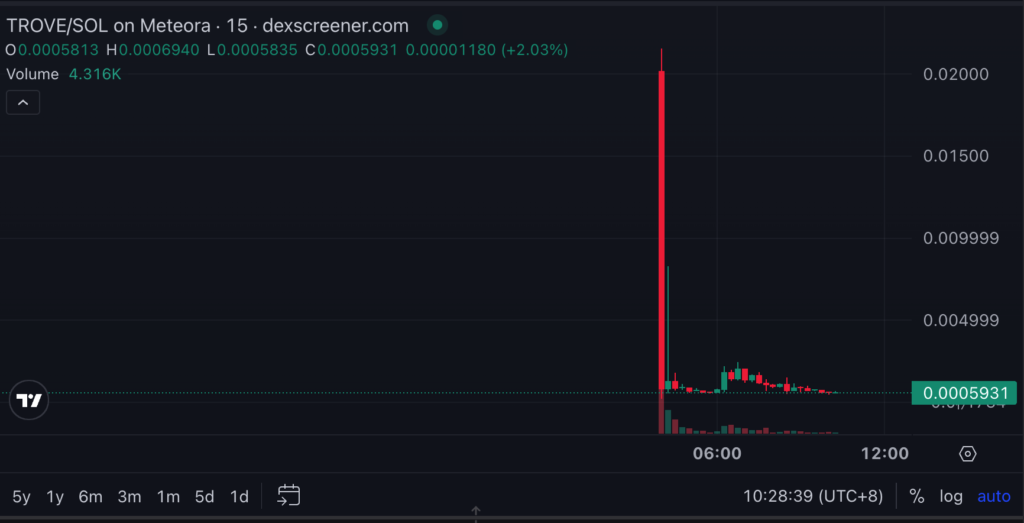
The market performance of the TROVE token was further exacerbated. According to DEXScreener data, the token plummeted 95% from its opening price to a low of $0.0008 within just 10 minutes of its launch. Its market capitalization also dropped from approximately $20 million to less than $1 million, practically reaching zero.
This flash crash pattern is similar to many past Rug Pull cases: the project team quickly sells off its tokens after raising funds, causing the price to collapse in a short period of time, and retail investors become the last ones to buy.
On-chain analysis reveals suspicious distribution patterns
An investigation by blockchain analytics platform Bubblemaps has added further mystery to the incident. The platform discovered that a single entity obtained as much as 12% of the TROVE token supply through 80 newly created wallet addresses. Even more alarming is that the funds in these wallets all pointed to the non-custodial exchange ChangeHero.
Although Bubblemaps stated that it cannot yet confirm a direct link between these wallets and the Trove team, the concentration of these wallets is highly similar to the "split transfer" method commonly used in money laundering, which undoubtedly deepens the community's doubts about the team's integrity.
The team claims they "won't run away," but the trust is already irreparable.
In response to criticism from all sides, the Trove team issued a statement emphasizing, "We will not disappear; we are still building," and promised to "regain trust through concrete actions."
According to its plan, the platform will focus on perpetual contract trading related to collectibles, including alternative assets such as Pokémon trading cards and Counter-Strike 2 (CS2) character skins. Asset management firm Bitwise has estimated that this market could reach $21.4 billion.
However, with 80% of the funds raised retained, the token price nearly zero, and numerous doubts surrounding the on-chain data, it remains highly questionable whether Trove can truly deliver on its promises and rebuild investor confidence.
Investors should be wary
This incident once again highlights the high-risk nature of participating in ICOs. Experts advise investors to carefully evaluate the following points before participating in any token offering:
- Are the team's background and past records transparent and verifiable?
- Is the fund utilization plan specific and reasonable?
- Does the token distribution mechanism pose a risk of centralization?
- Is there an independent third-party audit or guarantee mechanism?