Global regulatory trends and the improvement of local regulations are jointly driving a new industrial landscape.
With the formal establishment of the Taiwan Virtual Asset Services Industry Association in 2024 and the increasingly clear regulatory frameworks for digital assets in major global economies, the global blockchain industry is ushering in a new wave of development. Particularly in the United States, the advancement of various bills targeting stablecoins and digital assets, along with national-level strategic deployments for mainstream assets such as Bitcoin, has solidified its market leadership. At the same time, the widespread adoption of tokenized real-world assets (RWA) and the rise of digital asset treasury companies (DAT) are profoundly reshaping the existing landscape of sovereign currencies, traditional finance, and geopolitics.
Amid this wave, Taiwan has demonstrated strong development momentum. Following the completion of the registration and review process for the Virtual Asset Operator Money Laundering Prevention Act, the public sector is actively drafting a special law, the "Virtual Asset Management Act," which covers licensing systems, regulations for traditional financial institutions operating virtual assets, and provisions related to stablecoins, demonstrating a commitment to actively aligning with international regulatory standards.
As one of the leading non-profit organizations advocating for Bitcoin policy and the major cryptocurrency industry in Taiwan, our association has recognized this dramatic shift. Therefore, based on the "2023-2025 Taiwan Blockchain Industry Key Report and Ecosystem Map," we conducted a new round of industry status surveys and proudly present the "2026-2027 Taiwan Blockchain Industry Ecosystem Map ," providing an in-depth analysis of the latest industry trends and future potential.
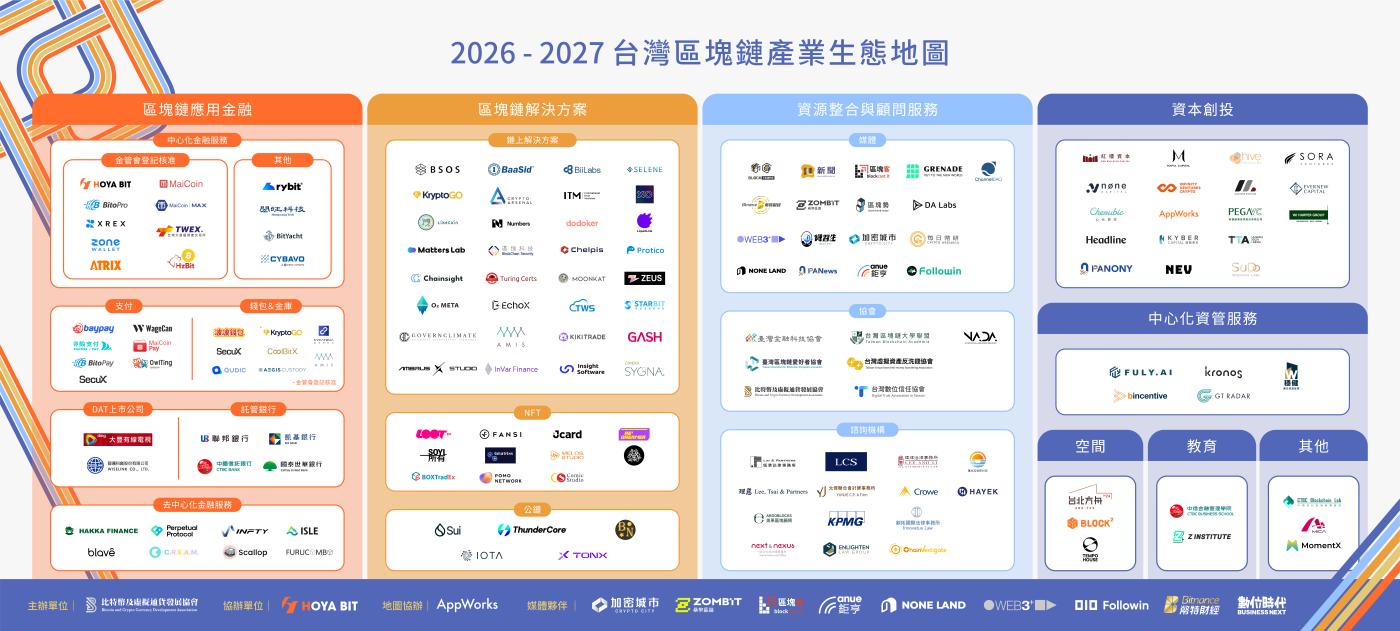
High-resolution version download link: https://pse.is/8lw2pl
Key findings of the 2026-2027 survey: Four major trends are leading the industry forward.
- The momentum of new ventures is accelerating: the proportion of newly established companies in the past five years has climbed from 69% to 75%, indicating that the industry is entering a stage of rapid growth and expansion.
- Remote work is becoming mainstream: as many as 85% of teams have adopted remote or hybrid work models, reflecting the industry's high regard for work flexibility, efficiency, and global talent deployment.
- Enhanced internationalization: Enterprises are more actively expanding into overseas markets, with North America and Southeast Asia accounting for approximately 25% of the target markets, demonstrating a strong ambition for globalization.
- Capital market confidence is rising: the proportion of companies that successfully raised funds and the median amount of funds raised have both increased significantly, indicating that investors have high confidence in the future development of Taiwan's blockchain industry.
Detailed comparative analysis of survey results (2023 vs. 2026-2027)
| Comparison items | 2023 Survey Results (Sample size: 84 companies) | 2026-2027 Survey Results (Sample Size: 106 companies) | Trend Analysis |
| Company Establishment Time | 69% were established in the last 5 years | 75% were established in the last 5 years | The industry is bursting with vitality: the speed of new company establishment has accelerated significantly, and the ecosystem has entered a stage of rapid expansion. |
| Work style | Approximately 69% of the teams are involved in remote work. | Up to 85% of the team is involved in remote work. | New work models have been established: remote and flexible work has become the industry standard, and the proportion of hybrid and purely remote work models has increased significantly. |
| Target Market | Taiwan accounts for 61% | Taiwan accounts for 55% | Accelerated globalization: Enterprises are expanding their international perspective and actively expanding into potential markets such as North America and Southeast Asia (totaling approximately 25%). |
| Capital activity | Approximately 38% have received funding. Median $1.2 million | Approximately 42% have received funding. Median $1.5 million | Capital market confidence has increased: both the success rate and median amount of financing have improved, reflecting investors' optimism about the industry's prospects. |
| Company size | 40% are micro-enterprises with fewer than 10 employees. | 45% are micro-enterprises with fewer than 10 employees. | Agile teams are becoming mainstream: The "light asset" micro-team model remains the norm, which is conducive to quickly responding to market changes. |
| Office Location | 11% No physical office | 15% No physical office (all staff work remotely) | More flexible operating models: The increase in the proportion of offices without physical locations further confirms the deepening and popularization of remote work. |
A New Chapter in Industrial Integration: Traditional Financial Institutions and Listed Companies Actively Enter the Fray
A major highlight of this survey is the active participation of traditional industries and financial institutions, injecting new vitality and trust into the ecosystem. The emergence of these two new tracks signifies that blockchain technology is moving from niche markets to mainstream applications:
(a) New track of corporate asset reserves (DAT): Listed companies such as Dafeng Cable TV and Zhitong Technology have included virtual assets in their corporate reserves, pioneering the "DAT listed companies" in Taiwan and providing new options for corporate asset allocation.
(ii) Pilot program for bank custody business: The four major banks, namely Commonwealth Bank, Cathay United Bank, KGI Bank and CTBC Bank, have launched a pilot program for virtual asset custody, paving a compliant and safe path for institutional funds to enter the market.
These developments demonstrate that the involvement of non-virtual asset native businesses and traditional financial institutions will lay a solid foundation for the diversification and sound development of Taiwan's blockchain ecosystem.
Overall, the "2026-2027 Taiwan Blockchain Industry Ecosystem Map" reveals a vibrant, rapidly growing, and increasingly international new industry landscape. With the improvement of the regulatory framework and the participation of mainstream institutions, the future development of Taiwan's blockchain industry is highly anticipated.
For a complete industry map and related reports , please refer to the official release page:
https://map.bcda.tw/
Contact Person: Manager Zhang (contact@bcda.tw )
The article " 2026-2027 Taiwan Blockchain Industry Ecosystem Map Reveals Key Trends: Taiwan's Blockchain Industry Enters a Period of Rapid Growth " was originally published on NONE LAND .