
Source: Bankless
Author: William M. Peaster
Compiled and edited by: BitpushNews
The landscape of Web3 consumer applications is undergoing a dramatic transformation.
Over the past few years, two of the most iconic on-chain social projects— Farcaster and Lens —have both experienced a change of leadership this week.
A New Chapter for Lens
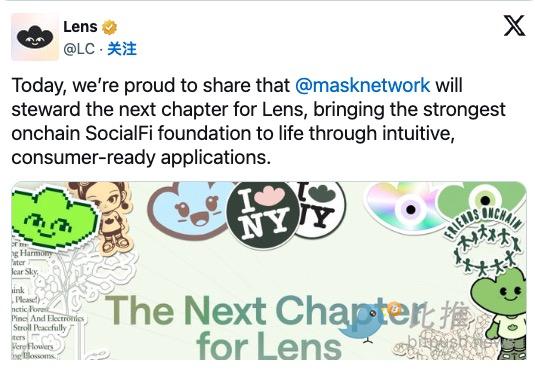
Avara (the parent company of Aave and Lens) has just announced the transfer of management of the Lens protocol to Mask Network . The Mask team has extensive experience in developing on-chain social applications such as Firefly and Orb. Avara will be fully committed to DeFi in the future, while Mask's goal is to usher in a new "product-centric" era for Lens.
Farcaster followed closely behind.
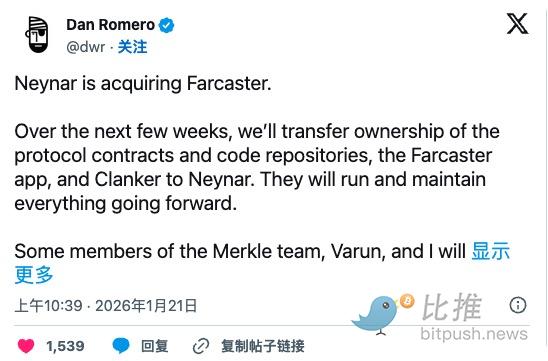
The day after the Lens news broke, Farcaster co-founder Dan Romero announced that Farcaster infrastructure provider Neynar was acquiring Farcaster's applications, protocols, and Clanker technology stack. Farcaster's founding leadership team will not be joining the new company, but Neynar stated they will focus on reshaping the project into a "developer-first" social network.
weighing the pros and cons
Mask is intimately familiar with every aspect of Lens, while Neynar has a deep understanding of every detail of Farcaster. These two teams are undoubtedly among the top developers and thinkers in the on-chain social networking field. In the long run, it seems that Lens and Farcaster have been handed over to the most suitable people.
However, the road ahead is by no means smooth.
To date, on-chain social projects have been striving to become mass-market social networks with "mass attraction." If this goal had been achieved, today's change of ownership wouldn't have occurred. Clearly, some aspects of the underlying structure remain to be addressed, making a degree of "restructuring" inevitable. Whether these changes can overcome bottlenecks and achieve lasting user engagement remains to be seen.
Regarding the news of Lens's change of ownership, Ethereum founder Vitalik Buterin (Vitalik) expressed his opinion. He wrote:
“What we need are social tools that serve the long-term interests of users, not just those that extract short-term engagement. [...] Decentralization is the way to achieve this: by sharing a data layer, anyone can build their own client on top of it.”
"But crypto social projects have often gone astray in the past. [...] There's nothing wrong with mixing 'money' and 'social' in itself: Substack proved that it's possible to build an economic system that supports high-quality content. But the core of Substack is subscribing to creators, not creating a price bubble around creators."
"Decentralized social networking should be run by people who deeply believe in the nature of 'social' and are primarily driven by solving social problems. [...] I am excited about Lens's development next year because I believe the new team is genuinely interested in 'social' itself."
“I encourage everyone to spend more time this year on Lens, Farcaster, and the broader world of decentralized social networking. We need to move beyond the current state where everyone is constantly tweeting in a global ‘information war zone’ and into a reopened frontier where better and newer forms of interaction will be possible.”
Macro picture
For Lens and Farcaster, the key to this game is cultivating multiple overlapping “public squares” – connected by shared data, but differentiated by different clients and cultures.
This diversity fosters innovation, which in turn leads to more social interaction, attracting more users and driving even more innovation, creating a vicious cycle. The core challenge remains getting this "flywheel" spinning.
Mask and Neynar seem ready for this role, and I'm optimistic about their performance in their new roles. If you'd like to support their comeback and heed Vitalik's call, a great starting point is to try the Firefly app developed by Mask. It allows you to access platforms like X (Twitter), Farcaster, and Lens simultaneously without manually reposting content.
Looking to the future
Cryptocurrency-based social media is not dead. However, for the pioneers of this new phase to embark on a successful second chapter, they need to reflect on what worked and what didn't in the first chapter, and continue to iterate based on that reflection.
In summary, we have moved from the "what if" stage to the "what should we do now" stage. In this sense, Mask and Neynar have taken over not only the protocol, but also a mission: to transform decentralization from an abstract ideal into something that many people are truly willing to spend time immersing themselves in.
This is no easy feat. But if these teams can continue to cultivate enduring communities with unique cultures while empowering users in new ways, they have the potential to go far. Now, let's wait and see if they can truly realize this vision.
Twitter: https://twitter.com/BitpushNewsCN
BitPush Telegram Community Group: https://t.me/BitPushCommunity
Subscribe to Bitpush Telegram: https://t.me/bitpush