When DeFi enters the era of atomic finance, returns are truly hedged for the first time.
In the past DeFi world, "yield" has never been a precisely defined concept. Most protocols only provide users with a numerical result, but never truly answer three questions:
1. How are profits generated?
2. When does the risk occur?
3. When extreme market conditions occur, does the system take preventative measures or react afterward?
It is precisely these unresolved issues that have kept DeFi in a phase of high volatility and low controllability for so long.
The purpose of VELA is not to create higher returns, but to rewrite the way returns are generated.
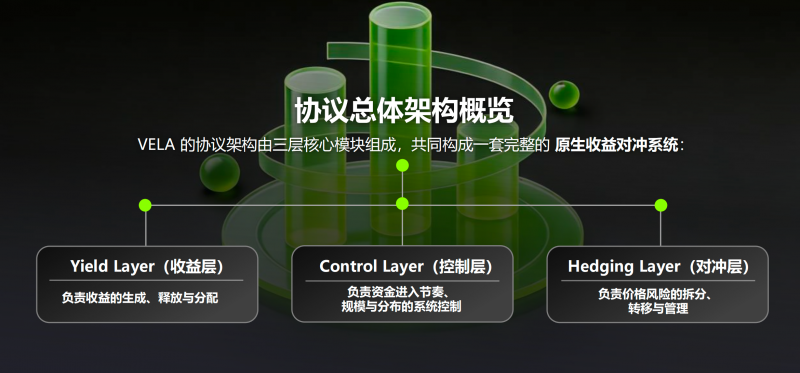
Native Yield Hedging
A concept that has been misunderstood for a long time
In traditional DeFi architectures, "hedging" often means:
●Additional Contracts
● Multiple on-chain operations
●Profits and risks are diversified across different agreements
This is essentially an ex-post hedging, rather than an original hedging.
The essential requirement of Native Yield Hedging proposed by VELA is:
Profit generation, risk exposure, and liquidation logic must be completed simultaneously within the same system. To achieve this, the protocol must operate in an atomic financial environment capable of handling spot trading, lending relationships, and risk control and liquidation concurrently.
And that is precisely why VELA chose PinPet.
Why is it that only PinPet can support VELA?
Most existing DEX or derivatives protocols still follow the "modular assembly" approach:
Matching is one system, while lending is another. Meanwhile, liquidation relies on Keeper or external triggers.
This means that risk always occurs slower than reward.
PinPet abandoned this model in its underlying design, instead building a unified market-making and clearing engine:
● Competitive bidding matching
●Native Lending
●Risk control judgment
● Liquidation Execution
All of them are compressed into a single on-chain atomic transaction.
This made VELA possible.
VELA is not a protocol “deployed on PinPet”, but rather the first advanced custom financial structure launched on PinPet.

Ultimate risk control starts with the ledger structure.
Mirror Reserve Ledger (MRL)
One of the biggest hidden dangers of traditional DeFi protocols is that the same liquidity pool simultaneously bears the responsibilities of yield, leverage, liquidation, and exit. While this may be manageable under stable market conditions, all risks can accumulate and erupt at the same time during periods of extreme volatility.
MRL's design logic is completely different:
All funds share the same real reserve, while different strategies and risk levels use mirrored ledgers for independent accounting. Funds are utilized at 100% depth, but risks are structurally broken down.
This means there is no idle capital, no deep waste, and no systemic collapse of "one pool bearing all the risks."
This is a ledger-level risk control innovation, not parameter tuning.
PriceLock Anchor Mechanism
Lock the risk of "margin call" out of the system
In traditional leveraged systems, margin calls often occur due to: sharp market fluctuations; delayed liquidation; and insufficient market depth. Pinpet, however, locks in risk the moment a trade is executed. Each leveraged order is anchored to a liquidable price corridor, and the system only allows exposure within this range. Even if the market experiences sudden and severe volatility, liquidation can be completed within the anchored range.
The approach is not to wait for risks to occur before taking action, but to prevent risks from spiraling out of control.
VELA truly solves the core problems of DeFi.
● Returns no longer depend on the direction of coin price.
● Risks are no longer hidden or postponed.
●Clearance is no longer the system's "last line of defense".
VELA brings profits, risks, and liquidation back onto the same timeline.
This is not a more radical form of DeFi, but rather a more mature form of on-chain financial engineering.
As DeFi evolves from "protocol assembly" to "atomic finance," and from "high-yield narratives" to "structured returns," VELA stands at the starting point of this generation of infrastructure.
VELA – Native Profit Hedging – is not a strategy upgrade, but an architectural evolution.