Bitcoin, which was originally expected to reach $100,000 soon, has suddenly returned to the $80,000 mark.
But what's even more disheartening for the crypto is that things are looking much better outside the crypto world. Gold and silver prices have hit new highs, with gold breaking through $5,000. The Russell 2000 index has outperformed the S&P 500 for 11 consecutive days, and the STAR Market 50 index in China has risen by more than 15% in a single month.
The "ABC Investment Method" (Anything But Crypto) joke continues to resonate in reality. Why is everything except crypto rising? And why has the crypto been in a continuous decline since Trump's arrival?
From macro to micro, from external to internal, the market seems to be brewing an even bigger storm: the White House faces another shutdown, Japan continues its monetary tightening, there is uncertainty surrounding Trump and his policies, and there is capital flight and meme drain within the crypto market.
The three major macro-level challenges
The White House is about to shut down again.
The U.S. government is once again on the verge of shutdown. Following another fatal shooting by federal law enforcement in Minnesota, Democratic senators collectively opposed a funding package that included funding for the Department of Homeland Security, causing the risk of a Polymarket shutdown to surge to 80% on January 30.
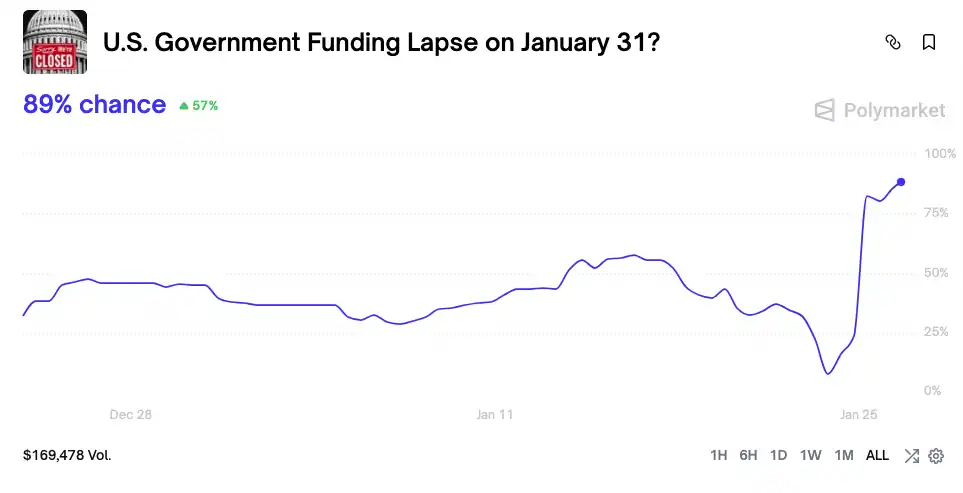
A government shutdown means a freeze in fiscal spending, locking hundreds of billions of dollars in the Treasury's General Account (TGA) and preventing them from flowing into the market. The TGA becomes a financial black hole that only takes in money and doesn't give out, draining liquidity from the market. The shutdown in October 2025 withdrew more than $200 billion from the market in just 20 days, comparable to multiple rounds of interest rate hikes.
When TGA massively drains the banking system's reserves, the market's funding costs soar. The crypto, always the most sensitive to liquidity, is the first to feel the chill.
Looking back at the 43-day shutdown in October 2025, Bitcoin's trajectory was quite dramatic:
• Initial stages of the shutdown (October 1-10): Bitcoin hit an all-time high of $126,500 on October 6. The market generally believed that the government shutdown would highlight the value of decentralized currencies.
• Mid-term of the shutdown (October 11 - November 4): The shutdown lasted longer than anyone imagined. During the policy vacuum period when everyone thought the problem had been resolved, the crypto encountered the 1011 liquidity black swan event, plummeting to $102,000, a drop of more than 20% from its peak.
• Post-shutdown period (November 5-12): Prices fluctuated around $110,000 and did not rebound immediately as the shutdown was about to end.
Having been bitten once, the market reacted more directly and quickly to the government shutdown this time. Within 24 hours of the shutdown risk surging, Bitcoin fell from $92,000 to below $88,000. The market seems to have learned its lesson, no longer viewing a government shutdown as a positive, but rather pricing it directly as a liquidity negative.
Japan's "butterfly effect"
The other straw that broke the camel's back came from Tokyo. On January 19-20, 2026, the yield on Japan's 10-year government bonds surged to 2.330%, a 27-year high.
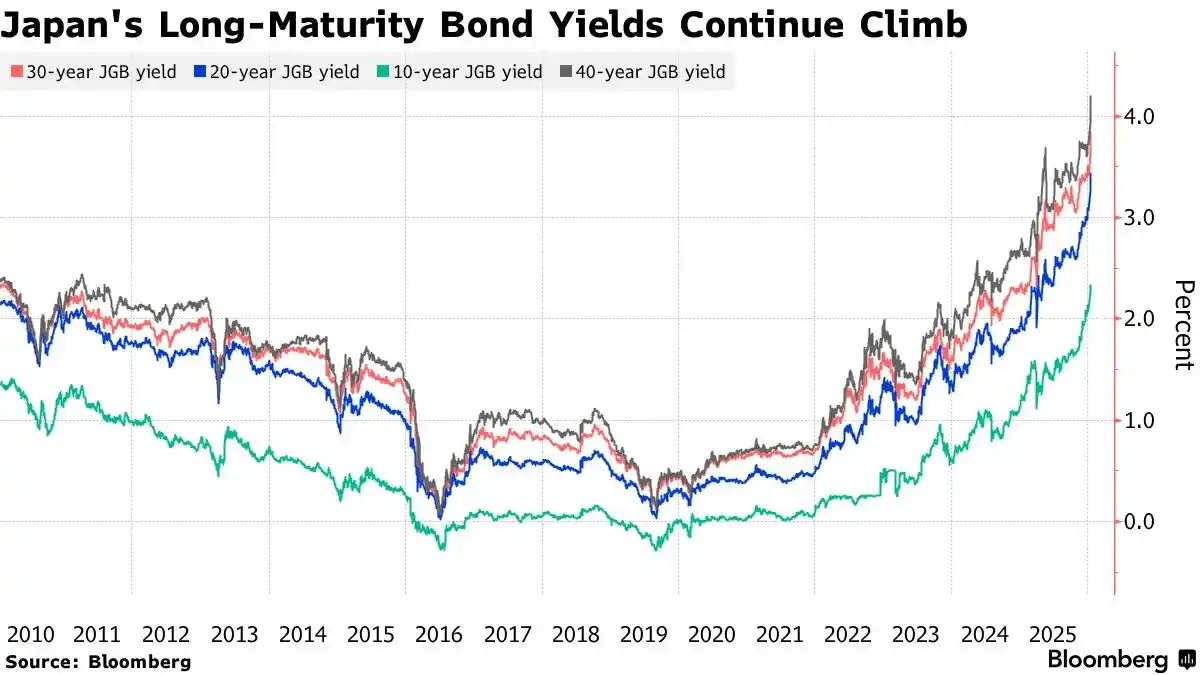
This reflects a reversal in yen carry trade. In the past, investors borrowed low-interest yen and exchanged it for dollars to invest in high-yield assets (such as US Treasury bonds and Bitcoin).
However, the Bank of Japan has now begun raising interest rates (to 0.75% in December 2025), and the newly appointed Prime Minister Sanae Takaichi has announced the end of fiscal austerity measures, planning large-scale investment and tax cuts. This has triggered serious concerns in the market about Japan's fiscal situation, leading to a sell-off of government bonds and a surge in yields.
More importantly, the fundamentals of the Japanese economy are supporting the possibility that high interest rates will become a long-term trend. Data from Japan's Ministry of Internal Affairs and Communications shows that as of November 2025, Japan's unemployment rate remained stable at 2.6%, marking 59 consecutive months of "full employment." This strong labor market gives the Bank of Japan the confidence to continue raising interest rates. This Friday (January 31st), Japan will release its December unemployment rate, which the market widely expects to remain low, further strengthening expectations of an interest rate hike.
The surge in Japanese bond yields has driven up global borrowing costs and further squeezed the spreads in yen carry trades. Carry traders have been forced to close their positions and sell dollar assets to buy yen, triggering a global liquidity crunch that appears likely to continue.
The "risk-averse period" before key data releases.
The Federal Reserve's FOMC will announce its interest rate decision at 3:00 AM (Beijing time) this Thursday, followed by a press conference with Fed Chairman Powell on monetary policy. On Friday, Japan will release its December unemployment rate, and the US will release its December PPI data.
This week is also a crucial week for these data releases, and large funds generally choose to enter a "quiet period" to reduce risk exposure and wait for the uncertainties to subside. This risk aversion has further exacerbated the selling pressure in the market.
Historical data shows that Bitcoin prices tend to weaken 5-7 days before an FOMC decision is announced, exhibiting a "pre-meeting drop" pattern. For example, before the December 2025 FOMC meeting, Bitcoin fell from a high of $94,000 to around $90,000. And before the October 2025 meeting, Bitcoin also fell from $116,000 to below $112,000.
Behind this pattern lies the risk-averse behavior of large institutional investors. Before the Federal Reserve's policy becomes clear, they tend to reduce their holdings of risky assets in preparation for potential unexpected policy changes.
The "seesaw" of liquidity
Without an increase in macro liquidity, both the global market and the crypto are facing a zero-sum game of liquidity. The liquidity of the crypto is being siphoned off by all markets, while the liquidity of mainstream coins such as BTC is being siphoned off by memes.
Bitcoin ETF vs Gold ETF
If macroeconomic factors are a long-term concern, then the flow of funds is a more direct, immediate worry.
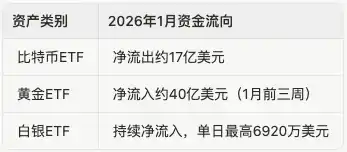
The approval of Bitcoin spot ETFs in early 2025 was once seen as the "engine" of the bull market. However, data shows that since mid-January, the inflow of funds into ETFs has slowed significantly, and there have even been five consecutive days of net outflows, totaling as much as $1.7 billion.
Meanwhile, gold and silver ETFs continued to attract funds. In 2025, gold ETFs recorded their strongest inflows since 2020, with total holdings increasing by more than 220 tons. This trend continued into 2026.
Asset Class Flows in January 2026: Bitcoin ETF saw a net outflow of approximately $1.7 billion; Gold ETFs saw continued net inflows.
This stark contrast reflects a fundamental shift in market risk appetite. Amid heightened macroeconomic uncertainty, funds are flowing from high-risk Bitcoin to traditional safe-haven assets like gold and silver.
Amidst a macroeconomic downturn, the crypto market presents a stark contrast: Bitcoin continues its relentless decline, while Memecoin is experiencing a frenzy.
The Solana Meme coin, named "Nietzschean Penguin" ($PENGUIN), saw its price surge a hundredfold in two days after the White House's official Twitter account posted an AI-generated image of Trump with a penguin, briefly pushing its market value to $170 million.
Behind this phenomenon lies an extremely suppressed market sentiment.
When macro narratives fail, value investing becomes ineffective, and the incremental capital inflow from ETFs slows down, existing funds in the crypto that lost their wealth effect after 10/11 (October 11th) begin to flow into Meme coins in search of short-term get-rich-quick opportunities. This is a "doomsday frenzy" mentality: since value coins aren't rising, why not gamble on a worthless coin?
However, investors' "chasing the rise" and "breaking even" mentality is often more easily captured and exploited by "market manipulators." The fact that "Nietzsche Penguin" received multiple retweets from A16Z, Solana's Official Twitter, the White House, and Musk's account within two days shows that it was "well-prepared."

Trump, Binance's fortunes—every time a high-flying, high-profile quick-access platform is followed by a market crash, it seems to follow suit. This pervasive sentiment further drains liquidity from mainstream cryptocurrencies, creating a vicious cycle.
However, the liquidity in the crypto is currently much worse than in December 2024 and October 2025, so the White House and a number of major Twitter accounts have been retweeting and pushing for its growth, and the current cap of "Nietzsche Penguin" is only less than 200M.
Will the storm continue?
Although the debate over whether there is still a "four-year cycle" for BTC is intensifying, the crypto seems to have entered a bear market since Bitcoin fell below $110,000 on October 11, 2025, with liquidity becoming increasingly thin during the three-month period of fluctuation.
But this time, we face a more complex situation. Short-term market movements will depend on political maneuvering in Washington, policy signals from the Federal Reserve, and the earnings reports of tech giants.
In the longer term, the global economy seems to be on edge due to geopolitical tensions, trapped in a cycle of debt-quantitative easing-bubbles from which it cannot extricate itself.
Trump remains like a "bomb" that could explode at any moment.
On January 17, the Trump administration threatened to impose a 10% tariff on imports from eight European countries, including Denmark, Norway, Sweden, France, and Germany, in an effort to pressure them into making concessions on Greenland. Although Trump temporarily dropped the tariff threat after talks with the NATO Secretary General on January 21, the "art of the deal" remains fraught with uncertainty.
On January 24, Trump threatened to impose a 100% tariff on all Canadian exports to the United States in order to prevent Canada from reaching a trade agreement with China.
No one can predict what "crazy" measures he will take next in order to secure re-election in the midterm elections.
For investors, now may not be a good time to chase after other assets. During this "January siege," patience and caution, waiting for the macroeconomic uncertainty to dissipate, may be the only option.
Click to learn about BlockBeats' job openings.
Welcome to the official BlockBeats community:
Telegram subscription group: https://t.me/theblockbeats
Telegram group: https://t.me/BlockBeats_App
Official Twitter account: https://twitter.com/BlockBeatsAsia