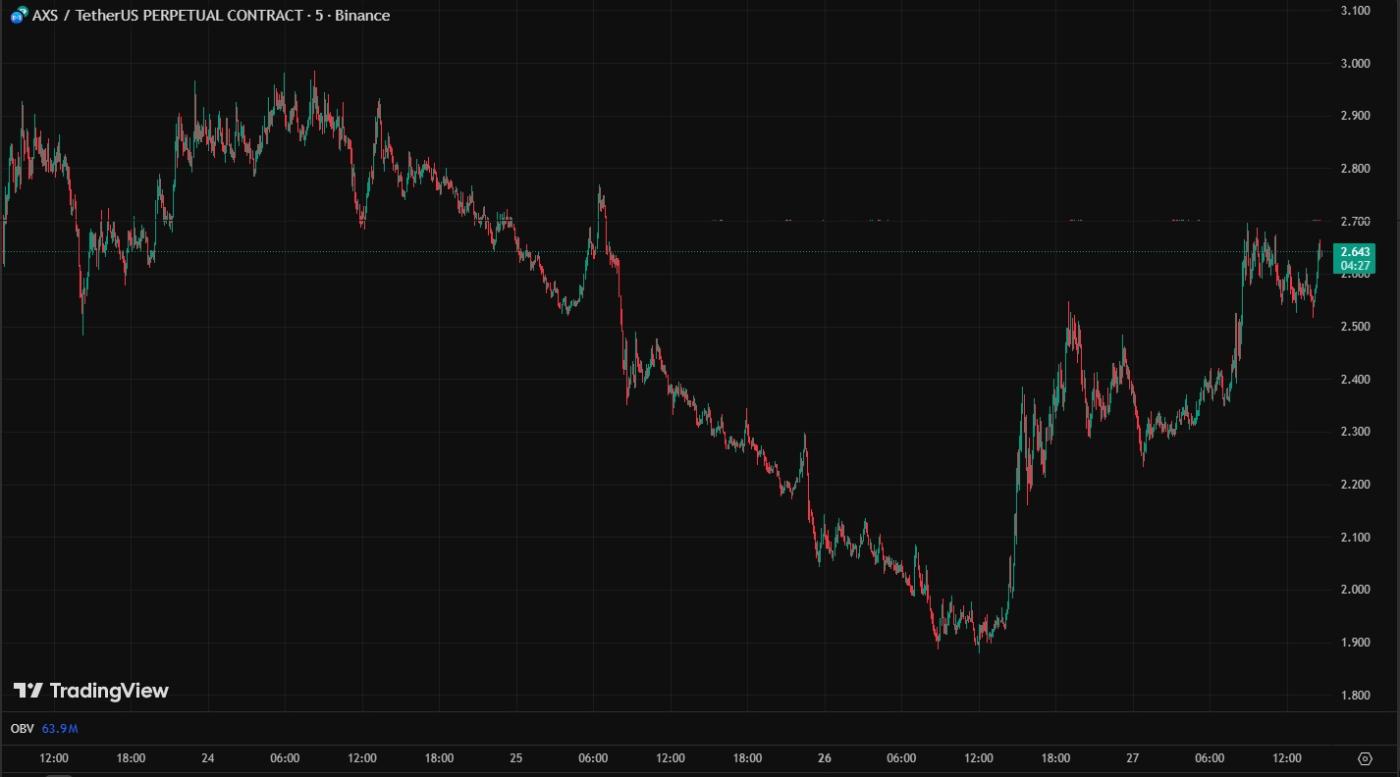
- Smart money capitalized on AXS’s bAXS mechanism announcement, entering at $1.66 after technical confirmation on January 21st and exiting near $2.90 for 75% gains.
- The bAXS tokenomics change locked 20-30% of circulating supply, creating artificial scarcity that smart traders identified through fundamental quantitative analysis and on-chain verification.
- This supply shock arbitrage strategy is replicable across crypto markets by monitoring narrative catalysts, confirming technical setups, and exiting when retail enthusiasm peaks.
Smart money earned 75% returns on AXS by timing the bAXS supply shock perfectly. Learn the systematic strategy behind this tokenomics arbitrage play.

The cryptocurrency market witnessed a remarkable price surge in Axie Infinity’s AXS token recently, with prices climbing from $1.65 to nearly $2.90 within just a matter of days. While retail investors scratched their heads wondering what drove this sudden rally, smart money had already positioned themselves days earlier, capitalizing on what many call a “supply shock arbitrage” opportunity. The catalyst? A fundamental shift in AXS tokenomics through the introduction of bAXS, a mechanism that essentially locked up 20-30% of circulating supply overnight.
What makes this case particularly fascinating isn’t just the impressive returns, but rather the precision timing that separated professional traders from the retail crowd. Smart money didn’t chase the bottom on January 20th when prices hit $1.65. Instead, they waited patiently until January 21st for technical confirmation before deploying capital. By January 24th, when mainstream media began covering the AXS rally and retail traders rushed in, these sophisticated players were already exiting their positions near $2.90. This wasn’t luck – it was a calculated play built on information asymmetry and fundamental quantitative analysis.
UNDERSTANDING THE BAXS TOKENOMICS: HOW AXS SUPPLY SHOCK CREATED SMART MONEY OPPORTUNITY
Understanding the smart money playbook starts with grasping what bAXS actually represents. Think of regular AXS as cash in your wallet – liquid, tradable, and immediately available. The new bAXS (Bonded AXS), however, functions more like a locked certificate of deposit or non-transferable voucher. When Axie Infinity announced this mechanism on January 18th, they fundamentally altered the game’s reward structure.
Previously, AXS rewards were distributed directly to players with full liquidity, meaning recipients could immediately sell these tokens on the open market. The introduction of bAXS changed everything. A significant portion of rewards now gets converted into bAXS, which remains locked within user accounts. These tokens cannot be traded on exchanges. Instead, they can only be used for in-game upgrades, staking, or unlocking higher-tier benefits within the Axie ecosystem.
The brilliance of this mechanism, from a tokenomics perspective, lies in its supply control. By converting rewards that would typically flood the market into locked, non-tradable assets, the protocol artificially manufactured scarcity. Essentially, 20-30% of AXS that could have created selling pressure was suddenly locked away in a digital vault. For traders who understood the supply-demand dynamics, this spelled one thing: upward pressure on price.
SMART MONEY AXS ENTRY STRATEGY: WHY TIMING BEATS BOTTOM FISHING
Here’s where professional trading diverges sharply from amateur speculation. Many retail investors see a significant price drop and immediately think “bargain hunting opportunity.” When AXS touched $1.65 on January 20th, amateur traders were salivating at what appeared to be a bottom. Smart money, however, remained on the sidelines.
The difference comes down to what traders call “left-side” versus “right-side” entry. January 20th represented a left-side risk zone – essentially trying to catch a falling knife. Sure, the price looked attractive at $1.65, but the downtrend hadn’t confirmed a reversal yet. There was genuine risk that prices could break lower, invalidating any bullish thesis. At that moment, entering felt more like gambling than calculated risk-taking.
January 21st told a completely different story. When prices retested the $1.66 level and then bounced with significant volume, technical analysts recognized a crucial pattern: a successful double bottom formation, also known as a Change of Character (ChoCh) in market structure. The price might have been slightly higher than the previous day’s low, but something far more valuable had occurred – confirmation of support and the establishment of upward momentum.
This distinction matters enormously. The January 20th entry would have required nerves of steel and tolerance for potential further drawdowns. The January 21st entry, meanwhile, offered what professionals value most: confirmation. Yes, you might pay a few cents more per token, but you’re buying into confirmed momentum rather than hoping a falling trend reverses. The slightly higher entry price represented insurance against catastrophic loss, and for smart money, that trade-off makes perfect sense.
AXS SMART MONEY EXIT STRATEGY: RECOGNIZING WHEN THE SUPPLY SHOCK PLAY PEAKS
If entry timing separated professionals from amateurs, exit timing revealed the true masters of the craft. By January 24th, AXS had surged to $2.90, representing a spectacular 75% gain from the $1.65 low. The media caught wind of the rally, headlines proliferated, and retail traders started piling in with FOMO (fear of missing out). This was precisely when smart money headed for the exit.
Three key factors informed this decision. First, the psychological barrier at $3.00 loomed large. Round numbers create powerful resistance in markets, and experienced traders know that $2.90-$2.95 represents the last opportunity to exit before hitting that wall. Rather than hoping to squeeze out the final 3-5%, professionals took their 75% gains and moved on.
Second, technical indicators likely showed extreme conditions. When the Relative Strength Index (RSI) pushes above 80, it signals overbought territory where short-term momentum becomes exhausted. Smart money doesn’t fight these indicators – they respect them and act accordingly.
Third, and perhaps most importantly, the narrative had fully played out. The January 18th announcement had spent a week percolating through the market. By January 24th, every crypto news outlet was reporting on AXS’s dramatic surge. When mainstream coverage reaches saturation and retail investors start flooding in, institutional players recognize the classic “sell the news” moment. The smart money that bought the rumor was now selling into the euphoria.
REPLICATING THE SMART MONEY AXS STRATEGY: TOOLS AND WORKFLOW FOR SUPPLY SHOCK TRADING
Executing this type of play requires integrating information across multiple dimensions. It’s not enough to read an announcement and blindly buy – successful traders follow a systematic workflow.
The first phase involves narrative hunting. This means actively monitoring project teams’ social media accounts, GitHub repositories, and governance proposals. Tools like RSS3 track on-chain activities, while Twitter provides direct access to core developers’ thinking. Arkham Intelligence allows traders to monitor project multi-signature wallets, revealing capital movements before they become public knowledge.
Phase two demands fundamental quantitative analysis. When a tokenomics change occurs, traders must calculate the actual impact on circulating supply. This involves examining token unlock schedules, inflation changes, and staking ratios. Platforms like TokenUnlocks provide raw data on unlock dates, while spreadsheet modeling or Python scripts help quantify supply shock magnitude. The goal is transforming qualitative announcements into quantifiable price impacts.
The third phase provides on-chain verification. Before committing capital, smart money verifies whether large holders are accumulating or distributing. Are whales depositing tokens to decentralized exchanges like Katana? Are they withdrawing from centralized exchanges? Tools like Nansen identify “smart money” wallet addresses and track their behavior, while blockchain explorers specific to each network (like Ronin Explorer for Axie) monitor overall activity levels.
Why Gold Is Surging: Central Banks, Sanctions, and Trust-1
Messari 2026 Crypto Theses: Why Speculation Is No Longer Enough (Part 1)
BEYOND AXS: APPLYING THE SUPPLY SHOCK STRATEGY TO OTHER CRYPTO OPPORTUNITIES
This strategy isn’t unique to AXS – it represents a repeatable pattern called “supply shock arbitrage.” Consider the Polygon case from 2024-2025, where MATIC transitioned to POL with new staking and burning mechanisms.
Following the initial upgrade announcement, market reaction remained muted. Most participants didn’t immediately grasp the implications. Smart money, however, calculated the new deflationary dynamics and observed rising staking rates, indicating reduced available supply. As major exchanges announced support for the token conversion, prices began their march upward.
The entry point for sophisticated traders came 2-3 days before exchanges formally announced conversion support. During this window, technical charts typically showed sideways consolidation – accumulation disguised as boredom. The exit point arrived on conversion completion day, when the “sell the news” effect took hold as the fundamental catalyst was fully priced in.
The same framework applies to numerous scenarios across cryptocurrency markets. Token burn announcements, major staking mechanism introductions, significant unlock events, and protocol upgrade migrations all create similar supply shock dynamics. Each presents opportunities for traders who combine fundamental analysis with technical timing and on-chain verification.
KEY TAKEAWAYS FROM THE AXS SMART MONEY PLAYBOOK
The AXS bAXS case study reveals that successful cryptocurrency trading isn’t about predicting the future or getting lucky. It’s about systematic information processing, disciplined timing, and understanding how fundamental changes ripple through market microstructure. Smart money didn’t achieve 75% returns through superior intelligence – they achieved it through superior process.
The framework is surprisingly straightforward: identify narrative catalysts that create measurable supply changes, wait for technical confirmation before entry, and exit when retail enthusiasm reaches fever pitch. Yet simplicity doesn’t mean ease. Executing this strategy requires patience to wait for confirmation rather than chase bottoms, discipline to exit at predetermined targets rather than hoping for more, and the emotional fortitude to act when positioning feels uncomfortable.
For traders looking to replicate this approach, the opportunity set remains abundant. Cryptocurrency markets continuously present similar supply shock scenarios through token burns, staking mechanism changes, major unlocks, and protocol upgrades. The question isn’t whether these opportunities exist – it’s whether you have the framework to identify them and the discipline to execute when they appear.
The AXS case ultimately teaches us that in markets driven by information flow and supply dynamics, the greatest edge comes not from being first, but from being right. Sometimes that means entering a day late but with conviction, and exiting before the crowd realizes the party’s ending. Smart money understands that perfect timing isn’t about catching absolute bottoms or tops – it’s about maximizing probability-adjusted returns through systematic execution.
The above viewpoints are referenced from Ace
〈How Smart Money Turned $1.65 AXS Into a 75% Gain: Decoding the bAXS Supply Shock Strategy〉這篇文章最早發佈於《CoinRank》。