Written by: TechFlow TechFlow
On January 28, the Ethereum team announced that the ERC-8004 protocol would soon be launched on the mainnet.
We mentioned this standard in our article last October. If you're completely unfamiliar with it, you can refer to this article: "x402 Gradually Entering a Period of Intensification: Early Exploration of New Asset Opportunities in ERC-8004"
Actually, it has a formal name: "Trustless Agents." In simpler terms:
Send an on-chain ID to the AI Agent.
The Ethereum Foundation rarely pushes an ERC standard so aggressively. They specifically established a team called dAI, included ERC-8004 in their 2026 strategic roadmap, and collaborated with Google, Coinbase, and MetaMask to write a draft. In November, they even held a Trustless Agents Day at DevConnect to promote it.
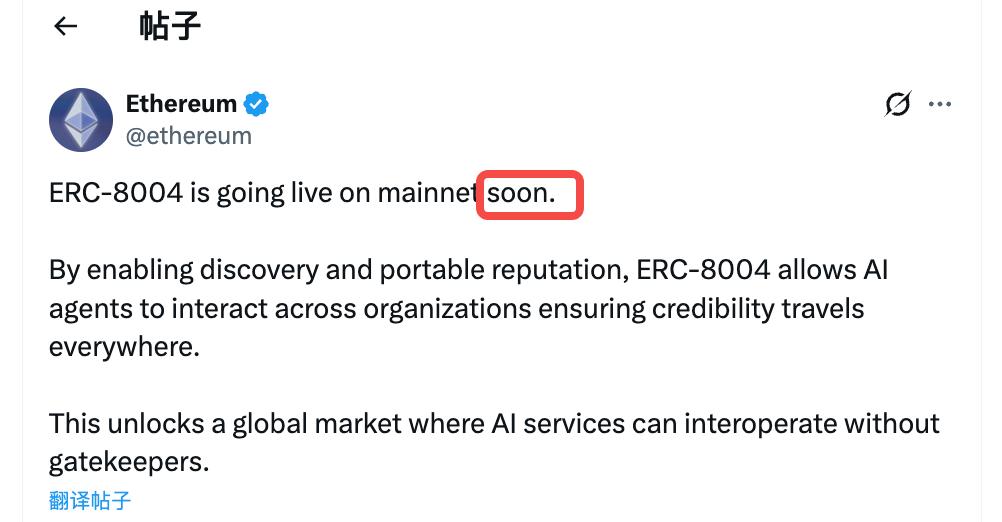
The last time Ethereum pushed for standards this seriously was with ERC-20 and ERC-721.
One defines a token, and the other defines an NFT.
Is it AI's turn now?
Ethereum's AI Anxiety
Why the rush?
Let's look at some data. According to Cookie.fun's statistics, the market capitalization of AI Agent tokens is distributed as follows: Solana and Base chains together account for 96%. There are only a handful of well-known AI Agent projects on the Ethereum mainnet.
There are only a handful of AI agent projects that you can name on the Ethereum mainnet.
In April 2025, the ETH to BTC exchange rate fell to 0.017, a five-year low. At that time, everyone was saying that Ethereum was not the future.
When DeFi was hot, Ethereum was the main player. When NFTs were hot, Ethereum was still the main player. But with the rise of AI Agents, the main player has changed.
Solana processes 36 million transactions per day, compared to 1.13 million on the Ethereum mainnet. High gas fees and slow speeds have led developers to abandon it. Virtuals Protocol launched on Coinbase, and ai16z previously chose Solana; even Coinbase's own AI project hasn't been deployed on the Ethereum mainnet.
Ethereum needs a new story.
ERC-8004 may be the beginning of this story.
Let's review ERC-8004 again.
Let's get back to the standard itself.
How exactly does ERC-8004 work to issue on-chain ID cards to AI Agents?
You don't need to know any technology; all you need to know are three registers.
The first one is called the Identity Register. Based on ERC-721, each AI Agent mints an NFT to prove "I am who I am".
The second is called the reputation register. It records the agent's historical performance, who has used it, what their reviews are, and whether it has done anything wrong.
The third is called the verification register. This involves a third-party organization stamping and endorsing the agent, for example, stating "This agent has passed a certain security audit."
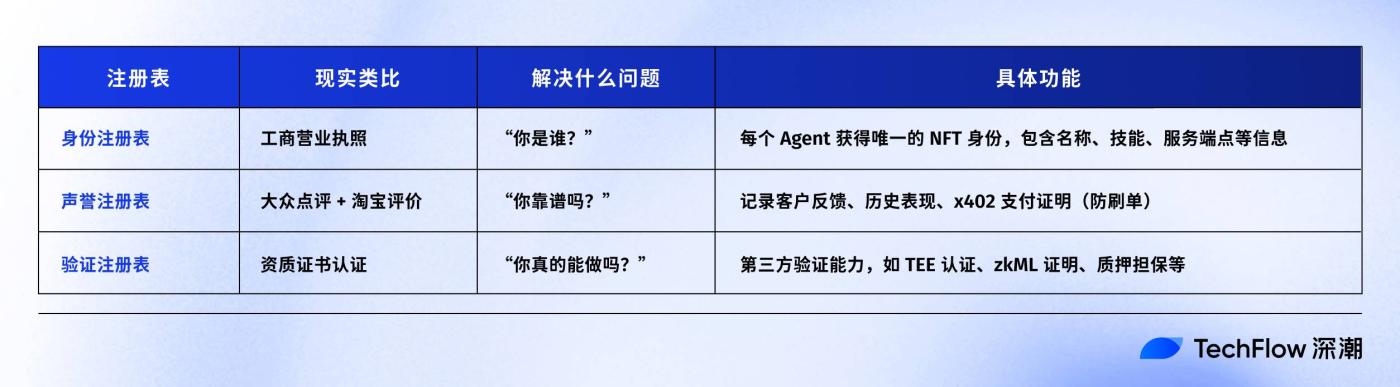
The three notebooks together solve one problem: when two AI agents meet on the blockchain, how do you know if the other is reliable?
The previous answer was "I don't know, we can only rely on humans." ERC-8004's answer is "check the on-chain records."
This system wasn't something Ethereum came up with on its own.
Its underlying logic comes from Google's A2A protocol released last year, Agent-to-Agent, which allows AIs to communicate and interact with each other. ERC-8004 adds another layer on top of this:
Trust backed by blockchain.
Google's A2A solves the communication problem, while Ethereum's ERC-8004 solves the trust problem. One handles communication, and the other handles verification.
Is issuing ID cards a good business?
I'd venture a guess that Ethereum's logic might be as follows:
For an AI agent to be truly useful, it needs to be able to manage its own money. This doesn't mean tweeting or chatting; it means directly manipulating on-chain assets. This includes signing transactions, adjusting contracts, and engaging in cross-protocol arbitrage...
Nobody dares to do this on a large scale right now. The reason is simple: how do you know the agent won't transfer your money? ClawdBot, which has become incredibly popular these past few days, has already had negative incidents posted by community members.
Web2's solution is platform endorsement. You use OpenAI's API, you trust OpenAI. If something goes wrong, you go to OpenAI.
Web3 doesn't have this. Agents are open source, deployment is permissionless, and they run on the blockchain unregulated. If you call a service from an unfamiliar agent, you can't find out who's behind it, whether the code is problematic, or whether it has a history of malicious activity.
In short, ERC-8004 essentially moves the traditional financial KYC process onto the blockchain. Ethereum is betting that this system will become a necessity once AI agents start handling real money.
For DeFi protocols to connect to external agents, they must first verify the agent's on-chain identity. Institutions needing to use agents for transaction execution must first check their transaction history. Auditing firms can issue on-chain certifications to agents, similar to security audits of smart contracts.
This is a strategic move to position oneself in the competition.
Ethereum knows it has lost at the execution layer, but no one has yet secured the trust layer. Institutional acceptance, the security audit ecosystem, and TVL scale are Ethereum's existing assets. ERC-8004 packages these assets into a standard, defining "what compliance for AI agents should look like" before others do.
The question is, does this need exist now?
Standards precede demand
Having discussed Ethereum's strategic plans, let's get to the practicalities. What are the on-chain AI agents doing right now?
With the AI meme wave over last year and the rapid advancements in AI products from several leading AI companies in the past year or two, few people are paying attention to on-chain AI agents anymore.
However, they are still making progress.
For example, ai16z has been renamed ElizaOS, transforming from a single agent into a cross-chain platform; Virtuals Protocol is developing AI DApps and plans to enter the physical bot market in 2026; other AI agents, such as those in Surf, can also automatically execute DeFi trading strategies.
But here's the question: do they really need ERC-8004?
Luna users trust Luna because it was developed by the Virtuals core team. The Agent on ElizaOS is used because it runs within the ElizaOS framework; Surf helps you execute policies, often because you trust the application itself.
Trust comes from the platform, not from on-chain identities.
ERC-8004 envisions a scenario where an unfamiliar agent approaches you, without platform endorsement or brand recognition, and you can only judge its reliability through on-chain records.
When will this scenario occur?
When AI agents truly achieve autonomous invocation across protocols, platforms, and organizational boundaries, an agent can borrow money from Aave, trade on Uniswap, and then earn profits on another protocol, all without human approval...
However, this scenario does not exist now.
Current AI agents, no matter how complex their functions, essentially still operate within a single platform. They don't need to prove themselves to unfamiliar protocols because they simply don't bother trying to access them.
Given the current hype surrounding the crypto market, there's no reason for them to knock on each other's doors unless they can work together to create a new narrative.
Therefore, ERC-8004 addresses a future problem.
If AI agents evolve from toys into tools, Ethereum's trust infrastructure will gain value. If the agent economy grows large enough and cross-platform calls become commonplace, ERC-8004 can collect tolls.
There are many "what ifs".
Therefore, institutions are likely to be the first to take action in this wave of forward-looking planning.
In late 2025, SharpLink Gaming announced it would invest $170 million in its Ethereum restaking strategy. During the same period, exchanges saw a net outflow of over 23,000 ETH, which flowed into private wallets and staking protocols.
This money could potentially buy Ethereum 12 to 18 months from now.
For retail investors, ERC-8004 is not a very good catalyst.
Betting on ERC-8004 itself? It's an open standard with no token, so you can't invest directly; you can only look for related small projects. Betting on Ethereum isn't out of the question either, but Ethereum's price is influenced by too many factors, and AI Agent is just one narrative among them.
Therefore, there is currently no clean target that allows you to accurately bet on the proposition that "AI Agents need on-chain identities".
Ethereum is not entirely the infrastructure for AI, and the identity anxiety of Ethereum will not be completely alleviated by AI. Making a business out of AI ID cards still has a long way to go.