A new way out for "on-chain governance".
Written by: @0xTodd, Partner at Nothing Research
To be fair, the OP governance mechanism is attracting me more and more, not because it is bullish vibe, but because it is very similar to what I have been thinking about recently.
In the past, "on-chain governance" was nothing more than two routes:
- One coin, one vote (with Ve or currency age)
- One person one vote (public chain BFT node or some PFP)
OP once again proposed route 3, which is its OP Collective, which combines 1 and 2.

The OP 's new system is a design of "upper and lower courts".
Originally, the OP is the user who delegates the ticket to the representative. This part is the traditional "one currency, one ticket". Whoever pledges the node + gets a large number of tickets will have more power. Many DeFi protocols are similar.
In OP 's new plan, the proposed idea is to add one person, one vote to the original one-coin-one-vote basis.
OP likes a concept called public good (public interest). The traditional one-coin-one-vote is sometimes difficult to achieve this. The purpose of giant whales is often hard to explain. The short-sighted behavior of sacrificing long-term interests for the sake of rising currency prices is not too much, and there are more serious ones, such as Luna trying to manipulate Curve at that time.
Let’s talk about the issue of one coin, one vote first.
Token governance, I think, not only comes from the projection of the real world, but also originated from the consensus of the public chain in the early years. The various chains in the early days paid so much attention to how to "reach a consensus" that they spent a lot of energy in the consensus design, and the participants in the market in 2017 should be quite impressed.
In the round of 21 years, the competition for consensus came to an end, leaving only three types of PoW, PoS and BFT. Then, PoS, a coin-based voting mechanism, has been inherited by DeFi due to its low threshold and relative decentralization. Of course, projects like Curve also created the idea of VE, which is also an extension of PoS.
However, the business of the public chain is single, so voting by currency is no problem; but when it comes to DeFi, its business is too diverse, so simple PoS is no longer effective. To give an inappropriate example, LFG once held a large number of CRV/ CVX ticket warehouses, and the UST pool will soon receive a large amount of CRV rewards. If it survives the crash, more LPs who don't know the truth will be tricked into the so-called new 4pool (high rewards), and Luna's victims will at least double.
Although OP is also a chain, its consensus layer is actually ETH L1. It does not need consensus, so its governance should refer to DeFi instead, and it cannot be kidnapped by scammers.
Speaking of the issue of one coin, one vote, then let’s talk about one person, one vote.
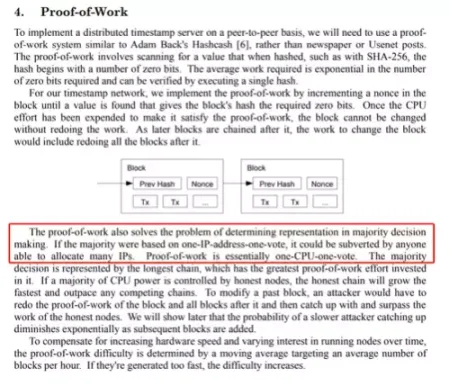
In fact, this issue was first discussed by Satoshi Nakamoto. If in a purely distributed system, 1 person 1 vote is too easy to be attacked by witches. Many friends on Twitter are particularly keen on AirDrop, and they should be familiar with this term.
OP is also a master of anti- witches. Therefore, OP 's "one person, one vote" is actually an elite one person, one vote system, and a "90-member committee" will be formed. This is the second time for OP to engage in this matter. The first time was to form a 22-member committee. This time, 90 people are 14 of the old committee + 14 nominated newcomers + developers using OP Stack + community + official A new committee appointed by hand.
What is the background of the old 14th Committee? I briefly DDed it. There are science fiction writers, founders of DeFi projects on OP , official members of OP , artists, cores of Gitcoin and Paradiam, and community KOLs. In short, it seems that the diversity is quite good.
As we all know, the OP has a large amount of unlocked tokens, and the FDV is huge (inserting a sentence is also a reason for me to hold more hhh), how to distribute these tokens?
A large part of it will be assigned to projects within the ecology, is it similar to Curve, but the task of dividing the money is handed over to the old 22-member committee.
These committee members scored a round of points for projects such as EtherJSJ, and finally distributed a reward of 1 million US dollars to these projects based on the weighted results of 22 people.
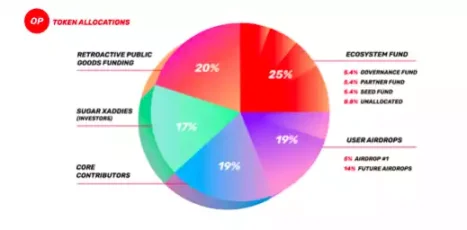
The point of Tricky is that there is a mismatch between personal interests and project interests. Then if you let the representatives of the OP 's voting warehouses vote, the money will probably be distributed to the projects with the best relationship with them in the end.
Then you may ask, is it impossible for the committee members to vote? Possibly, of course, but certainly a mitigation. Ticket warehouses are built up by money, while elite representatives rely on reputation, and the difficulty of getting seats is different, so they tend to cherish their feathers more.
Especially when the number of seats in this committee continues to expand, its fault tolerance will increase. So this time, the OP started the second round of money sharing plan (Retro2), so it is reasonable to introduce 90 committees. Of course, this system must not be perfect, and no system is even perfect. Each system is a better solution to the current problem and an improvement on the previous system. After the improvement, there are new problems.
If it is applied to modern political systems, such as the political system of the United States. The U.S. Congress is the House of Representatives + the Senate. The House of Representatives allocates quotas to each state directly according to the population, and it only works for 2 years, similar to civilian representatives. The House of Representatives is more like the Senate. There are only 2 people in each state, and they can work for 6 years, which is more elite.
Of course, it is assumed that the United States also has a virtual "Money House", such as Wall Street, where money is represented. I am not a fan of conspiracy theories, but there is no doubt that capital is implicitly promoting American politics.
So many current projects have turned this into a teaching and a standard, and only relying on this virtual "Money House" to solve proposals is of course not a good solution.
The OP introduced elite representatives this time, allowing its "Senate" and "Money House" to work together to check and balance each other, which seems to be a good attempt.
And I personally have a feeling that OP especially likes "the golden mean". The OP Stack I analyzed for you before also has the same idea. Not that extreme, very soft.
This kind of moderate philosophy, really, makes me more and more optimistic about OP (NFA).