
After studying NVIDIA Isaac and Lightwheel Intelligence, the logic behind Axis AI becomes clearer. Because I wasn't very familiar with the robotics field and Axis AI (@axisrobotics) before, I specifically sought out some information. During my research, I discovered several key industry benchmarks in this field, such as NVIDIA and Lightwheel Intelligence. Comparing these together, Axis AI's logical positioning becomes very intuitive: 1⃣ The Infrastructure of Physics Simulation In the development of embodied intelligence, a physics simulation platform is an indispensable experimental field. NVIDIA's Isaac platform is currently the most typical representative in the Web2 field. It uses a high-fidelity physics engine to simulate gravity, material properties, and complex object interactions, providing robots with a digital twin environment. The significance of this type of infrastructure is that it allows models to complete preliminary learning of physical rules in virtual space, thereby reducing the cost of training in the real world. 2⃣ The Supply Logic of Synthetic Data Data scarcity is currently the main technical bottleneck restricting the evolution of robot intelligence. Lightwheel Intelligence represents a standardized approach to solving this problem in the Web2 domain: generating large-scale, high-quality synthetic data through generative AI. This approach can cover extreme scenarios that are difficult to collect in reality, providing continuous fuel for model training and improving robot performance in complex environments. 3⃣ Axis AI's Web3 Production Model The essential difference between Axis AI and the previous two lies in the restructuring of production relations. As a Web3 project, it does not follow the centralized development route of Web2, but instead builds a distributed infrastructure. - Distributed Contributions: Through the participation of global contributors, the project directly captures diverse human intelligence data, attempting to solve the problem of a single institution's inability to obtain massive amounts of human operational samples. - Production of the Algorithmic Brain: Its core goal is to overcome the algorithmic challenges of large-scale transfer of human intelligence to robots, transforming human decision-making logic into Robotic General Intelligence (RGI). - Transparency and Scalability: Utilizing the incentive mechanisms of Web3, Axis AI attempts to make the creation process of intelligence verifiable and more scalable. // Finally, in layman's terms, what exactly does Axis AI do? What it does: Simply put, it's running a global training program for robot brains. It doesn't build the robot's physical shell; it focuses on developing the brain that makes robots as intelligent and capable as humans. How it does it: It believes that relying solely on a few people to write code is too slow, so it adopted a Web3 model, mobilizing people worldwide to teach AI their actions and intelligence. This allows AI to learn from the best and solve the problems of insufficient robot data and unresponsive robots. What its positioning is: If we consider NVIDIA Isaac as a simulator for robot training, and Lightwheel Intelligence as a mock exam providing training materials, then Axis AI uses the Web3 reward mechanism to encourage people worldwide to become coaches, infusing human intelligence into the robot's brain. Do you think this Web3 model has a good chance of succeeding in dealing with the complex data bottlenecks that even Web2 giants struggle with? @0xsexybanana #axisai
This article is machine translated
Show original

Dr. Moyu 摸鱼局长
@Jason23818126
01-27
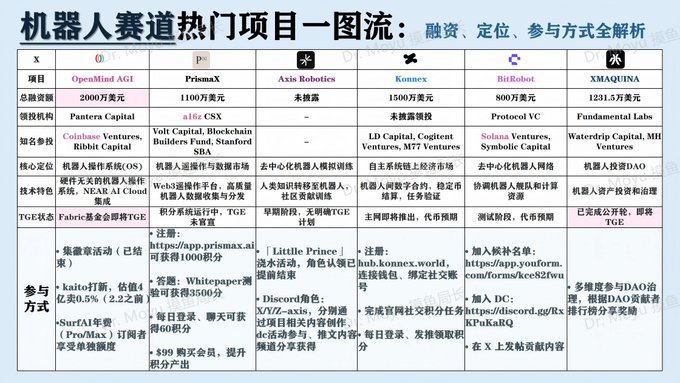
OpenMind 估值冲上 4 亿美金,一图理清 2026 机器人赛道 6 大热门标的
2026 年确实是机器人赛道从概念验证走向资产化落地的转折点。最近把这块项目整体过了一遍,发现顶级机构的布局已经非常垂直。
为了方便大家调研,我把目前最热门的 6 个项目做了一张对比图,重点看核心定位和参与机会:
1.

From Twitter
Disclaimer: The content above is only the author's opinion which does not represent any position of Followin, and is not intended as, and shall not be understood or construed as, investment advice from Followin.
Like
Add to Favorites
Comments
Share
Relevant content