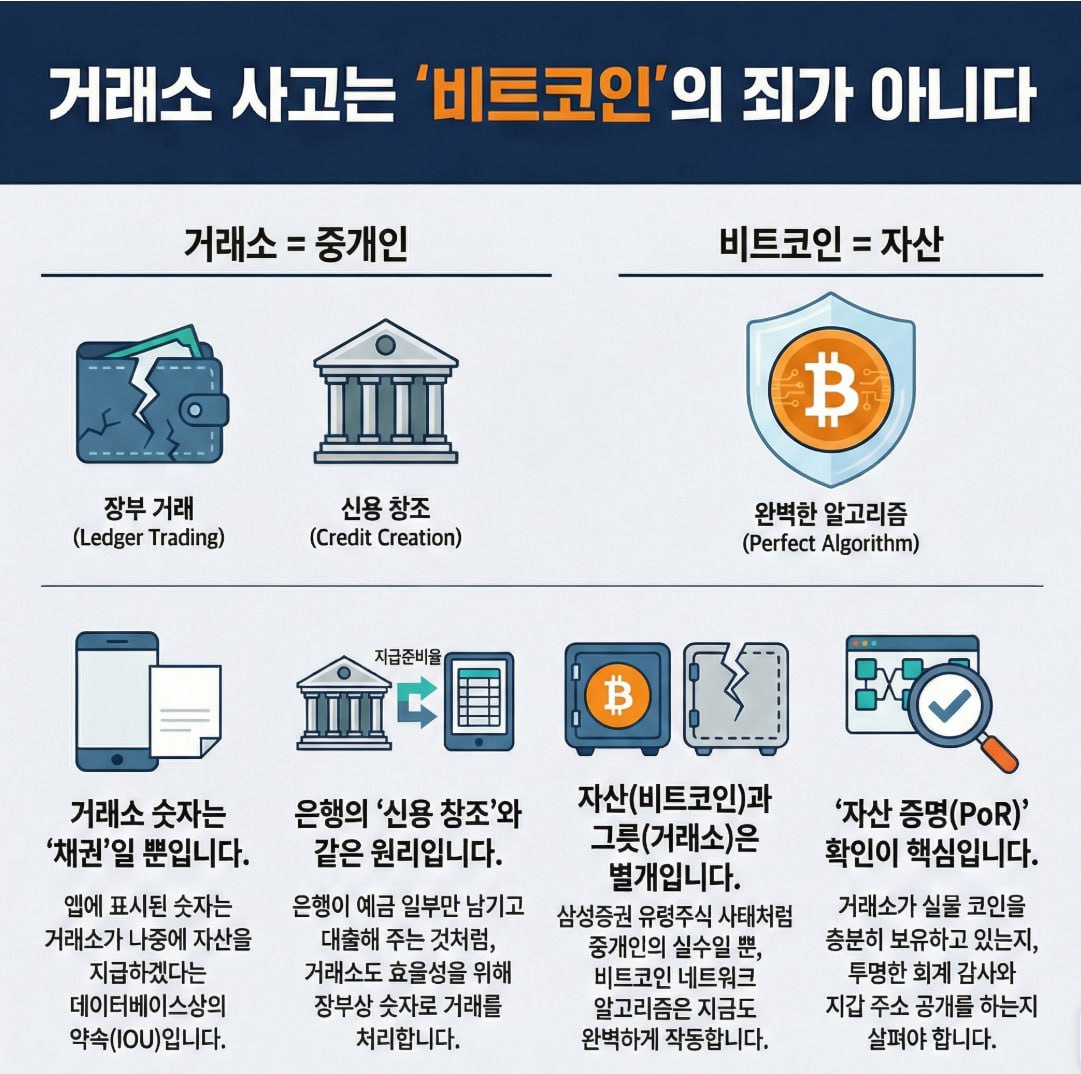
Bithumb's Ghost Bitcoin Incident? Samsung Securities Hits 112 Trillion Won (The Reality of Modern Finance) The market seems to be buzzing about the Bithumb incident ending Bitcoin. But this isn't just a problem with coins; it's an incident that exposes the fundamental vulnerabilities of the modern financial system. I'll just point out the facts, so don't be fooled and read carefully. 1. Why bother with "bookkeeping" transactions? (feat. Banks are the same) Efficiency and speed: If you waited for on-chain confirmation every time you sent a Bitcoin, the exchange wouldn't be able to operate. To save on fees and speed up transactions, they simply change internal database numbers through bookkeeping transactions. Bank credit creation: The banks we trust are actually the same. Banks don't keep 100% of your deposits in their vaults. They only keep the reserve requirement (approximately 7%) and print the rest on their books to lend out to others. This is a credit creation system. The Promise of Numbers: Ultimately, the numbers we see on apps are merely a promise (bond) from a bank or exchange to deliver assets later. Whether Bithumb misprinted the numbers or the bank increased the money supply through loans is, in principle, only a slight difference. 2. Assets are not at fault (Bitcoin vs. brokers) It's a bit premature to say, "Bitcoin itself is a scam" just because a fraud occurred. A mirror image of the Samsung Securities incident: In 2018, Samsung Securities also printed 2.8 billion "phantom" shares by offering 1,000 shares for 1,000 won. This was a "fat finger" incident on the part of the broker (securities firm/exchange), not a defect in the assets themselves. The problem with the vessel: Just because a vault keeper incorrectly recorded the number of gold bars in the ledger doesn't mean the gold is fake. The Bitcoin network is still operating perfectly according to its algorithm. The problem lies with the vessel (exchange) that failed to manage it. 3. What if an exchange deliberately commits fraud? You might say, "If an exchange deliberately inflates its numbers and starts carrying them, isn't that the end of it?" However, this is as unlikely as Samsung Securities deliberately inflating its supply. Spot Reserve Ratio: By law, domestic exchanges must store at least 80% of their customers' coins in physical, internet-disconnected cold wallets. This effectively serves as a "security reserve ratio." Surveillance and Punishment: Just as Samsung Securities is subject to the Financial Supervisory Service's (FSS) supervision, exchanges are now subject to 24-hour audits by external accounting firms and FIU surveillance. The punitive penalties (up to life imprisonment for ill-gotten gains of 5 billion won or more) are too severe for deliberate fraud. Proof of Assets (PoR): Major exchanges are currently disclosing wallet addresses, claiming, "I actually hold this much Bitcoin." It seems there are too many eyes on them to deliberately commit fraud. Still anxious? You should either store it in a cold wallet or leave the cryptocurrency market. However, keep in mind that money stamped in a bank account and stocks in a watch account are also money on the ledger. Summary Exchange numbers are just bonds; the real Bitcoin is on-chain. Banks are essentially a system that operates on ledger numbers, so it's not just about the coin. Rather than doubting Bitcoin itself due to an exchange mistake, it's wiser to see if the exchange is transparent about its Proof of Assets (PoR). When others are complaining about "the coin is ruined," you need to look at the root cause. The recovery process (99.7% recovery and compensation announcement) also serves as evidence that the systemic defenses are working. Don't be overly excited or depressed; just trust in the value of 1 BTC = 1 BTC. And why isn't my Xpin score increasing????? ㅠ
This article is machine translated
Show original

Telegram
Disclaimer: The content above is only the author's opinion which does not represent any position of Followin, and is not intended as, and shall not be understood or construed as, investment advice from Followin.
Like
Add to Favorites
Comments
Share
Relevant content