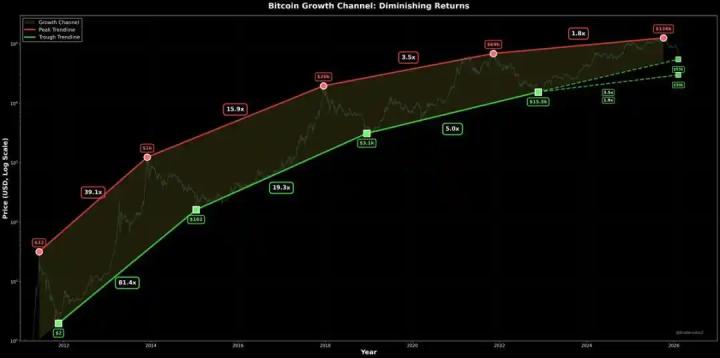
Bitcoin is consolidating around $68,000–$70,000 after a 13% rebound from $60,000, and a breakout above $80,500 could trigger the liquidation of approximately $5.7 billion in Short positions.
This development demonstrates the resilience of the price, but also reveals the fragility of the market, as any subsequent scenario depends on the major resistance zone above and signals from miners, whales, and the level of interest sought.
- Bitcoin held the $68,000–$70,000 range after bouncing 13% from $60,000.
- A breakout above $80,500 could trigger approximately $5.7 billion in Short liquidation, creating upward momentum.
- The sharp decrease in mining difficulty, the withdrawal of 1,546 BTC by whales, and the increased search interest are signals to watch.
Bitcoin is consolidating after a 13% rebound from $60,000.
Bitcoin's price is trading sideways around $68,000–$70,000 after touching $60,000 and then surging by about 13%, indicating that buyers have defended a key support zone in the short term.
Maintaining price stability after a sharp decline typically reflects two parallel factors: weakening selling pressure and accumulated buying demand emerging around what is considered the market's "fair price."
However, the 13% rebound does not necessarily mean a sustainable uptrend. The crypto market can reverse quickly when liquidation is thin or when prices enter areas with high leverage.
One notable point is that Bitcoin is still a long way from its previous all-time highs (ATHs), so investor reaction is often more sensitive to major resistance and support levels rather than the "breakthrough" narrative.
A sharp decrease in mining difficulty could pave the way for miners to return if prices stabilize.
The mining difficulty adjustment on February 8, 2026, was the sharpest reduction since the 2021 mining ban, typically indicating a withdrawal of some miners due to declining profitability.
Adjusting the difficulty to negative essentially makes mining "easier" than before, thereby reducing the marginal cost to produce each BTC (based on a fixed power output). As the difficulty decreases, units with low electricity costs or efficient Mining Rig can improve their profit margins.
The impact on price depends on two opposing forces: if miners are forced to sell to cover costs, supply pressure increases; but if mining conditions improve and prices remain above $60,000, the risk of a “sell-off to survive” may subside.
Therefore, the key question is Bitcoin's ability to hold above $60,000 and what factors could support this price level when the market enters the upper resistance zone.
The whale's withdrawal of 1,546 BTC from Binance is a signal leaning towards long-term accumulation.
On February 8, 2026, on-chain data showed a whale withdrawing 1,546 BTC (approximately $106.7 million) from Binance, which is generally XEM as a sign of reduced short-term selling intent.
Large-scale BTC withdrawals from exchanges to cold storage wallets are often accompanied by expectations of long-term holding. In many cases, large investors do not move assets off exchanges if they anticipate further sharp price drops in the immediate future.
Therefore, this move could reflect the view that the short-term Dip has been "tested" and the market is likely to shift to a more positive state.
However, a single whale transaction is not enough to confirm a trend. The signal would be more reliable if it occurred simultaneously with an increase in net BTC outflows from exchanges over a period of time, and the price held firm at key technical support levels.
Interest in searching for Bitcoin peaked in 12 months after the drop from $81,500 to $60,000.
After Bitcoin dropped from $81,500 to $60,000, search volume surged and reached a 12-month peak, reflecting a sharp increase in public and trader attention.
Increased search activity often occurs during periods of significant volatility, when investors need more information to make decisions. This could be a sign of a psychological "turning point," but it could also be an overreaction to the volatility.
Regarding market behavior, increased interest sometimes coincides with the influx of new money, but it can also coincide with periods of panic or FOMO. Therefore, it is necessary to compare this with price structure, volume, and leverage data to avoid one-sided interpretations.
In the current context, the bullish outlook suggests that many traders remain "hesitant," waiting for confirmation of whether Bitcoin will break through resistance or return to lower support levels.
Bitcoin needs to surpass $83,000, otherwise it risks a pullback to $49,000–$53,000.
Bitcoin is at a crossroads: breaking above $83,000 could open up an uptrend driven by Short liquidation, while failure to do so could drag the price back to the $49,000–$53,000 range.
Following a recovery of over $10,000 from the Dip, the $83,000 level is identified as the next major resistance. This area could attract a large concentration of sell orders and profit-taking sentiment, making it easy for the price to get "stuck" if buying pressure is not strong enough.
In a positive scenario, liquidation heatmap data suggests that if Bitcoin breaks above $80,500, the market could see approximately $5.7 billion worth of Short positions liquidated. The Short squeeze mechanism typically amplifies upward volatility due to a surge in buy-to-cover orders.
In a negative scenario, failure to break above the $80,000–$83,000 range could lead to a return to lower support, with the $49,000–$53,000 range cited as a Vai area in 2024.
The overall view is: whales may be betting on a breakout scenario, but the market still needs a strong catalyst and real money flow to confirm momentum, rather than just relying on leverage liquidation.
Conclusion: The recovery is significant, but the $83,000 level is the decisive test.
Bitcoin showed resilience by holding above $60,000, but the next step depends on breaking through the $83,000 resistance and the market's reaction to liquidation zones around $80,500.
- Recovering above $60,000 shows resilience, but the $83,000 mark remains a significant hurdle to overcome.
- Whale activity and market sentiment signals are leaning towards a potential bullish reversal, although this cannot yet be considered confirmed.
Frequently Asked Questions
Why is the $80,500 mark XEM important for Bitcoin?
Because the liquidation heatmap data shows that if the price exceeds $80,500, it could trigger the liquidation of approximately $5.7 billion in Short orders, creating a Short squeeze effect and further strengthening the upward momentum.
What impact does the decrease in mining difficulty have on the Bitcoin market?
A decrease in difficulty usually reflects miners withdrawing when profitability declines. But when the difficulty is lower, mining becomes cheaper and easier, which could encourage miners to return if the price of Bitcoin stabilizes, thereby reducing the pressure of forced selling.
Is it always a bullish signal when whales withdraw BTC from exchanges?
Not always. BTC withdrawals from exchanges often suggest a long-term holding trend and a reduced intention to sell immediately, but further confirmation is needed from net outflows, price structure, and reaction at resistance levels such as $80,000–$83,000.
If Bitcoin doesn't surpass $83,000, what are the downside risks?
The scenario suggests that prices could retreat to the $49,000–$53,000 range, which acted as support in 2024, if rejected at the $80,000–$83,000 level.