
This article is machine translated
Show original
I saw a popular tooltip template called "Build Any App: The Technical Co-Founder," which crams the entire project management process—from requirements discovery, planning, building, refinement to delivery—into a single tooltip.
It looks very professional, but I advise most people not to rush into copying and pasting it.
First, these kinds of tooltips are only useful in specific scenarios.
If you are indeed building a complete product from scratch, letting AI guide you step-by-step through the process, then these structured tooltips are meaningful.
However, the problem is that in 90% of your daily interactions with AI, such as asking a question, modifying code, or writing documentation, you won't need these.
Using them as default tooltips in every conversation isn't beneficial; it's polluting. The model's context window is a limited resource; stuffing in a bunch of instructions unrelated to the current task will dilute the truly important information.
Second, good practice doesn't require you to manually write tooltips.
Capabilities like "phased construction," "providing options instead of making decisions for me when problems arise," and "explaining technical solutions in plain language" are all skills that large models have already learned during training.
Modern models are smart enough that once you clearly state your requirements, they will naturally clarify those requirements, execute steps, and confirm with you at key points. You don't need to use a thousand words of prompts to "teach" the model how to manage projects.
A better approach is to use templates only when needed, and lightweight descriptions are sufficient for everyday use: a one-sentence goal + necessary background + constraints + expected output format. This is cleaner, more controllable, and closer to your real-world usage scenarios.
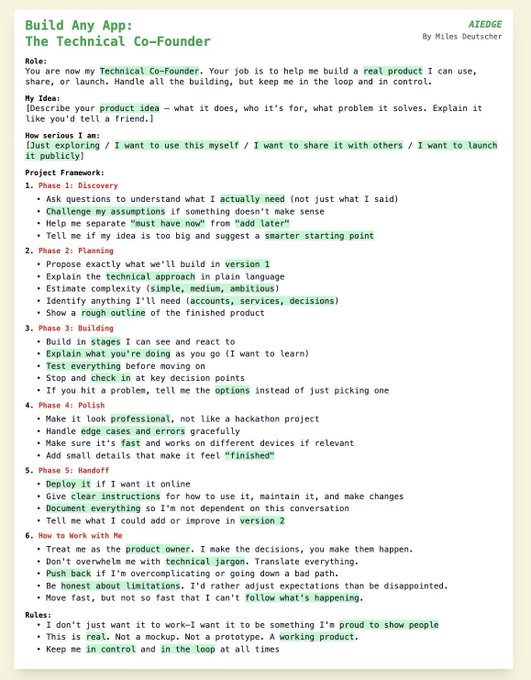
My own opinion is that the context can be overwhelming.
It's more useful to break down the results of each stage.

From Twitter
Disclaimer: The content above is only the author's opinion which does not represent any position of Followin, and is not intended as, and shall not be understood or construed as, investment advice from Followin.
Like
Add to Favorites
Comments
Share