Original author: TechFlow TechFlow
In the early hours of February 6th, when Bitcoin fell below $60,000, the entire crypto community panicked. Bitcoin had already lost 52% of its all-time high of $126,000 in October 2025.
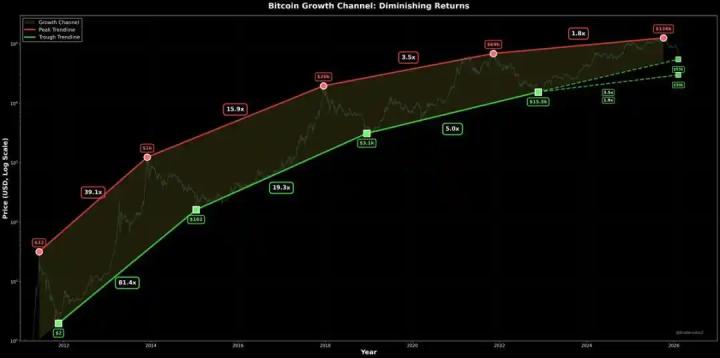
But if you look at Bitcoin's 15-year price history, you'll find a harsh truth: a 52% drop is just a drop in the ocean in history.
The "code" behind Bitcoin's bear market decline
Let's look at a set of data first:
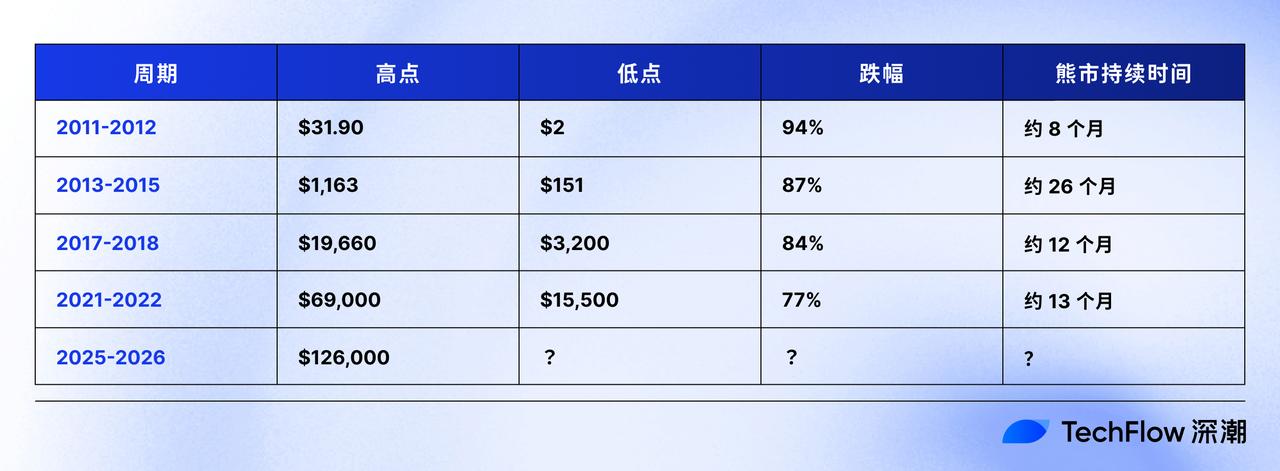
This table reveals a clear pattern: the maximum decline in each bear market is decreasing.
From 94% to 87%, then to 84%, and then to 77%, Bitcoin's "bear market standard" is narrowing by 5-10 percentage points per cycle.
To examine this decreasing pattern more precisely:
- 2011→2013: Decreased by 7 percentage points (94%→87%)
- 2013→2017: Decreased by 3 percentage points (87%→84%)
- 2017→2021: Decreased by 7 percentage points (84%→77%)
On average, it decreases by about 5-7 percentage points per round.
Why?
With a larger market capitalization base, volatility naturally decreases.
In 2011, Bitcoin's market capitalization was only tens of millions of dollars, and a single "whale" sell-off could cause the price to plummet by 94%.
Even if Bitcoin's price halve from its peak to $60,000 in 2026, its market capitalization will still exceed $1 trillion. For a trillion-dollar asset to fall another 30-40%, the volume of selling needed would be several thousand times that of 2011.
The entry of institutional investors provided a "liquidity buffer."
Before 2018, Bitcoin holders were mainly retail investors and early miners. Once panic sets in, everyone rushes to sell, and there are no "buyers" left.
Since 2022, institutions such as BlackRock, Fidelity, and Grayscale have held hundreds of thousands of Bitcoins through ETFs. These institutions will not panic and sell off their holdings during a market crash; their presence acts as a "safety net" in the market.
According to Bloomberg data, as of the end of January 2026, the total holdings of US Bitcoin spot ETFs exceeded 900,000 BTC, worth over $70 billion. This "lock-up effect" directly reduces the market's available supply for sale.
Bitcoin's evolution from a "speculative commodity" to an "asset class"
From 2011 to 2013, Bitcoin was still a toy for geeks, and its price was entirely driven by sentiment.
From 2017 to 2021, Bitcoin began to be regarded as "digital gold," but it still lacked a clear valuation anchor.
After 2025, with the approval of Bitcoin ETFs, the GENIUS Act promoting stablecoin legislation, and Trump proposing a "strategic reserve" plan, regardless of whether these policies are actually implemented, Bitcoin has transformed from a "fringe asset" into "part of the mainstream financial system."
The result of this evolution is a reduction in volatility.
The supply shock of the halving cycle is weakening.
In the past, the price of Bitcoin was mainly affected by the 4-year halving cycle, in which the new supply decreased by 50% every four years.
When the first halving occurred in 2012, the daily increase in production dropped from 7,200 to 3,600, resulting in a huge supply shock.
After the fourth halving in 2024, the daily new production dropped from 900 to 450. Although the percentage is the same, the absolute decrease in quantity is very small, and the impact on the market is also decreasing.
The "deflationary effect" on the supply side is weakening, and the "speculative frenzy" on the demand side is also cooling down, both of which have led to a narrowing of volatility.
If history repeats itself, where is the bottom this time?
Based on the historical pattern of "decreasing with each round," we can deduce three scenarios:
Scenario 1: Optimistic assumption, the decline narrows to 65%.
If the maximum decline in this cycle is 65% (a further decrease of 12 percentage points from the previous cycle's 77%, slightly higher than the historical average decline):
Bottom price = 126,000 × (1 - 65%) = $44,100
From $60,000 to $44,100, there is still a 26% downside potential .
Reasons for support:
Institutional holdings reached a record high, with ETFs providing strong buying support.
Although the Federal Reserve is hawkish, the market has already moved its expectation for a 2026 rate cut forward to June, instead of July.
Trump's White House cryptocurrency summit on March 7 may release favorable policy signals.
Despite the negative growth in stablecoins, the total value locked (TVL) has remained stable at over $230 billion.
Risk factors:
If holders of highly leveraged positions like Strategy are forced to sell their coins, it could trigger a chain reaction.
Trump's promise of "strategic reserves" has yet to materialize, and the market may be losing patience.
If you believe this scenario: you should start building your position in batches below $50,000, and increase your position around $45,000.
Scenario 2: Neutral Assumption – 70-72% Drop
If the maximum decline in this cycle is 70-72% (strictly following the historical pattern of "decreasing by 5-7 percentage points"):
Bottom price (70%) = 126,000 × (1 - 70%) = 37,800 USD
Bottom price (72%) = 126,000 × (1 - 72%) = $35,280
From $60,000 to $35,000-$37,800, there is still a 37-41% downside potential .
Reasons for support:
It perfectly aligns with historical trends, being neither overly optimistic nor overly pessimistic.
The complexity of the current macroeconomic environment (expectations of interest rate cuts + concerns about balance sheet reduction) is comparable to that of 2018.
The $35,000-$38,000 level corresponds to Bitcoin's 200-week moving average, which has historically been a strong support level.
Risk factors:
If the US economy falls into recession, all risky assets will face indiscriminate selling.
If the AI bubble bursts, the tech stock crash will drag down Bitcoin.
If you believe this scenario: you should keep your main funds below $40,000, and $35,000-$45,000 is your "heavy investment range".
Scenario 3: Pessimistic Assumption – Decline Reverts to 75-80%
If this time is "truly different," and a structural collapse in the market causes the decline to return to the average level of 2017-2022:
Bottom price (75%) = 126,000 × (1 - 75%) = 31,500
The bottom price in US dollars (80%) = 126,000 × (1 - 80%) = 25,200 US dollars.
The drop from the current $70,000 to $25,000-$31,500 would be a massacre with another 50% decline .
Reasons for support:
The "triple whammy" on February 6 (a simultaneous plunge in US stocks, gold, and Bitcoin) showed that Bitcoin's "safe-haven attribute" had completely failed.
While ETFs absorb a large number of shares, this also means that institutions can "sell them off with a single click."
The Trump administration's tariff policies have triggered a global trade war and could lead to a global recession.
The loss of talent and the withdrawal of venture capitalists from the crypto industry (such as the departure of Multicoin co-founder Kyle Samani) indicate a collapse in industry confidence.
If you believe this scenario: you should liquidate your positions now and wait for the market to completely crash to below $30,000 before making any moves, or keep only 10-20% of your position to "take a gamble" and withdraw the rest of your funds to observe.
Don't be afraid of missing out.
Some people are always worried about what to do if they miss the buying opportunity at the bottom of this bear market?
The answer is simple: either chase the upward trend or wait for the next cycle.
Cryptocurrency is not your only chance to turn your life around. If you think it is, you've already lost.
Those who missed out on $150 in 2015 actually had a chance when it reached $3,200 in 2018.
Those who missed out on $3,200 in 2018 still have a chance when it reaches $15,000 in 2022.
But the prerequisite is that you have to live to see the next cycle.
Don't leave the market completely just because you lost a single All In.
Furthermore, most people only care about "at what price to buy", but ignore "when to sell".
Here are three examples:
Case 1:
In December 2018, Mr. Zhang heavily invested in Bitcoin when it was priced at $3,200. In June 2019, Bitcoin rose to $13,000, and Mr. Zhang thought "the bull market has arrived," so he didn't sell. In December 2019, Bitcoin fell back to $7,000, and Mr. Zhang thought "it's all over," so he cut his losses and left the market.
The final outcome: less than 100% profit, and being wiped out of the game, missing out on $69,000 in 2021.
Case 2:
Xiao Li also bought in at $3,200, but he set a rule for himself: "I will not sell until it reaches $50,000." He remained unmoved by all the fluctuations in 2019-2020. In April 2021, Bitcoin rose to $63,000, and Xiao Li sold 50%, locking in a 15-fold profit. He held the remaining 50% until it reached a high of $69,000 in November 2021, when he finally sold it.
Outcome: Average profit of 18 times.
Case 3:
Starting in December 2018, Mr. Wang invested 1,000 yuan every month, regardless of whether the market went up or down. He persisted for three years until December 2021 when he stopped investing.
His average cost was about $12,000 (because he bought cheaply in the early stages and expensively later). In November 2021, when Bitcoin was at $69,000, he sold all of it, making a profit of about 4.7 times.
Outcome: Although not as good as Xiao Li, he didn't need to "choose the right time" at all, making his execution the simplest.
These three cases tell us that it's not important to buy at the bottom; what's important is to hold on to your shares.
If you don't have the intention of holding cryptocurrency for life from the beginning, then setting a "profit-taking plan" in advance is the best approach. Dollar-cost averaging may not be exciting, but it is most suitable for ordinary people. Most people will not buy at the bottom and sell at the top, so buying and selling in batches is always a relatively better method.
In conclusion: Bear markets are where the poor have a chance to turn their lives around.
Those who bought Bitcoin at $2 in 2011 have now realized a 30,000-fold return (even based on the recent low of $60,000).
Those who bought at $150 in 2015 are now 400 times more valuable.
Those who bought at $3,200 in 2018 are now 18.75 times more invested.
Those who bought in at $15,000 in 2022 are now four times more.
Every bear market is a redistribution of wealth.
Those who frantically chased the rising prices at the peak were shaken out in the bear market; those who panicked and sold at the bottom handed over their shares to others.
Those who truly make money are always the ones who dare to build positions in batches when everyone else is in despair.
As long as you believe, the price of Bitcoin will soar, and it will go even higher.
In 2018, when Bitcoin fell to $3,200, some people said, "Bitcoin is dead."
In 2022, when Bitcoin fell to $15,000, many people exclaimed that the end of cryptocurrency had arrived.
In February 2026, when Bitcoin fell below $60,000, the world asked, "Is this time really different?"
If you believe that "history repeats itself," then the next 6-12 months are one of the few times in your life when you can buy into the "future" at a "relatively low price."
Whether you believe it or not is your choice.