Chainfeeds Summary:
A bear market is where the poor have a chance to turn their lives around.
Article source:
https://www.techflowpost.com/zh-CN/article/30288
Article Author:
TechFlow TechFlow
Opinion:
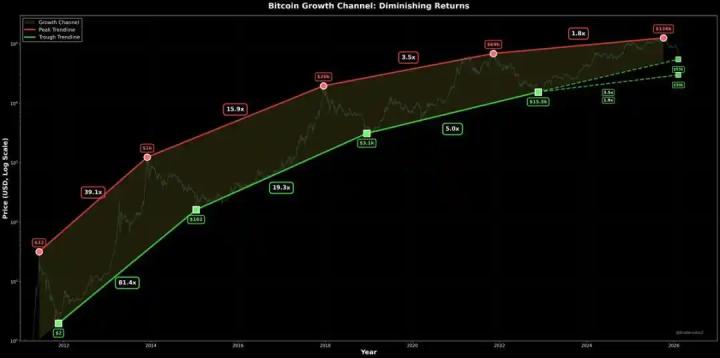
TechFlow TechFlow: This table reveals a clear pattern: the maximum decline in each bear market is decreasing. From approximately 94% retracement in 2011, to approximately 87% in 2013, then to 84% in 2017, and 77% in the 2021–2022 cycle, Bitcoin's "bear market standard" is gradually narrowing by about 5–10 percentage points per cycle. Looking at this trend more closely: a decrease of 7 percentage points from 2011 to 2013, a decrease of 3 percentage points from 2013 to 2017, and a further decrease of 7 percentage points from 2017 to 2021, averaging a decrease of 5–7 percentage points per cycle. This change is not accidental, but driven by the evolution of market structure. First, the larger market capitalization naturally reduces volatility. In 2011, Bitcoin's market capitalization was only tens of millions of dollars; a single large sell-off could cause a devastating impact. By 2026, even if the price halves from its peak to $60,000, the overall market capitalization will still exceed $1 trillion. For a trillion-dollar asset to fall another 30%-40%, the required sell-off volume would be orders of magnitude different from its earlier stages. Secondly, institutional entry has created a liquidity buffer. Before 2018, the market was almost entirely dominated by retail investors and early miners; once panic set in, everyone would sell simultaneously, leaving no one to take over. However, after 2022, institutions like BlackRock, Fidelity, and Grayscale held large amounts of Bitcoin through ETFs. These funds are more focused on long-term allocation and are less likely to panic-sell due to short-term fluctuations, thus reducing overall volatility. Bitcoin's role is also fundamentally changing, and this evolution is also compressing the magnitude of bear market declines. From 2011 to 2013, Bitcoin was more of a niche experiment within the geek community, with its price almost entirely driven by sentiment. From 2017 to 2021, it gradually came to be seen as "digital gold," but still lacked a stable valuation anchor. After 2025, a series of policy signals, such as the approval of ETFs, the advancement of stablecoin legislation, and discussions on national reserves, have begun to integrate Bitcoin into the mainstream financial system, gradually transitioning it from a speculative commodity to an asset class. The direct result of this shift is decreased volatility. Furthermore, the impact of halving cycles on prices is also weakening. In the early halvings, the daily new supply plummeted from 7200 to 3600, a huge change in absolute quantity; while after the fourth halving in 2024, the daily new output only decreased from 900 to 450. Although the proportion remains 50%, the absolute reduction in supply is far less significant than before, and the impact on market structure is noticeably smaller. The deflationary effect on the supply side is weakening, and the speculative fervor on the demand side is gradually cooling down. These two factors combined are causing Bitcoin's volatility range to gradually narrow. If historical patterns continue, the maximum decline in this bear market may further shrink, rather than returning to the extreme crashes of the early stages. Based on the historical experience of "decreasing declines in each halving," three possible bottoming scenarios can be deduced. The first scenario is a relatively optimistic one: if the maximum decline in this round narrows to 65%, then the theoretical bottom, calculated from the high of $126,000, would be around $44,000, meaning there's still about 20% downside potential from the current $60,000. This scenario is supported by factors such as record-high institutional holdings, stable buying from ETFs, and potential policy benefits. The second scenario is a neutral one, continuing the historical pattern of a 5-7 percentage point decrease per round, with a potential decline of 70%-72%, corresponding to a bottom range of approximately $35,000 to $38,000. This area also coincides with Bitcoin's long-term technical support level. The third scenario is a pessimistic one: if systemic risks emerge in the market structure, causing the decline to return to 75%-80%, then the bottom might fall in the $25,000 to $31,000 range. From an investment perspective, these projections are not predictions, but rather risk frameworks. The more important lesson is that those who truly profit are often not those who precisely buy at the absolute bottom, but rather those who can consistently build positions in batches during downturns and execute clear profit-taking strategies during bull markets. History has repeatedly shown that bear markets are more like a phase of redistribution of resources than the final stage.
Content source