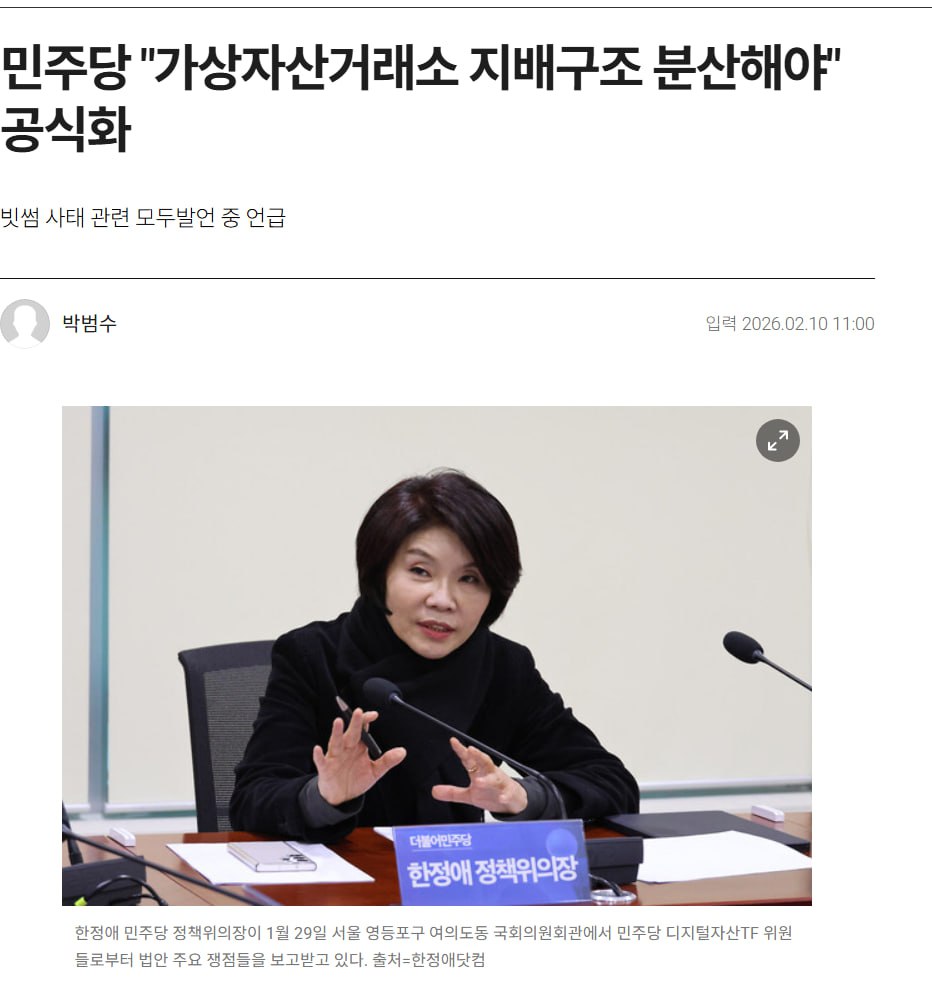
Democratic Party Officially Declares "Decentralization of Virtual Asset Exchange Governance Structures" During a floor strategy meeting on the 10th, Democratic Party Policy Committee Chairwoman Han Jeong-ae stated, "We must swiftly pursue the enactment of the Digital Asset Basic Act, the second phase of legislation, to improve the structural problems of exchanges and establish a foundation for trustworthy digital asset trading through decentralized governance." He explained, "We will address systemic weaknesses by imposing internal control standards, mandating periodic audits of digital asset holdings by external organizations, establishing no-fault liability for virtual asset operators in the event of computer system failures, and reviewing the eligibility of major shareholders." The chairman stated, "This case clearly reveals the vulnerabilities of digital asset exchanges' ledger transactions and internal control systems, beyond simple operational errors." He continued, "Amounts not actually held were issued and immediately paid out. Despite the large amounts of tokens being paid out in excess of the assets held, there was no systematic filtering to block or warn of this." In other words, following the Bithumb incident, the government ultimately decided to align its stance with the Financial Services Commission and propose a basic law on digital assets. ※ Note 1. Limiting major shareholders' stakes in exchanges to 15-20%, the same level as alternative exchanges. ✔️Impact of this: - Strengthened supervision by financial authorities. - Establishing a 'public infrastructure' structure, mandating a verification system between assets held and ledgers. - Global competitiveness. Weakening ➡️While Korea's equity cap is benchmarked against the 15-20% cap of traditional financial institutions (ATSs), most global economies (the US, EU, and Japan) apply controlling shareholder suitability or governance regulations instead of ownership caps. ※ Conclusion - The decentralization ideology of cryptocurrency is a core value that began with the Bitcoin whitepaper. Its core value is a system operated by consensus among network participants without a central authority. -> Global regulatory trends are pursuing regulations while recognizing this to some extent. -> While decentralization is viewed as the "core of innovation," the government is prioritizing regulation of centralized elements (e.g., CEX, stablecoins) for investor protection, financial stability, and AML (anti-money laundering) compliance. A significant difference lies in Korea's refusal to recognize the concept of decentralization itself, attempting to "absorb" it into the traditional market. This will likely lead to a decline in global competitiveness and the decline of the Korean cryptocurrency industry.
This article is machine translated
Show original

Telegram
Disclaimer: The content above is only the author's opinion which does not represent any position of Followin, and is not intended as, and shall not be understood or construed as, investment advice from Followin.
Like
Add to Favorites
Comments
Share
Relevant content