The days of ad-free ChatGPT are coming to an end.
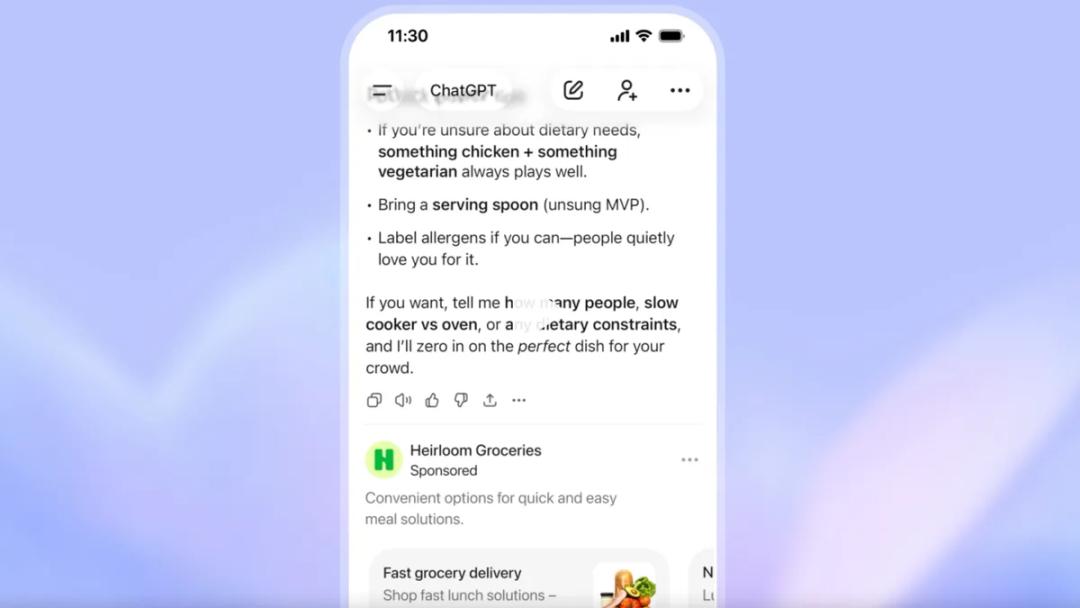
After weeks of build-up, OpenAI has just announced that it will officially begin testing ads on its AI platform, and ChatGPT users may soon see ads in their conversations. These ads will appear as "sponsored" links at the bottom of ChatGPT answers, but OpenAI states that the ads will not affect the content of the ChatGPT answers and will be visually distinguishable.
Currently, ads are only displayed to free ChatGPT users and users of the low-cost $8/month Go subscription. Plus, Pro, Business, Enterprise, and Education users will not see any ads. This means that users who want to avoid ads need to subscribe to the Plus plan for at least $20/month. OpenAI notes that free users can opt out of ads, but at the cost of fewer free daily conversations; Go plan users cannot opt out of ads.
A source close to OpenAI indicated that the company expects advertising revenue to account for less than half of its total revenue in the long run. Currently, the company also takes a cut of user purchases through its chatbot's integrated shopping functionality. According to foreign media reports, OpenAI CEO Sam Altman told employees that ChatGPT's "monthly growth rate has recovered to over 10%" and that an "updated chat model" will be deployed this week.
ChatGPT Advertising Rules Revealed
Prior to the launch of this advertising feature, Anthropic subtly criticized ChatGPT's advertising model in an ad. For example, in one ad, a young man sought help from AI to develop six-pack abs. The AI, acting as a personal trainer, initially offered guidance but then began promoting a fictitious height-increasing insole. Anthropic later changed the ad's tagline to: "Advertising has its time and place, but your conversation with AI shouldn't be one of them." This quickly drew criticism from Altman, who called it "clearly dishonest," using "deceptive advertising to criticize non-existent, theoretically deceptive advertising," which contradicted their actual advertising model.
In the latest episode of OpenAI's podcast, Asad Awan, one of OpenAI's heads of advertising, detailed the ad-making decisions in their AI products. "On the one hand, we take a 'highbrow' approach, not running ads, but at the same time limiting the amount of money used and using weaker models; on the other hand, we embrace the advertising model."
In this dialogue, many core issues of concern to the outside world were brought to the forefront and clear answers were given.
From the user's perspective, why advertise? And why now?
“This brings us back to our mission: to make AGI accessible to all of humanity,” Awan explained. When a consumer product has over 800 million users, how do you deliver the best product to everyone? Advertising is a proven, mature model, making it a natural choice for a company that wants to bring the best AI to all of humanity. Providing the best models and higher usage limits ensures that advertising is truly useful for both users and businesses.
He stated that people are concerned about the potential negative impact of advertising, so OpenAI prioritizes the principles of advertising: setting extremely high standards for the platform to ensure that advertising is truly useful. Several core principles have been established:
First, the model's answers are completely independent of the advertisements. Whether in terms of visuals, model training, or system logic, the answers are always credible, and the entire product is built on trust.
Second, the conversations are private. Sensitive conversations will never feature ads, and the content will never be shared with advertisers. We will internally match appropriate ads, but advertisers will not be able to see user conversations.
Third, transparency and controllability. Users can clearly understand how the data is used and can control it independently.
Fourth, the incentive mechanism is centered on user value. We don't pursue the length of time users stay on the platform; a truly useful advertisement is enough.
"Simply put, it's about popularizing AI through advertising while strictly preventing various negative issues, clarifying principles from the beginning, and continuously testing and improving," Awan said.
How frequently do advertisements appear?
"The highest principle is: are there any useful ads to display?" Awan said. The core principles are: are they useful, helpful, and supplement the user's actions? Can they showcase high-quality products? The content quality must be high, the ad quality must be high, and the relevance must be high. "If not, we'd rather not display any. In fact, during the testing phase, you'll see very few ads because we're very conservative and are still learning where to insert them."
According to reports, the model cannot see ads and has protective measures in place. "Bombarding users with ads is not good for either users or businesses. We don't want advertisers to waste money on exposure, nor do we want users to see a bunch of ads. We only want to show the right ad. As a top AI company, this is exactly what we can do well."
When a company has a dedicated advertising revenue department, will it still build a wall between models and advertisements?
"As long as the goal and incentive mechanism are to become the most trustworthy AI, we will not go astray."
Awan emphasized, "Our core business is trust. For individual users, it's about providing reliable and high-quality answers; for enterprise clients, trust is everything. You entrust us with your most important data, and we must safeguard it. If we truly want to be your most trusted intelligent assistant, we must ensure you feel comfortable sharing your most important information and know it will be treated properly. Our business model is based on trust, which is completely different from many products that only offer one-time queries and content recommendations. For us, trust is not an option, but a necessity. What we want users to remember is 'trustworthiness.'"
How should you respond to a competitor who makes jokes about advertising?
“Different companies have different missions,” Awan said. OpenAI’s business scenarios are more diverse: enterprise business, subscription business, and a large number of free users. The enterprise version has no ads, the subscription version has no ads, and the ads are to support the free user business. “If your mission is not to make AI accessible to everyone, then not advertising is reasonable; but our mission is to implement AI in various scenarios so that everyone can use the best AI.”
He emphasized that if they only served paying users, they could certainly say, "We don't need to advertise." But OpenAI's vision is not abstract; it's very concrete: how AI can truly help ordinary people. "If we take an elitist approach, where only those who can afford it can use AI, then we don't agree with that from a value perspective. Our position is very clear: everyone should have access to the best AI. And we are not a pure advertising company; the incentive mechanisms of pure advertising companies are completely different from ours."
What will advertising look like in ten years?
According to Awan, the next step will be more realistic conversational ads that truly understand what the product is. Further down the line, AI will be able to automatically aggregate the best discounts, the most cost-effective products, and the most suitable versions in the background. This will create a match between users actively searching and merchants hoping to be discovered by the right people.
“The future will be more intelligent and integrated. We’ll start with the existing forms, improve the experience, and make it more relevant, controllable, understandable, and trustworthy. As the main product and system evolve, the advertising formats will also evolve,” Awan said.
The first batch of companies to place advertisements have appeared.
ChatGPT's launch of advertising comes at a time of increasing competitive pressure in the artificial intelligence industry and higher expectations for the sustainable profitability of large AI platforms. OpenAI stated, "ChatGPT is used by hundreds of millions of people for learning, work, and daily decision-making. To ensure the rapid and stable operation of both the free and Go versions, we need to invest heavily in infrastructure and ongoing funding. Advertising revenue helps fund these efforts, enabling more people to use artificial intelligence through higher-quality, free, and low-cost options, and allowing us to continuously improve the intelligence and functionality we offer."
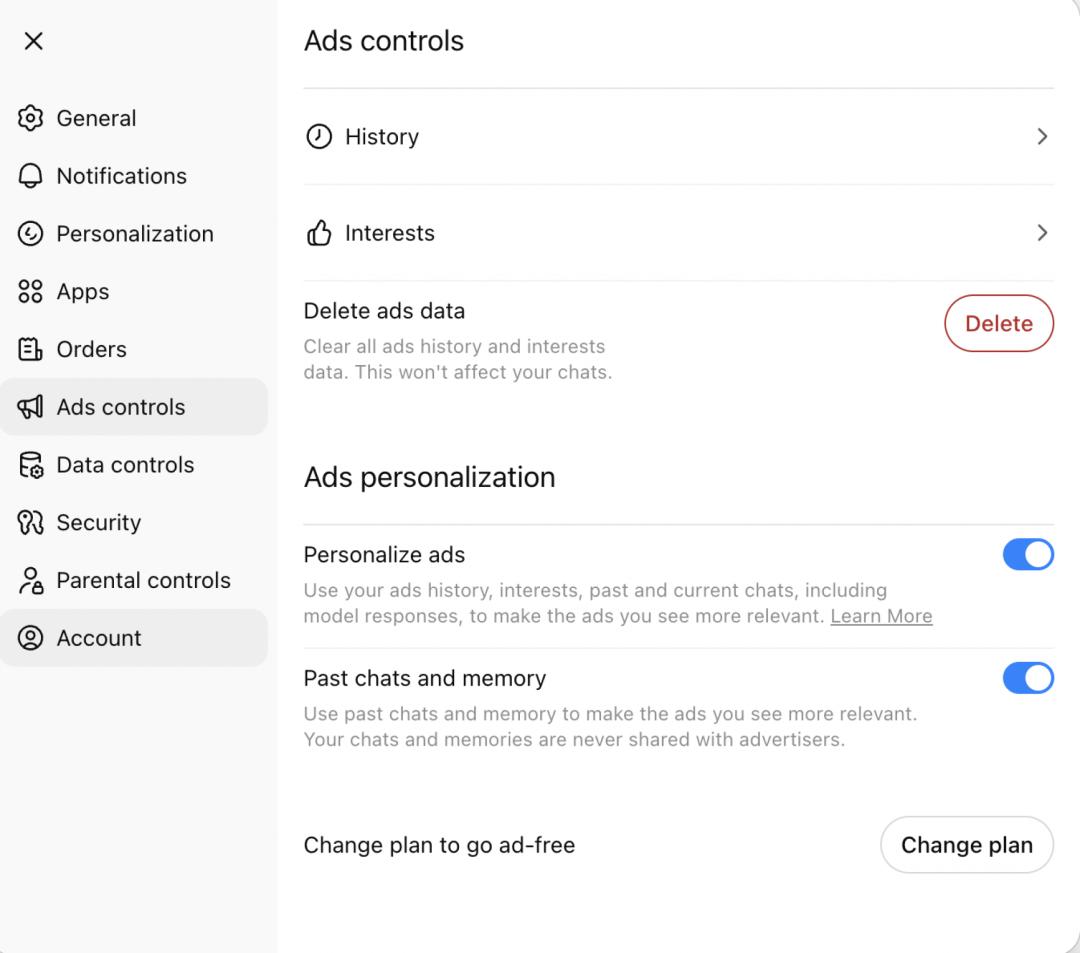
Meanwhile, the company stated that advertisers will only receive aggregated ad views and clicks, and will not access users' ChatGPT conversation personalization data or content. Free and Go users can provide feedback on ads, disable ad personalization settings, and turn off ad recommendations based on historical conversations, thereby limiting how sponsored content is delivered and deleting ad-related data. Furthermore, OpenAI does not currently serve ads to all users and conversations, such as users under 18 and conversations involving specific sensitive topics like health, mental health, and politics. Even adult users of the free and Go versions may not see ads immediately, as the feature is still in the testing phase.
While the move has drawn mixed reactions from ChatGPT users and industry observers, OpenAI insists the ads are intended to subsidize the cost of using its free and low-cost services. The company emphasizes, "The focus of this test is learning. We will closely monitor feedback to ensure the ads integrate effectively and naturally into the ChatGPT experience before rollout." Early user feedback will help improve the ads and may expand their reach in the future. OpenAI states it will leverage insights from this pilot project to better balance profitability and user experience.
Several companies have already revealed how they will run ChatGPT ads. Adobe stated that it will initially pilot the feature with ads in Acrobat Studio and Firefly. Target, which has already integrated with ChatGPT, will display ads when users ask questions such as, "What countertop kitchen appliances can make everyday cooking easier?"
As testing progresses, OpenAI's approach is likely to influence other AI companies' thinking about monetization models and the role of advertising in conversational AI tools. However, Anthropic, the developer of the Claude AI assistant, has "promised" never to include ads, even promoting this decision in a series of Super Bowl ads. Google, a competitor of OpenAI, has reportedly hinted that its Gemini AI platform might include ads in 2026, although Google DeepMind CEO Demis Hassabis stated in late January that Gemini "has no plans" to include ads. Currently, Google already includes ads in its AI overview alongside search results.
Someday in the future, all free AI apps and services may feature ads, but for now, ChatGPT is the only major app and service provider to have done so. Previous versions of Microsoft Copilot (then called Bing Chat) also featured ads, but the current version appears to have removed them.
Reference link:
https://openai.com/index/testing-ads-in-chatgpt/
https://www.cnbc.com/2026/02/09/sam-altman-touts-chatgpt-growth-as-openai-nears-100-billion-funding.html
https://www.youtube.com/watch?v=2agJo3Jf_O4
This article is from the WeChat official account "AI Frontline" , compiled by Huawei, and published with authorization from 36Kr.