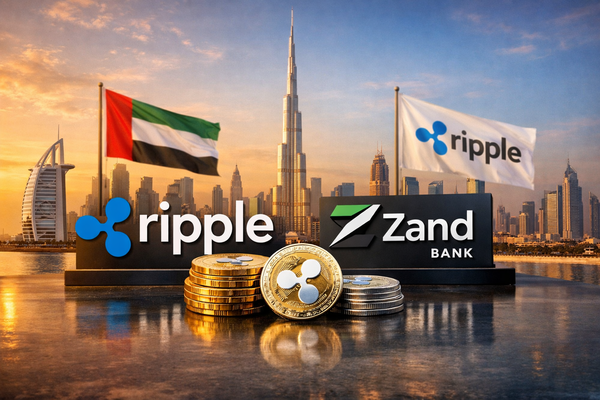
US blockchain company Ripple is partnering with Zand Bank, a digital bank in the United Arab Emirates (UAE), to accelerate its push into the Middle East's stablecoin market. The plan is to expand digital financial infrastructure by linking the dollar-pegged stablecoin RLUSD with the dirham (AED)-pegged stablecoin AEDZ.
Ripple announced that it is exploring support for RLUSD in Zandt's regulated digital asset custody environment, building on a partnership the two companies established last year. The company is also exploring ways to connect RLUSD and AEDZ liquidity and issue AEDZ on the XRP Ledger.
The core of this collaboration is the establishment of a "currency bridge." RLUSD is a stablecoin pegged to the US dollar, while AEDZ is pegged to the UAE dirham. Directly linking the two assets on-chain will establish a real-time payment and settlement channel between the dollar and the dirham. This is significant not only because it involves additional token issuance, but also because it represents an experiment in digital payment infrastructure that connects the global reserve currency with local currencies.
The UAE, in particular, is considered to have established the most proactive digital asset regulatory framework in the Middle East. Operating stablecoins within a regulated banking environment also aligns with Ripple's institutional expansion strategy. As regulatory reforms are underway in the US and Europe, the Middle East is emerging as a strategic base for global blockchain companies.
There are also technical aspects to note. If AEDZ is issued on the XRP Ledger, XRPL will evolve beyond a simple remittance network into a stablecoin platform based on local currencies. This will directly expand the practical use of the XRPL ecosystem and broaden its potential for use in cross-border financial areas such as business-to-business trade settlements and international remittances.
The Middle East is a region active in energy trade and international payments. While the dollar is heavily used, there is also significant demand for local currency-based payments. Connecting RLUSD and AEDZ could offer an alternative by digitizing this dual structure, reducing costs and settlement times.
The global stablecoin market has recently been diversifying from a dollar-centric structure to a regional currency-pegged model. Ripple's latest move goes beyond a simple partnership announcement and is interpreted as a strategic move to establish the Middle East as a digital payments hub by combining dollar stablecoins with regional currency stablecoins.
As the stablecoin race spreads beyond the US and Europe to the Middle East, attention is focused on whether the UAE will establish itself as a hub for global digital currency testing.