The Layer 2 network MegaETH officially launched its mainnet yesterday, marking the official entry of this project, which calls itself an "instant blockchain," into the practical application phase.
Article by Chloe
Article source: ChainCatcher
Layer 2 network MegaETH officially launched its public mainnet yesterday, marking the official entry of this self-proclaimed "instant blockchain" project into the practical application phase. Last October, the project completed a $450 million token sale, with subscriptions reaching $1.39 billion, representing an oversubscription of 27.8 times. It also received endorsements from prominent figures such as Ethereum co-founder Vitalik Buterin and ConsenSys founder Joseph Lubin. However, later that year, the project experienced two major crises: the revocation of a crypto KOL's token allocation and the loss of control over the pre-deposit sale. Fortunately, the project team quickly resolved these issues, preventing a larger crisis.
MegaETH aims to process 100,000 transactions per second (TPS) with a block time of less than 1 millisecond. It has consistently achieved 35,000 TPS in recent stress tests. However, Vitalik has recently become increasingly pessimistic about the current Layer 2 landscape. Despite MegaETH receiving substantial capital support, its ability to break through in the highly competitive L2 market remains to be seen.
What happened to MegaETH before its launch?
Despite being touted as a performance dark horse, MegaETH has experienced dramatic ups and downs in recent months. From a frenzied public offering to refunds triggered by technical mishaps, the road has been far from smooth. Last October, MegaETH launched its MEGA token auction, igniting market sentiment. The auction ultimately attracted $1.39 billion in subscriptions, an oversubscription of 27.8 times, making it one of the most notable fundraising events of the year.
However, just ten days after the public offering ended, crypto KOL IcoBeast was found to have violated the "no resale intent" rule of the one-year lock-up period by publicly discussing how to hedge his $1 million allocation on the X platform. Chief Strategy Officer Namik Muduroglu immediately canceled his allocation and refunded his principal, stating publicly that MegaETH only welcomes "true believers" who agree on long-term value, and speculators have no place there.
In late November of the same year, MegaETH attempted to inject early liquidity into its upcoming mainnet via a pre-deposit bridge. However, this event devolved into a chaotic disaster due to a series of technical glitches: the SaleUUID contract was misconfigured, the KYC system was severely throttled, and a pre-prepared multi-signature transaction was prematurely executed by a third party, causing the deposit channel to unexpectedly open and funds to surge past $500 million. Faced with the situation spiraling out of control, the team ultimately announced a full refund and temporarily closed the bridge, citing "careless" execution. Afterwards, the official statement read: "The assets were never at risk, but that's not important. We have higher standards for ourselves, and there are no excuses for this."
After a series of upheavals at the end of 2025, MegaETH has finally officially launched mainnet.
MegaETH sets token issuance KPIs, abandoning the traditional TGE strategy.
According to official sources, along with the mainnet launch, MegaETH also launched The Rabbithole, an ecosystem front-end platform offering features such as application exploration, asset bridging and exchange, and ecosystem event notifications. Furthermore, MegaETH has adopted a token issuance strategy drastically different from traditional projects; while the mainnet is now live, the native token MEGA will not be issued at this time.
According to the mechanism published by the team, TGE must meet three strict KPI conditions:
1. Stablecoin circulation threshold: The native stablecoin USDM must maintain an average circulating supply of $500 million over 30 days, which is equivalent to approximately $20 million in protocol revenue per year.
2. Ecosystem Application Deployment Standards: At least 10 rigorously vetted MegaMafia incubator projects must be fully deployed and operational.
3. Application Revenue Verification: At least 3 applications must generate $50,000 in revenue daily for 30 consecutive days, equivalent to $4.5 million in ecosystem revenue per month. This "build the ecosystem first, issue tokens later" model attempts to break the vicious cycle of "airdropping tokens upon mainnet launch and dumping them upon token unlocking" in the past.
MegaETH links token issuance rights with actual ecosystem value creation, forcing the team to first prove the network's real demand and revenue potential before launching the token economy. This can be seen as a bold experiment against the traditional token issuance paradigm.
A review of MegaETH ecosystem projects and their funding backgrounds.
According to the ecosystem map on RootData, MegaETH has already spawned many promising applications, including:
- Noise: This project offers an alternative to prediction markets by allowing traders to bet on which topics will maintain long-term online popularity. The platform combines elements of Google Trends and existing prediction markets to measure which brands, trends, and narratives have sustained cultural impact. In January of this year, Noise completed a $7.1 million funding round led by Paradigm.
- GTE: This decentralized exchange, incubated by MegaETH Labs, combines AMM and centralized limit order book, aiming to bring CEX-level performance and liquidity to DeFi. Its first funding round was completed in January of last year, raising $10 million from investors including Maven11 and Wintermute. In June of the same year, GTE further completed a $15 million Series A funding round, led by top crypto venture capital firm Paradigm.
- CAP: This project is a yield-generating stablecoin protocol that has completed three rounds of financing since the end of 2024, raising a total of $11 million. Last April, the project announced two rounds of financing on the same day: an $8 million seed round co-led by Franklin Templeton and Triton Capital XYZ, with participation from over ten institutions including GSR and Flow Traders; and a $1.1 million community round with participation from projects in the MegaETH ecosystem, including GTE, echo, and Euphoria Finance. CAP's cUSD has recently launched on the Ethereum mainnet, and its TVL (total value) previously exceeded $200 million.
- HelloTrade: Positioned as an on-chain derivatives platform with institutional-grade security, this project offers 24/7 global trading of stocks, commodities, and real-world assets, supporting fast mobile trading and leveraged perpetual futures. Founded by former BlackRock crypto business leaders Wyatt Raich and Kevin Tang, the project completed a $4.6 million funding round last November, led by Dragonfly.
- Euphoria Finance: This project is a derivatives trading platform that introduces gamification mechanics to on-chain trading. It combines the fundamental principles of price prediction with the efficiency of CLOB market making to create a fun, social, mobile-first, and game-like trading experience. Euphoria completed a $7.5 million seed round of funding last August, led by Karatage, with participation from Robot Ventures, Bankless Ventures, and other institutions. Its angel investor lineup includes prominent figures such as Kain Warwick, founder of Synthetix.
- Rocket is a redistribution marketplace where everything can be traded, including cryptocurrencies, stocks, emojis, NFTs, and even Polymarket odds. Anything with a price can be traded on the platform. Rocket completed a $1.5 million seed funding round last year, led by Electric Capital, with participation from Amber Group, Bodhi Ventures, and prominent KOL Taiki Maeda.
- Valhalla: This project positions itself as a perpetual contract exchange, leveraging the high throughput of MegaETH to provide users with a low-latency, high-efficiency on-chain derivatives trading experience. Valhalla completed a $1.5 million seed round of financing in December 2024, led by Robot Ventures, with participation from GSR, Kronos Research, and other institutions.
- Reach: This project is a SocialFi collaboration platform serving Web3 community creators and contributors. Operating as a Discord Bot, it allows creators to set promotional tasks covering interactions such as following, liking, retweeting, and commenting on X, rewarding participants with ETH or points for completing tasks. The aim is to make content promotion more targeted and measurable in terms of return. Reach completed a $1 million funding round in December 2023, valuing the company at $3 million, with participation from NxGen and Punk DAO. Three days after the funding round, the platform's native token, REACH, was officially launched.
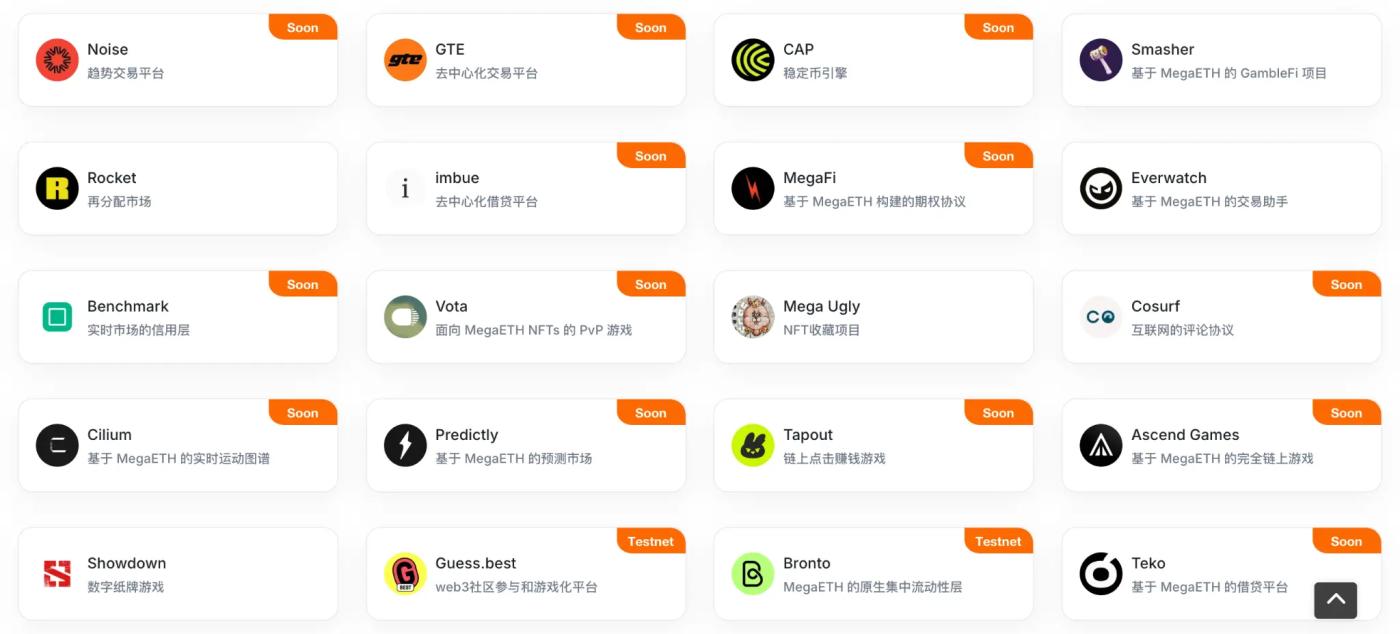
It's evident that the MegaETH ecosystem has attracted a diverse range of projects across DeFi, derivatives, and SocialFi before and after its mainnet launch, with some projects even receiving endorsements from top institutions such as Paradigm, Dragonfly, and Electric Capital. However, the ecosystem is still in its early stages of development, with most projects yet to issue tokens, and the actual user base and on-chain activity are still accumulating.
Market enthusiasm for L2 has waned considerably; MegaETH needs to differentiate itself.
Finally, Vitalik's attitude towards the L2 ecosystem has clearly shifted recently. Although he invested in MegaETH, he has repeatedly criticized the Ethereum ecosystem as "fragmented," emphasizing that L2 projects should meet "Phase One" decentralization standards, otherwise they are hardly important. This is not just empty pressure for MegaETH.
According to its official MiCA Whitepaper, MegaETH currently operates under a single orderer model. Decentralization at the orderer and governance levels is listed as a future, incremental goal, not a completed state. Messari analysis also points out that this architecture introduces additional trust assumptions at the execution level. In other words, MegaETH's final settlement relies on Ethereum's security backing, but the ordering and execution of transactions are currently dominated by a single node, and true decentralization has not yet been achieved.
Although the MegaETH mainnet has been launched, ecosystem validation has only just begun. In the future, MegaETH will need to prove itself to be an exception to Vitalik's criticisms, rather than another case of ecosystem "parasitism".