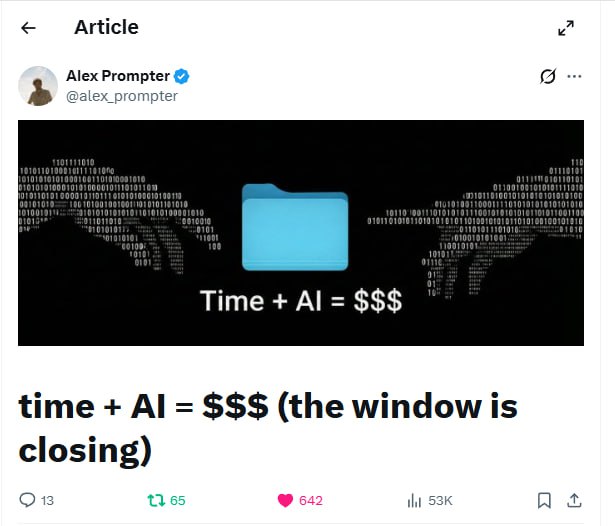
Time + AI = Money The opportunity is closing fast. 🔫 Original Text Within five years, everyone will be using AI. But few will understand it. And the gap between "people who use AI" and "people who understand AI" will be the most valuable gap in the future economy. Let's talk about why that is, and why now is almost the only time we can close that gap. Many smart people say things like: "I'll start when AI becomes more mature." "When it becomes easier." "When the winners are decided and the workflows are organized." On the surface, this seems like a reasonable decision. But it's the worst strategy for now. AI isn't getting harder; it's getting easier. And that's the problem. Every month, tools become more seamless, more click-through, more 'black box.' For now, we can still see inside. You can ponder why the prompt failed in Claude, and see firsthand how agent nodes work in n8n. You can even experience the process between input and output by running open source models locally. But this window is closing quickly. Think back to the early days of the internet. In the early 1990s, those who set up their own modems and explored BBSes were not simply network savvy. They were the ones who would later become founders, CTOs, and architects of the companies that would eventually employ countless others. Those who understood HTTP, DNS, and FTP were not simply "tech-savvy users." They were the ones who intuitively sensed the flow of e-commerce, SaaS, and the cloud before the advent of e-commerce. It wasn't because their ideas were unique, but because they had firsthand experience with the architecture. Since 2005, anyone can build a website with WordPress, but those who have been working with HTML since 1997 didn't simply create pretty websites. They designed systems, led teams, and thought differently than drag-and-drop users. The problem wasn't "ease." It was the obscurity of structure. If you can't see the structure, you can't design new structures. The same thing is happening with AI today. Those who refine prompts, build agents, and experiment with open-source models today are not wasting time on tools that will become obsolete. They are accumulating intuition that will shape the next step. The person who generates an email with AI is different from the person who understands why assigning roles first can lead to different results. The first person gets the results. The second person builds the system. And then improves, automates, and scales that system. The difference isn't intelligence, but the starting point. It all comes down to whether you started when the tools were still raw. So, what does it mean to "understand AI"? It's not about memorizing model names. It's not about keeping up with every release. Understanding AI today means the ability to: Design context, not prompts. Understand that LLMs are probabilistic engines, not knowledge repositories. Experience building automation at least once. The insight to distinguish between wrappers and underlying models. A sense of self-judging the tradeoffs between speed, cost, and accuracy. This is a feeling that comes from experience, not theory. AI will become something that "just works," like electricity. We're entering an era where all you have to do is flip a switch. But the people who design the power grid aren't the ones who flip the switch. Of the billions of internet users, only a small minority have designed the architecture and reaped the benefits. And most of them lived through the early turmoil. We are now in the midst of a turbulent era of AI. The barrier to entry isn't a degree. It's not venture capital. It's curiosity and execution. This opportunity doesn't last forever. It's not because the tools are becoming more expensive, but because the environment for learning the fundamentals is disappearing. The gap isn't one of accessibility, but of accumulated understanding. Anyone can use the same model for a few tens of thousands of won per month. The question is who has spent more time and in more depth. As you use AI every day, you accumulate models in your head. You see patterns, you see the difference between good and bad questions, and you get a sense of when to trust and when to doubt. This builds up. Quickly. A one-year gap may seem small, but in this field, it's a crucial gap. Start now. Don't wait until it's perfect. Just as the early internet didn't reward those who waited for broadband, AI won't reward those who wait until it's "easy." Now, when it's challenging enough to learn and open enough to experiment, is the most valuable time. The door is open. But it won't stay open for long.
This article is machine translated
Show original

Telegram
Disclaimer: The content above is only the author's opinion which does not represent any position of Followin, and is not intended as, and shall not be understood or construed as, investment advice from Followin.
Like
Add to Favorites
Comments
Share
Relevant content