Coinbase's fourth-quarter financial report is worth analyzing; the angle from which you view it determines what color you see.
The bad news is on the table: revenue was $1.78 billion, a 20% year-over-year decrease, falling short of Wall Street's expectations of $1.85 billion. Earnings per share were $0.66, far below analysts' estimates of $1.05, a negative 37% drop. The most glaring figure is the net loss of $667 million (compared to a profit of $1.3 billion in the same period last year).
The good news requires you to extend the timeframe: annual revenue reached $7.2 billion, a 9% year-over-year increase. Even as Bitcoin plummeted from its October 2025 high of nearly $120,000, Coinbase's overall transaction volume still grew. More importantly, the main reason for the losses was not bleeding from its core business, but rather unrealized impairment losses on the company's crypto assets and strategic investments.
In other words, Coinbase isn't losing money selling coffee; rather, the coffee (Bitcoin) in its stores has depreciated in value.
Consumers are leaving, and institutions haven't filled the gap.
Looking at the revenue structure, consumer transaction revenue decreased by 13% quarter-on-quarter. This is not entirely a result of a cooling market; in part, it is due to a shift in user behavior.
More and more people are using advanced trading interfaces with low fees or enjoying preferential rates through the Coinbase One subscription plan. In layman's terms, Coinbase's "high-margin retail users" are becoming low-margin advanced users, and the revenue structure is undergoing a qualitative change.
This is a classic dilemma faced by all exchanges: to grow, you need to improve your products and lower your fees; but lower fees mean less money earned per trade. In the world of traditional brokerages, this battle is already over: Robinhood disrupted the entire industry with zero fees and ultimately survived on order flow rebates (PFOF) and interest income.
Coinbase is on a similar path, but in the crypto world, alternative income streams are far less secure than those in traditional finance.
Is Deribit an antidote or a painkiller?
Coinbase's biggest strategic move over the past year was its acquisition of Deribit, the world's largest cryptocurrency options exchange. The logic behind this deal is clear: the derivatives market is far larger than the spot market, with higher trading frequency and stronger customer loyalty. Coupled with new business lines such as stock trading and prediction markets, Coinbase is striving to reduce its reliance on spot trading.
The problem lies in timing. Derivatives can generate phenomenal leveraged returns in a bull market, but in a bear market, trading volume shrinks just as dramatically. Back in Q4 2024, when Bitcoin was still above $100,000, Deribit's monthly trading volume routinely exceeded $100 billion. Now, with Bitcoin struggling around $66,000, derivatives volume has shrunk accordingly. Acquiring Deribit was the right long-term strategy, but it cannot hedge against the decline in revenue in the short term.
Analysts are more concerned about whether Coinbase can establish a stable revenue structure that can "transcend economic cycles" through diversified businesses. The answer is currently "not sure, but the direction is right."
The stock price has already priced in the panic for you.
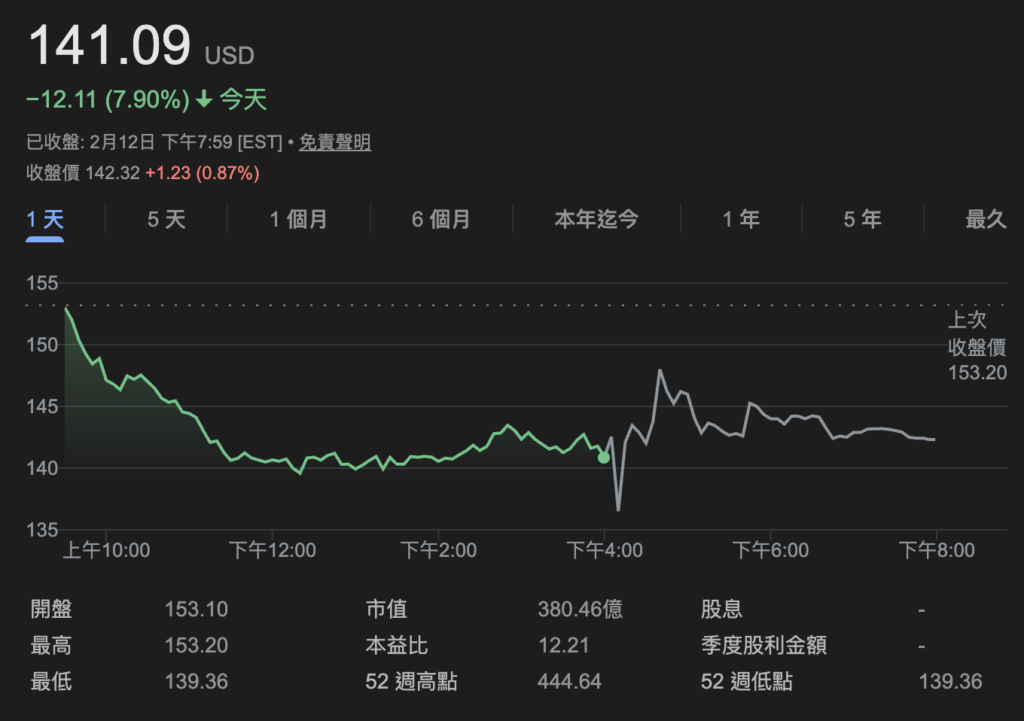
After the earnings report was released, COIN's stock price fluctuated wildly in after-hours trading, closing at $142.32, a 40% drop since the beginning of 2026.
However, as mentioned above, Coinbase's losses primarily stemmed from unrealized asset impairments, not from a depletion of operating cash flow. The company's cash reserves remain ample, and its balance sheet has not shown any structural deterioration.
The market sell-off isn't because Coinbase is collapsing, but because investors still believe that crypto exchage revenue is essentially a function of Bitcoin's price. A rising price means good revenue; a falling price means no amount of diversification can save you… at least for now.
Waiting for the next round of admission tickets
Looking back at Coinbase's history, it has been predicted to fail in every bear market and sought after in every bull market. During the storm of 2022, Coinbase laid off thousands of people and its stock price fell to just over $30, but it rebounded to over $300 two years later.
Will this story repeat itself? JPMorgan Chase, in a report this week, expressed a "positive overall view" on the crypto market in 2026, anticipating institutional funds to be the main driver of the next upward wave. If this assessment is correct, Coinbase, as the largest listed compliant exchange in the US, will remain the preferred channel for institutional entry.
However, a positive outlook doesn't equate to buying now. Until Bitcoin finds a clear bottom, Coinbase's financial reports will continue to be dragged down by asset impairments. Investors should ask themselves not whether Coinbase will survive, but rather, "Are you willing to enter the market before the bear market bills are fully delivered?"