Bitcoin selling pressure intensified again on Thursday, with prices quickly retreating from an intraday high of $68,300. Recent reports from on-chain data analytics firms Glassnode and CryptoQuant both point to the same conclusion: Bitcoin's capitulation is not over, and the market may have to endure even deeper pain.
Long-term holders engaged in a mass exodus, with 245,000 BTC sold off in a single day.
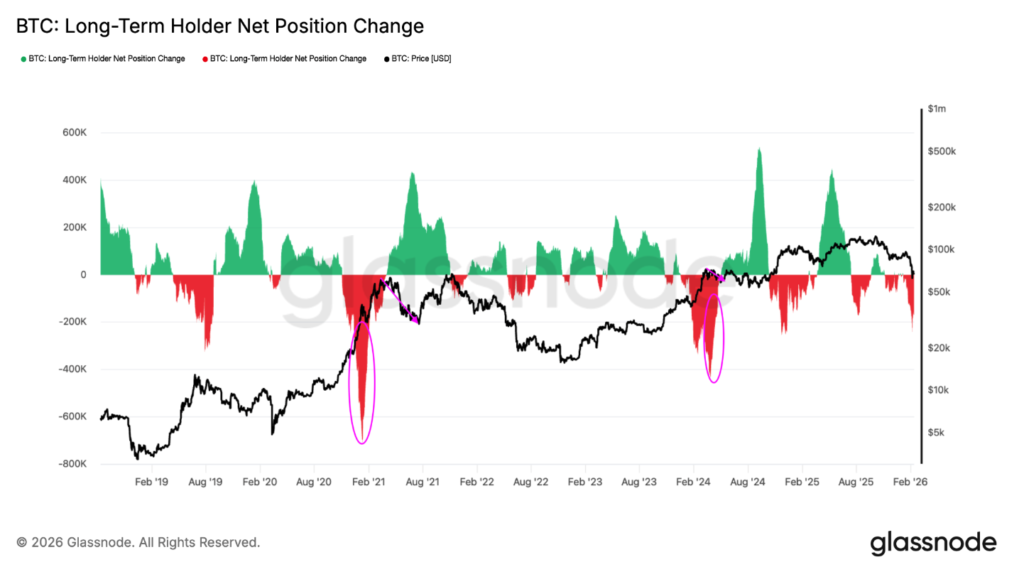
According to Glassnode's data on net position changes among long-term holders (LTH), investors who held their positions for more than 30 days sold 245,000 bitcoins in a single day on February 6, setting an extreme record for this cycle. Since then, this group has continued to sell an average of approximately 170,000 bitcoins per day.
It is worth noting that similar sharp declines in LTH net positions occurred during the correction phases of 2019 and 2021, and these periods were followed by prolonged consolidation and further declines.
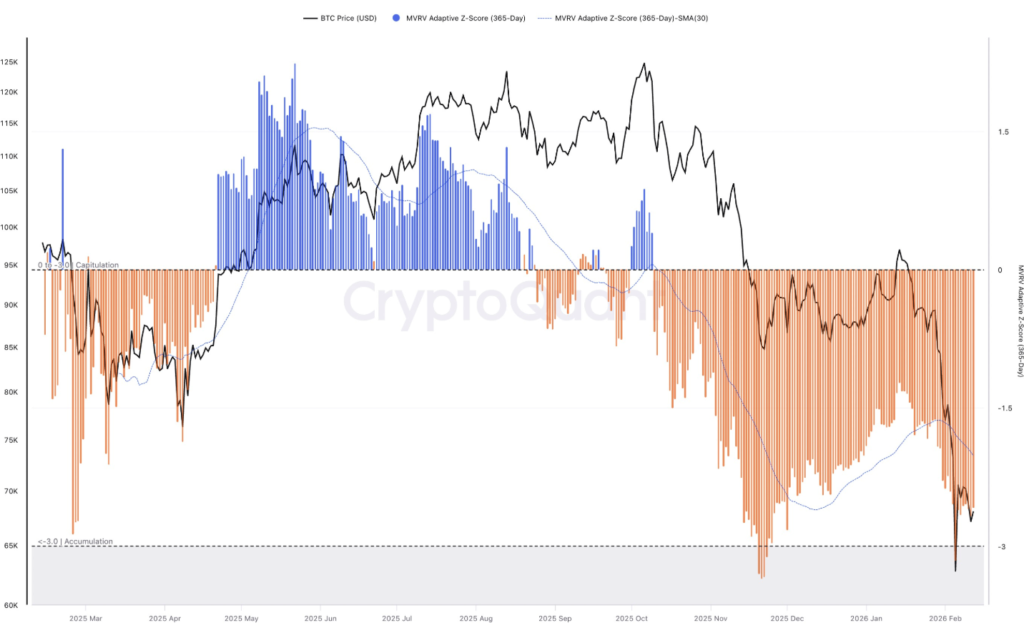
MVRV Z-Score drops to -2.66, "still in capitulation territory".
Data from CryptoQuant shows that Bitcoin's MVRV adaptive Z-Score (365-day window) has fallen to -2.66, further confirming the severity of the current selling pressure.
On-chain analyst GugaOnChain stated:
"The current Z-Score reading of -2.66 proves that Bitcoin is still in capitulation territory. This indicator suggests that we are approaching a historic accumulation phase."
Furthermore, Glassnode's Realized Profit/Loss Ratio is also approaching the threshold of falling below 1. Historically, a ratio below 1 has typically corresponded to a "comprehensive capitulation" market condition—meaning that realized losses exceed profit-taking.
Analysts: BTC bottom may be in Q4, with a target of $40,000 to $50,000.
Several analysts have offered predictions regarding the timing of Bitcoin's bottoming process, based on technical analysis and on-chain data. Crypto analyst Tony Research stated bluntly :
My view is that BTC will bottom out between $40,000 and $50,000, most likely between mid-September and the end of November this year.
Another analyst, Titan of Crypto, pointed out that looking back at the bear market cycles of 2018 and 2022, the lows typically occurred 12 months after the top of the bull market. Bitcoin's all-time high of $126,000 occurred on October 2, 2025. If this cycle follows the same pattern, the bottom will likely fall around October of this year.
On-Chain College, an on-chain analytics account, shared another key statistic: Bitcoin's net realized losses surged to an extreme level of $13.6 billion on February 7th, comparable to the peak of the 2022 bear market. The analyst added:
The peak of losses in 2022 occurred five months before the actual bottom of the bear market.
Based on this calculation, BTC may bottom out in July of this year.
The brutal consensus of a bear market year
Based on various forecasts, 2026 is widely considered a bear market year, and the possibility of Bitcoin's price falling to $40,000 is being increasingly considered by analysts. For investors still in the market, the most critical question now is no longer "whether it will fall," but rather "how long will it fall and how deep will it fall?"
*This article is for informational purposes only and does not constitute investment advice. The cryptocurrency market is highly volatile; please carefully assess the risks before investing.*