Written by: JW, Techub News
The start of 2026 was colder than expected. We thought that after enduring a long period of decline, spring was just around the corner, but reality turned out to be an unexpected "late spring cold snap".
It's like you're scrolling through Twitter scrolling through those "Builders'" grand pronouncements, only to turn around and see them secretly change their status to "Open to work" on LinkedIn.
As everyone has seen in recent news, even Jack Dorsey, the seemingly ardent Bitcoin purist and founder of Block.com and co-founder of Twitter, couldn't hold on any longer. According to Bloomberg, Block.com (formerly Square) has initiated a layoff plan, cutting another 10% of its workforce. Even if you're a payment giant, even if you're running a money-printing machine like Cash App, you still have to cut your own back for the sake of so-called "efficiency improvements."
What does the industry look like right now? Exchanges are laying off staff to cover compliance costs, NFT platforms are laying off staff due to a lack of trading volume, and the GameFi project has dissolved because its token went to zero. This isn't just a winter for the crypto industry; it's a global tech industry undergoing a process of "draining fat and building muscle."
But amidst this wave of layoffs and widespread despair, there is one exception: instead of laying off employees, they are hiring like crazy and even spending lavishly.
That's right, it's Tether.
Tether, the company that was once under scrutiny by the SEC, fined by the New York Attorney General, and whose collapse was predicted by countless short sellers for years, is now planning to expand its workforce to 450 employees, according to Cointelegraph.
You might laugh: 450 people? Even after layoffs, Binance still has several thousand employees, and Coinbase also has several thousand.
But you have to look at efficiency. Tether manages hundreds of billions of dollars in assets with just a few hundred people, and they've even recently expanded into 140 traditional investment projects.
While everyone else was struggling to survive in the existing Web3 market, Tether had already quietly moved its profits to Web2, and even the more traditional "old world".
In this article, we will explore what exactly Tether, this "super central bank" disguised as a Web3 entity, is playing at.
The most profitable businesses never require many people.
First, we must acknowledge a fact that leaves all Web3 entrepreneurs feeling hopeless: Tether is doing the best business in the entire industry and in the world.
While you're all struggling with coding, operations, airdrops, and hacking, Tether only needs to do one thing: collect USD, issue USDT, and then use the USD to buy US Treasury bonds.
During the years the Federal Reserve maintained high interest rates, Tether practically lived off a fortune. They didn't need complex liquidity algorithms like Uniswap, nor did they need to maintain a massive node network like Ethereum. Their business model was shockingly simple: profiting from interest rate differentials.
This is what is known as "seigniorage".
That's why they have so few people. Because printing money doesn't actually require a large number of people.
But here's the question: what do you do after you make money?
Looking back at the last bull market, most Web3 projects (and even some top exchanges) typically followed a similar path after making money: lavish spending, buying luxury homes, sponsoring stadiums (the lesson of FTX Arena is still fresh in our minds), or frantically reinvesting in low-quality assets within the ecosystem, playing a self-destructive spiral of ascent. We all know how it ended: when the tide goes out, you see who's been swimming naked.
However, Tether's top management, especially Paolo Ardoino, a tech geek, after becoming CEO, exhibited an extremely frightening "old money mentality."
Tether did not reinvest its profits back into high-risk crypto assets (or rather, invested only a small percentage), but instead operated as a sovereign wealth fund. They were keenly aware that USDT's competitive advantage lay not in technology (issuing ERC-20 tokens had no barriers to entry), but in its credit backing and risk resistance capabilities.
The stablecoin sector, while seemingly a technological competition, is fundamentally a competition of trust. The real barriers to entry are who can deliver on redemptions during extreme market conditions, who can weather regulatory storms, and who can avoid bank runs during black swan events. Tether has faced countless "death sentences" in the past few years, each time proven wrong by real redemptions and reissues. To some extent, its credibility isn't built on audit reports, but on round after round of bank run stress tests. This brutal market selection is itself a form of endorsement.
If you look closely at the financial reports and news over the past two years, you will find that Tether is undergoing a dramatic "transformation from virtual to real".
I didn't squander the money I earned.
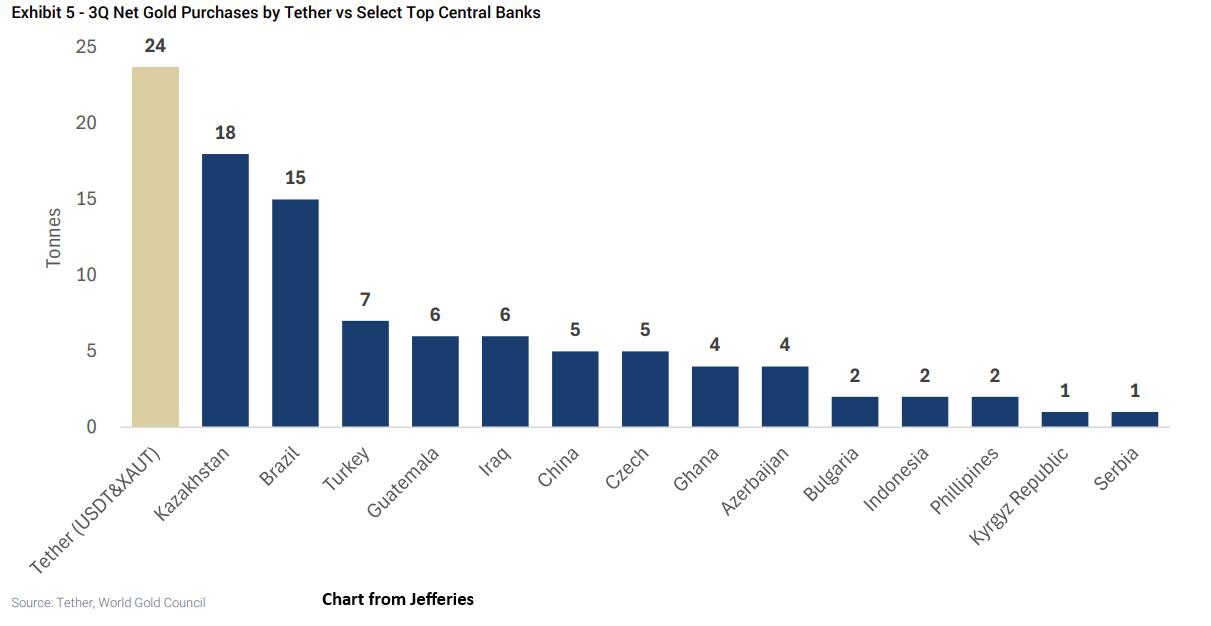
The latest data is truly staggering. According to a report by investment bank Jefferies, as of January 2026, Tether's gold reserves have exceeded $23 billion. That translates to 148 tons of physical gold. This holding immediately places them among the top 30 gold holders globally.
Source: Wall Street News
You think they're comparing themselves to crypto whale? No, they're comparing themselves to countries.
Tether's current gold reserves surpass those of sovereign nations like Australia, the UAE, and Qatar. In just a few months, from the fourth quarter of 2025 to January 2026, they purchased 32 tons of gold. This purchasing speed is second only to the central banks of Poland and Brazil globally.
This is the most "visionary" move in Tether's risk control strategy.
Everyone is worried about the decline of the dollar's hegemony and the liquidity crisis of US Treasury bonds. As the issuer of a dollar-denominated stablecoin, Tether is essentially a shadow bank of the dollar. If the dollar sneezes, USDT catches a bad cold.
To hedge against this greatest "systemic risk," Tether chose gold, the only hard currency in human history. While other stablecoins were still fiercely competing for compliance proof of "100% US dollar reserves," Tether had quietly converted its underlying holdings into gold. This means that even if something major happens to the US Treasury tomorrow, or the dollar's credit system collapses, Tether still has 148 tons of heavy gold bars in its hands.
This isn't a cryptocurrency issuing company; it's clearly a "digital Federal Reserve" that's been given a cheat code.
This configuration alters Tether's risk exposure structure. Previously, the biggest criticism of it focused on the "quality of its dollar assets"; now, the question has become "what kind of diversified asset portfolio is it actually building?" When a stablecoin issuer begins to allocate gold like a central bank and diversify its investments like a sovereign wealth fund, its role has subtly shifted. It is no longer just an on-chain liquidity tool, but an invisible node in the real financial system.
This also explains why Tether's narrative increasingly downplays "crypto ideals" while emphasizing "asset security" and "long-term stability." In an industry where narratives change rapidly, it chooses to side with the times. In a bull market, everyone is an innovator; in a bear market, only balance sheets speak. Tether has exchanged the imagination gained in the bull market for certainty in the bear market.
140 projects, ranging from neurotechnology to Happy Farm.
If hoarding gold is a form of defense, then investing in 140 traditional projects represents Tether's all-out offensive.
At first glance, Tether's investment portfolio appears chaotic, but a closer look reveals a chilling truth. They are not just buying assets, but rather the "necessities for survival" for humanity's future.
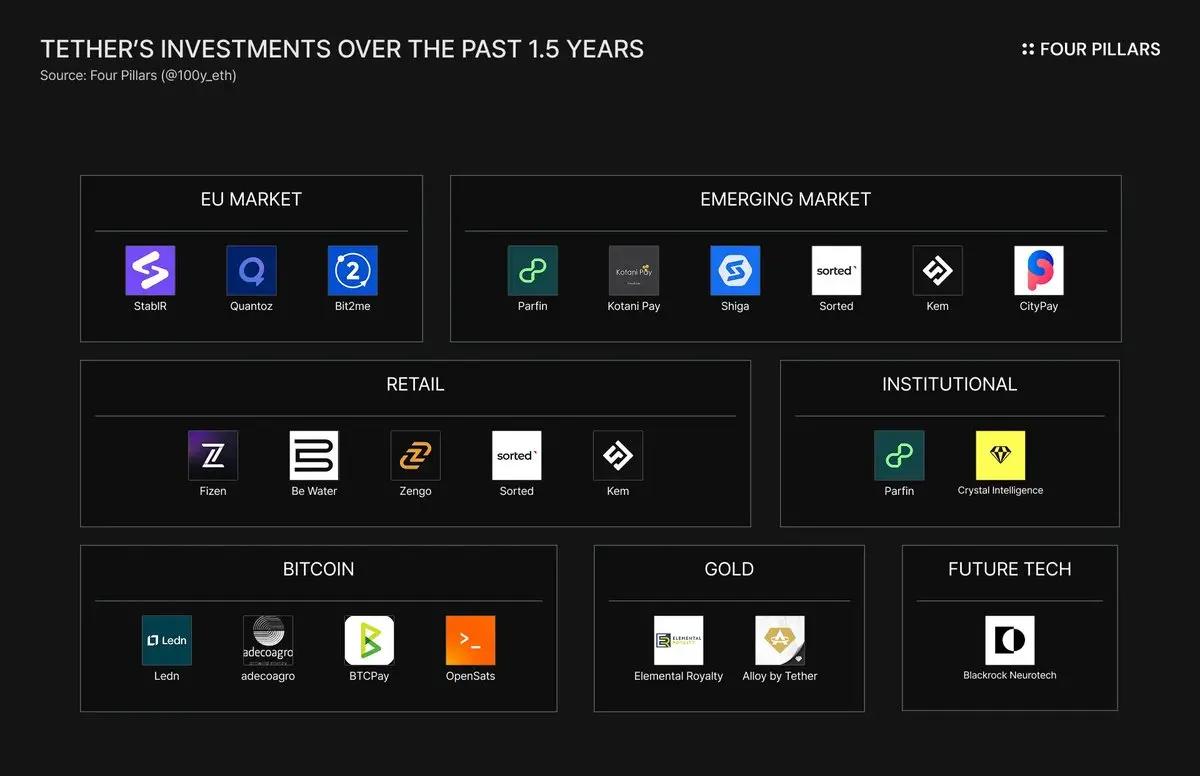
Unlike other crypto funds that focus on investing in tokens and protocols, Tether has channeled its profits into real-world sectors such as computing power, energy, agriculture, and healthcare, building a vast resource empire.
First, by monopolizing computing power and energy, Tether aims to become the "landlord" of the AI era. Over the past two years, Tether has heavily invested in computing infrastructure, not only mining cryptocurrencies using geothermal energy in Uruguay and El Salvador, but also entering the AI computing power leasing market through its investment in Northern Data. Its logic is very sound: the Web3 narrative may fade, but AI's demand for computing power and electricity will be a necessity for the next decade. With its cash (USDT) and computing power (GPUs), Tether is becoming the most fundamental infrastructure service provider in the digital age.
Secondly, Tether is betting on biotechnology to hedge against the risks of relying on a single industry. Less known is that Tether has even invested in the brain-computer interface company Blackrock Neurotech. While traditional venture capitalists see this as positioning for the next era, Tether views it as transforming the often-commercial profits of "stablecoins" into "technological capital" that benefits humanity. This has not only earned it a reputation but also allowed its asset allocation to transcend the cycles of the financial world.
Third, investing in agriculture and land is a fundamental way to mitigate risk. Tether has begun buying land and investing in modern agriculture. This may sound the least "sexy," but it's the most stable approach. When the digital bubble bursts, food and land will always be hard currency. This allocation logic is entirely based on a "doomsday survival" scenario.
Furthermore, by investing in the Georgian payment system and sponsoring European football clubs, they are continuously penetrating offline traffic entry points. All of this indicates that Tether intends to make USDT permeate the capillaries of the real world, like water and electricity.
Tether's "Web2" survival philosophy
Returning to the question at the beginning of the article: Why is Block laying off employees while Tether is hiring?
Because Block is still playing the "growth game" of Web2, it will need to reduce costs and increase efficiency once growth slows down. Tether, on the other hand, is playing the "resource game".
Tether's expansion isn't about developing more powerful DApps or building Layer 3. The 450 people they've hired are most likely not writing Solidity code, but rather dealing with compliance, government relations, asset management, and geopolitical maneuvering. This is precisely why Tether has weathered multiple bull and bear market cycles and outlasted countless competitors.
They are extremely "Web2-ized," even "traditionalized." In the Web3 casino, a place full of air and bubbles, Tether acts as the house, collecting the strongest chips (US dollars), then turns around and walks out of the casino to buy buildings, land, gold bars, and power plants next door. While others in the casino fight because their chips have run out of steam, or scatter because regulators rush in to arrest people, Tether sits in a high-rise building across the street, holding a cup of coffee, watching it all.
This is an extreme form of rationality, even tinged with coldness. Many criticize Tether for its lack of transparency, calling it a black box. But from a business strategy perspective, one has to admire Paolo Ardoino and his team. They weren't misled by the grand narratives of Web3. They knew that cryptocurrencies would only survive if they truly became "water" and "electricity," a part of the real world. So, when you see Block laying off staff and major organizations downsizing, don't just panic. Look at what Tether is doing.
It tells you a very simple truth: it's not hard to take off when the wind is blowing; the hard part is whether you're truly holding onto the roots of the tree once the wind stops. Tether has grasped gold, computing power, and the land.
This may be the ultimate form of Web3 companies: using decentralized technology to earn excess profits, and then using the most centralized methods to control the means of production in the real world.
It sounds a bit cyberpunk and a bit dystopian, but it could very well be reality.