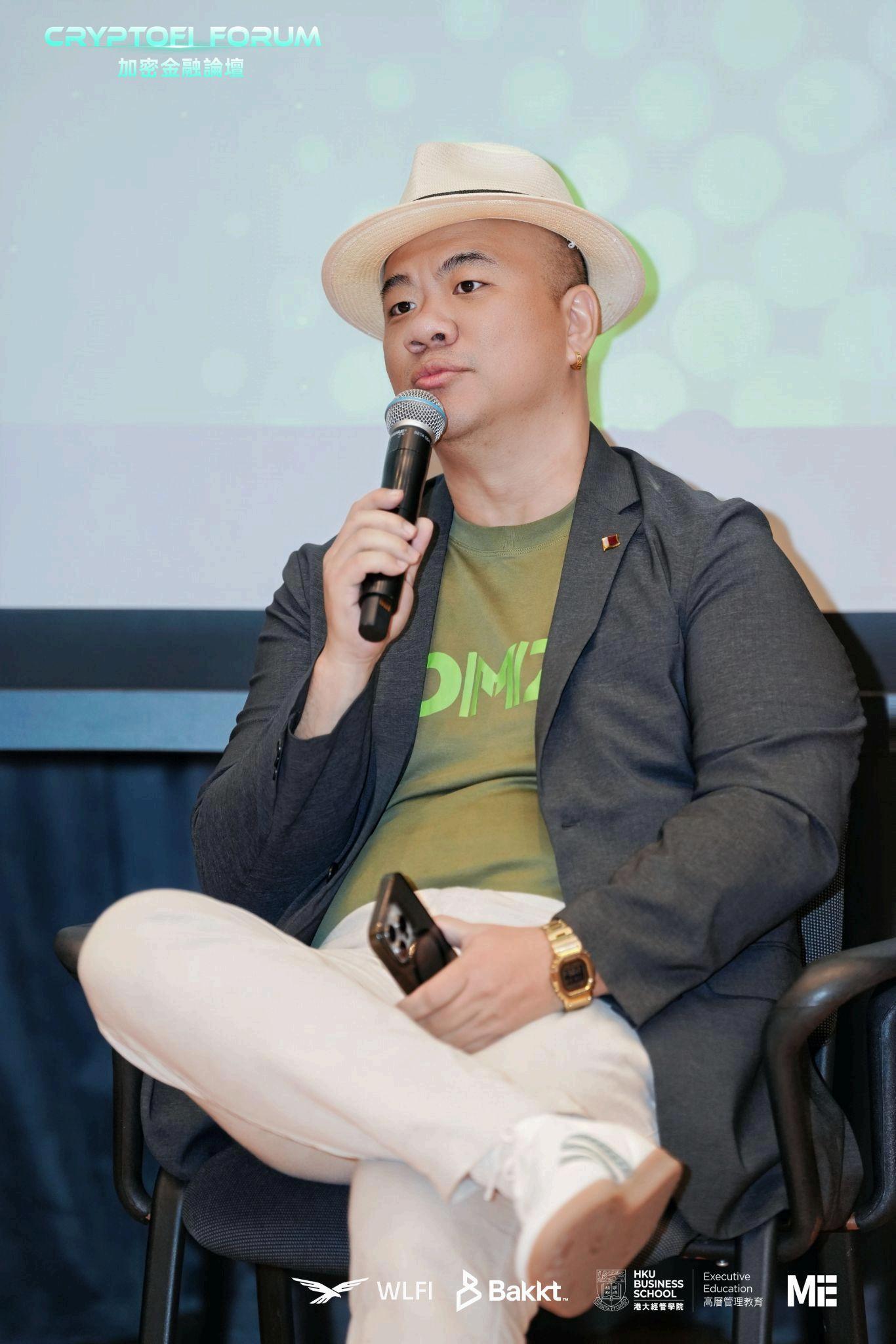
Nathan Ma, co-founder and chairman of DMZ Finance ("DMZ"), was invited to participate in the CryptoFi Forum (CFF) roundtable forum co-organized by WLFI, Bakkt, the Faculty of Business and Economics of the University of Hong Kong and ME Group, and to have an in-depth discussion on the theme "Institutional vs. Degenerate: Who Will Win the RWA2.0 Race—Regulated Giants or Permissionless DeFi Innovators?"
Article author and source: DMZ Finance
Hong Kong, February 13, 2026 — The CryptoFi Forum (CFF), jointly organized by WLFI, Bakkt, the Faculty of Business and Economics of the University of Hong Kong, and ME Group, was successfully held at the University of Hong Kong recently. With the vision of "Decoding Crypto, Reshaping Finance," this year's forum brought together representatives from traditional financial institutions, the crypto-native ecosystem, public blockchain protocols, and academia to discuss the evolution of crypto finance and innovative practices within a compliant framework.
Nathan Ma, co-founder and chairman of DMZ Finance (“DMZ”), was invited to participate in a roundtable discussion on the theme “Institutional vs. Degenerate: Who Will Win the RWA2.0 Race—Regulated Giants or Permissionless DeFi Innovators?” The forum was moderated by Horace Peng, founder and CEO of CoinFound, and other guests included DC Huang, head of product for Antalpha RWA Hub; John, head of APAC at TON Foundation; Bridget Li, co-founder and CEO of Asseto; and Sonia Shaw, CEO of OneAsset.
RWA 2.0: A System Upgrade from "Asset On-Chain" to "Asset Usability"
Regarding the question of "key elements driving the development of RWA 2.0", Nathan pointed out: "If RWA 1.0 was about putting assets such as US Treasury bonds on the blockchain, then what RWA 2.0 really needs to solve is how these assets are used. Simply putting them on the blockchain does not constitute a closed value loop; there must also be liquidity and real-world use cases."
He emphasized that RWA 2.0 focuses more on the programmability, composability, and liquidity of assets, while the key issues currently facing the industry are concentrated on three levels: First, asset encapsulation capabilities, which is not just asset mapping, but how to achieve a structural balance between yield and liquidity on the blockchain; second, liquidity distribution and market-making capabilities, including in-depth market management and operational experience around assets such as US stocks and gold ETFs; and third, the boundary between regulation and permissionless innovation, how far the permissionless mechanism can go, which will directly affect the path of RWA's large-scale development.
Nathan points out that after experiencing cyclical fluctuations, on-chain investors are returning to rationality. "Today's on-chain investors want returns, liquidity, and security. Whoever can satisfy all three has a better chance." In his view, the core of RWA 2.0 is not simply to expand the number of assets, but to establish a sustainable asset structure and liquidity system.
Compliance giants and DeFi innovators: Role division determines ecosystem efficiency
Regarding the discussion of "who will be the winner, Regulated Giants or Permissionless DeFi Innovators", Nathan said that RWA 2.0 is not a simple binary opposition, but a competition of systemic capabilities.
He pointed out that in the RWA 1.0 phase, regulation was the main theme, and compliant institutions had a natural advantage; while in the 2.0 phase, the division of labor in the industry is clearer: licensed institutions provide a trustworthy architecture and institutional guarantees; public chain protocols provide the underlying technology and composability; and exchanges and ecosystem platforms undertake the functions of liquidity organization and market distribution.
The key to competitiveness lies not only in compliance qualifications, but also in the ability to design a trustworthy architecture, encapsulate assets, and integrate channels and brands. "In the RWA 2.0 era, the real competition is a contest of comprehensive capabilities. Institutional trust and technological efficiency need to be integrated, not opposed."

Asset Trends: From Single-Structure US Treasuries to ETFs and Structured Products
When discussing the RWA asset class with the greatest growth potential in 2026, Nathan pointed out that US Treasuries dominated the RWA 1.0 era, but the 2.0 phase is moving towards diversification.
He believes that areas with growth potential include ETF-type assets, gold RWA, and structured products. Against the backdrop of global macroeconomic uncertainty, gold-type assets possess natural safe-haven attributes, while structured products better meet the dual needs of on-chain investors for both returns and liquidity. The trend of RWA 2.0 is not simply about increasing the number of asset types, but rather about driving the productization and structuring upgrades of assets.
User Structure and New Markets: Two Types of Customers in the Post-P2P Era
Regarding the question of "where are RWA's real users?", Nathan stated that the industry has entered the "post-P2P era," and the market is returning to common sense and rationality.
Currently, RWA users are mainly divided into two categories: the first category is on-chain clients who are returning to rationality and emphasizing the balance between returns, liquidity and security; the second category is infrastructure-level clients who are willing to try, including institutions that have taken the lead in deploying on-chain asset allocation and new market participants.
He specifically pointed out that future new liquidity and user growth may come from the Middle East and Japan markets. These two regions have advantages in capital scale and institutional maturity, respectively, and are expected to become important sources of incremental growth in the RWA 2.0 phase.
Nathan stated that the core of RWA 2.0 is not about "institutions winning" or "DeFi winning," but about whether it can build a sustainable asset encapsulation structure, a stable and efficient liquidity system, and a scalable market mechanism within a compliant framework.
With the vision of "Decoding Encryption, Reshaping Finance", DMZ will continue to promote the deep integration of RWA with the traditional financial system, connect key markets in Asia and the Middle East, and participate in the long-term construction of global digital financial infrastructure.
About DMZ Finance
DMZ Finance is a leading Real-World Asset (RWA) infrastructure company and a tokenization partner of QNB Group, the largest bank in the Middle East and Africa. Together, they are driving the integration and development of asset tokenization within traditional and decentralized finance systems. DMZ Finance, in partnership with QNB Group and Standard Chartered Bank, launched QCDT, the first tokenized money market fund in the Dubai International Financial Centre (DIFC), and was also selected for the DIFC Digital Asset Lab and BNB Chain's "Most Valuable Builder" program.
Follow DMZ Finance X: https://x.com/DMZ_Finance
LinkedIn: https://www.linkedin.com/company/dmz-finance/
Media inquiries
Disclaimer
This announcement is for informational purposes only. The products mentioned may not have been approved or may not be available in some jurisdictions. Any statements regarding regulatory approval are in principle and are subject to final conditions, and do not constitute confirmation of full regulatory authority.
This announcement does not constitute investment advice or a recommendation, nor does it constitute any purchase, sale, or holding of crypto/digital assets or securities.
This offer or solicitation does not constitute financial, accounting, legal, or tax advice. The information contained herein is for general informational purposes only.
This announcement is intended for institutional or professional investors only and is not for retail investors.
Despite exercising reasonable care in preparing this announcement, no liability is assumed for any errors, omissions, or inaccuracies.