The next year is promising as we continue to see developments in the Ethereum roadmap
Original: 2022 Year End Review: Network Coverage, Layer 1s & 2s (Blockworks)
Compilation: Dongxun, the way of DeFi
Cover: Photo by Loegunn Lai on Unsplash
main points
- The 2022 Contagion started with the Terra crash and spread to major CeFi players such as 3AC, BlockFi, Celsius, FTX/Alameda, and most recently DCG.
- Ethereum’s successful transition to Proof-of-Stake (PoS) consensus, “merge” could be one of the biggest events in the cryptocurrency’s nascent lifecycle
- Ethereum Layer 2 saw widespread adoption in the second half of 2022; we expect this trend to continue into 2023.
- "Alt-Layer-1" transactions faced significant headwinds in Q3 and Q4 due to CeFi bankruptcy, massive block space combined with declining demand, and the rise of the Ethereum L2 community.
- With the release of the ATOM 2.0 white paper, the launch of the Circle chain, and dYdX's imminent migration from StarkEX to Cosmos, the Cosmos "application-specific blockchain" theory has become even stronger.
- Infrastructure is an area ripe for innovation in the crypto space, competition in the oracle space is minimal, and cross-chain bridge hacks are still commonplace.
In November 2021, the total market value of cryptocurrencies reached an all-time high of $2.9 trillion. Since then, the market has fallen sharply, with a year-to-date (YTD) decline of 65% from $2.2 trillion to the current level of $770.5 billion.
DeFi TVL has experienced a similar decline, plunging 76% year-to-date, from about $170 billion to $40 billion. This decline is not unexpected, as DeFi TVL is mainly composed of volatile cryptocurrencies. In ETH terms, TVL is only down 8.6% year-to-date, implying that the TVL drop was driven by negative price action rather than users withdrawing funds from DeFi protocols.
However, since the DeFi summer, DeFi yields have contracted significantly and are currently generally less attractive than the risk-free yields on U.S. Treasuries.
This has been a challenging year for many companies in the industry, with several notable bankruptcies including FTX, Alameda, BlockFi, Celsius, Voyager, and Three Arrows Capital (3AC). Additionally, many bitcoin miners, funds and other cryptocurrency companies have been struggling to make ends meet. Many "Alt Layer-1s" such as Solana, Avalanche, Terra, and Near saw significant losses, with most experiencing YTD declines of around 90%.
Due to UST's death spiral , Terra's LUNA lost 99.99% of its value over the same period. "Contagion" is the theme throughout 2022, with Terra's collapse becoming the first domino to fall, triggering a massive deleveraging this year. We hope the worst is over, but it remains to be seen whether the last domino has fallen due to uncertainty over DCG/Genesis' solvency.

Despite the negativity, builders have continued to move forward. With Ethereum successfully merged into the proof-of-stake beacon chain, Layer-2s gaining full adoption, the Cosmos theory of “application-specific blockchains” continues its momentum.
Ethereum
The most important event in the crypto space of the past year was of course “The Merge,” in which Ethereum transitioned from Proof-of-Work to Proof-of-Stake consensus on September 15th. Many have likened the transition to "changing an airplane's engines mid-flight," showing how difficult the feat is and why it took years to achieve.
While there is some debate surrounding whether PoW or PoS provides stronger security, the most significant impact of this change is the new supply dynamics of ETH. After the merger, the ETH supply increased by only 3800 ETH, compared to 1.2 million ETH if the network was still running under the PoW consensus. The chart below visualizes the inflation (or deflation) dollar value under PoW and PoS, and assumes a PoW block subsidy issuance rate of 13,500 ETH per day, with an ETH value of $1250.
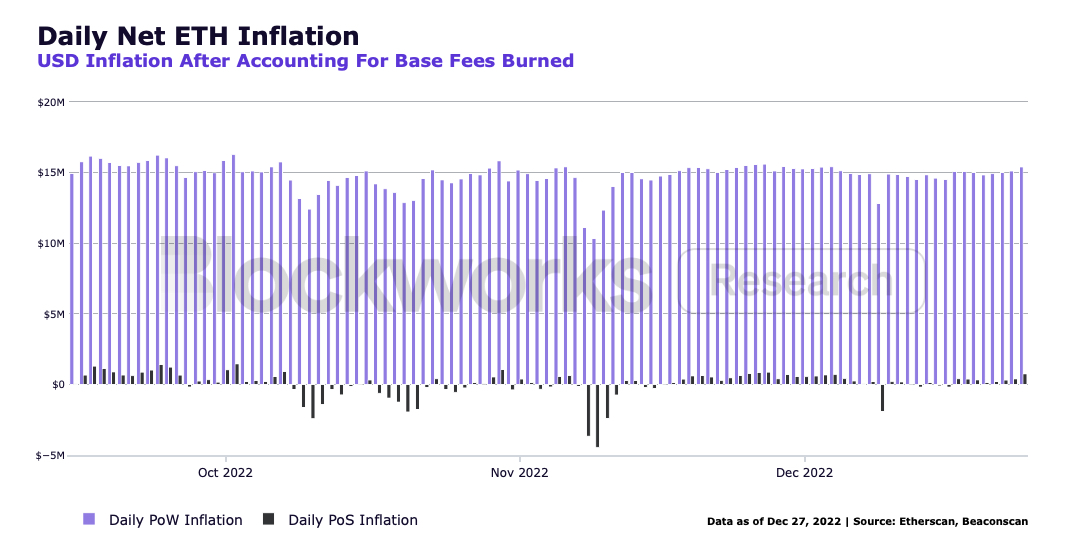
In other words, in less than four months, more than $1.5 billion of selling pressure has been removed from the market as a result of the merger. Additionally, miners under a PoW network have to sell some newly mined tokens to pay for operating expenses, and they don't lock the chain's native assets because there is no need for a slashing mechanism to adjust incentives. The amount of staked ETH continues to climb at a steady pace, with about 13% of the total supply locked in pledge contracts, yielding about 5-6%.
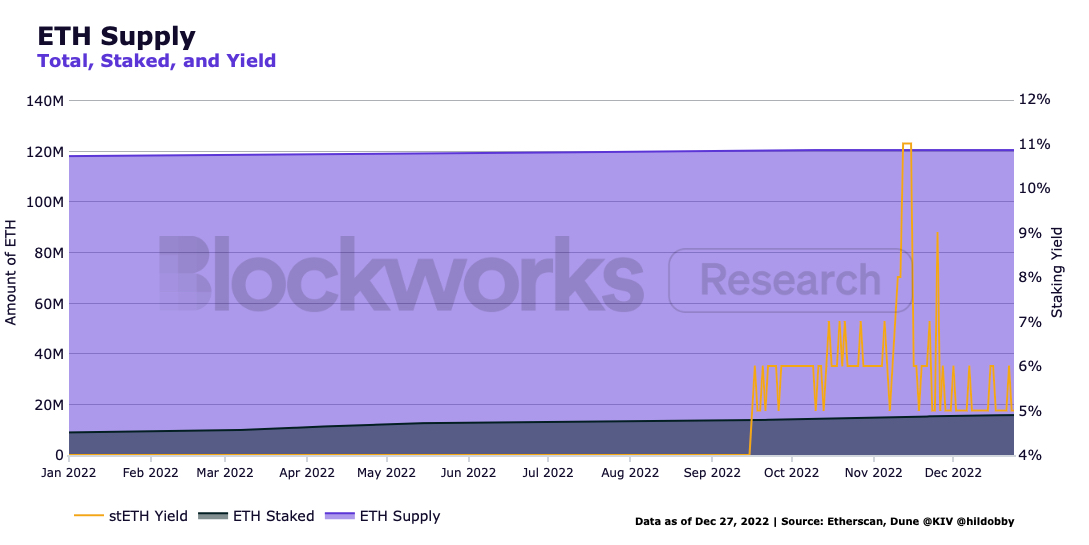
In addition to activating staking withdrawals, the next major upgrade on the Ethereum roadmap is the inclusion of EIP-4844, also known as Proto-Danksharding, which is a step towards full Danksharding, where L2s will "blobs" instead of calldata Send to Ethereum to reduce gas cost.
Other EIPs that are likely to gain more attention include EIP-4488, an alternative to Proto-Danksharding that reduces the cost of issuing calldata; EIP-4337, which allows account abstraction at the L1 level; and EIP-1135, which It should be possible to reduce L1 gas costs and has been heavily lobbied by the Uniswap team who are building their V4 product with this upgrade in mind.
Ethereum L2s
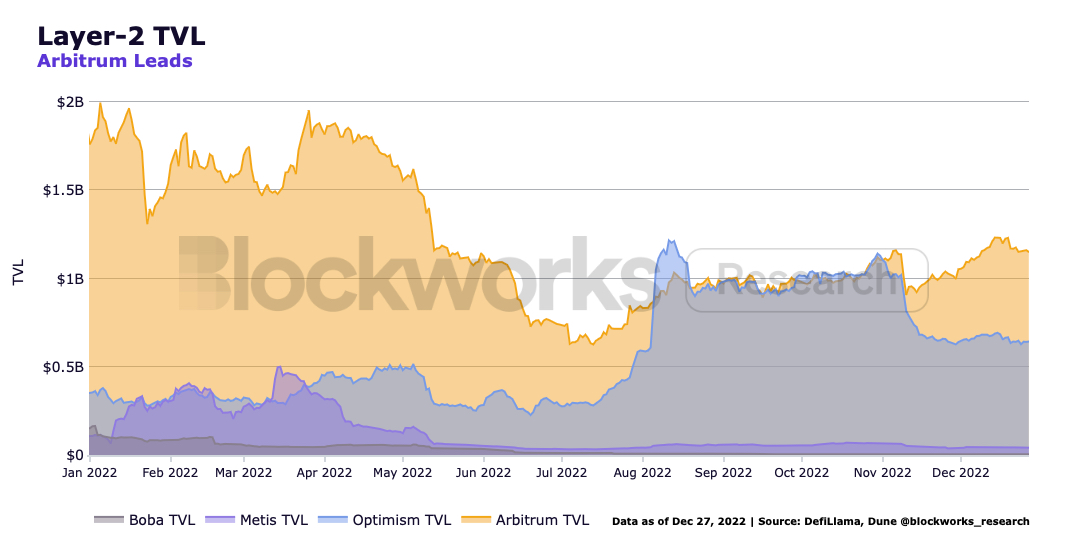
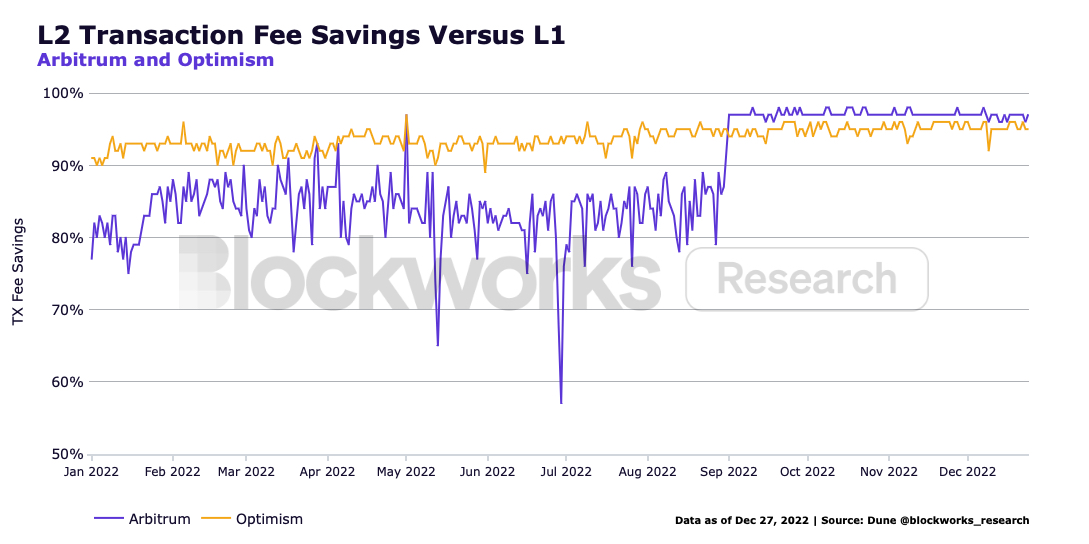
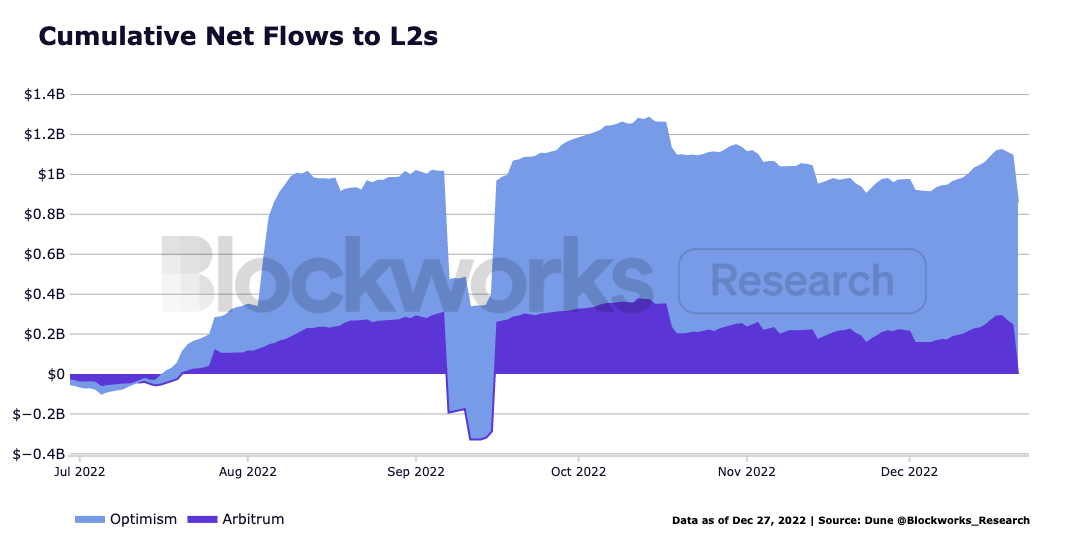
Layer 2 on Ethereum continues to gain more adoption through 2022 as different ecosystems and communities start to form, as well as significantly lower transaction fees compared to Ethereum L1. The percentage of total Ethereum gas consumed by L2s has grown steadily over the past year, with Optimism and Arbitrum sharing most of the load.

Arbitrum
Arbitrum One remains the dominant L2, accounting for more than 65% of all rollups TVL with a value of $1.1 billion despite having no tokens as rewards. The biggest highlight of Arbitrum as a network is the upgrade to Nitro , which improves performance and cost in many aspects, such as compressing calldata and providing better interoperability and gas compatibility, resulting in significantly lower transaction fees.
Arbitrum's DeFi ecosystem has experienced rapid growth, with many unique applications originating from Arbitrum, the main outpost of which is Arbitrum. This includes a large number of perpetual futures exchanges such as GMX, Mycelium and Rage Trade, as well as options protocols such as Dopex and Premia. Arbitrum also hosts TreasureDAO, a blockchain P2E game that combines DeFi and NFT elements, which has gained widespread attention this year.
Trader Joe's move to Arbitrum was announced in December, a sign that the Rollup is becoming a destination for apps to build their hits. Offchain Labs, the team behind Arbitrum, is also launching Arbitrum Nova in the second half of 2022. Nova is tailored for applications requiring high transaction throughput and low fees by publishing transaction-related data to an off-chain data availability committee.
As we move into 2023, we can expect more details on the project's token AirDrop and distribution, which could be when you compare its network usage to Optimism and OP's current FDV market cap ($4.1 billion) Very valuable.
Optimism
The second largest general-purpose L2 by adoption is Optimism, another optimistic Rollup on Ethereum, which has achieved a TVL of $650M and a market share of 32% of all Rollup . Optimism is also home to a growing ecosystem of DeFi protocols, including Synthetix and related applications such as Kwenta for perpetual futures, Lyra for options, and Overtime for sports betting. Optimism also hosts Velodrome, an automated market maker heavily influenced by Curve, as its primary venue for liquidity and spot trading.
The biggest development for Optimism this year was the release of the OP Stack , which allows anyone to leverage their modular design and code base to create their own Rollup. There are many rollups under this umbrella, which creates a vision of a "super chain", where using the same development stack means direct composability across all OP Stack chains.
The first of these OP Stack chains are OPCraft, a Minecraft emulator in which all elements of the game are recorded on-chain, and the Optimistic Game Boy, a Game Boy emulator, in which all actions are also recorded on-chain. In 2023, we can expect many more projects, including the Ribbon Finance-based Aevo Options Exchange, leveraging tailor-made solutions and direct composability with other OP Stack chains.
On April 26th, Optimism announced their OP token and first AirDrop distribution. 25% of the token allocation will go to the Ecosystem Fund, which has been allocated to the application, 20% will go to retroactive public goods funding , and a total of 19% will go to the AirDrop. Shortly after launch, the team discovered a code bug where they actually emitted 20% of the supply instead of 2%. While this was quickly resolved, there was definitely more OP supply than originally estimated.
The first AirDrop provided only 5% of the 19% supply, so we can expect 14% of the supply to be left for further AirDrop, some of which will be distributed to active users in 2023.
zkEVMs
One of the more interesting areas of development for Layer 2 is zkEVM, zero-knowledge rollups that attempt to maintain a level of equivalence or compatibility with the EVM, combining the former's massive scalability with the latter's network effects.
The big three players in this space are Polygon , Scroll , and zkSync, and others like ConsenSys and Taiko are also experimenting with the model. None of these solutions are live on a fully open, permissionless mainnet; zkSync is currently in "baby Alpha", Polygon is in the final stages of a testnet, and Scroll is in a pre- Alpha testnet.
This could be one of the main narratives in 2023 as these products start to open their doors to users, EVM-based applications open for business, and if these solutions start to take market share away from Arbitrum and Optimism. Besides that, there are other general purpose zk rollups performed using different virtual machines, such as StarkNet .
Cosmos Ecosystem
There are currently 53 IBC-enabled chains in the Cosmos ecosystem with a combined market capitalization of $9.7 billion. Over the past 30 days, users have moved $745 million in value via IBC, with the bulk of the volume going through Osmosis, the largest DEX in the universe.
After the Terra crash, the TVL of Cosmos SDK-based chains plummeted -93%. However, this implosion was an unexpected stress test for the Cosmos technology stack. On May 11, Terra executed a record 1.2 million trades, more than double the daily average, while Osmosis processed a record $500 million in trade volume, more than double its previous high. All Cosmos SDK and Tendermint-based blockchains remain up and running, as is IBC.

In June, dYdX announced plans to launch dYdX Chain as an application-specific blockchain (Application Chain) within the Cosmos ecosystem. The dYdX team has been building their product since 2017, so the decision to leave the Ethereum ecosystem is groundbreaking. The current version of dYdX exists on Ethereum L2 ( StarkEx ), but the team says that moving to the Cosmos ecosystem paves a shorter path to decentralization.
The next iteration of dYdX will feature a fully decentralized off-chain order book run by validator sets. Each validator will store and maintain their version of the order book locally, creating a scalable and decentralized perps exchange. While this system has some trade-offs, utilizing validator memory allows for the decentralization of the order book - an stated priority of the dYdX team. This concept pushes the current boundaries of the validator design space, so if dYdX succeeds, the value proposition of building a blockchain becomes even stronger.
In late October, Circle announced that USDC supports Cosmos through Circle Chain . Circle Chain is an asset issuance that incorporates USDC into the Cosmos ecosystem, allowing users to send native USDC to any IBC-connected chain. It is likely to be the consumer chain of Cosmos Hub's Interchain Security.
Stablecoins play an integral role in DeFi, and currently there is no dominant stablecoin in the Cosmos ecosystem. There is only $430,000 in IST on Osmosis, a CDP stablecoin backed by ATOM and built on the Agoric protocol (native to Cosmos). There is also ~$17M in wrapped stablecoins on Osmosis, including USDC, USDT, BUSD, and DAI, but 2022 has shown us that wrapped assets carry unnecessary risk. While there is room for more decentralized options, USDC has the power to kick-start DeFi in the Cosmos ecosystem and become the dominant Cosmos-native stablecoin.
Cosmos Hub
The Cosmos Hub is responsible for the birth of the Cosmos ecosystem. The protocol funded the creation of the core technology used by Cosmos Lisks today. However, it now finds itself with outdated token economics and no meaningful revenue streams. Furthermore, Osmosis threatens its position at the top of Interchain. While the Cosmos Hub stagnated, Osmosis continued to improve its "hub-like" qualities.
DEX has more liquidity, IBC volume and active addresses than Cosmos Hub. ATOM is listed on most centralized exchanges, so one of its main use cases is for users to join the Cosmos ecosystem. Suppose a user wants to buy Cosmos ecosystem tokens, in that case the process looks similar to buying ATOMs on CEX, transferring them to a self-custodial wallet, IBC transfers ATOMs to Osmosis, and uses Osmosis to exchange them for into the required assets. However, Binance recently listed OSMO, which shortens the above process by reducing the need to purchase ATOMs and connect to/from the Cosmos Hub.
Cosmo Hub needs to reassess its position in the ecosystem, move towards sustainable revenue generation, and upgrade its first-generation token economic model. The ATOM 2.0 proposal aims to do this by transforming the Cosmos Hub into a new role, placing it at the center of ecosystem expansion and bringing value back to the protocol. ATOM 2.0 aims to leverage Interchain Security to add new application chains to the ecosystem, generating revenue for ATOM validators and stakeholders. The new revenue stream will offset the reduction in ATOM issuance, enhancing the sustainability of the protocol while considering the impact on validator revenue. Strengthening monetary policy will also better position ATOM as the de facto reserve currency of the Cosmos ecosystem.
The proposal also introduces a new economic engine, the Scheduler and Allocator, which will create additional protocol revenue streams for the protocol. The proposal went live in November but failed with 37.4 percent of "no" votes, with the opposition saying it was too broad and arguing it should be broken into a series of smaller proposals.
The ATOM 2.0 vision depends on the successful implementation and adoption of Interchain Security and is expected to be ready by Q1 2023. While governance needs to approve the launch of Interchain Security, there are already a range of potential consumer chains. Consumer chains pay the Cosmos Hub to secure their chains, so it is important to keep an eye on where these revenues are going.
Ideally, it follows the ATOM 2.0 vision and flows to validators and stakers, minus taxes that go to the community pool. A recent proposal raised the community pool tax to 10% to increase funding for the protocol.
Alternate L1s (Alt L1s)
Solana
After the FTX debacle, the TVL and activity of the Solana ecosystem decreased significantly. TVL plummeted 96% from $12 billion year-to-date to below $500 million. The Solana Foundation announced its holdings in FTX: $1 million in cash equivalents, 3.24 million FTX shares, 3.43 million FTT tokens, and 134.54 million SRM tokens. Additionally, Alameda and FTX purchased 50.5 million SOL tokens from the foundation, with a linear unlocking schedule until 2028.

After FTX withdrawals were frozen, malicious parties exploited FTX security and compromised its exchange wallets. Serum, Solana's main central limit order book (CLOB), is largely dead. It turns out that the Serum program update key is not controlled by the SRM DAO, but by a private key connected to FTX. Therefore, Serum developers cannot update any code themselves, and the protocol is vulnerable to malicious code. The Solana community chose to fork Serum in a new CLOB called OpenBook . DEXs such as Raydium and Jupiter have implemented OpenBook.
The network itself suffered several performance-related outages with the catastrophic decline of the ecosystem throughout the second half of 2022. Due to Solana's original base fee design, the network is a playground for bots who can take advantage of the absence of priority fees to overload the network with transactions, stop DeFi liquidations, and even force the network out of consensus.
However, on June 1st, validators elected to hard fork the network. Shortly after, a new base fee mechanism was introduced that dynamically adjusts the base fee based on the network's target load. This new mechanism also accounts for priority fees, which significantly reduces the risk of network DoS attacks.
With the majority of Solana DeFi shifting sharply from VC-fueled movements to community-led projects, the future of the ecosystem looks bleak, but there are some beacons of hope. The plans for the upcoming Saga phone will continue. Saga will use xNFT Backpack to enable users to run a large number of dApps directly from their mobile operating systems. Additionally, Jump Crypto has been steadfast in launching Firedancer - an open-source validator that will improve the reliability, throughput, and scalability of the entire Solana network. With Saga and Firedancer, Solana's strategy remains highly focused on attracting the next wave of users to cryptocurrency, regardless of the obstacles the community faces.
Avalanche
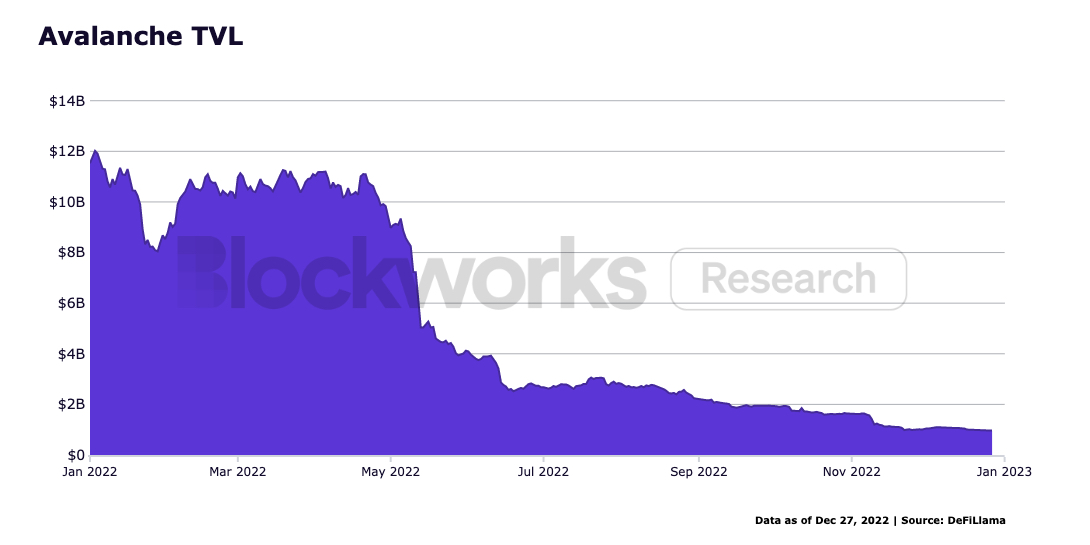
In the second half of 2022, the Avalanche ecosystem has experienced a period of relative stagnation. In June, the collapse of 3AC, a major backer of projects built on the network, led to reduced investment in the Avalanche ecosystem in a risk-off environment. Total Value Locked (TVL) fell from $12 billion to $1 billion. Avalanche's TVL fell 92%, in line with the 89% drop in AVAX's price over the same period.
Despite Avalanche's champion 3AC being exposed as an overleveraged fraudster , some developers have continued to release updates. Major advances have come from Trader Joe's NFT marketplace Joepegs and its centralized liquidity AMM: a major advance in the form of liquidity ledgers. As mentioned earlier, Trader Joe's announced that it will be deploying on Arbitrum's Ethereum L2, although the team still seems to see Avalanche as their main focus.
The cross-chain exchange network THORChain completed the integration of AVAX in the fourth quarter. Crypto game developers are flooding into the ecosystem, with Shrapnel and Ascenders making notable developments and announcements, both heading toward full release. DeFi Kingdom and Crabada launched subnets to help set the example that projects can grow on the Avalanche C chain, and once a project matures enough, a custom subnet can be created.
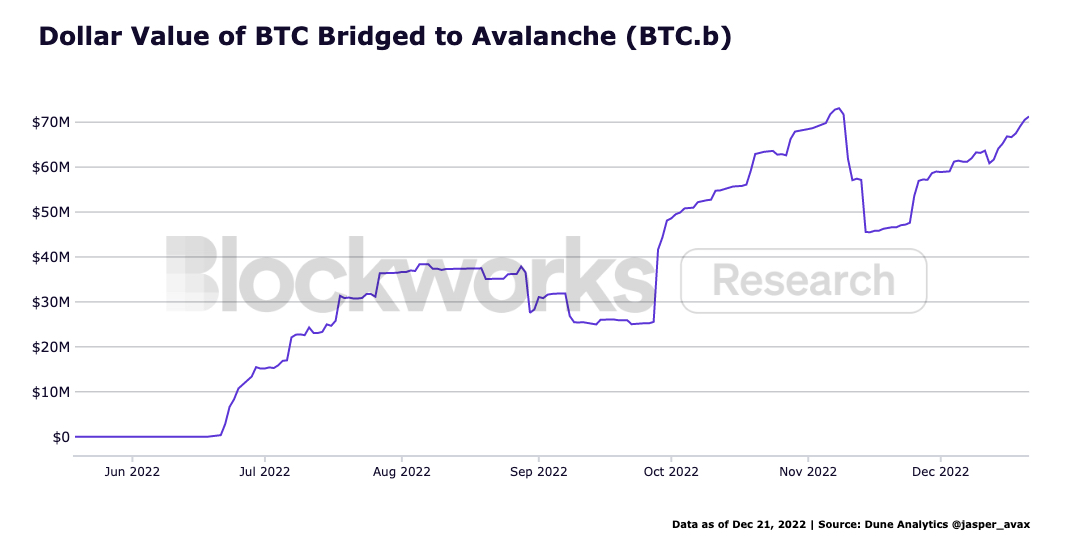
Avalanche successfully implemented the Banff upgrade on October 18th, which is a big step towards subnet-to-subnet communication called Avalanche Warp Messaging. Through subnet interoperability, the network could become a more serious competitor to Cosmos. Avalanche launched its native BTC bridge BTC.b in June, which should see widespread adoption in the last 6 months of 2022.
Aptos
Diem-centric Libra is a blockchain and cryptocurrency announced by Facebook (Meta) in 2019. Diem failed to launch after internal controversies, regulatory scrutiny, strategic shifts and lost partnerships. A large portion of the engineering and research team went on to create Aptos, a Layer 1 blockchain that hopes to realize the original vision of Libra and the MOVE smart contract language.
After raising $475 million throughout 2022 at a valuation of over $1 billion, the team finally launched the token and network in October. Much to the dismay of investors and Crypto Twitter, the project saw little user adoption or developer interest. The token quickly fell from $13 to $4 and is currently trading at around $500 million with a FDV of around $4 billion. Early investors can greenmark their investment, while anyone who buys the token on the open market will lose their principal. Aptos is a perfect example of a "VC chain": a token fundraising model that retail investors may want to stay away from in the future.
Despite these headwinds, the chain is functioning as expected; with the team's connections in Silicon Valley and the ability of the MOVE language, Aptos has the potential to see more dApps and adoption in the future.
network infrastructure
Oracles
Towards the end of the year, one of the most notable developments in blockchain infrastructure was the launch of the Chainlink staking mechanism . LINK holders can now stake their tokens to increase network security and earn LINK rewards. This marks a shift in the nature of oracle providers and further decentralizes the protocol. However, do not confuse LINK staking with the typical PoS consensus mechanism associated with other blockchain networks. Rather, the mechanism is more akin to service guarantees around Oracle data reliability. If a node operator fails to meet its service agreement obligations, a portion of the staked LINK can be slashed and redistributed to a more reliable node operator.
Chainlink provides an on-chain source of truth for the DeFi lending market, so enhancing the security of oracles is critical to the continued success of DeFi. The protocol enforces an initial staking pool cap of 25M LINK. This protected launch will help the protocol to gradually upgrade in a protected manner. In its infancy, staking will be incentivized through LINK emissions, but over time these will be phased out and user service fees will become the main source of incentives.
Additionally, Chainlink will launch a Partner Growth Program where various protocols and DAOs can offer incentives to staking participants in exchange for price/data feeds. While other oracles exist, Chainlink has by far the most adoption and battle-testing. With the introduction of staking, the future of Chainlink remains bright.
Throughout 2022, the upcoming oracle solution Pyth continues to announce new partnerships and integrations. Pyth differs from Chainlink in its "pull" model of price updates. Typically, oracles "push" price updates to the blockchain, but Python is designed to improve latency and scalability with a pull model where users only request price updates when they need them.
Python currently exists on 13 blockchains, including Ethereum, Solana, Avalanche, and Polygon. So far, Synthetix, Ribbon, Lido, and several other protocols have committed to using Python feeds to update applicable data in real time. While Pyth’s token is not yet live, the protocol could pose a significant threat to Chainlink’s oracle dominance in 2023.
Bridges
Bridges saw a significant decrease in activity in the second half of the year, largely due to an overall decline in on-chain activity. Another contributing factor may have been the high number of hacks that occurred throughout the year, totaling at least $2.1 billion.

However, the cross-chain bridge is still the key infrastructure of the multi-chain future, but the security needs to be greatly improved to mitigate the risk of loss of liquidity providers and end users. If anything, 2022 proves that we are still a long way from being able to jump between chains without worry. We are still waiting for Synapse and Stargate to deploy their own "layer zero" chains, which can greatly improve the user experience of the multi-chain of everything.
As we move into 2023, we can expect a successful deployment of the Synapse Network or Layer Zero Network to help solve the siled liquidity problem where dApps race to maintain liquidity across multiple networks, rather than having all deployments use one fluid layer. The figure below shows the TVL of six well-known cross-chain bridges on their local network.

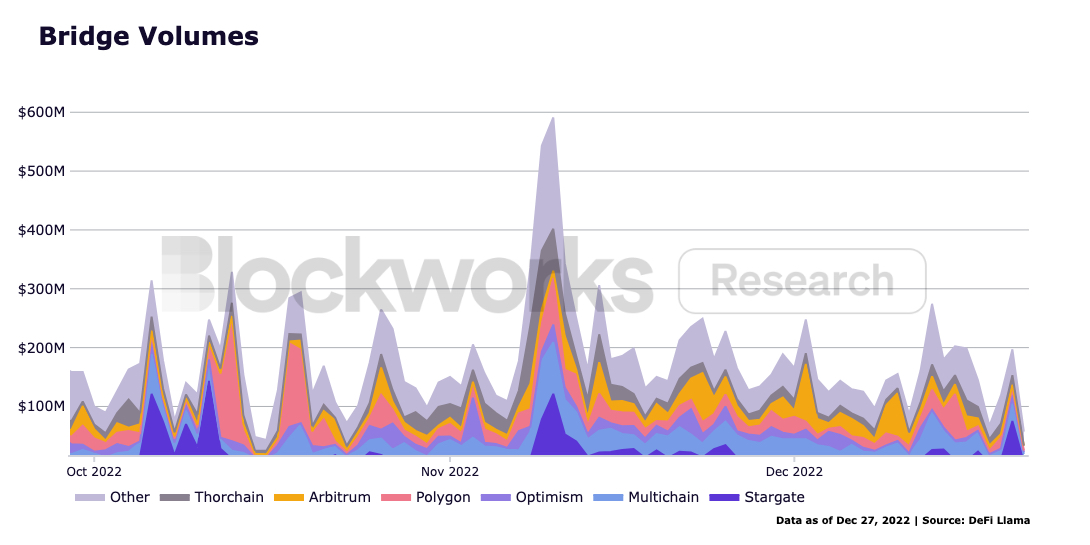
While the overall cross-chain bridge TVL decreased significantly and bridging volume stagnated, bridging activity between L2s (eg, Optimism and Arbitrum) did show substantial growth in the second half of the year. Combined with the metrics discussed above regarding L2 utilization, these ecosystems show promise. Specifically, GMX saw increased inflows thanks to Arbitrum. AirDrop hunters and participants seeking to use Velodrome, Lyra, and Synthetix could bring a surge of optimism.
final thoughts
While TVL fell across the board as a result of the sharp drop in asset prices, there have been many positive developments this year. Ethereum was able to successfully migrate from PoW to PoS and reduce selling pressure by $1.5 billion in less than four months. Adoption of Optimism and Arbitrum continues to climb, indicating the need for the EVM and Ethereum L2.
Cosmos has made great strides in increasing the presence and value accumulation of the Cosmos Hub, while providing an attractive enough developer environment to lure dYdX away from StarkEx. While "Alt Layer-1s" such as Solana and Avalanche have taken a huge hit this year in terms of TVL, developer share, and VC capital, developers remain as ambitious as ever, steadfast in creating the best experience possible, and always aiming to make The next billion users enter the crypto space.
While cross-chain bridges have been the subject of many hacks this year, the security of these networks continues to be strengthened, especially with the development of Stargate and LayerZero, Circle’s cross-chain transfer protocol, and zk rollups’ atomic composability. The next year is promising as we continue to see the evolution of the Ethereum roadmap, the launch of zk rollups, zkEVM, and L3s, the release of Solana’s Saga mobile, exciting new Cosmos appchains like dYdX, and more.
Disclaimer: As a blockchain information platform, the articles published on this site only represent the personal opinions of the authors and guests, and have nothing to do with Web3Caff's position. The information in the article is for reference only, and does not constitute any investment advice or offer, and please abide by the relevant laws and regulations of the country or region where you are located.